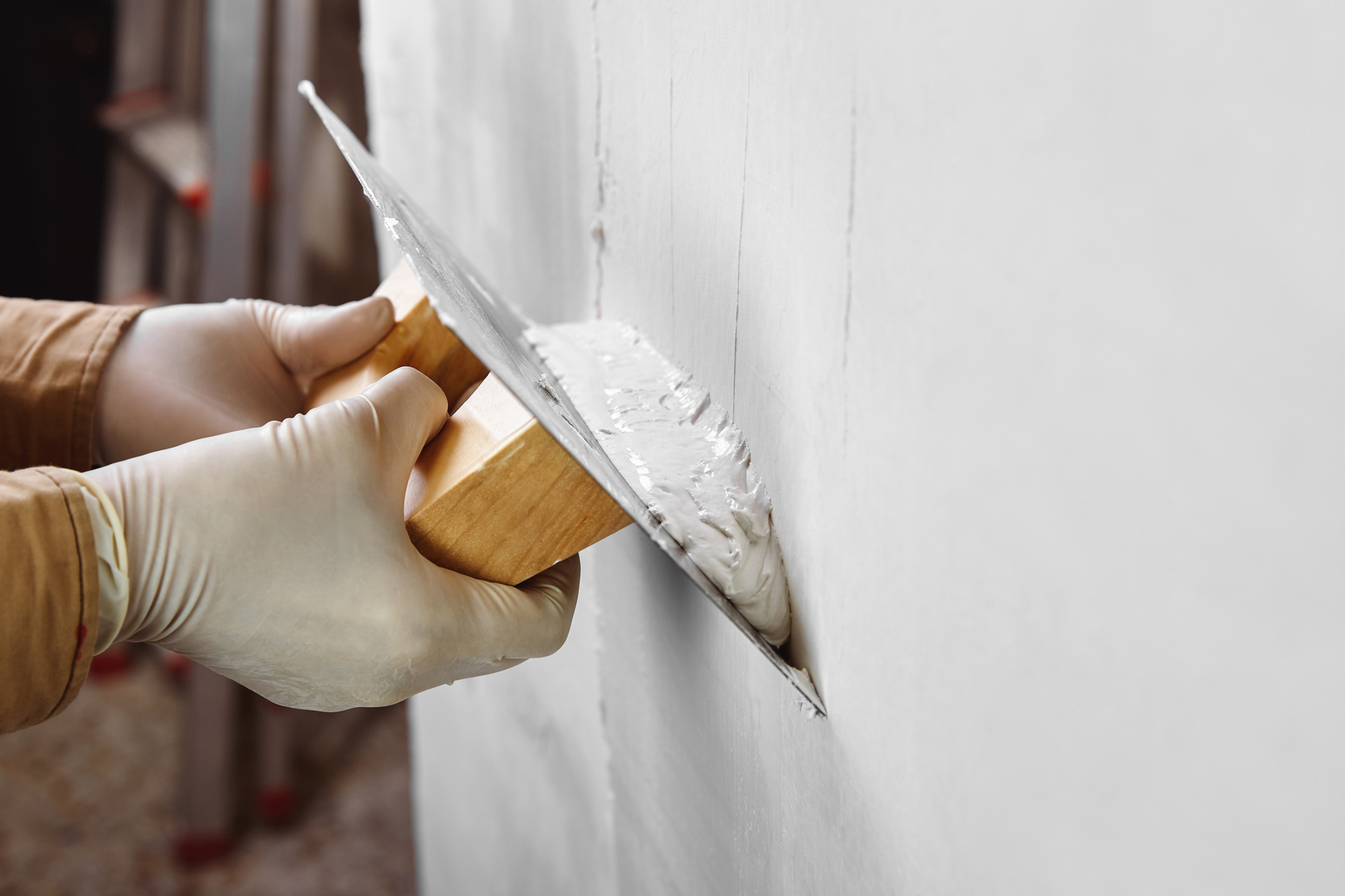
Plastering and rendering in West Parley
Whole house skims, dry lining, ceilings, re-plastering and external render across West Parley and BH22. Free site visit, free written itemised quote.
The site visit is free and so is the written itemised quote. Thomas Hannen prices every job himself.
A wall that sounds hollow in a West Parley house is usually supposed to sound hollow. Most houses of this age are dry lined, so the drum you hear is board and the gap behind it rather than plaster that has failed. Telling those two apart is the difference between a skim and a rip out, and that is what the free visit settles.
People ring us here for four or five things. A house has just changed hands and every room needs flattening before the carpets go down. A ceiling has cracked along the board joints. A wall has started to sound hollow and somebody has said the word blown. A garage or a conservatory is being turned into a proper room. Or a rendered gable has crazed and greened and nobody can say whether it matters.
Almost all of it sits in one cohort. The great bulk of West Parley went up between the war and the early eighties, mostly detached houses and bungalows, and they were built the same way with the same materials, so they wear out in the same way too.
That is useful, because it means we can usually tell you on the phone what we expect to find. It is still a survey before a price: every wall and ceiling in the room gets sounded, and you get an itemised written quote with the method on it as well as the number.
The work
Cheaper to do the lot while the house is empty
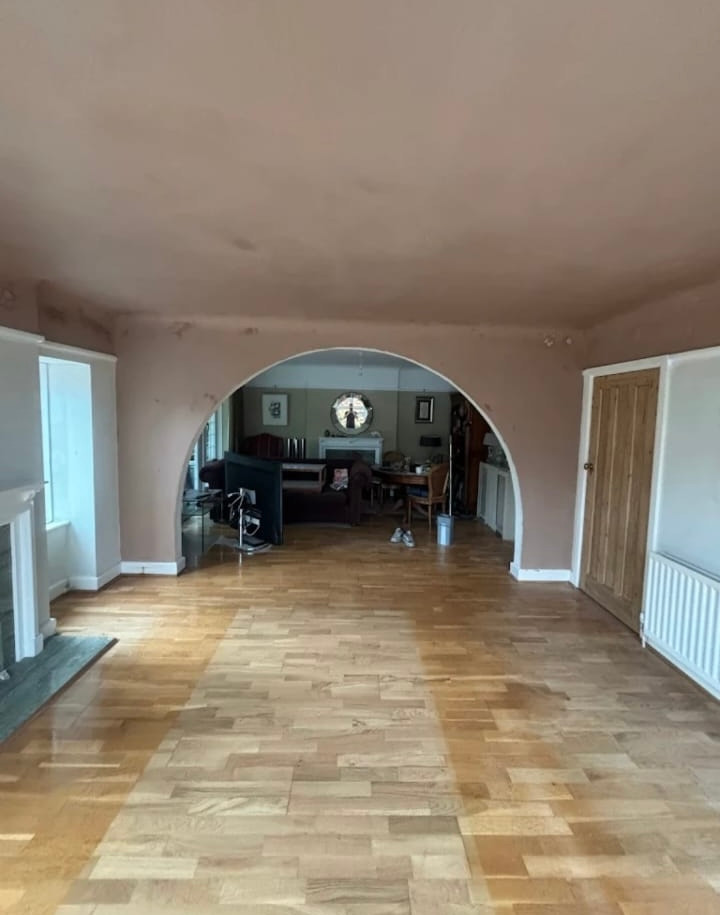
Whole house skims after a move. The commonest big job here. Textured coatings and artex come off or get overboarded, tired coving comes down, then every wall and ceiling is prepared, primed with thinned PVA or a bonding primer depending on the background, and given two passes of finish coat off the trowel, then a mist coat before you decorate. Done room by room it is slow. Done in one run with the house empty it is much quicker, and the quote shows that rather than hiding it.
Six in ten homes in West Parley went up between the war and the early eighties, most of them around the turn of the seventies, and the outside walls in those houses are dry lined: board on timber battens in the earlier ones, dabs in the later ones. Damaged board is cut out square and replaced rather than filled, and anywhere new board meets old plaster gets mesh across the joint so the crack does not come back through your paint. Not every wall here is board, though. Where a room was plastered straight onto blockwork and it has parted company, the loose work comes off back to a clean background and a backing coat goes on first: bonding on dense block or a painted face that will not suck, browning where the background keys, hardwall where you want a harder surface.
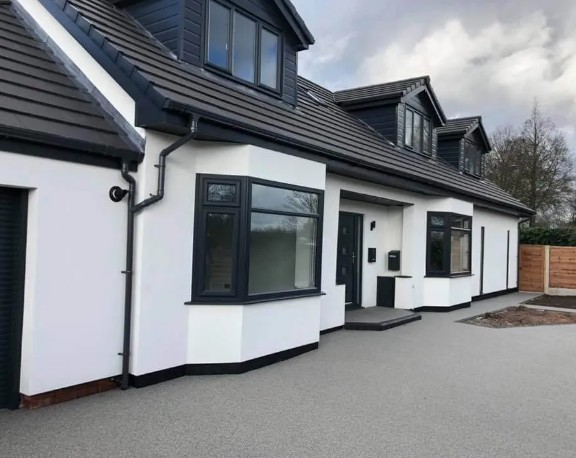
More than a third of the village is bungalows, so ceilings are a large part of it. Cracks along the board joints and popped nail heads are movement, and scrim and a skim sorts them. A ceiling that has begun to sag between the joists is usually thin old board, and overboarding across it and skimming is quicker and less mess than pulling it down. Extensions, garage and conservatory conversions are the same build up each time: board on dabs or on a stud, insulated board where a cold wall comes inside, moisture resistant board behind a shower, then tape and joint or a full skim, with an angle bead on every corner and a stop bead at each reveal. Outside it is gables and porches, mostly sand and cement with some pebbledash, patched in a matching mix or stripped back to a silicone thin coat or monocouche off a bell cast bead.
The older houses near the church and the river. A handful of properties down towards Church Lane and the Stour predate all of the above. Those are solid wall with no cavity, lime plaster inside and sometimes a lath ceiling over the top. They have to stay breathable, so a hard gypsum skim over a wall still carrying water will blow again, and on a lath ceiling we look at the keys from the loft before promising anyone a skim. Ground here drains badly and surface water sits in a downpour, which is what puts damp into the foot of a wall.
How it runs
From your call to a written price
The quote is itemised: protection, hacking off, board, the backing coat, beads, the finish coat, making good and disposal each on its own line. If something turns up behind the old surface that nobody could have seen, you get a photograph and a price before we carry on. On permission, West Parley is straightforward. There is no conservation area over the village and only four listed entries in the parish, so listed building consent rarely comes into it and what you put on the outside is very largely your own choice. The exception is scale: re-rendering a whole elevation rather than patching it is where Approved Document L and building control come in.
Cost
What decides the price
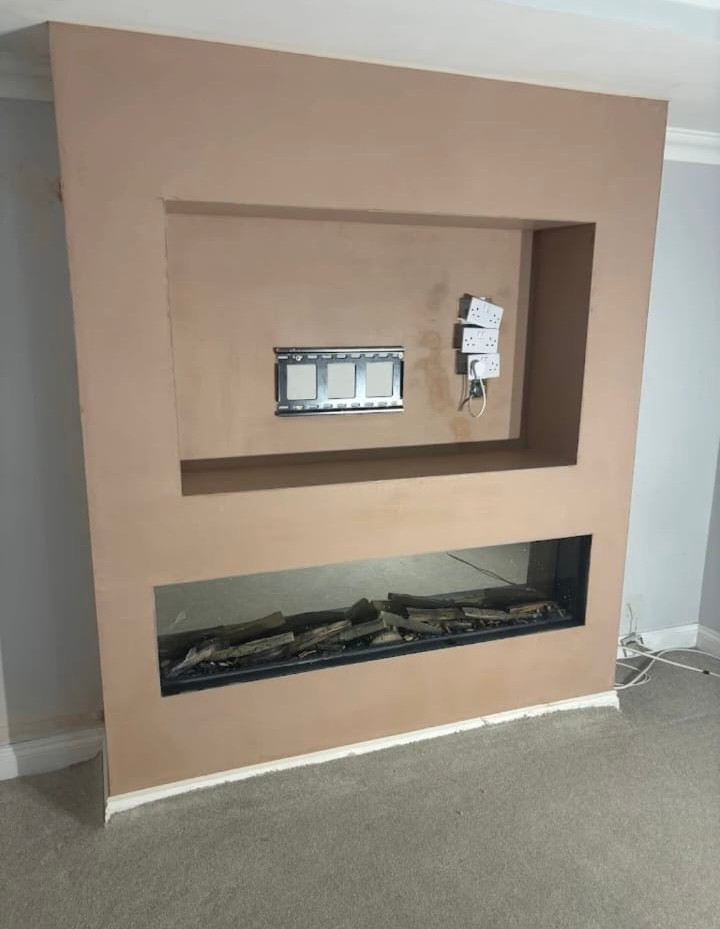
No rate per square metre. Every wall and ceiling is sounded with a knuckle first, because the split between what is skimmed and what comes off back to the block moves the price further than the size of the room does. A detached house standing empty between owners with a drive to work off, a bungalow where the only route to the back room is through the middle of the house, and a first floor flat at Parley Cross with a shared stair are three different jobs. A tower reaches a porch or a low soffit. Above a low gable, scaffold is its own line, because work at height rules decide the platform rather than the budget.
If it has come down
Plaster blown off a wall, or a ceiling starting to go
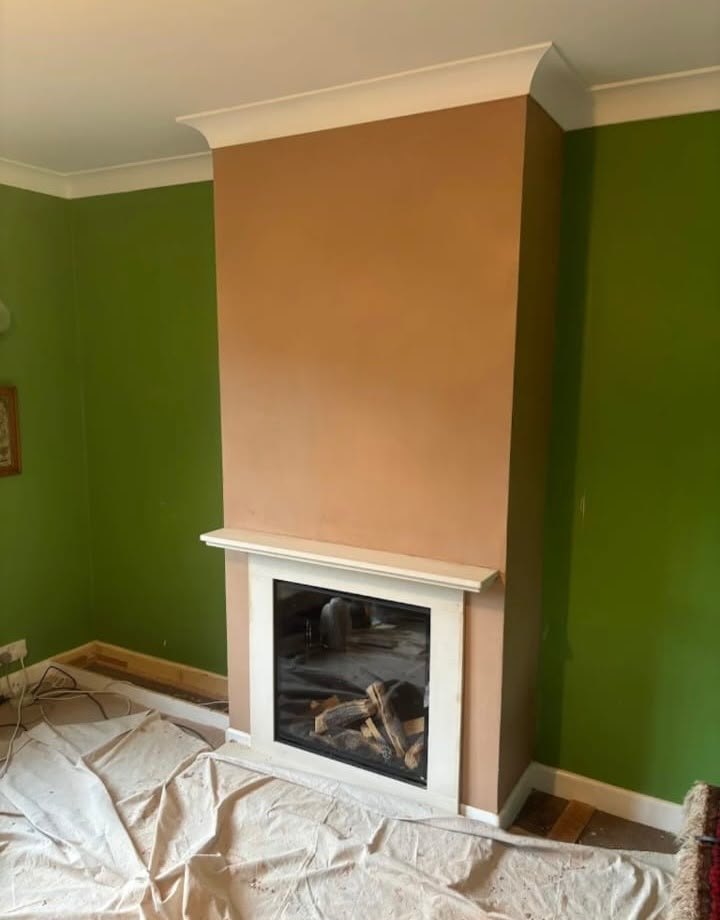
Ring rather than use the form. A ceiling pulling away from the joists, or plaster coming off a wall in sheets, goes to the front of the queue, because the next piece usually follows within days. West Parley is ten minutes from us, so in most weeks we can look the same day and make it safe on the same visit.
Worth knowing
A hollow wall here is usually a dry lined wall, not a failed one
Half the arguments we walk into here are about a hollow wall, and most of them do not need to happen. In a house of this age the outside walls are usually dry lined: plasterboard held off the blockwork on timber battens in the earlier houses, or on dabs of adhesive in the later ones. That leaves a void behind the board, so the wall drums when you knock it.
It is meant to. Tap along it and a dry lined wall gives you an even, boardy note the whole way across, changing pitch slightly every foot or so where the dabs are. Plaster that has genuinely blown off a solid background sounds dead and dull in patches, gives slightly under your hand, and crumbles at the edges of any crack.
The difference is worth real money. Skimming over a sound dry lined wall is ordinary work and a day a room. Stripping that lining off because somebody called it blown costs you the job, the insulating air gap and the reinstatement, and buys you nothing. Two practical things follow. First, fixings: a heavy shelf or a wall-hung television needs a fixing long enough to reach the blockwork behind, not a plug in the board.
Second, when a dabbed wall has actually failed there is usually water in it, tracking down inside the void from a window head or a leaking gutter, and the tell is board going soft along the bottom edge with staining that keeps returning. That one does need the board off, the wall dried out and new board back, and no amount of skim will hold it.
Who you are dealing with
A local firm you can check
We cover West Parley, Parley Cross and Dudsbury, out to Ferndown, Longham and Hampreston on BH22, and Dorset Council is the planning and building control authority for this address. Bournemouth Roofing & Building Ltd, registered in England and Wales, company number 15471719, which you can look up in a minute. Thomas Hannen's business, and he is the one who comes out to price the job, not a salesman. A verified customer's 10 out of 10 on Checkatrade. The site visit and the written itemised quote are both free.
Questions
West Parley questions we get asked
Heavy rain floods our drive. Can that damage internal plaster?
It can, and West Parley is mapped in the high band for surface water even though it falls outside the river flood zones for the Stour. Water that ponds against a wall gets into the base of the plaster and shows up as a tide mark, blown patches and salting a few weeks later rather than on the day. The fix starts outside, with levels and drainage. Replastering before that is sorted just repeats itself.
Ours is a detached bungalow. Where does plaster usually fail?
At the ceiling perimeter and around the loft hatch. West Parley is 36.4% bungalows and 35.2% detached houses, and in both the ceiling sits under cold loft with an outside wall on every side. The cold strip where ceiling meets external wall is where warm damp air condenses, so that is where the dark patch and the soft plaster turn up. Insulation and ventilation come before any new finish goes on.
Are the walls in these houses solid plaster or board?
Mostly solid. 57.8% of West Parley dates from between 1945 and 1982, peaking in the late 1960s and early 1970s, so walls are generally a backing coat on block with a finish over it rather than dry lining. That matters, because a solid wall is repaired by cutting back to the block and rebuilding the coat. Dry lined walls on dabs, which turn up in the newer pockets here, get taken back to the board instead.
You are close by. How quickly can someone look at it?
West Parley is about four and a half miles from where we work, so it is one of the quickest calls we make. Thomas comes out, looks at the wall or the ceiling and measures up, and the itemised quote goes over in writing afterwards. Both of those are free. For a small repair it usually means we can see it the same week rather than queueing it behind larger work.
What happens to the plaster where the extension meets the house?
It cracks along the join, and filling alone will not hold it. New brickwork and older structure move at different rates for a year or two, and where a modern extension meets a 1960s West Parley wall the two sides also dry at different speeds. We cut the joint out, fix mesh or a movement bead across it and set over, so the movement is absorbed instead of opening a line through the paint each winter.
Nearby, and next door
Plastering and rendering near West Parley
Plastering and rendering nearby
Our other trades in West Parley
Everything we do in Ferndown Plastering and rendering, all areas Every area we cover
Free quote
Get a price for plastering in West Parley
Tell us the address and what the wall or ceiling is doing. We come out, sound it and put an itemised price in writing. No charge for either.