Roofers and builders in Moordown
Roofs, flat roofs, fascias and gutters, brickwork, render, plastering, insulation, drives, patios and exterior cleaning across Moordown and BH9, from the Wimborne Road shops to the avenues of 1920s and 1930s houses either side. Hipped roofs, bay windows and pebbledash, most of it close to a hundred years old.
The site visit is free and so is the written itemised quote. Thomas Hannen prices every job himself.
Last updated
Moordown
A suburb built between the wars, and roofs to match
Moordown filled up in the 1920s and 1930s, so much of the roofing here is original work reaching the end of a long life: hips and valleys on tiled roofs, lead round the chimneys, the little roofs over the bays, painted pebbledash and lath ceilings. All of it goes on one visit and one written quote.
Roof trouble in Moordown follows a pattern. A stain on a bedroom ceiling that turns out to start at a valley two metres away. Tiles off a hip after a windy night. Or a buyer's survey that says the roof, the render and the wall ties all need attention, and a new owner who wants to know which of those is true before spending anything.
If water is coming through a ceiling now, ring 07435 839745, put a bucket under it and tell us which room. On a hipped roof the drip is often a long way from where the water gets in, so we trace it from the loft. Otherwise Thomas comes out, looks at it from the roof and the loft, and writes a quote that prices each part separately.
The housing
Mostly detached, mostly pre-war, and built in a decade of change
Around three quarters of the homes in Moordown were built before the Second World War, and more than half are detached. Farm land was sold for housing after the First World War, and avenues such as Coronation Avenue and Queen Mary Avenue filled up with detached houses, some semis and a scattering of bungalows. There are flats too, above the Wimborne Road shops and in houses since divided.
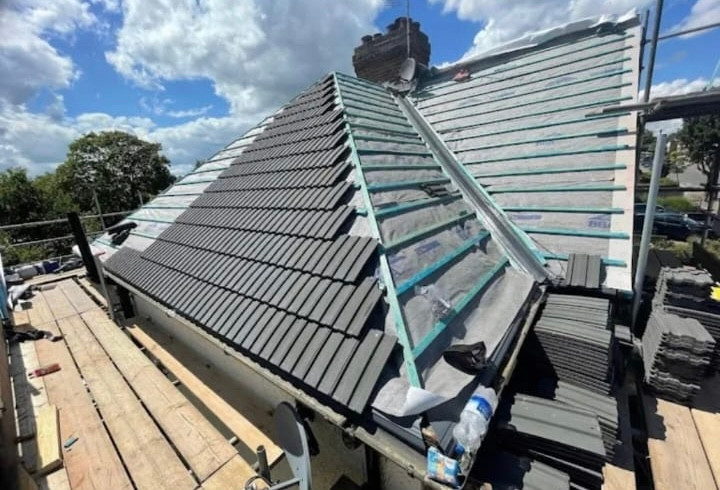
Those two decades were when building methods changed, which is why two houses of the same age on the same Moordown road can need different answers. Early twenties houses were often still built with solid brick walls; by the thirties most had a cavity, but a narrow early one tied with iron ties that can rust. Roofs are hipped, in clay plain tile or an early concrete tile, often laid with no underlay at all. Ceilings may be lime on lath or early plasterboard, and you cannot tell which once they have been painted a dozen times.
- Look up in the loft. If you can see the backs of the tiles and daylight between them, the roof has no felt. That is not a fault in itself, and many of these roofs have kept the rain out for a century. But driven rain and powder snow blow through, the insulation takes the wet, and foam sprayed onto the tiles to stop it traps moisture against the battens and worries mortgage lenders. The lasting answer is a breathable membrane when the roof is re-covered.
- Pebbledash that has been painted. Plenty of the original dash has been painted over, often more than once. Most masonry paint forms a skin, so water that gets in at a crack cannot dry out, the dash lets go from behind and the damp shows inside. We tap the walls before anyone chooses a colour.
- One home in five is rented. If you let a house here, keeping the structure and exterior in repair, gutters included, is the landlord's duty under section 11 of the Landlord and Tenant Act 1985. We price for agents who are not local and send before and after photographs.
Planning
No conservation area, two listed buildings, and the usual permitted development
Moordown is not in any of BCP Council's conservation areas, which you can check on the council list. On a house, re-covering in a similar looking tile, renewing fascias and gutters, repointing and re-rendering in a like finish are normally permitted development. Replacing more than half of a roof still brings in building control, because the loft insulation has to come up to standard.
Listed buildings, front walls and flats over the shops in Moordown need thinking about first.
- The two listed buildings. Historic England lists Old St John's Buildings on Wimborne Road and Moorside Cottage, a thatched cottage nearby, both at Grade II. On either of them almost any change, repairs included, needs listed building consent, so tell us early if yours is one.
- Front walls. A wall beside the road or the pavement can be built or rebuilt up to one metre high without permission, and up to two metres elsewhere, as the guidance on walls and fences explains. We measure an old wall before it comes down, so there is no argument later about how high it was.
- Flats over the shops. A building containing flats has no householder permitted development rights, so changing how the covering looks or adding a rooflight usually needs an application. The roof and front wall are normally the freeholder's to instruct.
The one local thing
Work above the Wimborne Road shops starts on the pavement
Wimborne Road is Moordown's high street. Much of it is a shop at street level with a flat or two above, built between the wars and fronting straight onto a busy pavement with bus stops along it. When the pointing on the upper floor goes, a chimney starts shedding mortar, or the flat roof over the back of the shop gives up, none of it can be reached safely from a ladder.
A scaffold on or over the footway needs a licence in writing from BCP Council under section 169 of the Highways Act, usually with notice and a fee, and it has to leave people room to walk underneath. So we apply for it, put it on the quote as its own line, and plan around it. Everything that needs that scaffold gets done while it is up: the front pointing, the stack and its flashings, the gutter, and any painting above the shop sign.
The other half of it is who pays. The shop may belong to one person, the flat to another and the freehold to a third. The roof and outside walls are usually the freeholder's, and if any leaseholder's share passes the threshold the freeholder has to consult under section 20 before work starts. We address the quote to whoever is instructing it, with photographs the agent can send round.
What we do in Moordown
Every trade, for inter-war houses
Each trade has its own Moordown page. These are the short versions, with the thing we would check first on a house of this age.
Roofs and flat roofs
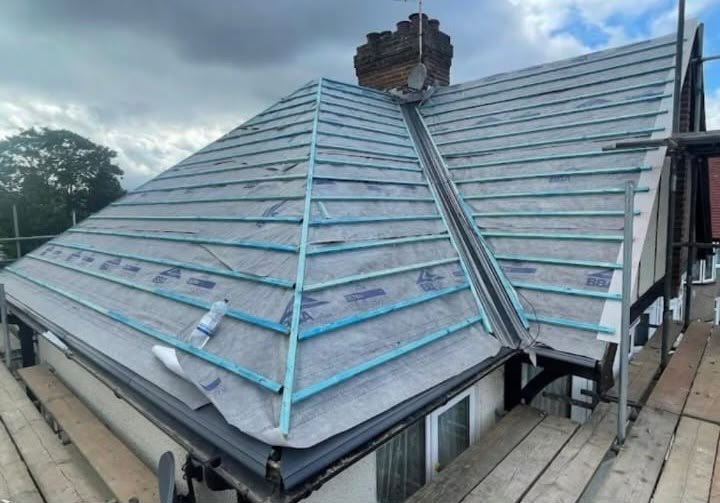
Plain tile and early concrete tile repairs matched from reclaimed stock, hips rebedded or dry fixed, lead valleys and chimney flashings renewed in code rated lead, and re-covers on breathable membrane. Felt roofs over bays, back extensions and the rear of the shops re-covered in GRP fibreglass, EPDM rubber or torch-on felt.
Roofing in Moordown Flat roofing in MoordownFascias, soffits and gutters
Rooflines on hipped houses run all the way round, so we price every side, including the narrow side passage that nobody looks at. Rotten boards replaced, sagging runs rehung, and every run and downpipe cleared.
Fascias and guttering Gutter cleaningBrickwork and repointing
Front walls and piers rebuilt to the right height, chimney stacks repaired, and repointing in a mortar softer than the brick so the joint wears instead of the face. Upper floor pointing over the Moordown shops done from a licensed scaffold.
Bricklaying in Moordown Repointing in MoordownRender and plastering
Hollow or painted pebbledash repaired, coated in a breathable mineral paint, or hacked off and re-rendered. Inside, lath and plaster ceilings checked from the loft before pricing, then patched, overboarded or taken down and skimmed.
Rendering in Moordown Plastering in MoordownDriveways and patios
Block paving, resin bound and tarmac drives, and patios in porcelain or sandstone. A new dropped kerb onto Wimborne Road needs planning permission as well as highway consent, and a front drive over five square metres must be permeable or drain to a border.
Driveways in Moordown Patios in MoordownCleaning and insulation
Soft washing of roofs, render and paving with a biocide finish. Loft insulation pushed right to the wall plate under the hips, where old layers always stop short, and walls checked with a borescope to find out whether they are solid or cavity before anything is offered.
Exterior cleaning Insulation in Moordown Loft insulation Wall insulationHow we work
From the first visit to the last sweep
Thomas comes out, looks from the street, the garden and the loft, and writes the quote himself. The scaffold, any highway licence, the strip out, the covering and each junction are separate lines, so you can hold it up against anyone else's.
Once the work starts, one person is your contact. A roof is only opened as far as it can be made watertight that day, the site is swept each evening and the waste leaves with us. If stripping a roof shows rotten rafter feet, or hacking off render finds a failed lintel, we stop, photograph it and price it in writing before going on.
On houses of this age we would rather repair than replace where the materials allow it. Two failed hips do not make a new roof, and a sound clay plain tile can go back on over new battens and membrane. When a roof is open, it is also the cheapest moment to insulate the loft, and Approved Document L sets what a renovated roof should reach.
Reviews
What customers said
A new roof and a patio, both written by the customer after the work was finished. The roof review covers the whole job from the first visit, and the patio review is about the result.
I couldn't be happier with the new roof. From the first visit to the finished job, the whole experience was excellent. The team were friendly, professional, and always turned up when they said they would…
Really happy with our new patio from Bournemouth Roofing & Building. It looks beautiful and we couldn't be more pleased with how it's turned out…
Free quote
How do you get a free quote in Moordown?
Send the form or ring 07435 839745. Thomas Hannen comes out to Moordown, looks at the job and puts an itemised price in writing, and neither the visit nor the written quote costs anything.
Our base is at 80a Wolverton Road, Boscombe, Bournemouth BH7 6HX. Scheduled work runs Monday to Friday, 8am to 6pm.
Planning at a glance
Do you need planning permission in Moordown?
Most repairs in Moordown need no application at all. What decides whether a change to the outside of your house does is who the council is, whether a conservation area or a listing applies, and whether the place sits in a protected landscape.
| Question | In Moordown |
|---|---|
| Who decides | BCP Council is the planning authority for Moordown. BCP Council's heritage pages set out what it controls. |
| Conservation area | None covers Moordown, so a like-for-like repair is ordinary maintenance. |
| Listed buildings | Yes, there are listed buildings in and around Moordown. If yours is one, work can need listed building consent. |
| Protected landscape | No National Park or National Landscape covers Moordown. |
Questions
Questions about building work in Moordown
Is Moordown in a conservation area?
No, none of BCP Council's conservation areas covers Moordown. Two buildings are listed, Old St John's Buildings on Wimborne Road and the thatched Moorside Cottage, and those need listed building consent for changes. Everywhere else the ordinary permitted development rules apply.
There is no felt under my roof tiles. Does it need replacing?
Not on that alone: roofs of this age were often laid without underlay and have kept the rain out for decades. Keep the loft ventilated and the insulation back from the eaves, and avoid spray foam on the tiles. When the tiles reach the end, the re-cover puts a breathable membrane in.
Should I paint my pebbledash?
Not if it is sound and unpainted. Most masonry paints trap water behind the dash. If it is already painted and peeling, repair the loose areas and use a breathable mineral paint, or re-render where large areas are hollow.
I own the flat above a shop on Wimborne Road. Who fixes the roof?
Usually the freeholder, under your lease, with the cost shared through the service charge. Report it in writing with photographs. We can come and look, write down what we found and price the job for whoever instructs it.
Do you cover all of Moordown?
Yes, all of Moordown and the rest of BH9, from the Wimborne Road shops down into Winton and across to Kinson, with BCP Council for planning and building control.
Moordown is in the north of Bournemouth, above Winton. Our Bournemouth page covers the rest of the town, from Winton and Charminster down to the centre and the coast.
Trade by trade
Each trade, written for Moordown
Every trade has its own Moordown page, written for the inter-war houses, the flats over the shops and what a century does to each part of a building.
- Roofing in Moordown
- Flat roofing in Moordown
- Fascias, soffits and guttering in Moordown
- Gutter cleaning in Moordown
- Bricklaying in Moordown
- Repointing in Moordown
- Rendering in Moordown
- Plastering in Moordown
- Driveways in Moordown
- Patios in Moordown
- Exterior cleaning in Moordown
- Insulation in Moordown
- Loft insulation in Moordown
- Wall insulation in Moordown
Who you are dealing with
A local firm you can check
Moordown is BH9, just over two miles from our base in Boscombe. We cover it from the Wimborne Road shops and the avenues either side down into Winton and across to Kinson. BCP Council is the planning and building control authority.
You are dealing with Bournemouth Roofing & Building, the trading name of Bournemouth Roofing & Building Ltd, registered in England and Wales, company number 15471719. That takes a minute to check. Thomas Hannen owns the firm and he prices every Moordown job himself, so the person who quotes it is the person answerable for it. One company covers every trade on the job.
There is a verified customer's 10 out of 10 on our Checkatrade profile. The site visit is free and so is the written itemised quote. Scheduled work runs Monday to Friday, 8am to 6pm. For anything urgent in Moordown, ring rather than use the form, and if we cannot pick up we ring you back as soon as we can.
Free quote
Get a price for your Moordown property
Tell us the road, whether it is a house or a flat above a shop, and what you or your surveyor have noticed. We will look at the roof, the walls and the loft, and put an itemised price in writing.