Loft insulation in Moordown
Inter-war and bungalow lofts cleared, laid to full depth right to the edges, and kept ventilated.
The site visit is free and so is the written itemised quote. Thomas Hannen prices every job himself.
Last updated
Loft insulation in Moordown usually means an inter-war house or bungalow whose old layer has settled well below the joists. We clear what is damaged, lay mineral wool in two crossed layers to about 270mm, keep the eaves ventilated and put any storage boarding back on raised legs. For walls and rooms in the roof, see insulation in Moordown.
A thin loft in Moordown usually comes to light at Christmas, on an EPC or as shadows on a ceiling. Someone lifts the hatch for the Christmas decorations and finds the wool is barely level with the joists. A new owner's EPC recommends loft insulation as the first step. Or a bedroom ceiling shows grey shadows along the edges every winter, which is often a cold strip where the wool never reached the wall.
Thomas goes up into your Moordown loft and checks the depth bay by bay, since a hatch only shows you the middle. He looks at the eaves, whether there is felt under the tiles at all, and the state of the timbers, then writes an itemised quote. The visit and the quote cost nothing.
The work
Clearing, laying and venting an inter-war loft
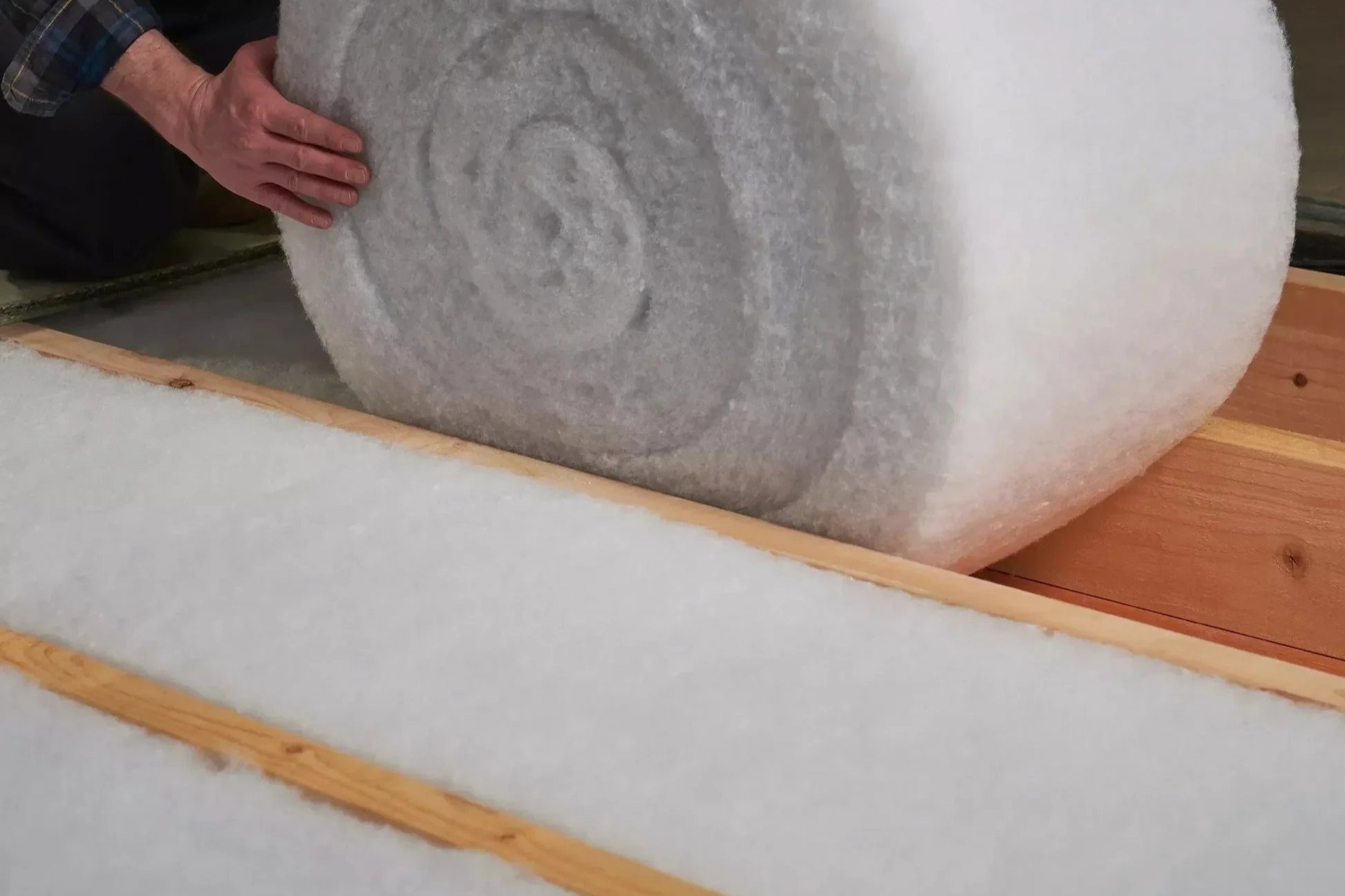
What comes out first. After ninety-odd years of cables being run across it, the old glass wool in a Moordown loft is usually compressed, settled and patchy, sometimes contaminated with droppings where birds got in under the hips. Dry, sound wool stays. Anything spoiled is bagged in the roof and carried down sealed. Loose grey or gold granules may be vermiculite, so we stop and have those tested before anything is disturbed.
Two layers, crossed. The first mineral wool roll fills between the old ceiling joists, which in a twenties house in Moordown are often irregular, so it is cut to each bay. The second runs across the joists so the timber no longer bleeds heat. Rockwool batts suit the short bays under the hips. That gets the ceiling to the U-value of 0.16 that Approved Document L asks for on a renovated loft, and it takes the heating bill down with it.
Keeping the eaves open. Air has to move in at the eaves and across a Moordown roof, or condensation forms on the underside of the felt and drips onto the new wool. We fit vent trays at each rafter bay so the insulation reaches the wall plate without blocking the air gap. Old bitumen felt holds more moisture than a breathable membrane, so we check it for wet patches first.
Roofs with no felt. Many Moordown roofs were laid with no underlay at all, so from the loft you can see the backs of the tiles and daylight between them. That roof breathes well, but driven rain and powder snow can blow in, and wet wool is useless. We lay the new layer loose and keep it off the tiles, and we never recommend foam sprayed onto the underside, which traps moisture against the battens and can put off mortgage lenders. A breathable membrane goes in properly when the roof is next re-covered.
Storage and access. Chipboard screwed flat to the joists of a Moordown loft crushes any new layer. We take it up, put the full depth in, and relay a smaller deck on loft legs by the hatch so you keep somewhere for the suitcases. A loft ladder can go in at the same visit, and the hatch is insulated and draught sealed.
Pipes, tanks and wiring. Once the ceiling is insulated the roof space runs colder, so the cold water tank gets a jacket and every pipe in the loft is lagged. Old cables are lifted clear of the wool and recessed lights get fire-rated covers.
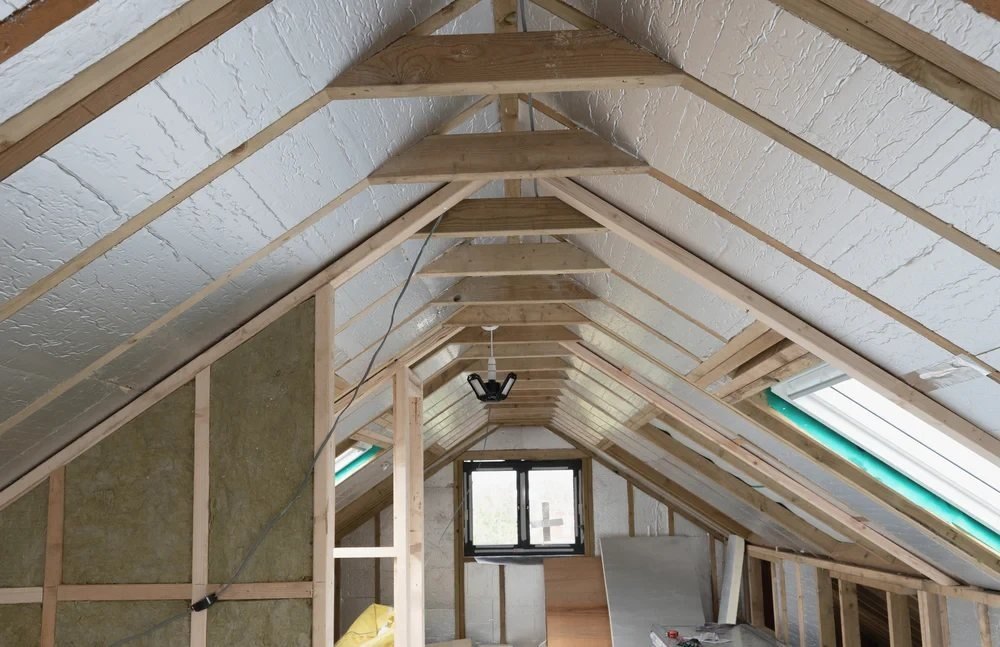
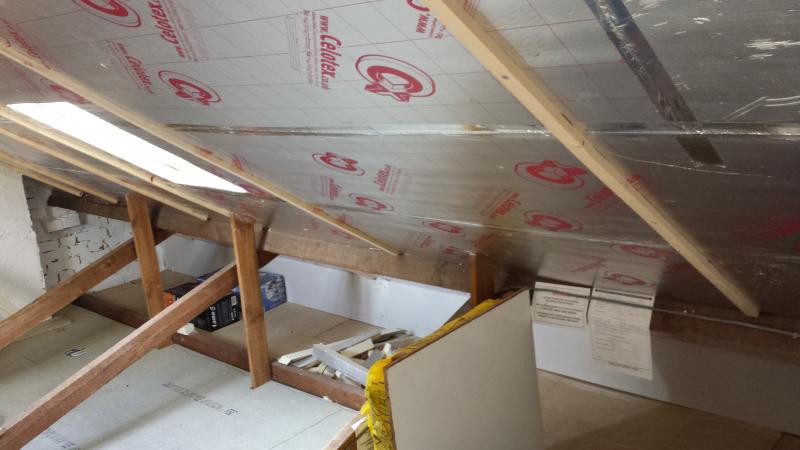
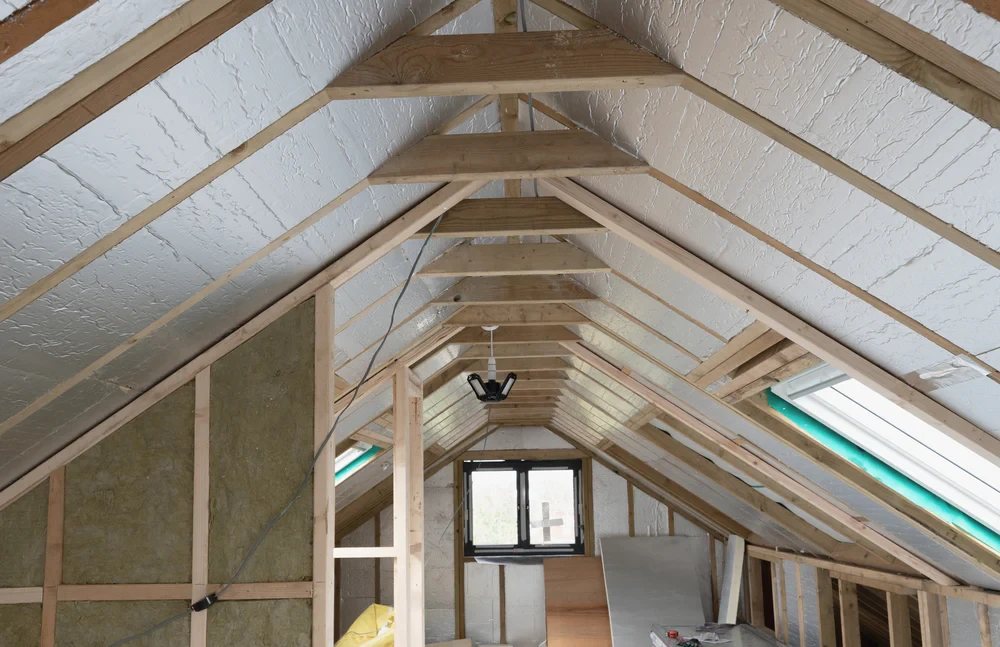
Sloping ceilings. Where a bedroom has been made in the roof, there is no loft floor to lay onto. Celotex or a similar PIR board is fitted in and below the rafters to 0.18 at rafter level, and that is priced as a job of its own.
Flats over the Wimborne Road shops. The roof space above a flat over a shop is normally the freeholder's, not the flat owner's, and the hatch is often in the flat's own landing or a shared stair. We quote whoever holds the freehold, arrange access with the tenant, and carry everything through the stair rather than the shop. A landlord letting one of the many rented houses in Moordown gets photographs of the finished depth for the file.
When we would say wait. If the roof space is damp from a slipped tile or a bathroom fan blowing into it, that gets fixed before any new wool goes down.
How it runs
From your call to a written price
One person to ring from the first visit to the last. The quote is itemised, not a figure on the back of a card: the survey, clearing and bagging whatever is up there now, the material and its depth, keeping the eaves clear, the hatch and any pipework, and disposal on separate lines, so you can compare it properly against anyone else's.
Nothing is left open or unusable overnight. The site is swept at the end of each day rather than the end of the job, and what comes out leaves with us. If something turns up once we start that nobody could have seen, you get a photograph and a price before we carry on.
Loft insulation is not development, so there is no planning application and no permitted development right is used, as the Planning Portal page on insulation confirms. If more than half of a roof is being renovated, regulation 23 brings in building control, and here that is BCP Council. Energy saving materials fitted in a home are zero rated until 31 March 2027 under HMRC notice 708/6, and we are not VAT registered, so there is no VAT line on our quote.
Cost
What decides the price of a loft
No rate per square metre, because the floor area is the easy part and the awkward edges are where the time goes.
Getting to it. A hatch in the landing of a two storey semi, a wide bungalow loft with low eaves at every side, and a small loft over a flat on Wimborne Road reached from a narrow stair are three different starts. A hatch on a landing you can stand a ladder under is one job. A hatch over a stairwell, a crawl space you can only move through on your knees, or a loft full of boarding that has to come up and go back, is time before any material is laid.
What is up there now, and what it is sitting on. Old material that has to come out, be bagged and taken away is a cost before anything new goes down, and so is a loft full of boxes that has to be emptied and put back. Joists at 400 centres with a flat run across them is a different afternoon from a trussed roof full of bracing.
Ventilation, and the edges nobody reaches. Insulation stops at the wall plate and the eaves have to stay clear, or you trade a warm bedroom for a wet roof. Getting depth right into the corners and around the hatch, boxing over downlighters and lagging anything that now sits in the cold, is most of the labour. Approved Document L sets what the work is expected to reach.
Comparing quotes? Ask what depth is actually being laid and in how many layers, whether the old material is coming out or being covered over, whether the eaves are being kept clear, what happens to anything you store up there, and whether the hatch and the pipework are included.
If the loft is wet
Water running off the felt, or mould on the underside
Ring rather than use the form. Droplets on the underside of the felt, black mould spreading across the roof timbers, or insulation that is visibly damp are all telling you the same thing: warm wet air is getting into a space that cannot breathe.
That does not wait, because it is the timbers that pay for it. We look before anything is added, because putting more insulation into a loft that cannot ventilate makes it worse. If you can see water on the felt or the wool is damp, keep stored boxes off the ceiling and ring before the next cold spell, because wet wool does not insulate. Scheduled work runs Monday to Friday, 8am to 6pm. For anything urgent, ring rather than use the form, and if we cannot pick up we ring you back as soon as we can.
Worth knowing
Hipped roofs and the hard-to-reach edges
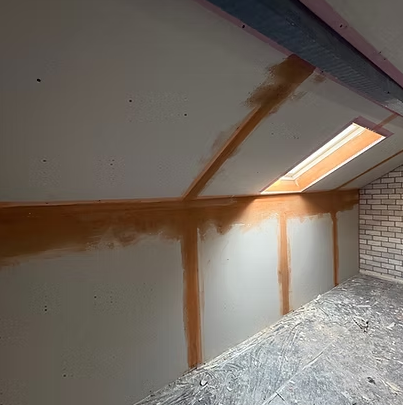
Many of Moordown's houses were built in the 1920s and 1930s, and a lot of roofs of that age are hipped, sloping down on all four sides rather than ending in a gable. That is good for wind, but it means the eaves run round the whole loft, and at the corners where the hips come down the space gets very low. Those corners are exactly where an old layer stops short, because nobody could reach them with a roll.
So on a hipped roof we treat the edges as the job, not the middle. We crawl or use a push board to get wool right to the wall plate at every side and into the corners under the hips, and fit a vent tray in each bay so the air still gets through. Ask any quote how it will reach the edges of a hipped loft, because a loft laid deep in the middle and thin at the edges still leaves cold ceilings around every outside wall, and that is where condensation and black mould start.
Who you are dealing with
A local firm you can check
We are based in Boscombe, about two miles away, and insulate lofts across BH9 and BH10, in Moordown, Winton, Redhill and Ensbury Park, with BCP Council as the building control authority.
You are dealing with Bournemouth Roofing & Building, the trading name of Bournemouth Roofing & Building Ltd, registered in England and Wales, company number 15471719, which you can look up in a minute. Thomas Hannen's business, and he is the one who comes out to price the job, not a salesman. A verified customer's 10 out of 10 on Checkatrade. The visit and the written quote are both free. Before you book a visit in Moordown, you can read our customers' Google reviews, word for word, on our reviews page.
Planning at a glance
Do you need planning permission in Moordown?
Most repairs in Moordown need no application at all. What decides whether a change to the outside of your house does is who the council is, whether a conservation area or a listing applies, and whether the place sits in a protected landscape.
| Question | In Moordown |
|---|---|
| Who decides | BCP Council is the planning authority for Moordown. BCP Council's heritage pages set out what it controls. |
| Conservation area | None covers Moordown, so a like-for-like repair is ordinary maintenance. |
| Listed buildings | Yes, there are listed buildings in and around Moordown. If yours is one, work can need listed building consent. |
| Protected landscape | No National Park or National Landscape covers Moordown. |
Questions
Questions about loft insulation in Moordown
How deep should my loft insulation be?
About 270mm of mineral wool, in two layers crossed over each other. That meets the 0.16 U-value expected when a loft is renovated. If you have 100mm in good condition, we top it up.
Is there VAT on loft insulation?
No, we are not VAT registered, so none is added. If you compare a firm that is registered, insulation fitted in a home is zero rated for them until 31 March 2027.
Can I still use my loft for storage?
Yes. We lift the boarding, lay the full depth underneath and put the boards back on raised loft legs so the insulation is not squashed.
How long does it take?
Most Moordown lofts take half a day to a day, including clearing the old material. A large bungalow loft with boarding to lift can run longer.
Will it cause condensation in my loft?
Not if the eaves are kept open. We fit vent trays so air still moves across the roof. Blocking the eaves is what causes the problem.
Nearby, and next door
Loft insulation near Moordown
Nearby places we also cover for loft insulation, with straight-line distances from Moordown, and the other trades we offer in Moordown itself.
Loft insulation nearby
Our other trades in Moordown
Loft insulation guides
Part L: do you have to insulate when you re-roof? Loft condensation or a roof leak: how to tell PIR board vs mineral wool: which insulation?Everything we do in Moordown Loft insulation, all areas Every area we cover
Free quote
Is your Moordown loft deep enough?
We go up, measure what is there, check the eaves and the felt, and price the work in writing. The visit and the quote are free.