Flat roofing in Poole
Flat roof repairs, re-covers and new warm roofs across Poole, in EPDM rubber, GRP fibreglass and torch on felt. We look at what is under the covering before we price anything.
The site visit is free and so is the written itemised quote. Thomas Hannen prices every job himself.
A flat roof in Poole that has split, blistered or lifted at an upstand is usually a repair or a re-cover rather than a rebuild. What decides which one you need is the deck underneath, and we lift a corner and look before we put a price on it.
People ring us about a flat roof for one of three reasons. A brown ring has appeared on a ceiling under a rear extension and it grows a little every time it rains. The garage roof has finally gone and the felt is flapping. Or water is sitting up there for days after a shower and somebody has told them that is normal.
It is not normal, and none of the three can be settled from a bedroom window. We get on the roof, open a small area at the worst corner, and photograph what is underneath so you see what we see. Poole roofs vary a lot, from the quay out to the estates behind it, but the questions are always the same. Is the deck sound. Does the water get off it. Is every upstand still stuck down.
The work
Garage roofs, extensions and the roofs you never see
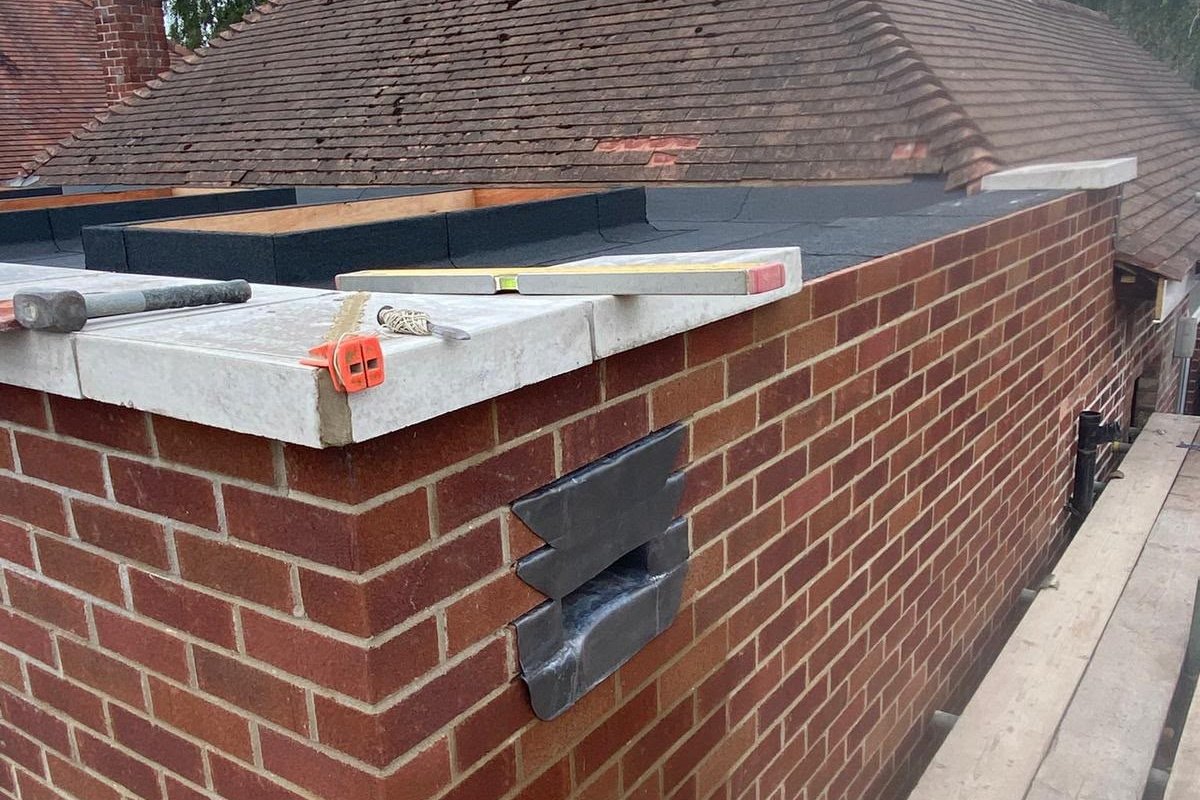
Extensions, garages and the roof over the bay. Most of what we are called to in Poole is a single storey rear extension, a garage, a porch or the small roof above a bay window. The covering is usually torch on felt, an older built up three layer system with a mineral cap sheet. Stripping it is where the survey really starts: the deck underneath decides the job. Sound plywood or OSB takes a new covering straight away. Chipboard that has been damp for years sags between the joists, so it comes off and new decking goes down first. Then it is EPDM rubber in one sheet, GRP fibreglass laid wet on the boards, a fresh torch on felt, or single ply on a larger roof.
Water that sits rather than leaves. Ponding is the fault we see most. Standing water works at every lap and seam and freezes them open in a cold snap. Sometimes the fall was never laid, sometimes firrings or tapered insulation have been squashed flat, and sometimes the rainwater outlet has blocked or been built over by a later extension. We put the falls back with firrings so the water runs to an outlet instead of pooling, and BS 6229:2025 on flat roofs sets the minimum. We check the gutter, hopper and downpipe as well, because a good roof discharging into a blocked hopper still soaks the wall.
Upstands, trims and seams. Flat roofs rarely fail in the middle. They go at the edge trim, the drip, the apron, the kerb around an opening and at the laps. On felt that is a blister, a bubble or a split; on single ply a lifted or failed seam where the weld was rushed; on fibreglass a crack at a sharp internal angle. We cut back to sound material, form the upstand to a proper height, and weld or bond the seam so you end up with one surface rather than a patch on an old one.
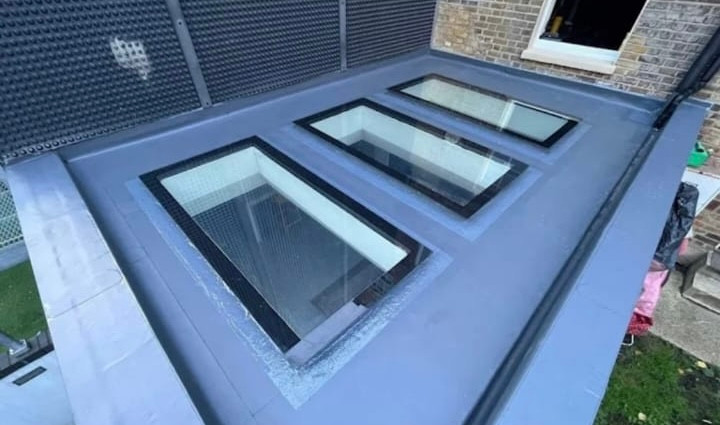
Openings and abutments. A rooflight, a lantern, a Velux, an old skylight, a hatch or a soil and vent pipe is a hole somebody chose to make, and each one wants a kerb and a collar rather than a ring of mastic. Where the roof runs into a wall we chase in a cover flashing in lead. On a parapet we check the coping and whether a cavity tray sits behind it, because without one the water goes into the wall and the roof gets the blame.
Warm roof or cold roof. Older flat roofs around Poole are cold roofs: insulation between the joists and a void above that was meant to breathe and rarely does. That is where condensation collects, and interstitial damp rots the deck from below while the covering still looks sound. When we rebuild one we build it warm, with PIR above the deck on a vapour control layer, keeping the deck and the joists on the warm side of the dew point.
How it runs
From your call to a written price
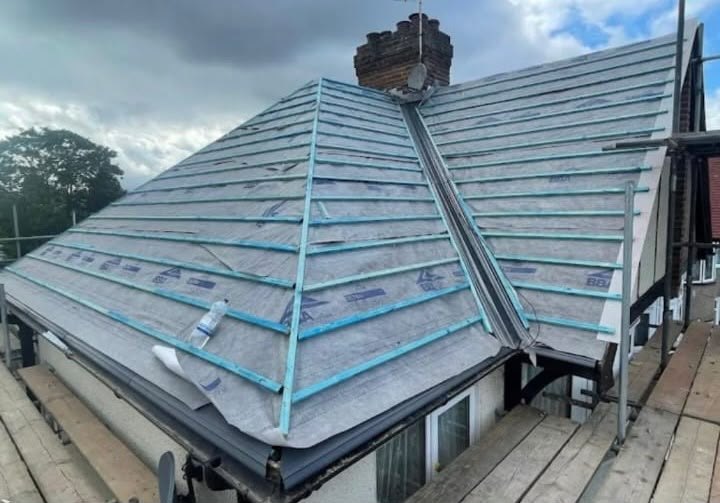
Same team from first visit to last, one person to ring, and no sub-contracting your work out to somebody you have never met. The quote is itemised, not a figure on the back of a card: access, stripping the old covering, any new deck or firrings, the insulation, the membrane and each upstand, outlet and edge trim, and disposal on separate lines, so you can compare it properly against anyone else's.
Nothing is left open or unusable overnight. The site is swept at the end of each day rather than the end of the job, and what comes out leaves with us. If something turns up once we start that nobody could have seen, you get a photograph and a price before we carry on.
Putting the same sort of covering back on a flat roof is maintenance, so there is no planning permission to apply for and it sits comfortably inside permitted development, which Planning Portal guidance on roofs sets out. Building control is the part people miss. Renewing more than a quarter of a roof surface makes it a controlled thermal element, so the insulation has to be brought up to the standard in Approved Document L, and the job goes in to Bournemouth, Christchurch and Poole Council as a building notice or an application with full plans.
Cost
What decides the price of a flat roof
No rate per square metre, because the square metres are the easy part and what is under the covering is what decides the job.
Getting to it. A garage behind a terrace in the old town, a rear extension on a nineteen thirties semi, and a communal roof over a converted house are three different jobs before anything is stripped. A garage or a single storey extension will often come off a tower, anything above a two storey wall wants a scaffold, and the platform has to stand while the deck is open rather than for an afternoon. The work at height rules are why it is a priced line rather than something folded into a rate.
The deck under the covering. A sound deck can be re-covered. Chipboard that has been wet for years, or ply that gives underfoot, has to come off and be replaced, and you cannot tell which you have from the ground or from a photograph. We lift a corner before quoting, because the deck is the single biggest swing in the price.
The falls, and where the water is meant to go. Most flat roofs that fail were never laid to a fall, or the fall runs at an outlet that has since been blocked or built over. Correcting it with firrings is more work than laying a membrane and it is the difference between a roof that lasts and one that ponds. Upstands, edge trims and each outlet are priced one at a time, because that is where the hours and the leaks both are.
Comparing quotes? Ask which system is being quoted and how many layers, whether the deck is being renewed or covered over, whether the falls are being corrected with firrings, how the upstands, outlets and edge trims are detailed, and whether the scaffold and the skip are in the price. Two quotes for the same job are usually two different jobs.
If it is coming through
Water through a flat roof
Ring rather than use the form. A flat roof that has split, blistered or lifted at an upstand puts water straight onto a ceiling, and once the deck is wet the damage carries on after the rain stops. The first visit is about getting it covered and dry, and we price the permanent job once we can see how much of the deck has gone. We are close enough to Poole to look the same day or the next in most weeks, and an emergency cover late on a Friday is still worth ringing about. The phone is answered 24 hours for emergencies; scheduled work runs Monday to Friday, 8am to 6pm.
Worth knowing
In the town centre, the covering is not always your own choice
A conservation area covers part of the town centre, and it changes exactly one thing about a flat roof: how it looks. Putting felt back where felt was is maintenance and nobody needs to hear about it. Changing the appearance of a roof that can be seen from the street, adding a run of rooflights or a lantern, or running a bright new trim along a parapet is a different conversation, and it is worth a phone call to the planners before anything is ordered rather than after. BCP Council keeps the list of conservation areas, so you can check your own address in a couple of minutes.
In practice most flat roofs in Poole sit behind a parapet or at the back over an extension, where nothing is visible from the pavement at all. There the choice is purely technical and you can specify whatever suits the roof. Where it genuinely is visible, a dark mineral cap sheet or a matt EPDM tends to pass without argument where a shiny metal trim does not, so it is worth knowing which of those two situations you are in before you start comparing quotes.
Who you are dealing with
A local firm you can check
We cover Poole town and the quay, Hamworthy, Oakdale, Parkstone and Branksome, and the rest of BH15, and the site visit costs you nothing. You are dealing with Bournemouth Roofing & Building, the trading name of Bournemouth Roofing & Building Ltd, registered in England and Wales, company number 15471719, which you can look up in a minute. Thomas Hannen's business, and he is the one who comes out to price the job, not a salesman. A verified customer's 10 out of 10 on Checkatrade. The visit and the written quote are both free.
Questions
Poole questions we get asked
Can a flat roof be repaired, or does it all have to come off?
Often it can be repaired. A split at an upstand, a lifted seam or a blocked outlet is hours of work, and if the deck under it is dry we will say so and price the repair. What we will not do is stick a patch over a deck that has already gone soft, because you pay twice for that.
How long does a flat roof take?
Most garage and extension roofs are stripped, re-decked and covered inside two working days. A bigger roof, or one with rooflights, a new outlet and fresh insulation, runs a little longer. We give you the days on the written quote so you can plan around it.
Do I need a scaffold for a garage roof?
Usually not. A garage or a single storey extension normally comes off a tower, and that is quicker and cheaper than a full scaffold. Anything above a two storey wall, or a roof where materials have to be lifted over a boundary, needs a proper platform and it goes on the quote as its own line.
Will you work on it in winter?
Yes, with limits. EPDM and torch on felt go down in cold weather without much trouble. Fibreglass needs a dry deck and a reasonable temperature to cure, so on a wet week we will sheet the roof and wait, or steer you to a system that does not mind. Nothing is left open overnight either way.
My flat is in a block. Who orders the work on the roof?
Normally the freeholder or the managing agent rather than you. Flats are a large share of the housing here, and on a leasehold flat the roof is part of the structure and is paid for out of the service charge. Where the cost passed to any one leaseholder is significant, they have to be consulted first under section 20 of the Landlord and Tenant Act 1985. We will still look and put the fault in writing so you have something to send them.
Nearby, and next door
Flat roofing near Poole
Flat roofing nearby
Our other trades in Poole
Everything we do in Poole Flat roofing, all areas Every area we cover
Free quote
Get a straight price on your Poole flat roof
Free site visit, free written itemised quote, and an honest answer about whether it needs re-covering at all.