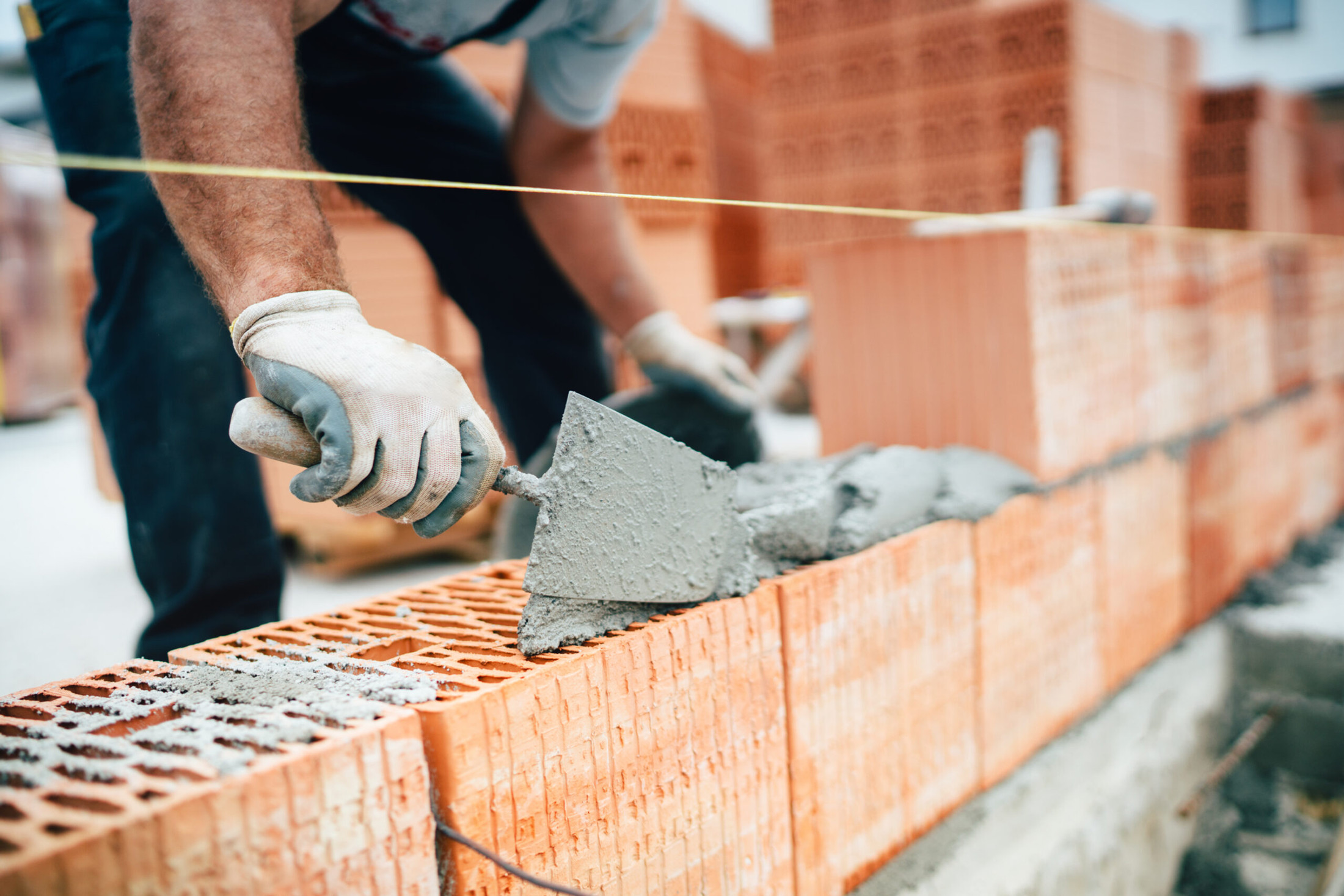
Bricklaying and repointing in Barton on Sea
Repointing, brick repair, wall ties, boundary walls and new brickwork across Barton on Sea and BH25. Free site visit, free written itemised quote.
The site visit is free and so is the written itemised quote. Thomas Hannen prices every job himself.
On a coastal wall the elevation facing the sea is usually a decade ahead of the other three, so the right question is not whether your Barton on Sea house needs repointing but which side of it does. Get the seaward face done, and specify stainless for anything metal that goes into that wall, because salt is what shortens the life of the fixings.
The calls here follow the weather. Joints on the seaward face have scoured back and there is a white bloom across the brick. Faces along the bottom of a wall have begun flaking away. A horizontal crack has appeared along an elevation at a regular height, and there is a bulge when you sight down it. Or a management company has been told the communal walls and bin stores need work before anything else on the block gets signed off.
We walk the whole building on the survey, not the one wall, because on this stretch the difference between the exposed face and the sheltered one tells you most of what you need to know. Joints get probed for depth, brick faces get tapped, and anything ferrous going into the wall gets looked at hard. The site visit is free and so is the written quote, itemised by elevation so you can do the exposed side now and hold the rest.
The work
The jobs we do most at Barton on Sea
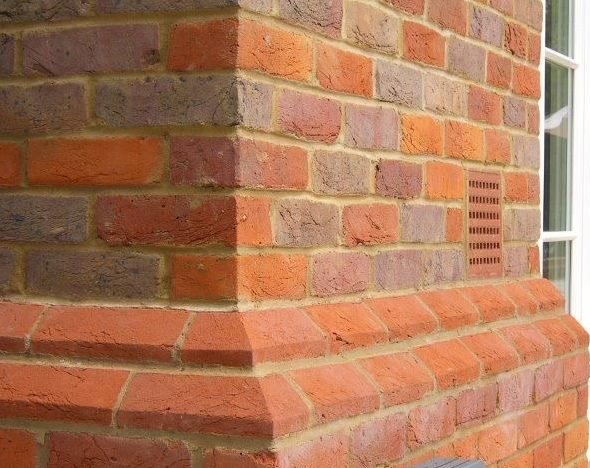
The seaward elevation. Barton on Sea is a little over a kilometre from the water, and salt laden air keeps a wall damp between showers and drives the mortar back faster than it does two miles inland. Joints open, the perpends go first, and water starts finding its way behind the brick. They are raked out by hand to sound mortar and put back in a mix deliberately weaker than the brick so the joint stays the sacrificial part, finished weather struck or bucket handle on an exposed face so it sheds water rather than holding it on a ledge, and flush only where that is what the wall already carries. Salt does not just sit on a wall either. It goes into the brick, crystallises in the pores as it dries and pushes the face off from the inside, which shows as spalling, a flaking face and a white powdery bloom, worst near the ground and worst on the side that takes the weather. Those bricks are cut out and replaced rather than filled, matched from a reclaimed batch where the original run has gone, with a sample panel so you can judge the colour on the wall itself.
Anything ferrous, and communal brickwork. Half the housing here dates from the war years to the early eighties, and cavity walls of that age were built with the ties of the day, which salt shortens the life of. As they corrode they swell and lift the outer leaf, showing as cracking that repeats along the same courses and a wall gone out of line. Replacements go in stainless steel through the face and the brickwork is cut out and rebuilt where it has been pushed. The same rule applies to a corroding steel lintel over a wide opening and to any fixing going into a coastal wall. Nearly a fifth of the dwellings here are flats, which brings its own work: parapet and balcony brickwork, screen walls, bin stores, communal boundary walls and gate piers, all of it in the same salt air with nobody living directly behind it to notice. If you are a leaseholder or on a residents' management company, major work has a consultation process attached to it under section 20 of the Landlord and Tenant Act 1985, so a written itemised quote matters twice over.
Two houses in five here are bungalows, so much of the work is long runs of wall a few courses off the ground. A freestanding wall on an exposed plot takes wind on both faces, so it wants piers at sensible intervals, a coping that overhangs and a proper footing under it, since a shallow foundation is what lets a wall lean, and a damp proof course at the base where the appearance allows it, and a bowed one is usually better taken down and rebuilt than patched. New work is cavity construction with the brick chosen for a coastal exposure and stainless ties throughout.
How it runs
From your call to a written price
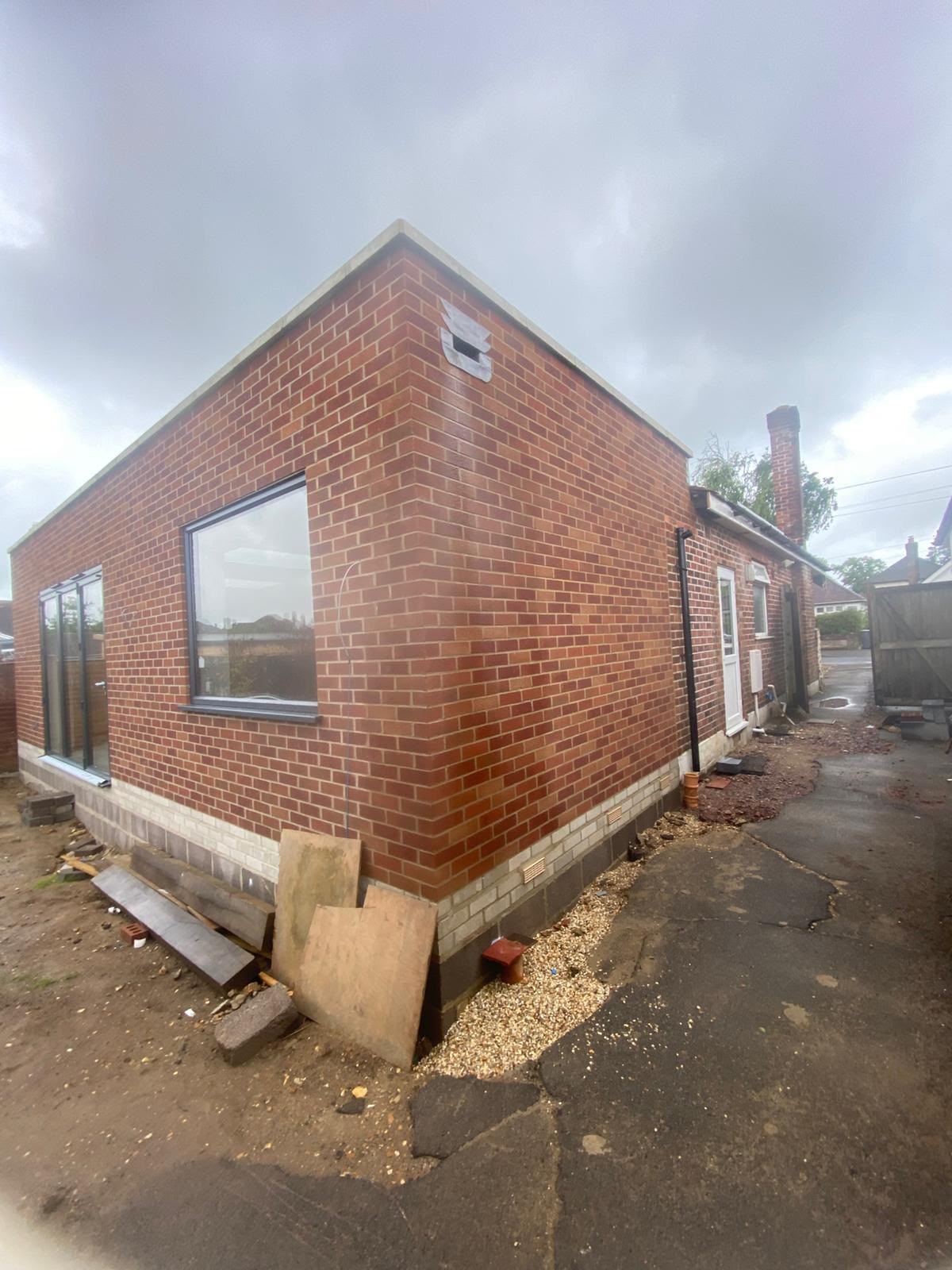
The quote is itemised: access, raking out, the mix, the area of each elevation, brick replacement and disposal on separate lines. Barton on Sea has no conservation area and only two listed entries, so for almost everybody here repointing and brick repair are maintenance and need no planning permission at all. Planning Portal covers where that line sits on external walls. Building control comes in when the structure changes, which on this housing usually means a replacement lintel or a widened opening. If your home is a flat, check the lease before anything is ordered, because the outside walls are often not yours to work on. And where a wall sits on the boundary line with a neighbour, the Party Wall etc. Act 1996 has to be dealt with first.
Cost
What decides the price of a brickwork job
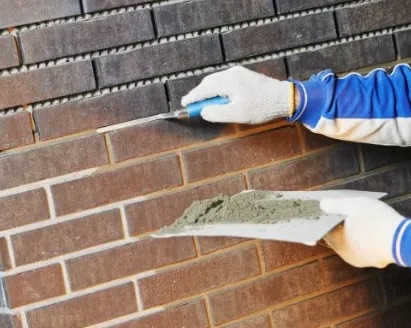
No rate per square metre, because the joints decide it and not the area. Most of what we price here is a bungalow a few streets back from the clifftop, a block of flats with communal walls and bin stores, or a detached house with a garage and a front boundary wall. A chimney or a gable wants a scaffold, and how long it stands is why work at height rules make access a priced line. Raking by hand is slow, and joint depth and spalled faces decide the hours. Ask how deep, by hand or disc, what mix, how many bricks, and whether scaffold is in.
If something has moved
Loose brickwork, or a wall that has shifted
Ring rather than use the form. Anything overhead or leaning goes to the front of the queue, and the first visit makes it safe before we price the permanent repair. At Barton on Sea that is usually an outer leaf bellying out where the ties have rusted through, or an exposed garden wall that has gone past leaning after a gale. The phone is answered 24 hours for emergencies; scheduled work runs Monday to Friday, 8am to 6pm.
One local thing
What salt air does to a brick wall
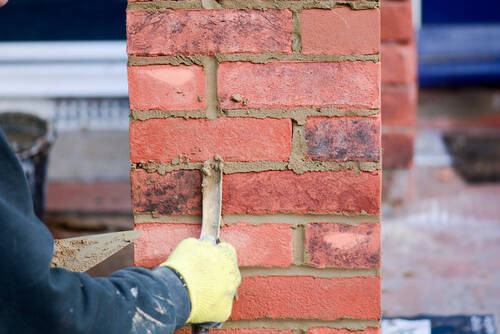
Barton sits about a kilometre from the water and that is close enough to change the specification rather than just the weathering. Salt arrives as spray carried inland on the wind, and it does three things to brickwork. It is hygroscopic, so it pulls moisture out of the air and keeps a wall damp between showers instead of letting it dry.
It travels into the brick in solution and crystallises in the pores as it dries, and those crystals push the face off from behind, which is why the damage looks like flaking rather than erosion. And it accelerates corrosion on anything ferrous buried in the wall, which is why wall ties and steel lintels give up sooner here than they would inland. Go and look at your own house from the corner: the seaward and south west faces will be visibly further on than the sheltered ones.
What that changes is what you should ask for. Stainless steel for every tie, fixing and strap going into an outside wall, not galvanised, because the cost difference is small and the failure mode is expensive. A mortar mix chosen to be softer than the brick, so the salt and the frost attack the joint you can renew rather than the face you cannot.
And one thing to refuse: a waterproofing sealer painted over the brickwork. It is sold as the answer here and it makes things worse, because it traps the salt and moisture already in the wall behind a film, and the face then comes off in sheets instead of flakes. A wall that can dry out is a wall that lasts, and a rinse down with clean water now and then does more good than any coating.
Who you are dealing with
A local firm you can check
We cover Barton on Sea and BH25, through Becton, New Milton and Ashley, and along the coast by Milford on Sea, Hordle and Everton. Bournemouth Roofing & Building Ltd, registered in England and Wales, company number 15471719, which you can look up in a minute. Thomas Hannen's business, and he is the one who comes out to price the job, not a salesman. A verified customer's 10 out of 10 on Checkatrade. The visit and the written quote are both free.
Questions
Barton on Sea questions we get asked
Why does my brickwork keep going white?
Salt and soluble salts in the brick coming to the surface as the wall dries out. Barton on Sea is about 1.2km from the water, so walls here carry a salt load that inland brickwork never sees, and every wetting and drying cycle pushes more of it out through the face. Brushing it off dry works better than washing, which drives it back in. If it keeps returning in one patch, water is getting in above.
Do wall ties rust faster on this stretch of coast?
They do, and it is the first thing we look for in the postwar housing that makes up 53.4% of Barton on Sea. Salt laden damp gets through open joints into the cavity and eats galvanised ties from inside the wall where nobody can see them. The signs are cracking along regular horizontal lines and a slight bulge in the outer leaf. A borescope through a small hole settles the question in an afternoon.
I own a flat. Who has to instruct the brickwork?
Not you on your own. Flats run to 17.6% of Barton on Sea, and the outside walls of a block are nearly always down to the freeholder or the managing agent, so the instruction and the payment come from them. What we can do is come out, look at it and hand a written itemised quote to whoever holds the building. Leaseholders tend to get further with an agent when there is a proper priced scope on the table.
Which elevation do you point first on a seafront bungalow?
The one facing the weather, which here means the south west. Bungalows are 42.0% of the housing in Barton on Sea and they catch the wind low down, right across the wall rather than only near the top. Driven rain works at the openings and the verge ends before anywhere else. Doing that one elevation properly is usually better value than a thin repoint all the way round that fails again on the same face.
Does the salt change the mortar mix you use?
It changes what we will not use. A hard dense cement mix traps salt and moisture behind it and the brick face blows instead of the joint, which on the exposed side of Barton on Sea can strip a wall in a handful of winters. We use a mix softer than the brick, bucket gauged so it is identical bag to bag, and finished slightly back from the face so water runs off rather than sitting on a ledge.
Nearby, and next door
Bricklaying and repointing near Barton on Sea
Bricklaying and repointing nearby
Our other trades in Barton on Sea
Everything we do in New Milton Bricklaying and repointing, all areas Every area we cover
Free quote
Get the seaward face of your house priced
Tell us the address and which wall is worst. We look at all four, and the written price shows each elevation separately so you can stage it.