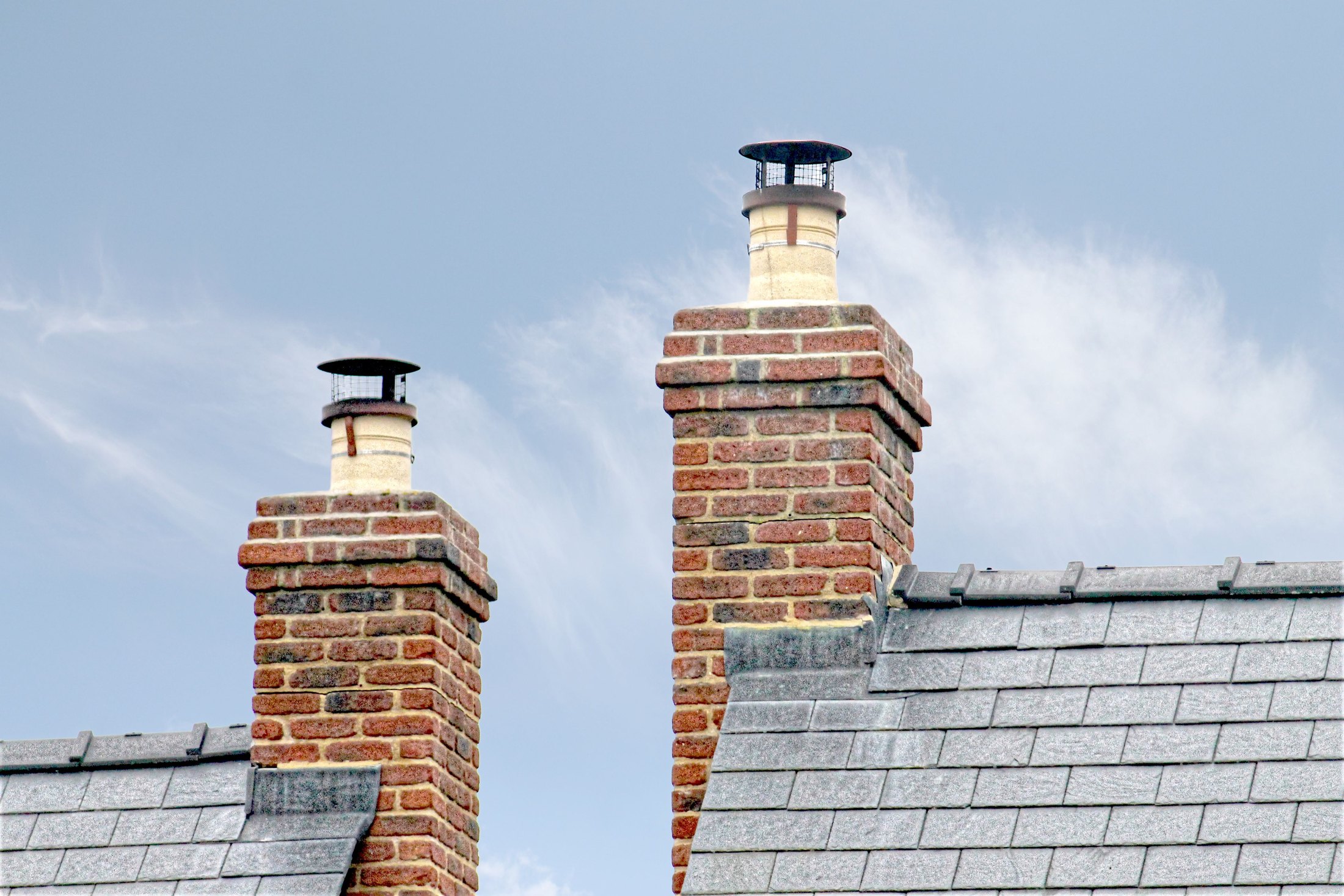
Roofing in Lyndhurst
Plain tile and slate repairs, valleys, chimney leadwork, re-covering and rainwater goods across Lyndhurst. Free site visit, free written quote.
The site visit is free and so is the written itemised quote. Thomas Hannen prices every job himself.
Last updated
The steep Victorian roofs here are mostly plain clay tile, and what fails on them is almost never the tile. It is the bonnet hips, the swept valleys and the mortar at the ridge: the hand made details. Which is why a repair in Lyndhurst is a tiler's job, not a tile order.
A good deal of Lyndhurst is Victorian or older, and it shows in the skyline: steep pitches, gables that meet at awkward angles, tall stacks with more than one flue in them, and tile hung elevations where the wall is doing the same job as the roof.
Those roofs shed water beautifully and give a roofer a lot of ways to get it wrong. The usual failures are a valley that has started weeping, a hip that has lost tiles after a gale, or a ceiling under a dormer that has gone. If water is dripping from under a dormer or a valley in Lyndhurst as you read this, ring 07435 839745 and we will tell you what to do while you wait. We come out, get on the roof, get into the loft and photograph what we find. About fifteen miles from us.
The work
A valley here is built, not fitted
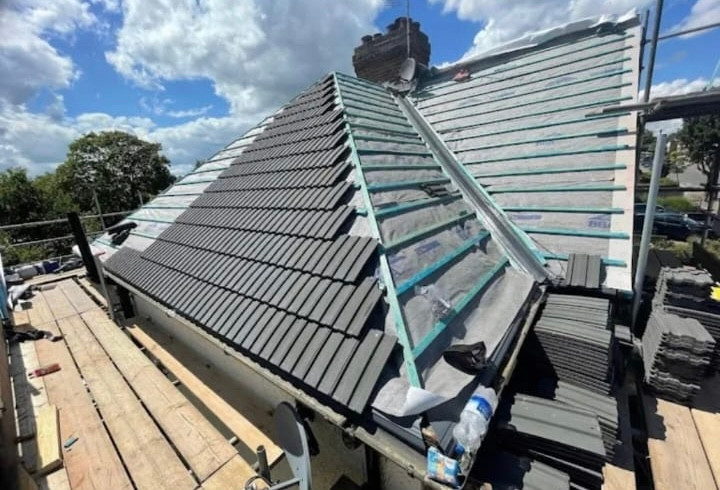
A valley here is built, not fitted. Much of the village went up before the First World War, and a steep plain tiled roof of that age is held together by its hips, valleys and verges, not by its field.
Bonnet hips are bedded and pointed one at a time and crack in sequence once the mortar has gone. Swept and laced valleys are built out of cut tile rather than dropped in as a trough, so a valley repair here means rebuilding a piece of roof, not fitting a part. We match the camber and colour of a weathered tile from stock sorted by hand, and lay a sample out at ground level first. A good deal of the decorative work on these buildings is roofing work as well: tile hung gables and dormer cheeks on battens, ornamental ridge and the odd finial. It is repairable, and the fixings behind it are usually the fault rather than the tile in front, so a decorative course is photographed and numbered before it comes off.
Chimneys and leadwork. Tall stacks with two or three flues are where most of the water gets in. Flashings, soakers stepped into the brickwork, back gutters and abutments in code rated lead, cut into lengths short enough to move without splitting, with the flaunching renewed on top while the scaffold is there. Behind a parapet it is often a secret gutter, a lead lined channel with no room for error. The mechanical fixing BS 5534 asks for can be had from a dry ridge and dry verge system, or from a renewed mortar bedding in a lime mix over a proper fixing. Where a roof is seen from the street in the conservation area we take the second route, because a plastic dry verge edge on a Victorian gable is the change everyone notices. On the post-war houses off the main road, where the covering is concrete interlocking tile, the dry fix system is the obvious answer and we say so.
On a steep roof water runs a long way along a rafter or purlin before it drops, so the stain and the hole are rarely above one another and we work from the loft outwards. When nails, battens and underlay have gone together a re-cover goes back on treated battens and breathable membrane with sarking and rafter feet replaced, but a new roof here is a last answer, not a first one. If it is one slipped slate, a cracked valley tile or a single leak at the stack, roof repairs in Lyndhurst covers mending that fault and leaving the rest of the roof alone. Dormer tops, rear additions and garages in felt, GRP fibreglass or EPDM rubber, with the deck checked before the falls, upstands and outlet. Cast iron gutters, downpipes, fascias and soffits repaired where they are worth repairing, and moss cleared off the shaded slopes by hand. Where a building has been split into flats, on the communal roof it is the freeholder or the managing agent who instructs the work. While a covering is off, insulation and eaves ventilation are dealt with to the standard Approved Document L sets, which costs a fraction of doing it later.
How it runs
Mending and re-covering the village's older roofs
Thomas drives out and looks at the roof himself, from the lane, the loft and the eaves. Much of Lyndhurst predates the First World War, so he expects Welsh slate on the Victorian villas and handmade clay plain tiles on the cottages, often on tired battens with no underlay at all.
The post-war houses mostly carry concrete tiles. The written quote itemises scaffold, stripping, battens and breathable membrane, the covering, ridge and hips, each lead flashing and valley, and disposal, naming the covering, the ridge detail and the lead code.
Lyndhurst roofs are quoted as one job, start to finish. Sound slates and tiles are stacked and hung again, topped up with matched reclaimed ones. On the High Street the scaffold stands on a busy, narrow footway and needs a highway licence; on the forest edge nothing is left on a verge where ponies and cattle wander. The roof is weathered every night, the site tidied daily, and old material leaves with us. Rotten rafter feet or a soft wall plate are photographed and priced before we touch them.
Planning in Lyndhurst belongs to the New Forest National Park Authority; building control stays with New Forest District Council. On an unlisted house, like for like repair is maintenance. Thirty one entries in the parish are listed, among them the Church of St Michael and All Angels and The Queen's House, and on those listed building consent covers anything that alters character. The Lyndhurst Conservation Area covers the town centre, and whether you are inside it is worth checking as well; the Authority’s interactive property map shows it for your address.
Cost
Slate, plain tile and a busy main street: what the roof costs
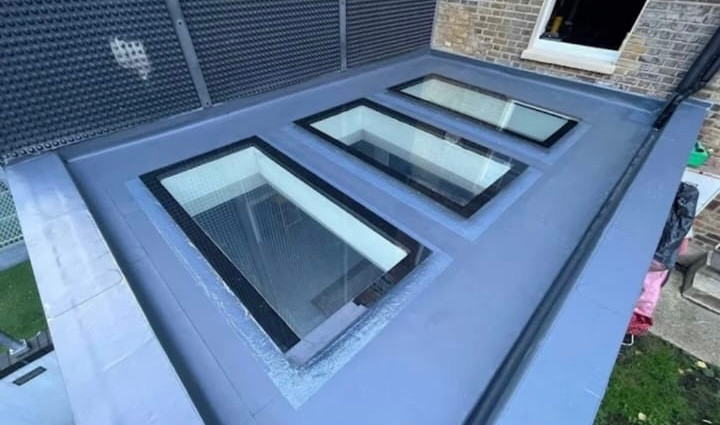
We will not price an old roof by the square metre. On a Lyndhurst house, what it is covered in and how that was fixed decide far more than the size.
The covering. A slated Victorian villa can usually be stripped and rehung using most of its own slate, topped up with a close match. A cottage in clay plain tiles has hundreds of small tiles to every slope, each one nailed and lapped, and that is slow. Changing either to concrete alters the look of the house, which inside the National Park makes it a planning question.
Nails, battens and what is under them. On many old slate roofs it is the nails that have rusted away, not the slate. Where slipping is widespread, the battens have usually gone too, and the job becomes a full strip and relay to BS 5534 with a new breathable membrane.
Lead. Chimneys, valleys, dormer cheeks and abutments are each priced separately, and on an older house some of that lead may be original and past saving.
Where the scaffold can stand. On the main street it needs a licence and usually a covered walkway. Out towards the open forest, materials are fenced or kept up on the scaffold, away from the animals. The work at height rules make the platform a separate line.
Ask any other roofer whether your slates are being reused, whether the battens and membrane are new, and whether the scaffold and licence are in the price.
If it is leaking now
A leak coming through an old slate or tile roof
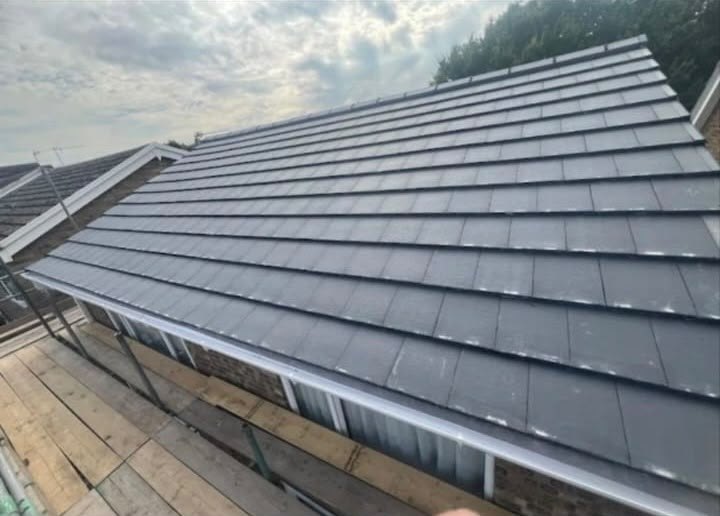
Put a bucket under the drip, and remember the hole in the roof is usually well uphill of where the water lands. If a neighbour offers to go up and have a look, thank them and say no: old slate and plain tile crack underfoot and are lethal when wet.
Phone us instead of using the form. The usual cause is a slate slid off a rusted nail, lead lifted at the chimney, or a cracked tile in a valley. The first visit refixes it or gets a temporary cover on to stop the water, and commits you to nothing larger. Booked roofing runs Monday to Friday, 8am to 6pm. If we are unable to answer, leave your number and we will ring you back as soon as we can.
Worth knowing
Your planning authority is the National Park, not the district council
Lyndhurst sits inside the New Forest National Park and has its own conservation area, so the body that decides a roof application here is the National Park Authority rather than a district council. For a like for like repair that changes nothing at all and there is nothing to apply for.
For anything that changes what the roof looks like, it changes both who you ask and what they will ask you for, because the National Park sets out what it protects on grounds of appearance in the landscape as well as heritage.
What that means in practice is that a change of covering, a new dormer, or a rooflight on a slope that faces a street is worth checking before you commit to a quote rather than after. It also means the useful quote is the specific one. A price that names the tile, the ridge detail and the lead code is a document you can put in front of an officer. A price that says renew as existing is not.
Who you are dealing with
Your roofer for Lyndhurst, Emery Down and Bank
Lyndhurst is 14.9 miles from our base in Boscombe, and we cover the roofs of the village and SO43 around it, out to Minstead, Emery Down, Bank and Swan Green. Planning sits with the New Forest National Park Authority, building control with New Forest District Council.
The company is Bournemouth Roofing & Building Ltd, registered in England and Wales, company number 15471719. Thomas Hannen owns and runs it, and he makes the drive to look at your roof and prices it himself. One verified customer has given us 10 out of 10 on Checkatrade. Neither the visit nor the written itemised quote costs you anything. Before you book a visit in Lyndhurst, you can read our customers' Google reviews, word for word, on our reviews page.
Planning at a glance
Do you need planning permission in Lyndhurst?
Most repairs in Lyndhurst need no application at all. What decides whether a change to the outside of your house does is who the council is, whether a conservation area or a listing applies, and whether the place sits in a protected landscape.
| Question | In Lyndhurst |
|---|---|
| Who decides | New Forest National Park Authority is the planning authority for Lyndhurst. New Forest National Park Authority's heritage pages set out what it controls. |
| Conservation area | Yes: Lyndhurst Conservation Area and Swan Green Conservation Area. They cover parts of Lyndhurst, so check whether your street is inside one. |
| Listed buildings | Yes, there are listed buildings in and around Lyndhurst. If yours is one, work can need listed building consent. |
| Protected landscape | Inside the New Forest National Park, where design is looked at more closely and permitted development rights are narrower. |
Questions
Questions about roofing in Lyndhurst
Can I change my covering inside the Lyndhurst conservation area?
Like for like, yes; a different material, not without asking first. The Lyndhurst conservation area is controlled on appearance, and replacing what is there counts as maintenance while changing the covering alters the character of the street. Slate coming off and slate going back on is straightforward. Slate off and concrete tile on is an application to the National Park Authority. We quote the compliant option first and set out what the alternative would involve.
Much of the village is Victorian or older. What does that mean for battens?
It means nothing is standard until we have looked. With so much of Lyndhurst built before 1919, many roofs here were put together before modern batten sizes and rafter spacings existed, and many have been re-covered at least once since then. Battens are frequently undersized or nailed to sawn rafters that have moved. We strip a section, measure what is actually up there and price the re-batten properly rather than assuming a grid.
Our building is flats. Who instructs you to do the work?
Whoever holds the freehold or manages the building, which is rarely the person who rings. Lyndhurst has its share of flats, and on a leasehold flat the roof is not yours to instruct even when water is coming through your own ceiling. What you can do is report it in writing and ask the agent to obtain quotes. We are glad to be one of them, and the quote is itemised so a committee can read it line by line.
Where does the scaffold go on the main street?
Off the pavement under a licence, and erected outside the busy hours wherever we can. Lyndhurst has 31 listed entries including the Church of St Michael and All Angels, and the main street is not a place to leave an unattended tower and a stack of tiles. We sheet and net the scaffold, keep the footway open with a walkway beneath it where that is required, and take deliveries at the quiet end of the day, never mid morning.
How long before you can start once I accept?
Our diary is only part of what sets the date. The rest is whether anything needs agreeing: inside the conservation area a like for like re-cover has nothing to wait for, while a change of covering follows the National Park's decision and we will not order materials ahead of that. Then the strip needs a settled weather window. Repairs that are actively letting water in jump the queue over booked work.
Nearby, and next door
Roofing near Lyndhurst
Nearby places we also cover for roofing, with straight-line distances from Lyndhurst, and the other trades we offer in Lyndhurst itself.
Roofing nearby
Our other trades in Lyndhurst
Roofing guides
Concrete vs clay roof tiles: which is right? Planning, building regs or listed building consent Storm damage to a roof: the first 24 hoursEverything we do in Lymington Roofing, all areas Every area we cover
Free quote
A written price for your Lyndhurst roof
Send the address and what the roof is doing. We will come out, look properly and put it in writing.