Exterior cleaning in Lyndhurst
Roof cleaning, low pressure washing for brickwork, tile hanging and painted render, plus paving and gutters across Lyndhurst.
The site visit is free and so is the written itemised quote. Thomas Hannen prices every job himself.
Cleaning a building in Lyndhurst is allowed and needs no permission. Changing how it looks is a different thing entirely. So the method here is a soft wash that takes the growth off and leaves the brick, the tile and the paintwork exactly as they were.
Nearly four in ten homes in the village were built before 1919, and it shows in what we get asked to do. Tall Victorian gables with decorative brickwork and tile hanging that has gone dark. Steep plain tile and slate pitches with moss in every lap. Painted frontages on the main street that have greyed at pavement level.
Cast iron rainwater goods running behind a bay. We come out for a free site visit, go over the building elevation by elevation, and put a written price together with each surface separately. On an old building the honest answer is sometimes that one wall wants doing and the rest does not.
The work
Cleaning older buildings in the village
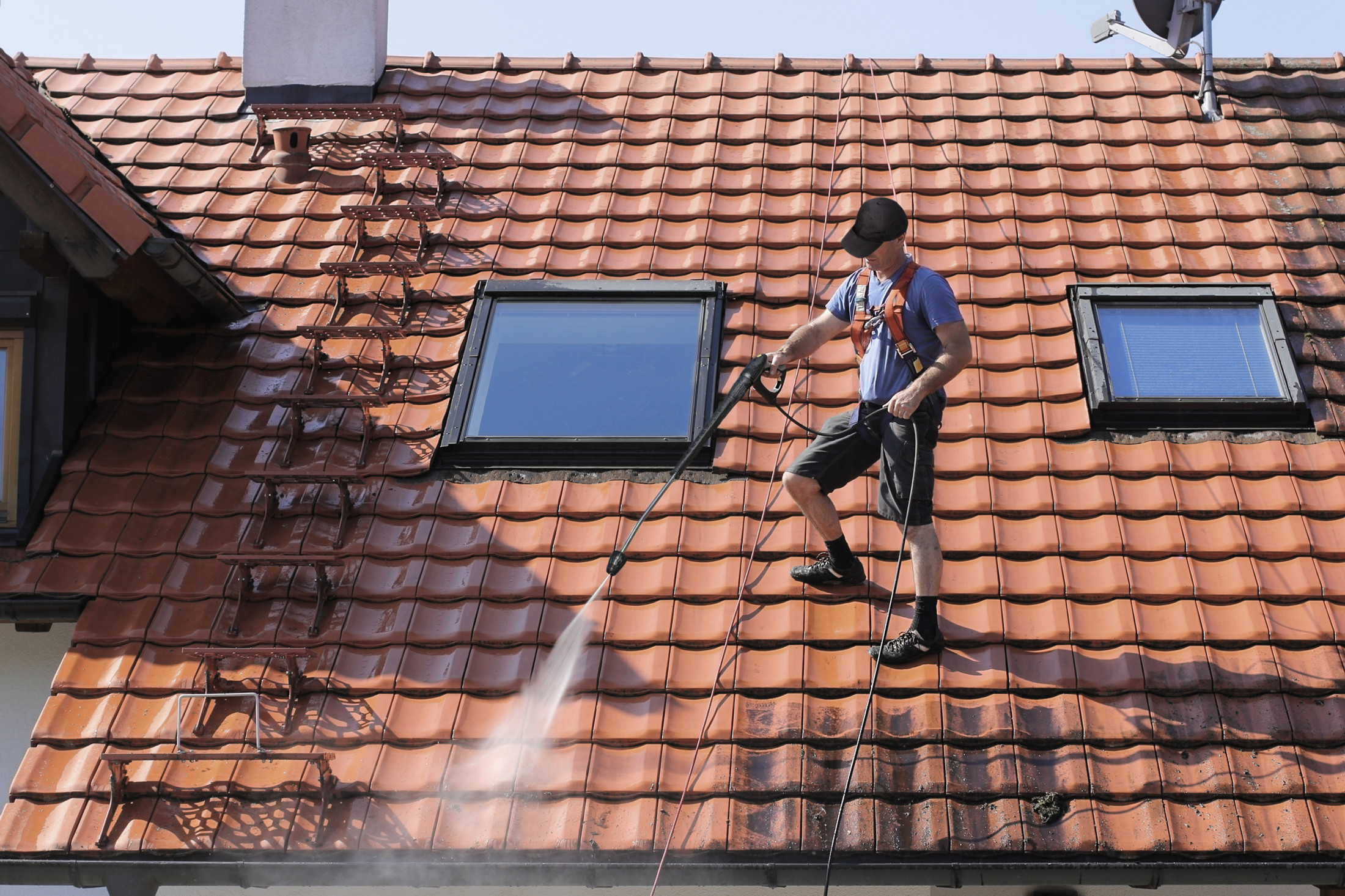
Roof cleaning. Plain clay tile and natural slate on the older roofs, concrete interlocking on the post-war housing. Steep pitches hold less water but they hold more moss in the laps than people expect, and the growth pushes the tail of the tile up as it thickens. We work the moss off dry by hand, clear the ridge, the valley and the gutter underneath, then treat the slope with a biocide. Nothing at pressure goes near an old roof: slate delaminates and a soft clay tile loses its face, and either way a roof clean turns into a roofing bill.
Close to four in ten houses in the village predate 1919. Victorian brick with banding and decorative courses is the most common wall here, along with hung tile on upper storeys and painted render on the frontages. All of it gets a low pressure soft wash and a treatment, and all of it gets a test patch first on an area nobody looks at. Old brickwork was laid in lime and the joints are softer than the brick on purpose, so a lance empties them. Painted masonry is worse again, because force does not clean paint, it strips it.
Forecourts and paths run to gravel, tarmac, brick and block paving, stone flags and the small walled areas behind shops and flats. Block paving is jet washed and re-sanded, and the joints get filled properly rather than left open. Steps and thresholds come first, because a green film on a worn stone step is genuinely dangerous in the wet. We will seal a driveway on request, but not over anything damp and never on old stone.
Clearing the gutter, the outlet and the downpipe is a twice a year job on plenty of properties here, with the forest trees so close. Where the goods are cast iron we look at the joints and behind the hopper heads, because a slow leak there darkens a wall for years and gets blamed on the wall rather than the pipe.
Before anything runs. Planting is watered and sheeted, drains and the gully are covered, and vents, lamps and signage are protected. A biocide is used at the dilution on the label, only on surfaces it is approved for, and it is kept out of the drains. That is what the biocides regime the HSE administers and pollution prevention guidance both come down to. We would talk you out of abrasive cleaning on old brick, out of sealing a solid wall to keep it clean when it needs to breathe, and out of a bright uniform finish on a hundred year old frontage, because that is not what a clean should leave behind.
How it runs
From your call to a written price
Lyndhurst sits inside the New Forest National Park, which is its own planning authority, and the village has its own conservation area and thirty-one listed entries. Cleaning itself needs no permission from anyone. It is a change of appearance that is controlled. The Authority's interactive property map will tell you what your own property carries.
The quote is itemised: the method for each surface, protection, access and where the water and residue go, each on its own line. If something turns up once we start that nobody could have seen, you get a photograph and a price before we carry on.
Cost
What decides the price of a clean
No rate per square metre: the same square metre can be twenty minutes or two, depending what is growing on it. A tall Victorian gable with the road hard against the front, a frontage that has to stay open to the public while we work, and a cottage with a gravel forecourt and space round it are three different days. Ground level off a lance is one thing, a roof slope another, and work at height rules decide which.
Comparing quotes. Ask what method each surface gets, whether treatment is included or only a rinse, and where the run off goes.
If there is a date
A viewing, a visit or a deadline
Ring rather than use the form. It is not emergency work, but it usually has a date on it: a sale, a letting, an inspection. Tell us the date and we will say honestly if it can be done properly. If scaffolding is coming down and you want the render done while it is up, give us the day not the week. The phone is answered 24 hours for emergencies; scheduled work runs Monday to Friday, 8am to 6pm.
The one local thing
Where cleaning stops and altering starts
The village has a conservation area of its own and around thirty listed entries in and about it. That sounds like paperwork and mostly it is not: washing dirt and organic growth off a building is maintenance, and maintenance needs no consent. The line is crossed when the work changes what the building looks like.
Taking an old limewash or a historic paint finish off a wall, sealing a brick or stone face that has never been sealed, or repainting a frontage in a different colour are all changes of appearance rather than cleans, and on a listed building any of them can need consent before you start. The Authority's heritage and conservation guidance sets out how it looks at that.
In practice it means one habit is worth insisting on from whoever you use. Test a small patch somewhere out of sight, wait, and look at it in daylight before the whole elevation is committed. On Victorian brick with coloured banding, the bands and the field brick weather at different rates and clean at different rates, so a wall can come up looking louder than the street expects.
Photograph the elevation before the work as well. It costs nothing, it settles any argument later about what changed, and on an older building it is the difference between a clean nobody notices and one everybody does.
Who you are dealing with
A local firm you can check
We cover Lyndhurst, Emery Down and Bank, over towards Minstead and Brockenhurst, and across the SO43 postcodes. Bournemouth Roofing & Building Ltd, registered in England and Wales, company number 15471719, which you can look up in a minute. Thomas Hannen's business, and he is the one who comes out to price the job, not a salesman. A verified customer's 10 out of 10 on Checkatrade. The visit and the written quote are both free.
Questions
Lyndhurst questions we get asked
The house is Victorian brick. Will washing hurt the pointing?
It can if the pressure is wrong. 39.0% of Lyndhurst predates 1919 and the peak is pre-1900, so the mortar on most of these houses is soft by design and a lance will cut it out of a joint in seconds. Growth on brick like that comes off with a low pressure wash and a biocide left to work. If a joint is already open, cleaning shows it up, and repointing is the job afterwards.
Lyndhurst is a conservation area. Does that stop a wash?
No. The designation controls appearance, and taking dirt and algae off a surface leaves the appearance as it was meant to be. There are also 31 listed entries in the village, the Church of St Michael and All Angels and the Queen's House among them, and if yours is one of those the constraint falls on the method we use rather than on consent. Consent belongs to altering a building, not to cleaning it.
Which side of the house needs doing first?
The east and north walls on most properties here. The local aspect is east, so those elevations lose the sun early and stay damp into the afternoon, and the growth is always heaviest on them. There is little point washing a south wall that is already clean. We walk round with you, agree which elevations go on the quote, and leave the ones that do not need touching this time.
Do you need a scaffold on a tall village house?
Rarely. Only 6.5% of the dwellings in Lyndhurst are bungalows, so nearly everything we clean here is two storeys or more, and a water fed pole reaches gutter level from the ground on most of it. A tower goes up where a roof has to be worked on rather than rinsed. Scaffold belongs to building work, and if a wash is the whole job we would not be putting one up for it.
You want to try a small area first. What for?
Whether the surface holds together, and whether the colour underneath is even. On the older brick and render in Lyndhurst there is often a limewash or a soft paint under the dirt that lifts off along with the algae, and it is better to find that out on a patch behind a downpipe than across the front elevation. The trial also shows how long the biocide needs, which sets the day we come back.
Nearby, and next door
Exterior cleaning near Lyndhurst
Exterior cleaning nearby
Our other trades in Lyndhurst
Everything we do in Lymington Exterior cleaning, all areas Every area we cover
Free quote
Get a price for cleaning in Lyndhurst
Tell us which elevation is bothering you and we will come and look at the building.