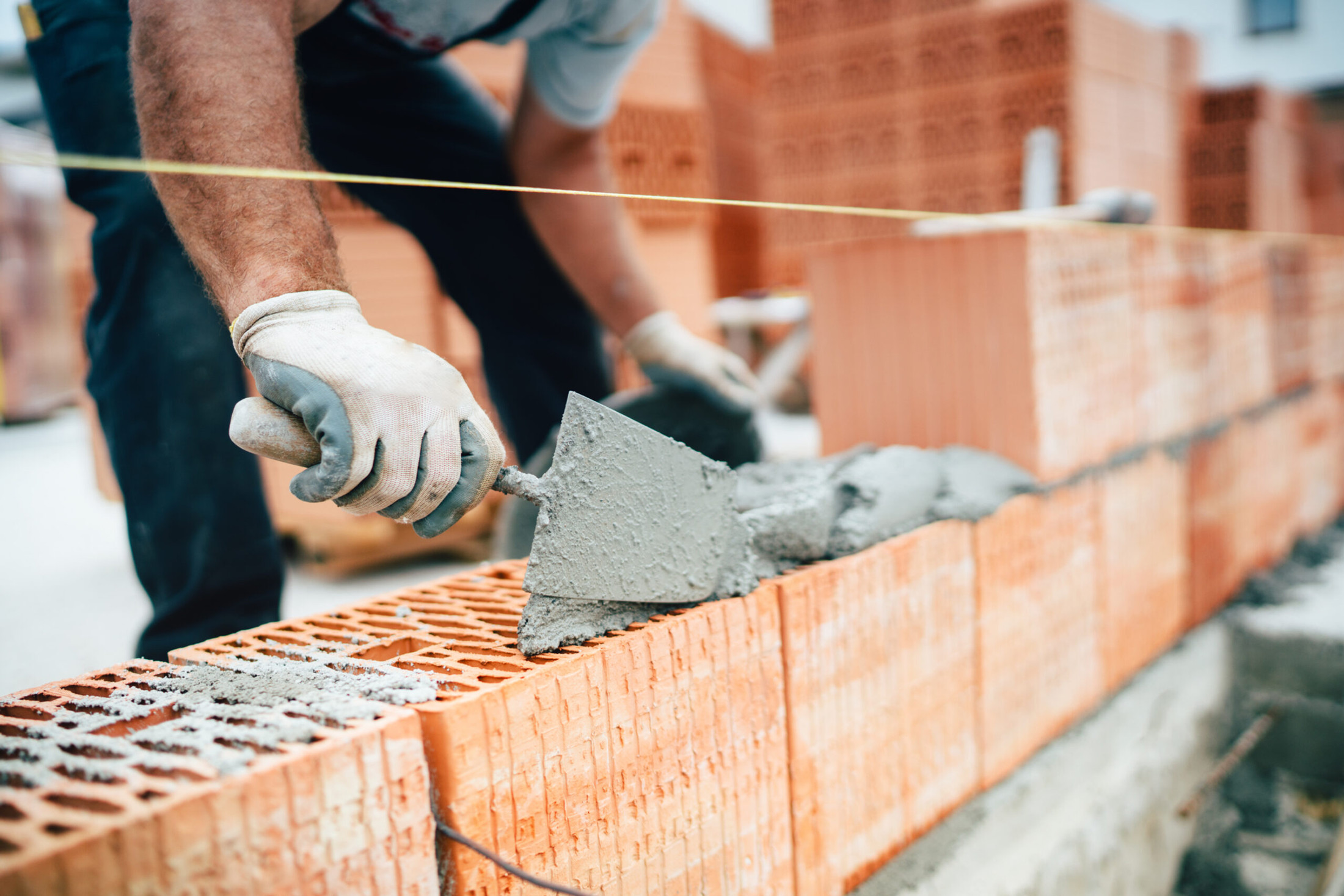
Bricklaying and repointing in Lyndhurst
Victorian brickwork, banded detail, tall stacks and garden walls, repaired so the repair does not announce itself. Free visit, itemised written price.
The site visit is free and so is the written itemised quote. Thomas Hannen prices every job himself.
On the Victorian brickwork that makes up much of Lyndhurst, the repair that matters is matching. Getting the brick, the mortar colour and the joint profile right is what decides whether a repointed elevation looks repaired or just looks like a wall.
People here usually ring about one of three things. Pointing that has weathered back so far you can put a finger into the joint, often worst high up on a gable or a stack. A band of decorative brickwork, an arch over a window or a moulded string course where the faces have started to break away.
Or a garden wall along the road that has bowed and lost a run of coping. All three are repairs, and all three go wrong when somebody reaches for whatever brick and whatever mortar is nearest. We come out, get close enough to see what is actually there, photograph it, and price it properly in writing.
The work
The jobs we do on Lyndhurst brickwork
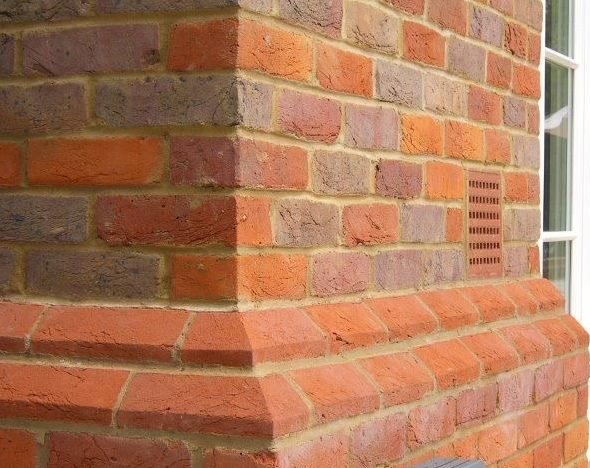
Repointing period brickwork. Much of the village is later nineteenth century brick, and a fair amount of it is more ambitious than it first looks: banded and polychrome courses, corbelled detail under the eaves, gauged arches over the windows. Nearly four in ten homes here predate 1919, so solid walls are the norm rather than the exception, and a solid wall has to stay breathable. We rake by hand to roughly twice the joint width, wash out and point in an NHL lime gauged with a sand chosen for colour, finished flush or slightly back so the brick reads and the joint does not. Where an original weather struck finish survives we put that back rather than default to a bucket handle profile because it is faster.
Matching, which is most of the job. A Victorian facing brick is not a standard size and the colour range in a single elevation can be wide. We work from samples: a small trial panel of the proposed mortar left to dry and judged in daylight, and brick samples, usually reclaimed or handmade, brought to you before anything is ordered. It adds a week at the front of a job and it is the difference between a repair you stop noticing and one you see every time you come up the path. In a village that is a conservation area in its own right, inside the National Park, that week is also what keeps the elevation looking like the rest of the street.
Stacks here are tall, often shared between two houses, and they take weather from every direction. Re-flaunching, repointing, rebedding pots and rebuilding from the last sound course where there is movement. Arches over windows drop when the timber or steel behind them gives up, and cutting in a new lintel and rebuilding the arch above it is a careful day rather than a quick one. Anything structural like that is building control work and we say so up front.
Faces flaking off, particularly low down and on the weather side, are usually the legacy of a cement repoint or of ground piled up over the damp proof course. We cut the failed bricks out individually and bed matched stock in, and where the cause is levels or a broken gully we tell you, because pointing over it only buys a couple of winters. The ground here shrinks and swells, so where the rainwater goes beside a footing is worth sorting before the wall is.
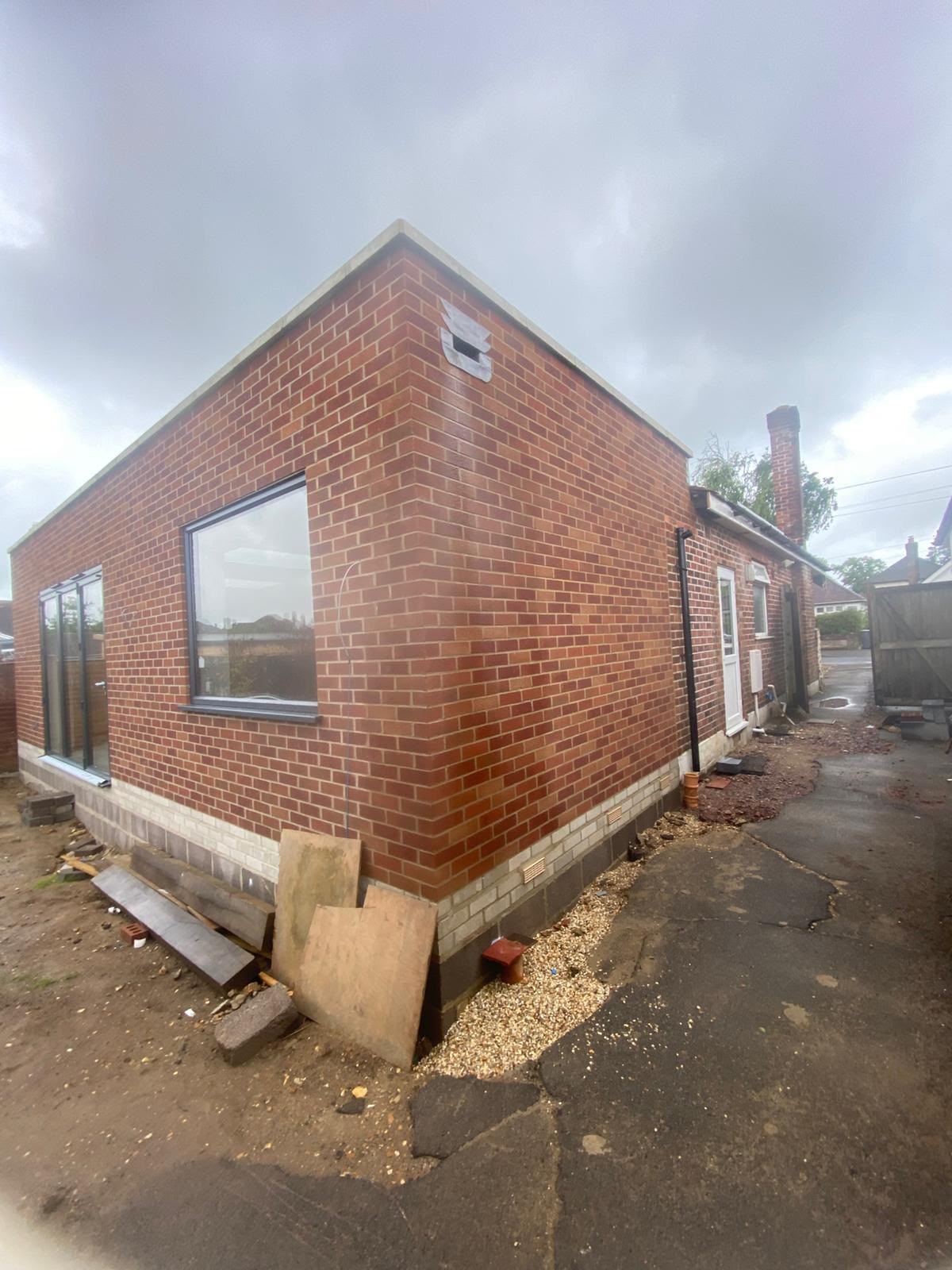
Boundary walls to the road with brick piers, coping and gate piers get rebuilt off their own footing where a length has bowed. And new building when it is wanted: extensions and garden rooms in cavity construction, blockwork inner leaf, outer leaf in stretcher bond, wall ties at proper centres and a visible damp proof course. Planning Portal guidance on garden walls covers the height a new wall can go to, and the Party Wall etc. Act 1996 covers anything on the line with a neighbour.
How it runs
From your call to a written price
Same team from the first visit to the last, one person to ring, and the quote itemised: access, raking out, the mortar mix, the area of each elevation, any brick replacement and disposal on separate lines. Lyndhurst is inside the New Forest National Park and has its own conservation area, with 31 listed entries in the parish including the church and The Queen's House, so the National Park Authority is the planning authority for your address rather than a district council. The National Park Authority's interactive property map will tell you which designations apply to your house, and we look before we price. Like for like repair needs no application; a change of material or appearance is a different matter.
Cost
What decides the price of a brickwork job
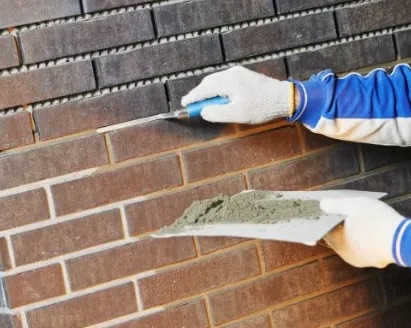
No rate per square metre: the metre of wall tells you nothing until you see the joints. A front boundary wall off the pavement, a rendered rear return and a shared stack three storeys up are three different jobs. How long the platform stands matters as much as its size, and the work at height rules are why it is a priced line. Raking by hand is slow, so joint depth and spalled faces decide the hours, and matching a mortar or sourcing a brick takes trial panels. Ask how deep joints are raked, by hand or disc, and whether the scaffold is in.
If something has moved
Loose brickwork, or a wall that has shifted
Ring rather than use the form. Anything overhead or leaning goes to the front of the queue. Plenty of the walls here front straight onto the road or a pavement, so anything leaning over one is dealt with the same week wherever we can. The first visit is about making it safe. The phone is answered 24 hours for emergencies; scheduled work runs Monday to Friday, 8am to 6pm.
Worth knowing
In the conservation area it is the detail that is protected
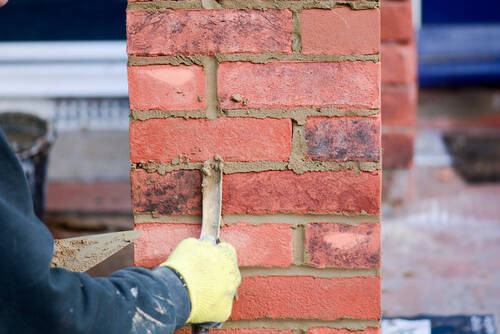
A conservation area does not stop you looking after your house. What it protects is the character of the place, and in Lyndhurst that character is largely made of brick detail: the colour of the mortar, the profile of the joint, the banding, the arches and the way an elevation reads from the street. So the things that get people into difficulty are almost never the repair itself.
They are the shortcuts taken during it. Repointing in a grey cement that reads as a grid across a red elevation. Replacing a run of gauged arch bricks with a modern wirecut that is the wrong size and the wrong colour. Rendering over brick that was always meant to be seen. Any of those changes the appearance, and appearance is exactly what the designation is about.
The practical route is short. Check what applies to your address on the National Park map, and if you are listed, or you are altering rather than repairing, speak to the Authority before you commit. The National Park's heritage and conservation guidance is a reasonable starting point and a phone call to a conservation officer is usually quicker than an application.
Then make the specification part of the quote, not a conversation on site: which mortar, which sand, which joint profile, which brick, and a sample panel signed off before the elevation starts. We write all of that down as standard, and it is worth asking anyone else you are getting a price from to do the same, because a quote that does not mention any of it is not really a quote for this wall.
Who you are dealing with
A local firm you can check
We cover Lyndhurst, Emery Down, Minstead, Bank, Brockenhurst and Ashurst, and out across SO43 and the middle of the Forest. Bournemouth Roofing & Building Ltd, registered in England and Wales, company number 15471719, which you can look up in a minute. Thomas Hannen's business, and he is the one who comes out to price the job, not a salesman. A verified customer's 10 out of 10 on Checkatrade. The visit and the written quote are both free.
Questions
Lyndhurst questions we get asked
Our brickwork is Victorian. What do you match it against?
A brick lifted from somewhere nobody sees, and a mortar sample from a sheltered joint. 39.0% of Lyndhurst dwellings predate 1919 and the largest block of those is pre 1900, so many walls here are handmade brick carrying a range of colours across one elevation rather than a single flat shade. We match the range, the size and the texture, and reclaimed stock generally beats anything new. Being in the conservation area, the finished work has to read as the old wall does.
What does the Lyndhurst conservation area control on a repair?
Appearance. Within the Lyndhurst conservation area a repair returning the same material in the same joint profile is maintenance and simply goes ahead, while changing the material, the colour or the finish is not, and the New Forest National Park Authority is the body that decides. That effectively rules out a grey cement ribbon joint on a village frontage. We match the sand so new work weathers in instead of standing out for its first few winters.
Are the older houses near the church all listed?
A fair number are. Lyndhurst has 31 listed entries, taking in the Church of St Michael and All Angels and The Queen's House, and the older frontages around them are well represented. Listing covers the mortar, the joint profile and any rendered finish, so consent comes ahead of cutting out rather than after. The National Park Authority deals with both listed building consent and the conservation area here, which at least means one office instead of two.
What if you open the joints and find something worse?
We stop and show you. Once a joint has been raked back you can see whether it is only the mortar that has gone, whether the brick behind it is sound, whether an old crack was filled instead of repaired, and whether a lintel or a tie is sitting there needing attention. Anything beyond the quoted work is priced and agreed before we go further. Thomas Hannen comes back to look at it himself rather than settling it over the phone.
Does the damp under the trees here slow lime mortar down?
It does, and mostly that helps. Lime has to stay damp while it carbonates, and the shaded plots around Lyndhurst on cohesive ground with impeded drainage stop it drying too fast in summer. The trouble comes at the other end of the year, when a wall that never sees sun fails to dry between showers and frost catches green mortar. We work the east and south west faces to suit the season and sheet anything freshly pointed.
Nearby, and next door
Bricklaying and repointing near Lyndhurst
Bricklaying and repointing nearby
Our other trades in Lyndhurst
Everything we do in Lymington Bricklaying and repointing, all areas Every area we cover
Free quote
Get a price that names the brick and the mix
A free site visit in Lyndhurst, samples agreed before anything is ordered, and an itemised written quote you can compare properly.