
Bricklaying in Minstead
Repointing, brick replacement, chimney stacks, garden walls and new brickwork across Minstead and the SO43 villages.
The site visit is free and so is the written itemised quote. Thomas Hannen prices every job himself.
Last updated
If the joints on a Minstead cottage have gone back and the brick faces are starting to crumble with them, the wall wants raking out and repointing in a soft lime mortar. Not a hard cement mix, and not a coat of render over the top to hide it.
Out in Minstead the brickwork usually fails on the weather side first. Rain has been getting into open joints on the weather side of the house and the faces of the bricks are flaking away with the frost. A chimney stack has gone soft at the top and the flaunching round the pots is cracked. Or a boundary wall on the lane has started to lean after a wet winter, or after something reversed into it.
None of those can be priced from the road, and the first two get read as a damp problem more often than not. We come out, get close to the wall, work out what the original mortar actually is before anybody mixes anything, and tell you what needs doing and what does not. The site visit and the written quote are both free.
The work
Brickwork jobs around Minstead
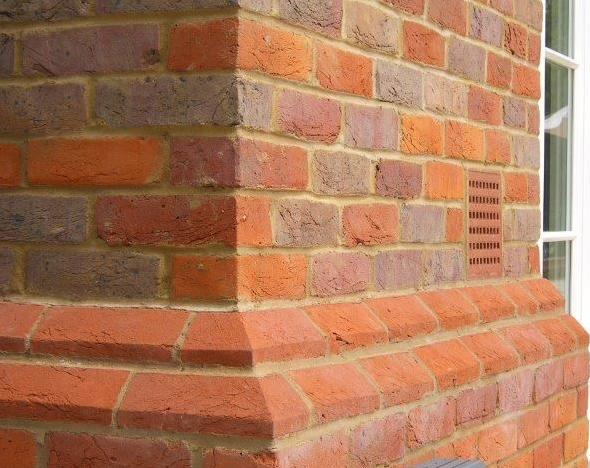
Solid walls. The older houses in Minstead are solid wall, one brick thick with no cavity, and they were built to take water in on the face and give it back out through the joint. That only works while the mortar stays softer than the brick.
Where a wall has been pointed in a hard sand and cement mix at some point, the water leaves through the brick face instead, and the face is what fails. We rake out by hand to roughly twice the joint width, never with a disc cutter on soft brick, and point back in a breathable lime, usually an NHL gauged to suit what is already in the wall, finished flush or bucket handle to match the original. Once a face has blown, every frost takes another layer off it, so the failed units are cut out and replaced with a matched brick, handmade or reclaimed where the original has been out of production for a century. The worst of it is usually the bottom few courses, the reveals either side of a door, and anywhere a downpipe has been running down the wall for years.
Stacks, lane walls and outbuildings. Plenty of houses out this way still have a fire or a wood burner under the stack, and above the roof line it is exposed on four sides with nothing sheltering it. We repoint stacks, renew cracked flaunching around the pots, reset a coping that has slipped and rebuild the top courses where they have gone soft, and where a stack is genuinely finished with we cap it and leave it ventilated rather than sealing damp inside. A roadside wall weathers from both faces at once and takes spray, splash and the occasional wing mirror, and a gate pier works loose because everything that swings hangs off it. Where a garden wall has bowed rather than simply cracked, it comes down and goes back up on a proper footing. A fair share of the brickwork here is not the house at all: a stable block, a workshop, an old outbuilding turned into a garden store, built lighter than the house on a shallow footing and in a soft brick. Where a path or a raised bed has been built up above the damp proof course the wall bridges, and the answer is to drop the ground back below the DPC rather than seal the outside and trap the water in.
How it runs
Brickwork and chimney repairs on Forest cottages and garden walls
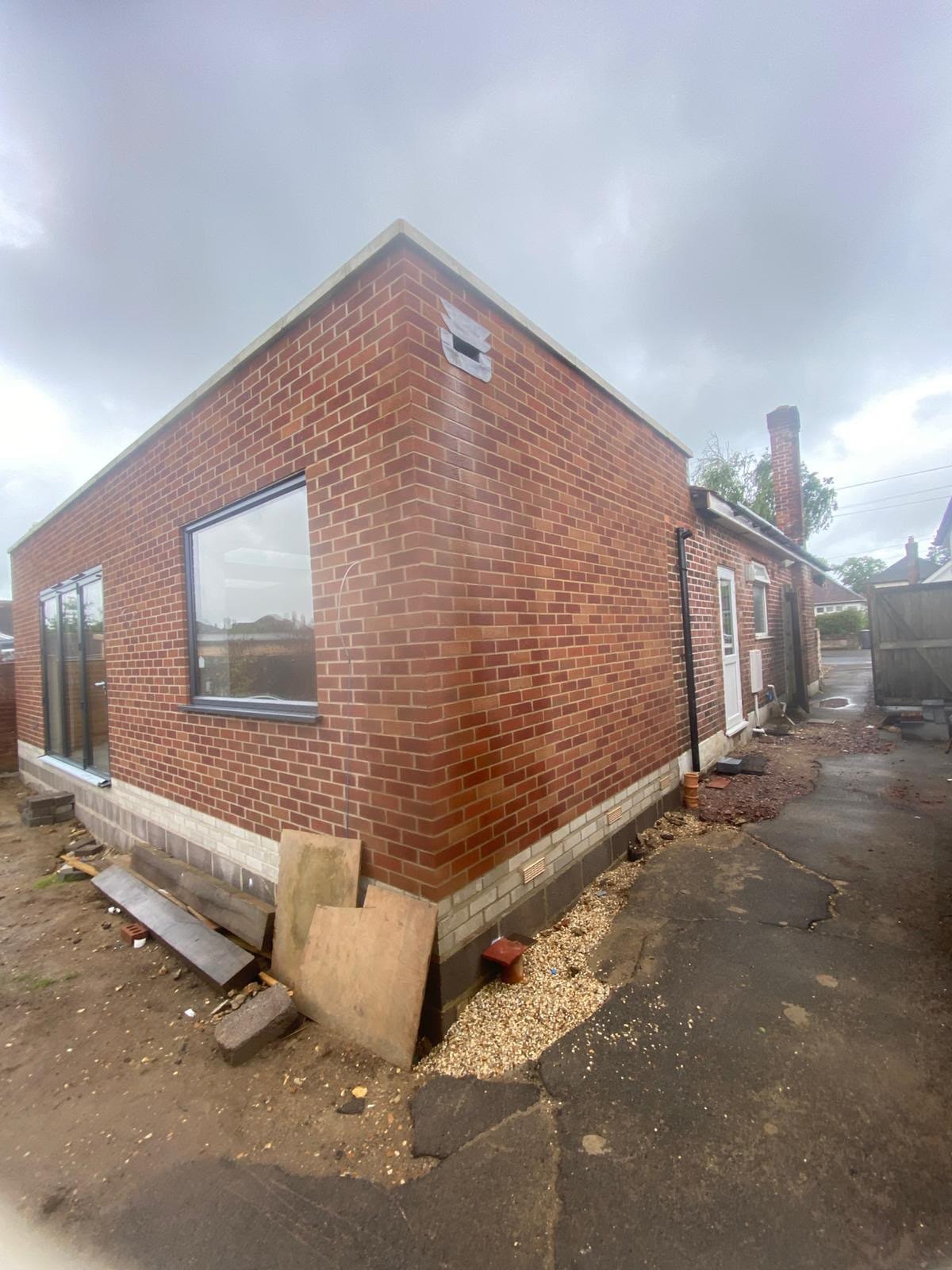
Thomas comes out and looks at the brickwork himself, elevation by elevation, and writes a price broken down that way: access, raking out or taking down, new or reclaimed bricks, the mortar, and waste. Building and repointing are covered together, start to finish. Before we mix anything we match the mortar to what is there, lime where the wall was built with lime.
Access for a stack or a gable is a scaffold, carried in by hand if the lane will not take the lorry, and never set up on the open Forest verge. For a boundary wall on a lane with no pavement we put up barriers so nobody walks into the work. Rubble and old bricks are cleared away each evening, and if a lintel or a foundation turns out worse than it looked, we photograph it, price it and wait for your answer.
Planning here is the National Park Authority, and appearance is what it controls: putting a wall back as it was is maintenance, changing how it looks is not. Minstead lies in the Forest Central (South) Conservation Area, and on a listed building even like for like repointing needs consent. A new garden wall has a height limit, and the Planning Portal sets out where that line falls. Where a wall is shared with a neighbour, the Party Wall etc. Act 1996 puts a notice period on the work.
Cost
What goes into a brickwork price out in the Forest
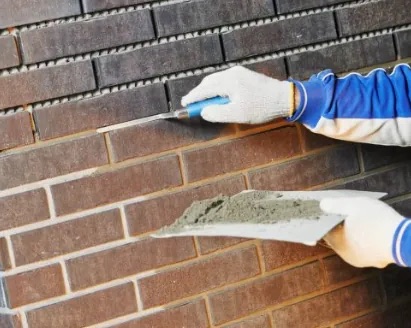
We do not price brickwork by the square metre, because the area of a wall says little about the work in it.
Reaching it. A cottage gable you can do off a tower, a chimney stack on a two storey house with a hedge along the boundary, and a wall on a lane with nowhere to stop a van are each priced on their own terms. The platform for a stack or gable is its own line, since work at height rules govern how long it stands.
How deep the damage goes. The hours are set by how far the joints have to be raked out and whether the brick faces have already spalled in frost. Hard cement pointing on soft old brick often caused that spalling in the first place, and cutting it out without chipping the brick is slow.
Movement. The ground here is clay that shrinks in a dry summer and swells in a wet winter. A crack that opens and closes with the seasons needs its cause found before it is rebuilt, or new brickwork cracks in the same place.
Matching. Finding a reclaimed brick that sits with the old ones, and a lime mortar that matches in colour and strength, takes time, and on a building the National Park looks at closely it is the part that shows.
On any other quote, ask whether the mortar has been matched, how deep the joints will be raked, and whether the scaffold is included.
If something has moved
A chimney stack or wall that has started to lean
Keep people and cars away from anything that is leaning, cracked right through or dropping bricks, especially a stack over a door or a wall beside a lane with no pavement.
The first visit makes it safe and stable, which can mean taking down loose courses, propping, or fencing the area off, and then we come back with a figure for the proper repair once the extent of the movement is clear. Ring about anything like this rather than filling in the form. Our booked work runs Monday to Friday, 8am to 6pm, and if we miss your call we ring you back.
The local bit
The National Park is the planning authority here
Minstead sits inside the New Forest National Park, and that changes who you are dealing with rather than what the wall needs. The National Park Authority is the planning authority here, not the district council, and the village is covered by the Forest Central conservation area.
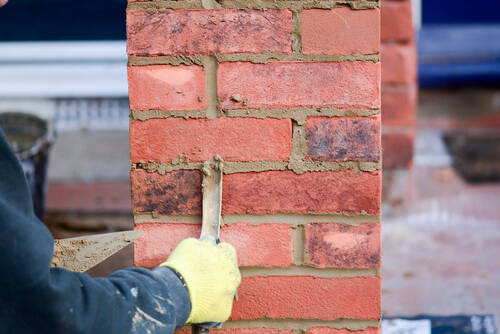
In practice the line is the one you would expect: repointing in a matched mortar, replacing damaged bricks with the same brick and putting a coping back the way it was are all maintenance, and nobody needs to hear about it.
Changing what an elevation looks like is a different conversation. Rendering over bare brick, painting masonry that has never been painted, or pointing a soft old wall up in a hard grey cement that reads as a stripe from the road are all changes of appearance, and the last one is a repair problem as well as a planning one.
There are eleven listed entries in Minstead, the church of All Saints among them, and on a listed building the mortar mix and the joint finish are part of what consent covers. So the order matters. Check what your property is before you book anybody, using the Authority's interactive property map and its heritage and conservation guidance.
Then ask whoever is quoting for a sample panel, mixed and left to weather before the whole elevation is done. It costs a morning and it is the only honest way to check colour and texture against the wall you have.
Who you are dealing with
A bricklaying firm you can look up before we come
Our base in Boscombe is 15.6 miles away, and from there we cover Minstead and the SO43 villages round it, from Lyndhurst and Emery Down over to Cadnam and Bartley. Planning applications here go to the National Park Authority; building regulations are dealt with by New Forest District Council.
Look us up as Bournemouth Roofing & Building Ltd, company number 15471719, registered in England and Wales. Thomas Hannen owns the business and is the person who inspects the brickwork and prices it. One verified customer rated us 10 out of 10 on Checkatrade. The visit is free, and so is the itemised quote. Before you book a visit in Minstead, you can read our customers' Google reviews, word for word, on our reviews page.
Planning at a glance
Do you need planning permission in Minstead?
Most repairs in Minstead need no application at all. What decides whether a change to the outside of your house does is who the council is, whether a conservation area or a listing applies, and whether the place sits in a protected landscape.
| Question | In Minstead |
|---|---|
| Who decides | New Forest National Park Authority is the planning authority for Minstead. New Forest National Park Authority's heritage pages set out what it controls. |
| Conservation area | Yes: Forest Central (South) Conservation Area. Check whether your street is inside the boundary before changing anything visible. |
| Listed buildings | Yes, there are listed buildings in and around Minstead. If yours is one, work can need listed building consent. |
| Protected landscape | Inside the New Forest National Park, where design is looked at more closely and permitted development rights are narrower. |
Questions
Questions about bricklaying in Minstead
What does the Forest Central conservation area actually control?
Appearance, and that is the whole of it. Minstead falls inside the Forest Central (South) conservation area, so putting back what is already there counts as upkeep, while a different brick, a changed mortar colour or a bucket handle joint where a flush one used to be does not. We record and photograph the existing joint before raking it out, then match it.
Do we deal with the district or the National Park?
The New Forest National Park Authority, not a district council. It is the planning authority for Minstead and it applies design scrutiny to anything visible in the landscape. For a straight repair that changes nothing, because you are not applying for anything. It matters the moment you want a new outbuilding, a wall on the road frontage or a different material, so speak to them before settling on a design.
Why does our boundary wall crack in the same spot?
Something under it is moving. The ground around Minstead is cohesive with a significant shrink and swell rating, so a shallow footing lifts and settles with the weather and the wall breaks where it is weakest. A crack that reopens after a repair is telling you the footing is at fault, not the mortar. We dig down at the crack, see what it stands on and rebuild that bay with a joint that can move.
Do we need a full scaffold or will a tower do?
For one elevation of a two storey wall a tower is usually enough, and it moves around a cottage on a narrow lane far more easily. A full scaffold earns its place on a gable, a chimney, or anywhere we are handling weight. Inside the Forest Central conservation area we keep standing time short because the street scene matters. Thomas Hannen decides at the visit and the quote says which is allowed for.
Is there a wrong time of year for lime pointing?
Hard frost and blazing sun are both wrong, for opposite reasons. A lime joint carries on setting slowly, so it wants covering against frost for the first few weeks and shading from a sun that would dry it before it has gained anything. Around Minstead we sheet the elevation and work the shoulder months by preference. We will not point a wall the evening before a hard frost.
Nearby, and next door
Bricklaying near Minstead
Nearby places we also cover for bricklaying, with straight-line distances from Minstead, and the other trades we offer in Minstead itself.
Bricklaying nearby
Our other trades in Minstead
Brickwork and repointing guides
Lime or cement mortar: which do you need? Single storey extension: planning and building regs Subsidence cracks: which ones matterEverything we do in Ringwood Bricklaying, all areas Every area we cover
Free quote
Get a price for your Minstead brickwork
Tell us what the wall is doing and we will come and look at it properly. The visit and the written itemised quote are both free.