
Repointing brickwork in Minstead
Hand raking, a breathable lime matched to the original sand, and a working area fenced and cleared every day out on the open Forest.
The site visit is free and so is the written itemised quote. Thomas Hannen prices every job himself.
A wall wants repointing when the joints have gone back behind the face of the brick and water is standing in them instead of running off. On the older cottages out here what goes back is a breathable lime, raked out by hand, and the site gets set up around the fact that there is nothing between the work and the open Forest.
Most of what we are called to around Minstead falls into three shapes. Open joints on the weather side letting rain in, with the brick faces flaking away as the frost gets at them. A stack gone soft at the top with the flaunching around the pots cracked. Or a wall on a lane that has lost a run of coping and is now taking water into its middle.
Those get read as a damp problem more often than they get read as a mortar problem, and pricing one off a photograph is guesswork. So we walk the building, scrape joints high and low because they are rarely in the same state, and find out what the original mix was before anything is ordered. It comes back to you elevation by elevation as a written itemised quote, with what we would leave alone marked as such. Both the site visit and the quote are free.
The work
The pointing jobs we do out this way
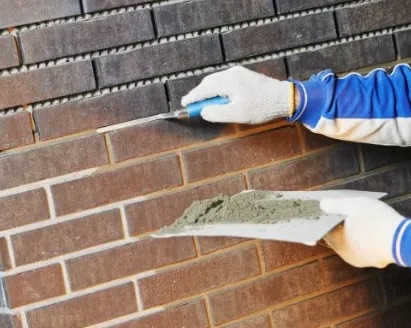
Solid wall cottages. The older houses here are solid wall, one brick thick with no cavity, built to take water in on the face and give it back through the joint. That works only while the mortar stays softer and more open than the brick. We rake out by hand to a depth of roughly twice the joint width, perpends as well as beds, damp the joints down and point back in a breathable lime, usually an NHL gauged against a sample of the original with the sand picked for grain and colour, then brush the face off once it has taken up. The finish goes back to whatever the wall carries, flush, recessed or bucket handle, rather than to whatever is quickest.
Cement pointing, and why it is often the cause. Where a wall has been pointed in a hard sand and cement mix at some point, the water leaves through the brick face instead of the joint and the face is what fails. The giveaway is joints that still look perfect standing proud of bricks that are spalling. Cutting that out without taking the arris off what is left is slow work with a chisel and a hacksaw blade, and a disc cutter or an angle grinder never goes near it.
Faces that have already blown. Once a face is off, every frost takes another layer, so the failed units come out whole and matched bricks go back in, handmade or reclaimed where the original has been out of production for a century. It is worst in the bottom few courses, in the reveals either side of a door, and anywhere a downpipe has been discharging down the wall for years.
Stacks and flaunching. Plenty of houses out this way still have a fire or a burner under the stack, and above the roof line it is exposed on four sides with nothing sheltering it. We repoint stacks, renew the cracked flaunching that beds the pots and make good the top courses where they have gone friable. Where a flue is genuinely finished with, it gets capped and left ventilated rather than sealed, so damp is not shut inside the brickwork.
Lane walls and copings. A free standing wall weathers from both faces at once and has no roof over it, so the coping is doing all the work. A loose or missing coping lets water straight into the core and the wall starts coming apart from the top. Rebedding coping and pointing the top courses, off a tower where the wall is low enough, is the cheapest useful thing you can do to one.
Outbuildings. A fair share of what we are asked to look at is not the house. A stable block, a workshop or an old outbuilding turned into a store, built lighter than the house in a softer brick, will show open joints and crumbling faces years before the main walls do.
How it runs
From your call to a written price
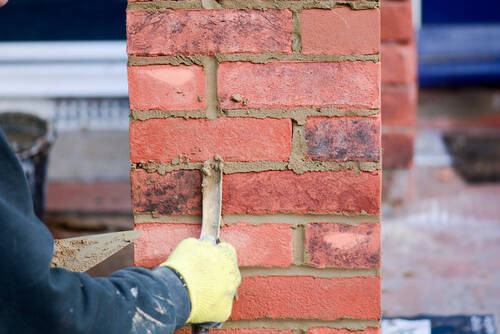
Same team from first visit to last, one person to ring, no sub-contracting. The quote is itemised: access, raking out, the mix, the area of each elevation, brick replacement and disposal on separate lines, so you can compare it against anyone else's.
Nothing is left open overnight and the site is swept at the end of each day. If something turns up that nobody could have seen, you get a photograph and a price first.
Repointing like for like is repair rather than development, so nothing goes to building control and there is no planning application in it. Who you would be applying to is worth knowing all the same. The New Forest National Park Authority is the planning authority here rather than a district council, and the village sits inside the Forest Central (South) conservation area, where the control is over appearance: the same mortar and the same joint is upkeep, a hard grey joint that reads as a stripe from the lane is not. Eleven entries in the parish are listed, the church among them, and on those the mortar mix and the joint finish are part of what listed building consent covers. National Park heritage and conservation guidance is the place to start, and we check an address before we price anything.
Cost
What decides the price of a repointing job
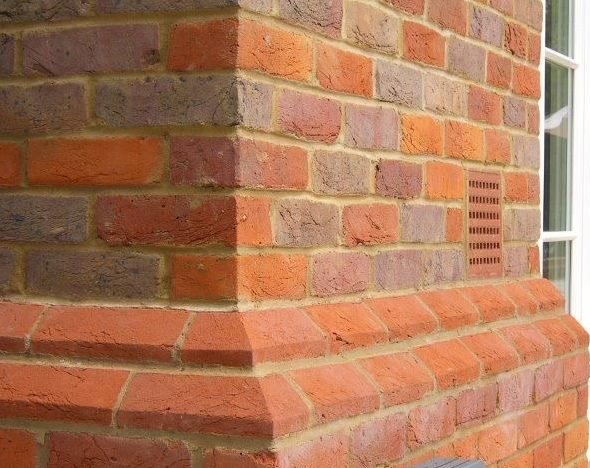
No rate per square metre. The area tells you almost nothing until somebody has looked at the joints.
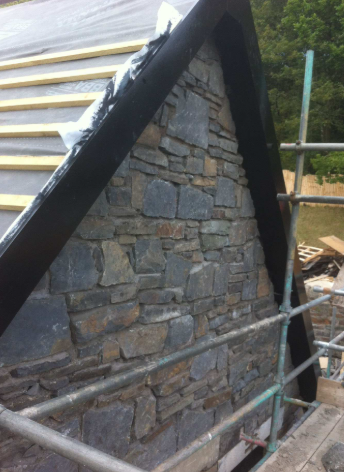
Getting to it. A cottage with the Forest right up to the gable, a stack on a two storey house set back behind trees and a low wall on a bend in the lane are three different set ups. A chimney or a gable wants a scaffold; a boundary wall wants nothing. The work at height rules are why access is a priced line rather than something absorbed into a rate.
The joints decide it, not the wall. How deep they come back, and whether the faces have spalled, sets the hours far more than the area does.
Matching is the part that shows. Lime is slower to work and slower to cure, and right on most pre-1919 walls here.
Comparing quotes? Ask how deep the joints are raked and by hand or by disc, what the mix is and whether it was matched, how many spalled bricks are being replaced, and whether the scaffold is in the price.
If water is getting in
Open joints, and water coming through the wall
Ring rather than use the form. Joints washed out let driven rain through to the inside face, and on a chimney it finds the flashings. We come and look, sheet or temporarily point the worst if the weather is against us, and price the elevation once it has dried enough to see what is sound. Out here that is usually a stack shedding mortar onto a roof, or open joints on a west facing gable with penetrating damp coming through onto a bedroom wall. The phone is answered 24 hours for emergencies; scheduled work runs Monday to Friday, 8am to 6pm.
Worth knowing
There is no fence between our sand heap and the Forest
The verges out here are open and the stock is not. Ponies, cattle and pigs move along the lanes and through gardens as a matter of course, and that changes how a mortar job is set up more than anything about the wall does. Lime is caustic. A bag of it, a mixer with material still in the drum, or a bucket of lime water left standing is not something to leave where an animal can get at it, and a heap of sand looks to a pony like a good place to lie down. So everything comes in and out with us. Material is stored inside a boundary or in the van rather than tipped on the verge, the mixer is emptied and washed out at the end of each day, and the working area is fenced off before a tool comes out of the bag.
The effect on you is small but worth knowing before you compare quotes. It means we mix in smaller batches and keep a tighter site than we would in a town, which suits lime anyway because it wants using while it is fresh. It means a delivery is timed for the day it is needed rather than dropped on the drive a week early. And it means the access line on your quote covers more than a tower, because fencing, sheeting and clearing the ground daily are not optional on an open plot. Tell us when you ring whether the working elevation is inside a fence or straight onto the Forest, because it changes how the day is planned.
Who you are dealing with
A local firm you can check
We cover Minstead, Emery Down, Lyndhurst, Cadnam, Bartley and the SO43 villages, with the New Forest National Park Authority as the planning authority rather than a district council. You are dealing with Bournemouth Roofing & Building, trading name of Bournemouth Roofing & Building Ltd, company number 15471719. Thomas Hannen's business, and he prices every job himself rather than sending a salesman. A verified customer's 10 out of 10 on Checkatrade. The visit and the written quote are free.
Questions
Minstead questions we get asked
Do you fence the working area off?
Yes, before anything comes out of the van. On an open plot that is partly about stock and partly about the material: raked out mortar makes far more spoil than people expect, most of it fine grey dust, and lime is caustic while it is fresh. We sheet the ground under the elevation, fence the working length and lift the sheets at the end of each day.
What decides whether our wall gets lime or a cement mix?
What is already in it, and what the brick can take. A solid wall built in lime has to keep breathing, so it gets lime back. A later cavity wall built in a cement and sand mortar gets a mix gauged a little under the strength of its brick. We settle that by scraping a joint and looking at the sand in the original, not by preference on the morning.
Our cottage is not listed. Does the National Park still have a view?
On repairs, no. Putting the same mortar back with the same joint profile is upkeep and needs nothing from anybody. Where the Authority does take an interest is a change of appearance: painting brick that has never been painted, rendering over it, or a joint colour that reads as a change from the lane. The repair itself is yours to get on with.
How much mess does repointing actually make?
More than you would think, and it is manageable. The spoil is fine dust that gets into a lawn and stays there, so the ground under the working elevation is sheeted before a tool comes out, planting is covered rather than trampled, and the sheets are lifted daily. Nothing is buried on the plot or washed into a gully.
Can a chimney we no longer use just be left?
Left, yes. Ignored, no. A disused stack still takes weather on four sides and its joints will wash out like any other, and once water is getting into it the damage lands in the roof space rather than on a wall where you would see it. If it is genuinely finished with, capping it and leaving it ventilated is cheaper than repointing it every decade.
Nearby, and next door
Repointing near Minstead
Repointing nearby
Our other trades in Minstead
Everything we do in Ringwood Repointing, all areas Every area we cover
Free quote
Get the joints and the stack priced in one visit
Thomas comes out, scrapes a joint on each elevation and puts the price in writing, itemised, at no cost to you.