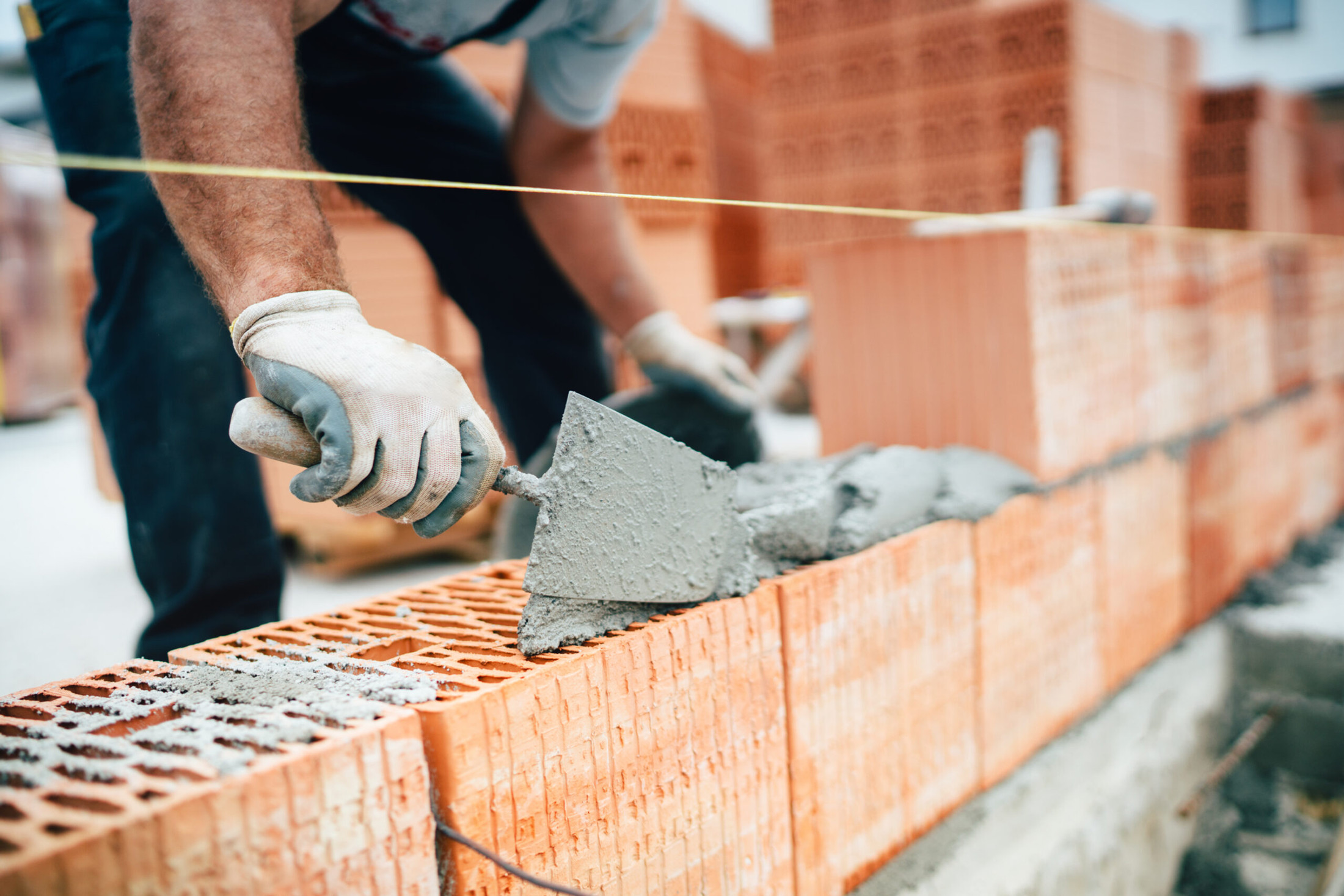
Repointing in Cadnam and Bartley, matched at eye level
Two ages of brickwork on the same lane, two different mortars, and a trial panel dried on your own wall before an elevation starts.
The site visit is free and so is the written itemised quote. Thomas Hannen prices every job himself.
Two houses a hundred yards apart on these lanes can need opposite mortars. Roughly a quarter of what stands in Cadnam and Bartley went up before 1919 and wants lime, while nearly two fifths is post-war cavity work that wants a gauged cement mix. Working out which one you have in front of you is the first half of a repointing job here.
Three things bring people to the phone. Mortar gone back to sand, so a joint empties under a thumbnail and daylight shows through a perpend. Brick faces flaking after a hard winter, nearly always on the elevation that takes the weather. And joints opening along the top course under the verge, or at an exposed corner, on a house that is otherwise sound.
None of those is urgent this week and none stops on its own: water stands in an open joint, freezes, and takes a little more of the wall every winter. We look at the whole elevation rather than the patch you noticed, scrape a joint or two to find what the wall was built in, tap for pointing that has parted from the brick, and photograph the lot. You get a written itemised quote, face by face, with the mix named on it. The site visit and the quote are free.
The work
Older walls, later walls, and the mortar each one takes
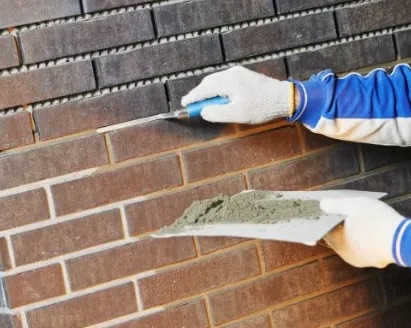
Pre-1919 solid walls. Close to a quarter of the housing here predates 1919: single skin solid walls of handmade brick bedded in lime, with no cavity behind them. A wall like that never stays bone dry and was never meant to. Rain wets the face, the moisture travels and leaves again through the joints, which is why the mortar was made weaker than the brick. We rake those out by hand to about twice the joint width and point back in a natural hydraulic lime with the sand matched to what came out. No disc cutter goes near them, because it widens the joint and takes the arris off a soft face for good.
Post-war cavity brickwork. Most of the rest of the two villages is later, the busiest years being the late sixties and early seventies: a brick outer skin with a cavity behind, laid in a cement and sand mortar and struck weather or bucket handle. They fail differently. The joint does not wash out so much as open at the arris on exposed corners and along the top course, and once water stands in it a frost lifts the face off the brick. On those walls a gauged mix matched for strength and sand is right, and lime would be soft for no reason.
Telling one from the other. Around a fifth of the stock is inter-war, the awkward middle: early cavity or solid, in a weak gauged mortar with lime in it, and a modern strong mix put back into one of those sheds brick faces within a few winters. We settle which wall we are in front of before anything is mixed.
Matching, and the trial panel. Colour in a mortar comes from the sand rather than the binder, so a sample of sound original is taken from a sheltered joint, broken down and matched for colour and grain. Then a trial panel goes up on your own wall and is left to dry, because wet mortar reads darker than it finishes.
Spalled faces and stacks. Where a face has blown, pointing round it only frames the damage, so the brick is cut out whole and a match bedded in. On the older cottages that means reclaimed stock, which takes longer to source than to lay. Stacks stand clear of everything and lose their joints and flaunching first, and that comes off a scaffold shown as its own line.
How it runs
From your call to a written price
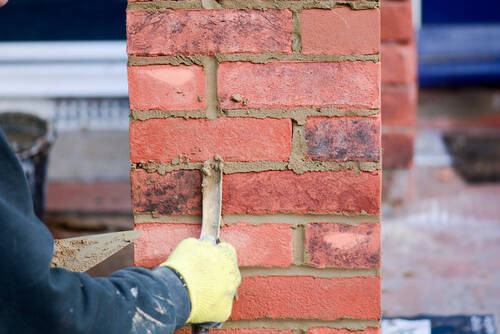
Same team from first visit to last, one person to ring, and no sub-contracting. The quote breaks out access, raking out, the mortar mix, the area of each elevation, brick replacement and disposal on separate lines, so you can compare it against anyone else's.
Nothing is left open overnight, the site is swept daily, and what comes out leaves with us. If something turns up that nobody could have seen, you get a photograph and a price first.
Repointing like for like is repair rather than development, so no planning application is needed and nothing for building control to sign off. Cadnam and Bartley sit inside the New Forest National Park, so permission is settled by the Authority rather than a district council. Neither village has a conservation area of its own, but there are ten listed entries between them, and on a listed building repointing is alteration to the fabric and needs consent first. the National Park Authority's interactive property map will settle your own address, and National Park heritage and conservation guidance sets out what the Authority looks for.
Cost
What decides the price of a repointing job
No rate per square metre: the area tells you almost nothing until somebody has looked at what the joints are like.
Getting to it. A detached house set well back, a bungalow with low eaves you can reach off a tower, and a stack on a main ridge are three different set ups before a joint is opened. The work at height rules are why the scaffold is a priced line, not something absorbed into a rate.
The joints decide it, not the wall. How deep the joints have to come back, and whether the faces have already spalled, sets the hours far more than the area does.
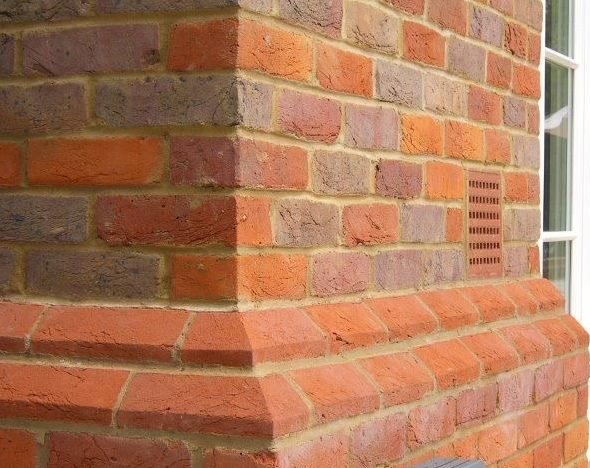
Matching is the part that shows. Too strong a mix is the classic mistake, and one hard frost takes the face off soft brick. Lime is right on most pre-1919 walls here.
Comparing quotes? Ask how deep the joints are raked and by hand or by disc, what the mix is and whether it has been matched, and whether the scaffold is in the price. Two quotes for the same job are usually two different jobs.
If water is getting in
Open joints, and water coming through the wall
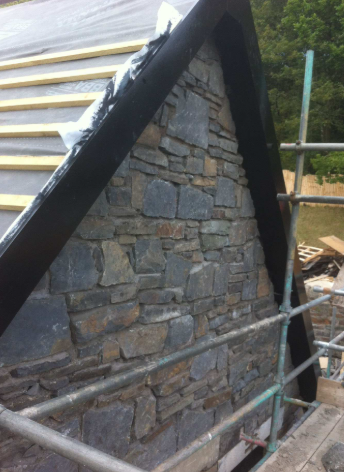
Ring rather than use the form. Joints washed out let driven rain straight through to the inside face, and on a chimney it finds the flashings too. We come and look, sheet or point the worst of it, and price the elevation once it has dried enough to see what is sound. Out this way it is usually a stack, or an exposed gable open long enough for the damp to reach the inside face. The phone is answered 24 hours for emergencies; scheduled work runs Monday to Friday, 8am to 6pm.
Worth knowing
At bungalow height, the sand is the whole match
A quarter of the homes here are bungalows and most of the rest are detached with low eaves on open plots, so a great deal of this brickwork is looked at from a metre away. On a two storey terrace a mortar a shade off reads as nothing from the pavement, because you see the wall at an angle from thirty feet. On a single storey elevation you walk past the joint every day at eye level, and a mismatch is obvious for years.
That makes the sand the decisive part of the specification rather than a detail. The binder gives the mortar its strength, but the colour and texture you see are the sand, so it is matched off a sample of the original and proved on a trial panel left to dry on your own wall. Judging it wet is how people end up with a stripe.
The other consequence is how much you do at once. A lot of the later brickwork here is machine made facing brick with very regular joints, and on that a patch of new pointing reads as a rectangle from the garden however good the match is. So on an exposed corner or a top course we take the pointing out to a natural break rather than stopping where the failure stops. It costs a little more on the day and saves you looking at the join.
Who you are dealing with
A local firm you can check
We cover Cadnam, Bartley, Copythorne, Winsor, Ashurst and Netley Marsh, broadly SO40, with the New Forest National Park Authority for planning and New Forest District Council for building control. You are dealing with Bournemouth Roofing & Building, the trading name of Bournemouth Roofing & Building Ltd, registered in England and Wales, company number 15471719, which you can look up in a minute. Thomas Hannen's business, and he is the one who comes out to price the job, not a salesman. A verified customer's 10 out of 10 on Checkatrade. The visit and the written quote are both free.
Questions
Cadnam and Bartley questions we get asked
Does the pattern of the brickwork tell you anything about the mortar?
It tells you a good deal. Where short brick ends appear at intervals along a course, the wall is tied through its thickness and is almost certainly a solid wall, which points to lime. Where every brick shows its long face, it is a cavity outer skin and a gauged cement mix is right. We read the bond on the visit and confirm it at a reveal.
Would a stronger mortar last longer on a 1970s house?
No, and it is the commonest thing we are asked to undo. A mortar joint is meant to be the weakest part of the wall, so that movement and weathering happen in it rather than in the brick. Put in a mix stronger than the brick and the faces take the movement instead and start popping off. We match strength as carefully as colour.
Our joints are struck at an angle. Should they go back the same?
Yes. That is a weather struck joint, the normal finish on the later brickwork here, cut so water runs off the face rather than sitting on a ledge. The older cottages tend to be flush or slightly recessed. A different profile changes how the elevation reads even when the colour is right, so we copy what the wall already carries.
How long will a repointing job take on a bungalow?
An elevation or two is days rather than weeks once access is sorted, and a single storey wall is quick to reach off a tower. What lengthens it is the raking, slow by hand, and the weather. The quote gives you working days and says what would push them.
Do we need to tell the National Park we are repointing?
Not for a repair in the same materials, which is maintenance wherever you are. The Authority is interested in change: a different brick, a different mortar colour on a visible elevation, a new opening. If your address is one of the ten listed entries the position is different, because there the mortar itself is protected.
Nearby, and next door
Repointing near Cadnam and Bartley
Repointing nearby
Our other trades in Cadnam and Bartley
Everything we do in Ringwood Repointing, all areas Every area we cover
Free quote
Have the mix decided before the price
Thomas comes out, works out which kind of wall you have, matches the sand off it and puts an itemised written price in your hand. Free.