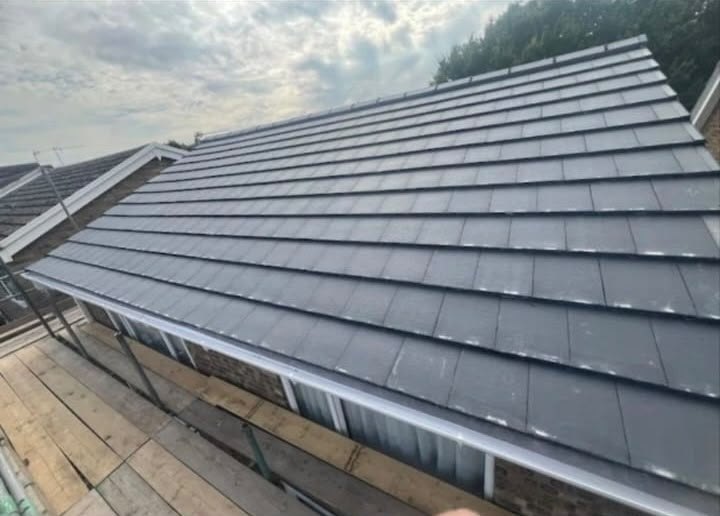
Fascias, soffits and guttering in Cadnam and Bartley
Rotten boards taken off rather than capped over, runs re-hung to a proper fall, and a straight answer on what the National Park will want to see.
The site visit is free and so is the written itemised quote. Thomas Hannen prices every job himself.
Replacing a roofline in Cadnam or Bartley is normally repair work with nothing to apply for. It stops being that the moment the appearance changes, because the National Park Authority is your planning authority here rather than the district council.
Most people ring about one of three things. A soffit has dropped away from the wall and there is a bird going in and out of the gap. A gutter has pulled off its brackets at one end and the wall below it has gone green. Or the fascia has softened and the paint is blown along the whole front of the house.
All three are decided by the timber behind the board rather than by the board itself, and you cannot see it from the ground. We come out, get to the eaves, test the boards with a screwdriver and photograph the rafter feet underneath. Then a quote in writing, split so the boards, the gutter, every downpipe and the access each show a figure of their own. The site visit and the quote are free, and Thomas prices the job himself.
The work
What comes off, and what goes back
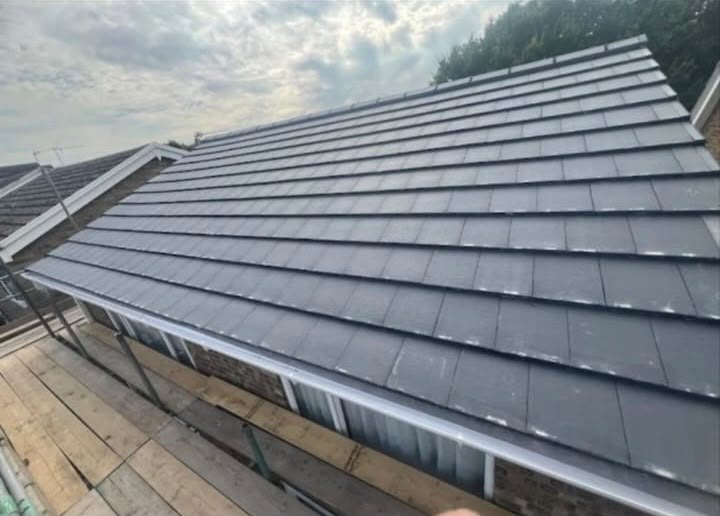
Reading the boards. A quarter of the housing here predates the First World War and a good slice more is inter war, so painted softwood is still common and so is a deep overhanging eaves. Softwood rots from the back and the top edge, where the felt has been dripping onto it, so the front can look tolerable while the board is soft the whole way through. We test at the ends of each run and either side of every joint. Where it goes, the fascia, the soffit and the bargeboard come off together.
The structure underneath. With the boards off you can see the rafter feet, the wall plate and the bottom course of tiles, which is the only honest way to price the job. Soft rafter ends are cut back and spliced. The tilt fillet is reinstated so the bottom tile lies at its proper angle, and an eaves tray is fitted so the felt finishes over the gutter and not behind it. Capping over is the shortcut we will not take on wet timber, because the rot carries on under the plastic and the new fixings are holding into nothing. Over a dry, sound, firmly fixed board, capping over is a fair job and we will quote it that way.
Gutters and pipework. Everything that hangs off the fascia is priced as its own item: the gutter run, each outlet, the unions, the brackets, any hopper, each downpipe and the shoe at the bottom. Half round is the standard profile, ogee sits square against the fascia and reads better on an older elevation, and deepflow is the one to specify where a long slope empties into a short run and the gutter overflows every time it rains hard. uPVC, aluminium and cast iron all have their place, and on the older properties we would sooner re-bed a cast iron joint and paint the run than take it down.
Hanging it so it empties. The commonest fault we put right is a run with no fall in it. Level looks tidy and works like a trough: water stands in the low spots, the outlet silts, and the timber behind a bracket never dries. So a line goes up, the run drops steadily to the outlet, and the brackets go in close enough that no length can bow, every one taking a screw into solid timber. Then we fill it from the far end and watch it leave at the shoe. Each downpipe is clipped back and made to deliver into a gully or a soakaway, because a pipe emptying onto a path puts the damp and the staining straight into the wall.
Ventilation and what lives up there. A deep soffit hides a lot. It is where birds and wasps nest, where moss and debris off the tiles collects, and where a loft quietly loses its air supply. While the boards are down we put in eaves ventilation, through the soffit or over the fascia, and make sure the air gap has not been closed off by insulation pushed too far into the eaves. Then the verge and the ends of each run are meshed so nothing gets back in, and every outlet is proved clear rather than left blocked.
How it runs
From your call to a written price
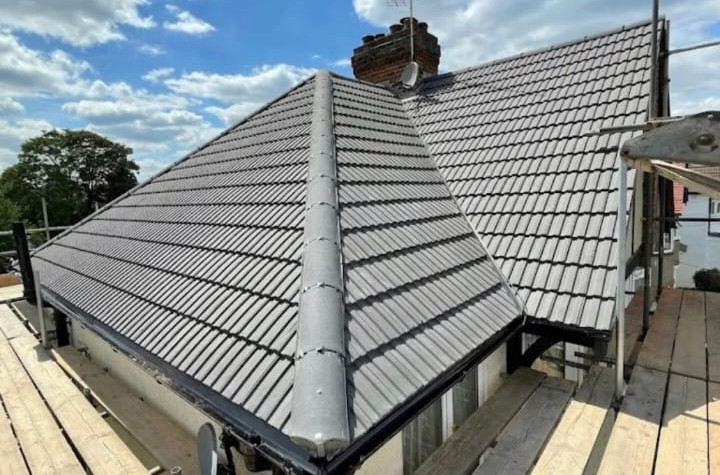
Same team from first visit to last, one person to ring, and no sub-contracting your work out to somebody you have never met. The quote is itemised, not a figure on the back of a card: access, the length of each run, stripping the old boards and gutter, the fascia, soffit and any bargeboard, the gutter, outlets and downpipes, and disposal on separate lines, so you can compare it properly against anyone else's.
Nothing is left open or unusable overnight. The site is swept at the end of each day rather than the end of the job, and what comes out leaves with us. If something turns up once we start that nobody could have seen, you get a photograph and a price before we carry on.
Renewing a roofline like for like is repair, so there is no planning application and nothing for building control. What is different here is who decides if the appearance changes: the National Park Authority is the planning authority for Cadnam and Bartley, and it publishes an interactive map of what applies to each property. There are listed entries in the parish, and work to one needs consent in its own right.
Cost
What decides the price of a roofline
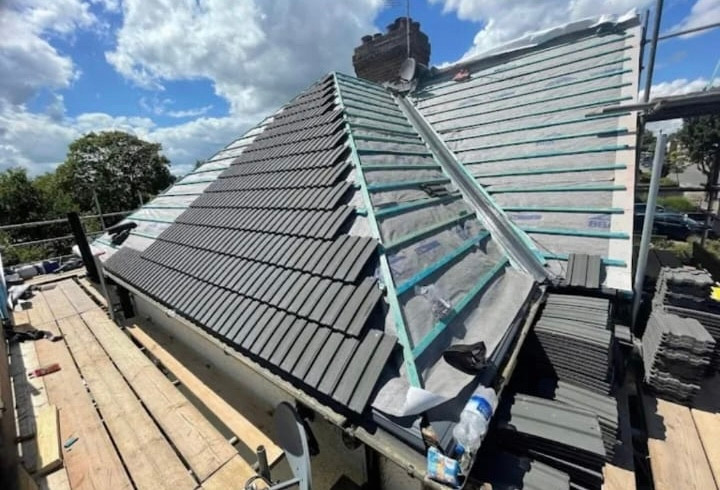
No rate per square metre, because a metre of fascia over a bay is not the same metre as one on a straight gable.
Getting to it. A detached house set back behind trees, a bungalow with a wide overhang, and an older cottage with a low eaves over a border are three different ways in. A bungalow run comes off a tower, a two or three storey gable wants a scaffold, and a run over a conservatory or a bay window means building the platform around it. The work at height rules are why the access is a priced line rather than something absorbed into a rate.
What is behind the boards. Rotten fascia is a symptom. The question is whether the rafter feet and the wall plate behind it are still sound, and nobody knows until the old board comes off. Capping over with plastic hides that instead of fixing it, which is why we take the old boards off rather than clad them.
The run, not the metre. A straight gable is quick. Bay windows, a conservatory in the way, a corner return, a run that has to be worked around a satellite dish or a service cable, and every outlet, hopper and downpipe are priced one at a time. So is putting the fall back: a gutter hung level looks fine and holds water all year.
Comparing quotes? Ask whether the old boards are coming off or being capped over, what happens if the rafter feet or the wall plate turn out to be rotten, whether the gutter, outlets and downpipes are all being renewed or only the fascia, and whether the scaffold is in the price. Two quotes for the same job are usually two different jobs.
If a section has come away
A gutter hanging off, or a fascia gone through
Ring rather than use the form. A length of gutter pulled off its brackets, a downpipe snapped at the bend or a fascia soft enough to put your hand through goes to the front of the queue, because the next heavy rain runs straight down the wall and into the brickwork. The first visit is about getting it supported and discharging somewhere sensible, and we price the run properly once we can see how far the rot goes. Cadnam and Bartley are a run up the road for us, so tell us when you ring if water is already getting at the brickwork and we will get there sooner. The phone is answered 24 hours for emergencies; scheduled work runs Monday to Friday, 8am to 6pm.
Worth knowing
Your planning authority is the National Park, not the district
This is the thing that catches people out. Cadnam and Bartley sit inside the New Forest National Park, so planning decisions are taken by the Park Authority rather than by the district council, and the Authority looks harder at how things appear from a lane or a green than an ordinary planning office would.
For a straight roofline replacement none of that engages. Taking rotten boards off and putting the same thing back in the same place is maintenance, and there is nothing to apply for. It engages when the look changes: a painted timber fascia going to bright white plastic on a frontage that is visible from the road, cast iron coming off and a modern square profile going up, or a deep traditional overhang being boxed in flush. None of that is automatically refused, and much of it is fine, but it is worth a phone call to the Authority before you commit rather than after the scaffold is up. The Authority sets out its approach in its heritage and conservation guidance. Our part is simple: we tell you honestly whether what you are asking for is a like for like renewal or a change of appearance, and we put both options on the quote so you can choose with your eyes open.
Who you are dealing with
A local firm you can check
We cover Cadnam, Bartley, Copythorne, Netley Marsh, Ashurst and the villages along the top of the Forest, broadly SO40, under the New Forest National Park Authority. You are dealing with Bournemouth Roofing & Building, the trading name of Bournemouth Roofing & Building Ltd, registered in England and Wales, company number 15471719, which you can look up in a minute. Thomas Hannen's business, and he is the one who comes out to price the job, not a salesman. A verified customer's 10 out of 10 on Checkatrade. The visit and the written quote are both free.
Questions
Cadnam and Bartley questions we get asked
Do I need permission to replace my fascias here?
Not for a like for like renewal. That is repair and maintenance, so there is no application and nothing for building control. Permission comes into it if the appearance changes noticeably from a public road, or if the building itself is listed.
Can I keep the timber look without keeping the maintenance?
Yes. A woodgrain foiled board reads as painted timber from the road and needs washing rather than repainting. It is usually the answer where somebody wants to lose the ladder work without the house looking plastic.
There is a bird nesting behind my soffit. Can you still do the work?
Not while the nest is active. We will make the area safe, leave it alone until the birds have finished, and book the renewal after that. Once the new boards are up the gap is closed with mesh so it cannot happen again.
How long will a full roofline take on a bungalow?
Often a day or two, because a single storey run can usually be worked from a tower rather than needing scaffold. A deep overhang, a conservatory in the way or several downpipes will push that out, and those show as separate lines on the quote.
Nearby, and next door
Fascias, soffits and guttering near Cadnam and Bartley
Fascias, soffits and guttering nearby
Our other trades in Cadnam and Bartley
Everything we do in Ringwood Fascias, soffits and guttering, all areas Every area we cover
Free quote
Get a price for your Cadnam roofline
Tell us the address and what you have noticed. We will get to the eaves, look behind the boards and put an itemised price in writing, free of charge.