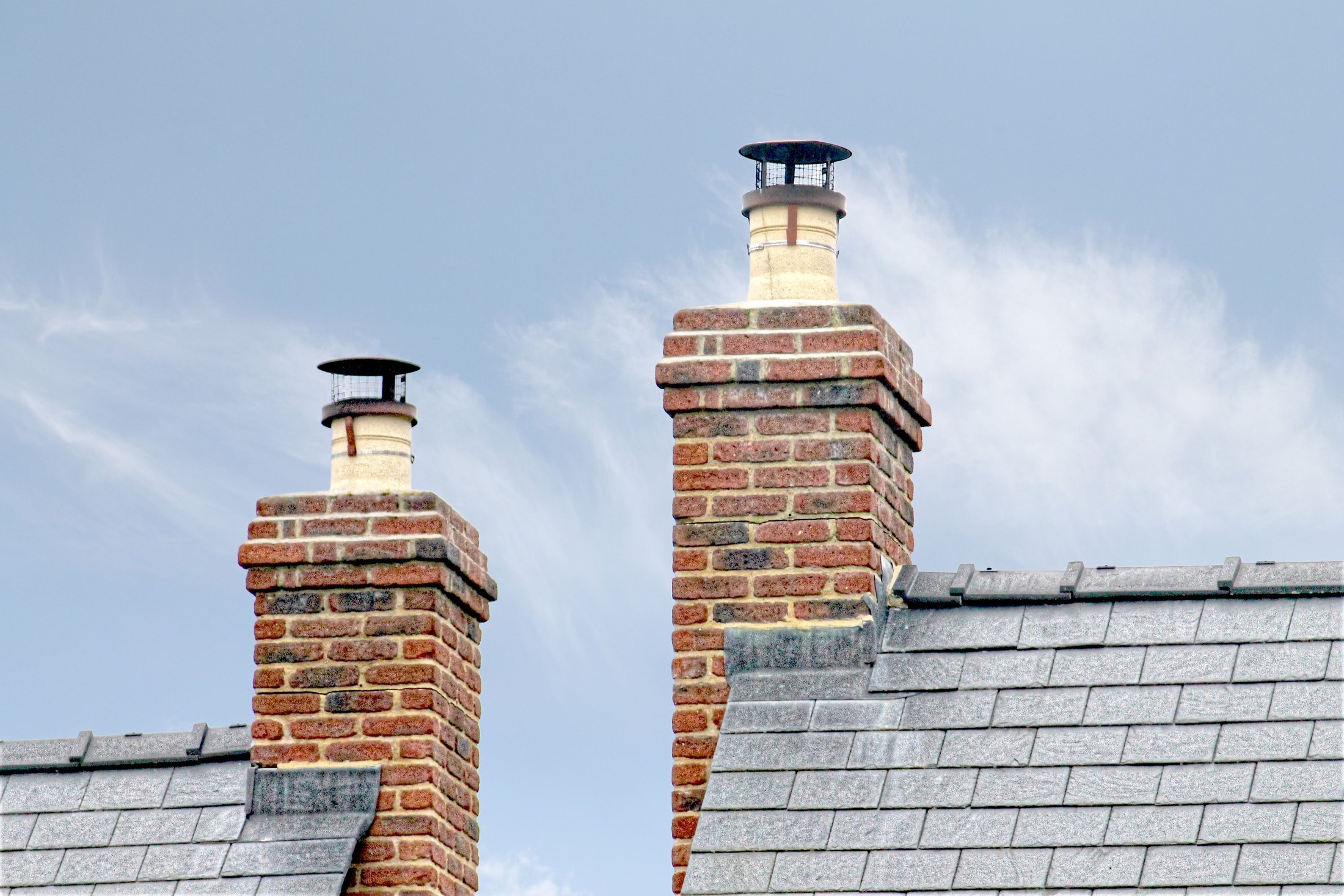
Roofing in Lymington
Repairs, dry ridge and verge, strip and re-cover, flat roofs, leadwork and gutter work across Lymington, Pennington and the SO41 streets.
The site visit is free and so is the written itemised quote. Thomas Hannen prices every job himself.
Close to open water the fixing gives out long before the covering does. Wind and salt work on the nail, the clip and the mortar bedding, so a Lymington roof is nearly always lost at its edges and hardly ever in the middle of a slope.
Three calls come out of Lymington more than any others. A south westerly has lifted a verge cap or a ridge tile and there is one on the path. A terrace has stained a bedroom ceiling beside a chimney or under a valley shared with next door. Or a house built in the 1980s has reached the age where the felt under perfectly good tiles has given up.
We survey the covering from the platform and the timbers from inside the loft, photograph what we find, and price it in writing. If a repair will hold we say so, and if it will not we show you why first. Site visit and written quote both free.
The work
Driven rain pushes water uphill under a lap
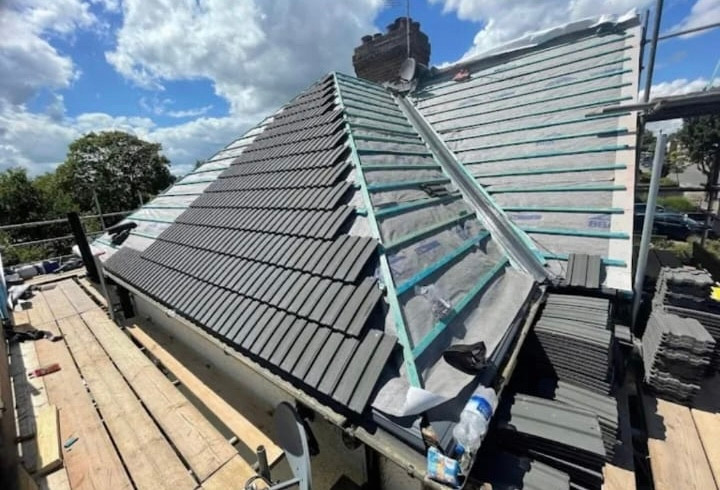
Ridge, hips and verges. The commonest job in town, because this is where an exposed roof lets go. The mortar bedding cracks, the tile begins to rock, and the next blow takes it. We strip the bedding and convert to a dry fix system, dry ridge and dry verge screwed down onto a vented roll, which is the mechanical fixing BS 5534 expects and which stops the detail that keeps failing from being rebuilt in the same material. It is measured by the metre of edge. Nearly half the housing went up between 1945 and 1982 and another quarter in the years after, so the bulk of the stock is concrete tile, most of it interlocking. The older properties in towards the quay carry plain tile, clay tile and natural slate on battens over felt with no sarking board behind them, and there is no stone slate anywhere in the New Forest.
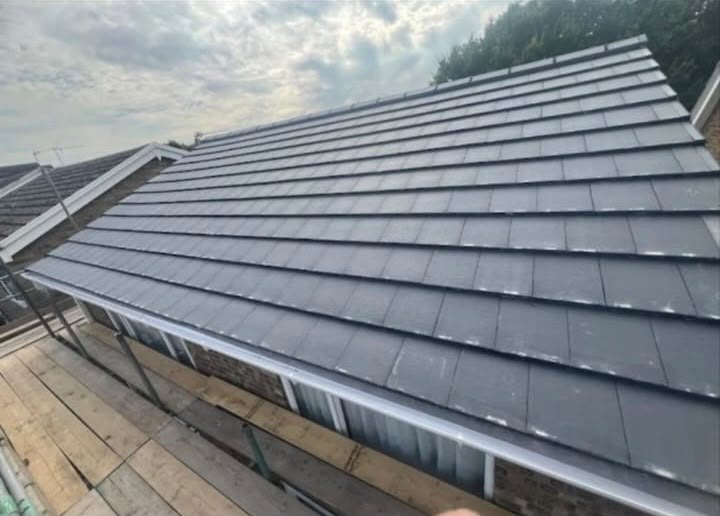
Fixings, which matter more here. A galvanised nail two streets from salt water does not last what it would last inland. We use stainless where the exposure calls for it, and on a windward slope we clip every tile rather than every third or fifth. It is a small line on a quote and the difference between a roof that holds and one you are calling us back to. When the nails have rusted through, the batten ends have softened and the underlay tears the moment it is touched, patching stops being worth paying for: the covering comes off, soft rafter feet and wet timber are replaced, and it goes back on breathable membrane and treated battens with a matched tile. Driven rain pushes water uphill, so a lap that would be fine in a sheltered village leaks here, which is why chimney flashings, soakers, valleys and the abutment where a rear extension meets the main roof go in code rated lead cut so it can move.
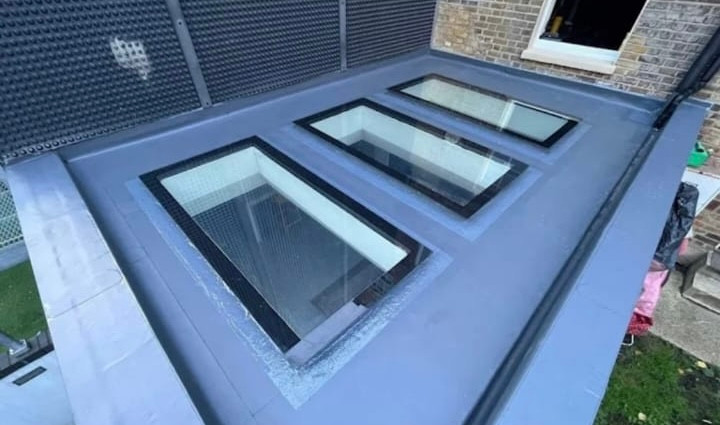
Rear extensions, garages, dormers and balconies in felt, GRP fibreglass or EPDM rubber. The deck gets looked at first, and because wind lifts a flat roof at its perimeter rather than its middle, the trim and the way the covering is turned and held down are worth more attention than the field of it. A fair share of the roof leaks we attend turn out to be rainwater goods rather than roof, and better than a fifth of the housing here is terraced, so a gutter run crosses more than one house: a blockage over your neighbour shows up in your ceiling, and the job needs both of you told before we start. Shaded slopes hold moss and algae and what washes off packs into the gutter below, so clearing it is ordinary maintenance. With the covering off, insulation and eaves ventilation are far cheaper to sort, and Approved Document L sets the standard a renovated roof is expected to reach.
How it runs
From your call to a written price
One team from first visit to last, and an itemised quote rather than a figure on the back of a card. On an unlisted house a like for like re-cover, a repair, new rainwater goods and rooflights sit inside ordinary householder permitted development, with no application and no building control sign-off, as long as nothing stands more than 150mm above the roof plane, and Planning Portal guidance sets out the limits. Lymington carries a hundred and sixty listed entries, almost all of them in the older streets, and a listed building needs consent whatever is going back on. Send us the address and we check it before anyone prices anything. New Forest District Council for planning and building control.
Cost
What decides the price of a roof
Access is the line that moves most in Lymington. An estate house has a drive and room for a scaffold. A terrace in the old streets has no side access at all, so material goes through the house or over the roof, and a platform standing on the pavement needs a licence from the highway authority. How long it stands matters as much as its size, and the work at height rules are why it is a line of its own rather than an optional extra. Ask whether the scaffold is in the quote, whether battens and membrane are renewed, and who takes the old tiles away.
If it is leaking now
Water coming in today
Ring rather than use the form. Anything letting water in goes to the front of the queue, and the first visit makes it watertight. Check the path for a ridge cap or a bedding tile, because the edge is where it starts. If a ceiling is bulging, pierce it into a bucket rather than let it drop in one. The phone is answered 24 hours for emergencies; scheduled work runs Monday to Friday, 8am to 6pm.
Worth knowing
The weather here arrives off the water
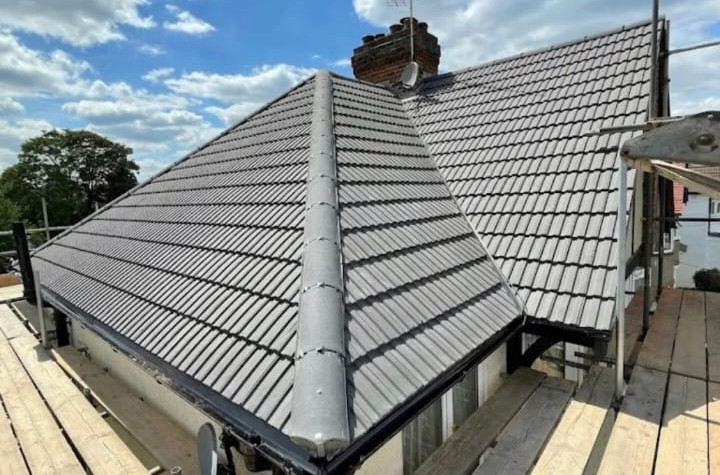
The most exposed elevation of a Lymington house faces south west, into open water and a long fetch, and there is nothing between the two. That single fact decides three things about your roof.
It goes at the edges. Wind does not peel a slope from the middle, it gets under a verge, a ridge or an eaves course and works from there, which is why edge work buys more here than the same money spent anywhere else on the roof.
It wants a fixing specification rather than a default, because BS 5534 sets fixings by exposure and a roof within reach of salt air is not the same job as one four miles inland. And driven rain travels uphill, so underlay laps, eaves detail and lead sizes want setting for the exposure they are actually in.
If a quote for a Lymington roof does not say what the tiles are fixed with, ask before you sign it.
Who you are dealing with
A local firm you can check
About fifteen miles from us, covering Lymington, Pennington, Boldre and the SO41 addresses down towards the quay, with New Forest District Council for planning and building control. Bournemouth Roofing & Building Ltd, registered in England and Wales, company number 15471719, which you can look up in a minute. Thomas Hannen's business, and he is the one who comes out to price the job, not a salesman. A verified customer's 10 out of 10 on Checkatrade. The visit and the written quote are both free.
Questions
Lymington questions we get asked
Lymington has many listed buildings. Does mine qualify?
There are 160 listed entries in Lymington, and listing attaches to the individual building rather than the street, so the only way to know is checking your address against the national list. We do that before quoting. If it is listed, consent has to be in place before a tile moves and the covering is agreed rather than chosen. If it is not, and there is no conservation area of its own over the town, putting the same thing back is maintenance.
My terrace has no side access. Where does the scaffold stand?
Out the front, and through the house for the back if there is genuinely no other way in. Terraces are 22.7 per cent of the housing in Lymington, so this comes up constantly and there is a normal answer to it. The front elevation is scaffolded off the pavement under a licence from the highway authority, and rear access is either through a neighbour's garden by agreement or by carrying components through with boards down. We settle which at the site visit.
Is a 1980s roof too new to be leaking?
It is not, and the culprit is normally the felt rather than the tiles. The 1980s are the biggest single slice of Lymington's stock at 17.1 per cent, with 26.1 per cent built between 1983 and 2008, and bitumen underlay from that period goes brittle where it is exposed at the eaves. Water then runs over the top of the fascia instead of into the gutter. Eaves trays and a re-bed at the ridge sort out most of it.
Does it matter where the rainwater goes once it leaves the roof?
It does on this ground. The subsoil under Lymington is cohesive with a significant shrink and swell rating, so it expands when wet and contracts as it dries, and putting a roof's worth of water into the same spot beside a wall each winter is a movement risk and not just a stain. Silted gullies, downpipes discharging onto a path and shared gutters between terraced properties are the usual causes. All three get checked.
A gale took one verge tile. Is the rest at risk?
The rest of that edge probably is. The exposed elevation here faces south west, and wind gets under a roof at the verge, lifts the first tile and then works its way along the run once the seal is broken. Losing one is a warning about the bedding along the whole gable rather than bad luck with a single tile. Dry verge units screwed down are the usual answer, and they can go on one gable without redoing the roof.
Nearby, and next door
Roofing near Lymington
Roofing nearby
Our other trades in Lymington
Roofing guides
Concrete vs clay roof tiles: which is right? Planning, building regs or listed building consent Storm damage to a roof: the first 24 hoursEverything we do in Lymington Roofing, all areas Every area we cover
Free quote
Get your Lymington roof priced in writing
A free site visit, a look in the loft as well as on the roof, and an itemised written quote that says what the tiles are fixed with.