Exterior cleaning in Lymington
Soft washing for painted render and masonry, roof cleaning, block paving and gutter clearing across Lymington and Pennington.
The site visit is free and so is the written itemised quote. Thomas Hannen prices every job himself.
Last updated
Exterior cleaning in Lymington starts with being clear about what you own. On a painted terrace or a converted house the wall, the gutter and the roof are often not all yours, and the first job is working out who is entitled to instruct the clean.
Once that is settled the work itself is straightforward. The typical candidates are painted render going grey and streaking under the sills, black growth on brick paved parking courts and paths, roofs greening on the shaded pitch, and rainwater goods that have stopped coping.
A lot of it is salt as much as dirt, because the water is close and the wind carries it inland. We do a free site visit, look at every surface you want done, and put a written price together with each one on its own line. If you are a leaseholder or you sit on a residents' committee, we will put it in a form you can send to someone else.
The work
What a property in the town usually needs doing
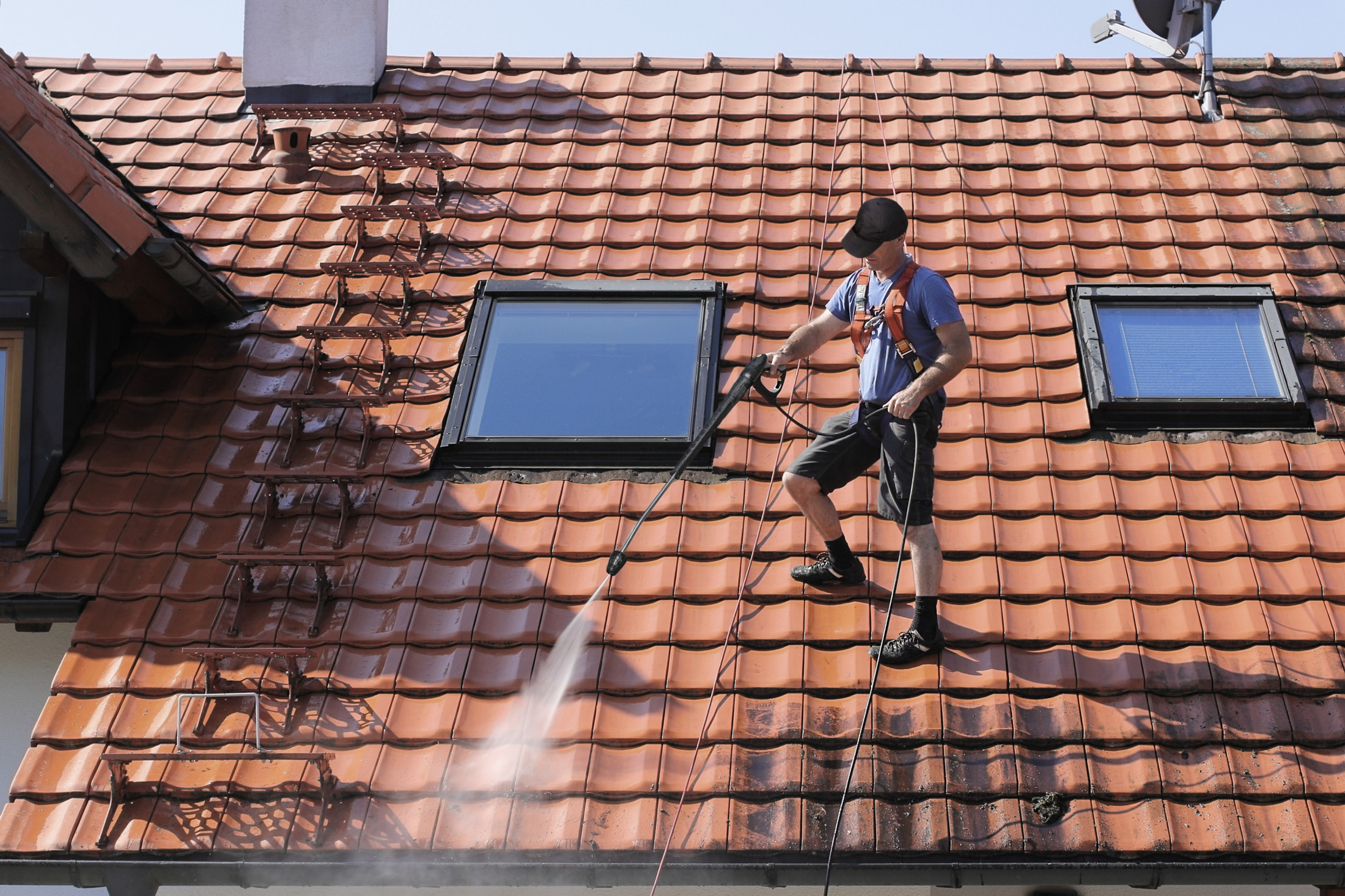
Painted render and masonry. A great deal of older Lymington is rendered and painted, and paint is the reason force is the wrong tool. A soft wash at low pressure with a treatment lifts the algae and the salt film without taking the paint with it, which is what a lance does in about four seconds.
Brickwork, stone plinths, pebbledash on the post-war houses and the render on the eighties estates all take the same low pressure approach. Where the surface is chalky to the touch, that is the paint itself breaking down and a clean will not fix it, so we will say so instead of washing it and handing you a bill.
Concrete interlocking and plain tile cover most of the housing, with slate on some of the older roofs. The moss comes out of the laps and off the ridge by hand, the valley and the gutter get cleared, and a biocide goes on afterwards to deal with the algae and lichen that a scrape cannot reach. No pressure washing on a roof, because it drives water under the laps and takes the surface off the tile. Close to a quarter of Lymington is terraced, and on a terrace we clean the full width of your roof rather than stopping at an invisible line, which is not always what a quote assumes.
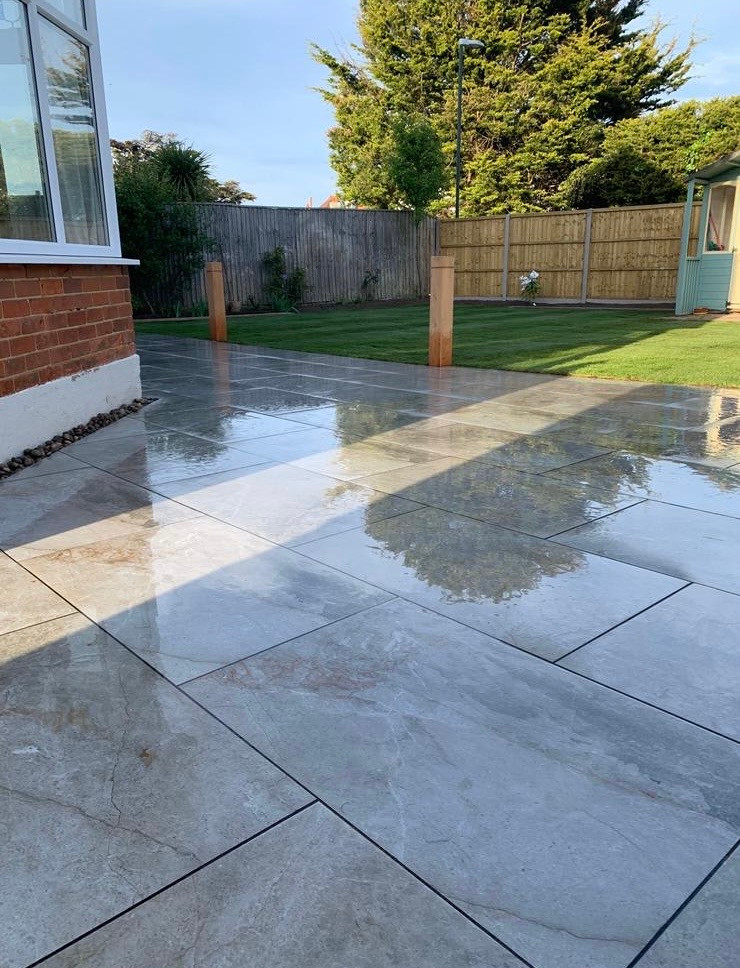
Block paving, brick paving, concrete and stone patios, and the shared parking courts behind a lot of the flats. Block paving is jet washed and then re-sanded, because leaving the joints empty is how the blocks start to move. Paths and steps near a front door are the ones to do first: green film on a wet flag is the most likely thing on the property to put somebody down.
Where the rainwater goods are cast iron, a slow leak behind a downpipe stains render for years before anybody notices, so have the gutters and hoppers checked before the render is washed.
Before any water runs. Planting is watered and sheeted, the gully and every open drain is covered, and vents, lights and alarm boxes are protected. Biocides are used at the dilution on the label and only on surfaces they are approved for, and nothing goes into a drain. That is what the biocides regime the HSE administers and pollution prevention guidance require, and it matters in Lymington because the surface water does not have far to travel. We would talk you out of washing painted render that has already failed, out of sealing a parking court you do not own, and out of cleaning half a shared elevation, which always looks worse than leaving all of it alone.
How it runs
Soft washing roofs, render and paths, surface by surface
Thomas comes out and looks at each surface you want cleaned, because the method depends on what it is. In Lymington that is often moss on the concrete tiles of a post-war semi or bungalow, green algae on a painted render frontage in the town centre, or a block paved drive on an eighties close.
Roofs and render are soft washed at low pressure with a biocide, while hard paving can take a pressure washer. The itemised quote says, for every surface, how it will be cleaned, what gets covered, how we reach it, and where the dirty water and residue end up.
Covering up comes first on every clean. Plants, windows, cars and doors are covered, and the run off is kept out of the road drains. Whatever moss comes off the roof goes into sacks and away with us, never into your gutters. At the end of each day the ground is rinsed and swept. If we find a cracked tile or blown render, we point it out with a photo and a price, and you decide whether to fix it.
Washing a building is maintenance and needs nothing from anybody. Abrasive cleaning, sealing a historic wall or painting a frontage a new colour is a different matter. Lymington's historic centre is a conservation area, and the town carries a hundred and sixty listed entries, so on those buildings consent can be needed first. Other permissions you may require is the place to start, and we tell you which your job is before it goes in the diary.
Cost
Moss, algae and access: how a clean is priced
No rate per square metre, because the same square metre can take minutes or hours depending on what is growing on it.
What is growing. Light algae on painted render washes off quickly, though the paint underneath may need checking. Thick moss on concrete tiles has to be scraped and bagged before any biocide goes on, and lichen on paving takes longer still. Biocides are regulated, and HSE's biocides guidance sets the rules on what can be used.
Where it is. A High Street frontage where the pavement is the only place to stand, a terraced cottage reached through a neighbour's garden, and a detached house on a Pennington estate with room all round are very different mornings. Ground level from a lance is one job, a roof slope is another, and the work at height rules decide which.
What happens afterwards. A rinse alone looks good for a while, then the green comes back within a season or two on a shaded north slope. A biocide treatment keeps growth back far longer, and a sealant on block paving is a further step.
When comparing, ask how each surface will be cleaned, whether a biocide goes on afterwards or it is only rinsed, and what happens to the run off.
If there is a date
Cleaning before a sale, a letting or a deadline
Cleaning is seldom urgent, but there is often a deadline: the house goes on the market, the letting agent inspects, or the scaffold is due down. Phone us with the date.
We will tell you straight whether it can be done properly in time, because a soft wash needs a dry spell and the biocide needs days to work. In a shared building, say who is instructing us. If a path has turned slippery and someone could fall, mention that and we deal with it first. Cleaning is booked Monday to Friday, 8am to 6pm, and if your call goes unanswered we ring you as soon as we can.
Worth knowing
On a terrace or a flat, the wall may not be yours to clean
Roughly a fifth of the homes in Lymington are terraced and about one in seven is a flat, so this comes up here more than in the villages. On a terrace the render and the paint usually run straight across the party line without a break, which means cleaning your share and stopping leaves a visible edge down the middle of somebody's wall.
It is worth a conversation with the neighbour first: two houses done together cost less each than two separate visits, and the result is the one you actually wanted. Rear elevations often cannot be reached at all without going through a neighbouring garden, and that permission is easier asked for a fortnight ahead than on the morning.
In a converted house or a block, the outside is normally the freeholder's and it is paid for out of the service charge, so a leaseholder booking a clean directly can end up paying twice. Find out who manages the building first. We will still come and look and put the work in writing so you have something to send them.
If you are on the residents' company, one thing to know early is that where work would cost any single leaseholder more than £250 the leaseholders have to be consulted formally under section 20 of the Landlord and Tenant Act 1985, which is a matter of weeks rather than days. Exterior cleaning on a small block often sits under that figure, but a whole building washed and treated may not, and it is better checked before the quote goes round than after.
Who you are dealing with
Who cleans roofs and frontages round the town
We travel 12.5 miles from our Boscombe base to reach Lymington. We cover Lymington and Pennington, out through Boldre and Walhampton and Portmore, across the SO41 postcodes, where New Forest District Council is the authority. The company is Bournemouth Roofing & Building Ltd, registered in England and Wales, company number 15471719. Before you book a visit in Lymington, you can read our customers' Google reviews, word for word, on our reviews page.
Thomas Hannen, who owns the firm, looks at each surface and prices the clean himself. One verified Checkatrade customer rated the work 10 out of 10. The site visit and the itemised written quote are both free.
Planning at a glance
Do you need planning permission in Lymington?
Most repairs in Lymington need no application at all. What decides whether a change to the outside of your house does is who the council is, whether a conservation area or a listing applies, and whether the place sits in a protected landscape.
| Question | In Lymington |
|---|---|
| Who decides | New Forest District Council is the planning authority for Lymington. The National Park boundary runs close by, and the Park's property map shows which side an address falls. |
| Conservation area | Yes: Lymington Conservation Area. Check whether your street is inside the boundary before changing anything visible. |
| Listed buildings | Yes, there are listed buildings in and around Lymington. If yours is one, work can need listed building consent. |
| Protected landscape | No National Park or National Landscape covers Lymington. |
Questions
Questions about exterior cleaning in Lymington
The town is full of listed frontages. Can they be washed?
Listed frontages can be washed, though not the way you would wash a modern render. Lymington has 160 listed entries, the parish church of St Thomas the Apostle and the older houses and their area railings among them, and on those the render, the joinery and the ironwork are all part of the listing. We work at low pressure, try it somewhere hidden, and keep water away from sash boxes and the base of the wall.
We are in a terrace with no side access. What then?
We carry, or we go round through a neighbour if they will have us. Terraced and semi detached houses make up just under half the stock in Lymington, 22.7% terraced and 25.1% semi, so this comes up constantly. The hose runs through on a mat, never across a bare carpet, and we agree it beforehand. Where nobody will let us through, the kit goes over the wall in sections.
Does the air off the water bring it back faster?
Salt does, rather than the water itself. At 4.1km from open water the air off the Solent leaves a fine salt film on render and paving, and salt holds damp on a surface long after the rain has stopped. A wall that is permanently a little damp grows algae faster than a dry one. So we rinse thoroughly and lean on a biocide here instead of trusting the wash to be the whole job.
When is the best time of year for the render?
Late spring or early autumn, when there are dry days either side and no frost in the forecast. A biocide put on a wall that is about to be rained on for a week runs off before it has worked. Gutters are the exception. With woodland close to Lymington there is no sense clearing them before the leaf has finished, so they go later in the year than the walls do.
The render greened again a year after the last wash. Why?
Usually because the wash had no treatment behind it, or because water is still reaching the wall. On the post-war stock here, and 48.8% of Lymington was built between 1945 and 1982, the plastic gutters are often original and the rubbers in the union clips have hardened, so a joint drips down the same stripe every time it rains. Get that seal looked at, then soft wash and treat the wall, and the green takes far longer to return.
Nearby, and next door
Exterior cleaning near Lymington
Nearby places we also cover for exterior cleaning, with straight-line distances from Lymington, and the other trades we offer in Lymington itself.
Exterior cleaning nearby
Our other trades in Lymington
Exterior cleaning guides
Soft washing vs pressure washing: safe for a roof? How to clean a patio without damaging it Moss on a roof: does it need removing?Builders in Lymington: all our building work Everything we do in Lymington Exterior cleaning, all areas Every area we cover
Free quote
Get a price for cleaning in Lymington
Tell us what needs doing and who owns it, and we will come and look properly.