Exterior cleaning in Walhampton and Portmore
Roof moss, green render, packed gutters and slippery paving, cleaned by the method each surface will take. Free site visit, free written itemised quote.
The site visit is free and so is the written itemised quote. Thomas Hannen prices every job himself.
Almost nothing that needs cleaning around Walhampton and Portmore is dirt. It is moss, algae and lichen growing on surfaces that never dry out under the trees, and it comes off with a low pressure soft wash and a biocide rather than with force. The pressure washer stays on the ground, and even there it does not go on everything.
People here ring about one of three things. A roof that has gone dark and started dropping moss into the gutters and down the path. One elevation that looks green and streaked while the wall facing the other way still looks fine. Or paving that has turned slippery enough that somebody has nearly gone over on it.
What we do about it is set by the surface, and that is the whole job. We survey the whole building first, work out what is growing and what it is growing on, then pick the method for the weakest thing on the building rather than the toughest.
Plain clay tile, painted render and soft old brickwork get treated, rinsed gently and left to die back over the following weeks. Block paving and concrete will take real pressure and are quicker for it. You get an itemised written price before anything is switched on, and a straight answer about how much of it comes back next winter.
The work
The work, under all those trees
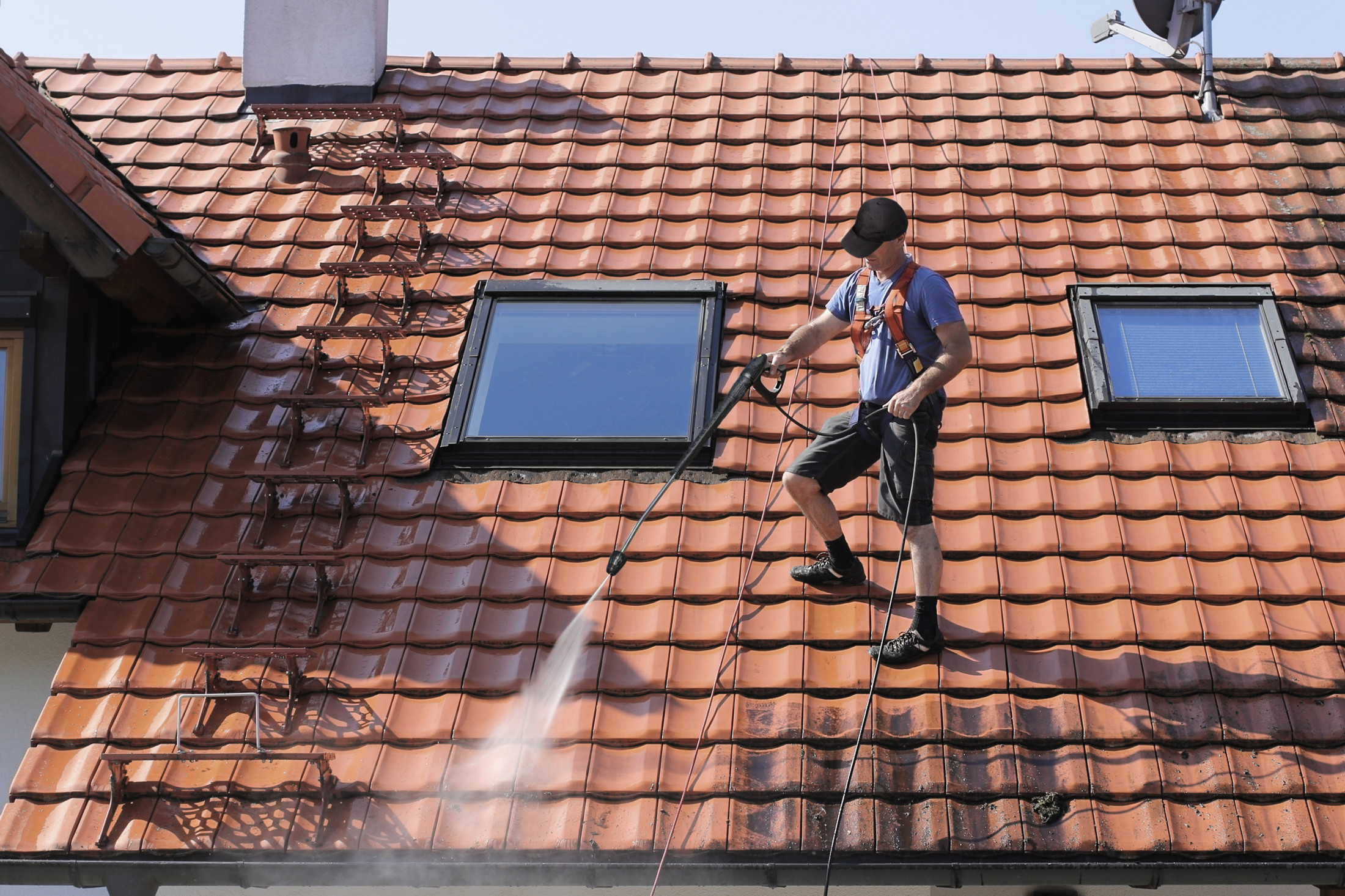
Roofs under a canopy. Over a quarter of the housing here predates 1919 and the largest single band is pre-1900, so the older cottages around Walhampton and the lanes down towards Portmore carry plain clay tile and natural slate, with concrete interlocking tile on the newer houses. All three go the same way under oak and beech: moss establishes in the laps, holds water against the tile and slowly lifts it. The bulk comes off dry, scraped from the gutter line upwards so the laps clear rather than pack, then a soft wash at low pressure and a biocide left on to finish the spores. What we will not do is put a lance on clay or slate. It takes the fired face off and washes the mortar out from under the ridge, and then you are paying for roof repairs to save a day on a clean.
Leaf fall is the standing problem. A gutter under mature trees packs with mulch, the outlet blocks, and the water goes over the back edge into the fascia instead of down the downpipe. A valley between two slopes does the same and hides it better. Clearing is by hand and by vacuum, every downpipe flushed through to prove it runs, and what comes out is bagged rather than washed into a gully. Twice a year is not fussy under this much tree cover. Nearly a third of the dwellings here are flats, and on those the roof and the gutters belong to the freeholder and come out of the service charge, so it is worth settling who can instruct the work before anyone quotes.
There is painted render and limewashed brick on the estate cottages, pebbledash on some of the post-war houses, and bare brickwork of an age that will not take pressure. All of it greens on the shaded side and all of it gets a soft wash: the treatment through a low pressure nozzle, time to work, then a gentle rinse. Force strips paint in stripes you can see from the road and takes mortar straight out of an old joint, so on anything lime bedded we test a patch round the back first.
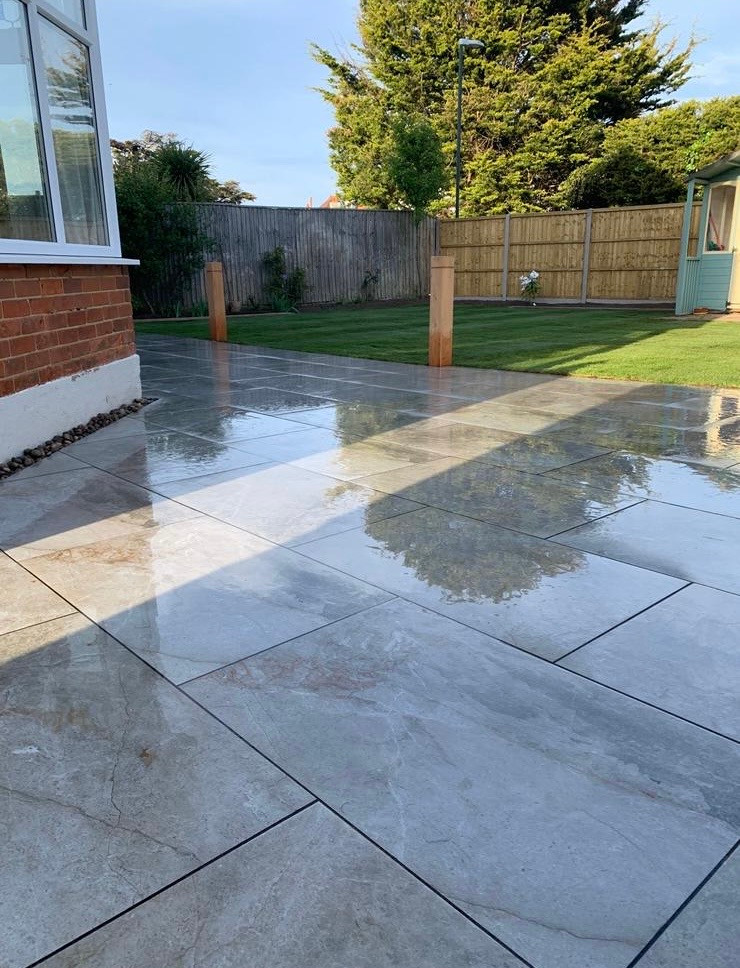
More gravel and shingle here than anything else, with block paving on the newer closes and brick paviours at the older properties. Block paving gets controlled pressure with a rotary head and then re-sanding with kiln dried sand, because paving left with empty joints goes loose and weedy inside a season. Stone and old flags get less pressure and more chemistry, and black spot lichen honestly takes two goes. Beds are watered down and sheeted, drains and gullies covered, and where the run off goes is agreed before we start. Products are used at the rate on the label and only where they are approved for that surface, which is what the biocides regime the HSE administers expects, and pollution prevention guidance is the reason nothing finds its way into a watercourse.
How it runs
From your call to a written price
One team, one person to ring, and an itemised quote with method, access, protection and the run off on separate lines. Washing a roof or a wall is maintenance rather than development, so there is nothing to apply for. What matters here is that this is inside the New Forest National Park and the Forest South East conservation area, where appearance is controlled: cleaning a surface is fine, painting brick that was never painted is a change. There are 93 listed entries in the immediate area, Walhampton House among them, and abrasive cleaning of a listed building can need consent, so we ask the National Park Authority first. National Park heritage and conservation guidance sets out where the line falls.
Cost
What decides the price of a clean
No rate per square metre, because the same square metre can be twenty minutes or two. Access decides most of it: an estate cottage with low eaves you can reach off a pole, a converted block three storeys up with communal gutters, and a house set well back behind its own mature planting are three different jobs. Poles do a lot, some of it wants a tower, and work at height rules decide which. Ask each quote which method goes on each surface, whether a second visit is included, and where the water goes.
If there is a date
A viewing, a visit or a deadline
Ring rather than use the form. Not emergency work, but usually work with a date on it. Walhampton and Portmore are a little under half an hour from us, and on a house going to market we would rather treat early and come back for the rinse than blast it the day before the photographer. The phone is answered 24 hours for emergencies; scheduled work runs Monday to Friday, 8am to 6pm.
Worth knowing
If you live in a flat, the outside is not yours to book
A good share of the homes around here are flats and maisonettes rather than houses, many of them conversions of older buildings, and the outside of a flat almost never belongs to the person living in it. The roof, the gutters, the render and usually the paths and the parking are the freeholder's, and they are maintained out of the service charge.
So if your bedroom ceiling sits under a mossy slope, or the communal downpipe is running down the front of the building, the first call is to the managing agent rather than to us. We are happy to be the quote they put in front of the leaseholders, and we will write it in the form an agent needs, surface by surface.
The reason to start that conversation early is the consultation. Where a freeholder intends to charge leaseholders more than a threshold set in law for one piece of work, section 20 of the Landlord and Tenant Act 1985 makes them consult formally first: notices go out, there is a period for observations, and estimates have to be obtained.
That is weeks rather than days, and all of it happens before a date is booked. If you want the block looking right by the summer, the conversation belongs in the winter. Where you own the freehold outright, or your flat is one of two in a converted house and the pair of you own it between you, none of that applies and you can simply ask us to come and look.
Who you are dealing with
A local firm you can check
We cover Walhampton, Portmore and the SO41 villages either side of the Lymington River, out to Boldre, Pilley and East End, and the New Forest National Park Authority is the planning authority for this address. Bournemouth Roofing & Building Ltd, registered in England and Wales, company number 15471719, which you can look up in a minute. Thomas Hannen's business, and he is the one who comes out to price the job, not a salesman. A verified customer's 10 out of 10 on Checkatrade. The visit and the written quote are both free.
Questions
Walhampton and Portmore questions we get asked
We rent a flat here. Can I book the outside cleaned?
Usually not on your own. Flats and maisonettes are 31.5% of the dwellings around Walhampton and Portmore, and the outside of a flat, roof and walls alike, belongs to the freeholder and is paid for out of the service charge. Ask the managing agent first. We are glad to price it for them and send the written quote to whoever holds the freehold, so nobody in the building is guessing at what is being done.
Does the National Park have a say in washing a house?
Cleaning is maintenance, so no consent is needed for the wash itself. What the New Forest National Park controls is appearance, and this village sits in the Forest South East conservation area, so like for like stays maintenance while a change of covering or material does not. If a wash leaves you wanting to paint the render or swap a slate, that is the point to ask them before anything goes on the wall.
The cottage walls are old and soft. Will washing harm them?
It can, if it is jetted. More than a quarter of the stock here predates 1919, at 26.9%, which means solid walls in lime that have to breathe and a face that comes away under pressure. Those we wash by hand at low pressure with a biocide, then let the treatment do the work over the following weeks. Cement patching and modern paint on a lime wall are the other things we look for while we are up there.
Which elevation gets done first on a house facing the water?
The south west one, because that is the face the weather comes at around Walhampton and Portmore. Rain carried on the wind gets into the openings and the corners long before it touches the middle of a wall, so staining starts under the sills and around the frames. We begin there while the day is still dry, since that side needs the longest dwell for the treatment. The sheltered elevations are usually a rinse afterwards.
Where do you park a van on the lanes down there?
On the verge where there is one, and off the lane entirely where there is not. The approach to Portmore is narrow and these are not verges to leave a van sitting on, so we bring the smaller vehicle and run hose from a tank rather than block the road. Where a drive is gravel we lay boards. Tell us at the visit if a gate or a cattle grid limits what will get in.
Nearby, and next door
Exterior cleaning near Walhampton and Portmore
Exterior cleaning nearby
Our other trades in Walhampton and Portmore
Everything we do in Lymington Exterior cleaning, all areas Every area we cover
Free quote
Get a price for exterior cleaning in Walhampton
Tell us the address and what has gone green. We come out, look at every surface and put an itemised price in writing. No charge for either.