Rendering in Walhampton and Portmore
Inside the National Park boundary, where a change of external finish is the Authority's decision rather than the district council's.
The site visit is free and so is the written itemised quote. Thomas Hannen prices every job himself.
Last updated
Rendering in Walhampton and Portmore is repair and re-render inside the New Forest National Park: cracked or hollow render tapped out and patched, or an elevation re-rendered in lime, silicone or monocouche. A change of external finish is the Park Authority's decision, not the district council's, and an application sent to the wrong office loses weeks. Walls inside are covered by our Walhampton plastering page.
The work itself in Walhampton and Portmore is ordinary enough. A blown patch that sounds hollow under a knuckle, a crack tracking down from a window head, dash flaking off a weather elevation, or a wall that greens over every winter under the trees and never really dries.
We come out to Walhampton and Portmore, tap the whole elevation, not just the bit you have noticed, and tell you whether it is a patch, an overlay or a wall that has to come back to the background. Then it goes in writing, line by line, with the access and the beadwork priced separately so you can compare it with anyone else's. The site visit and the written itemised quote are both free.
The work
Systems we fit, and the walls they belong on
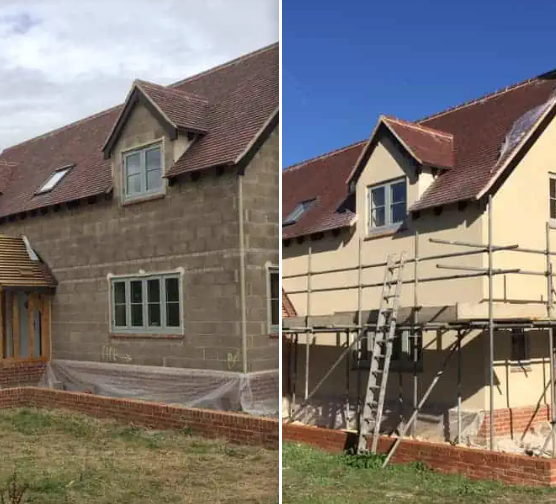
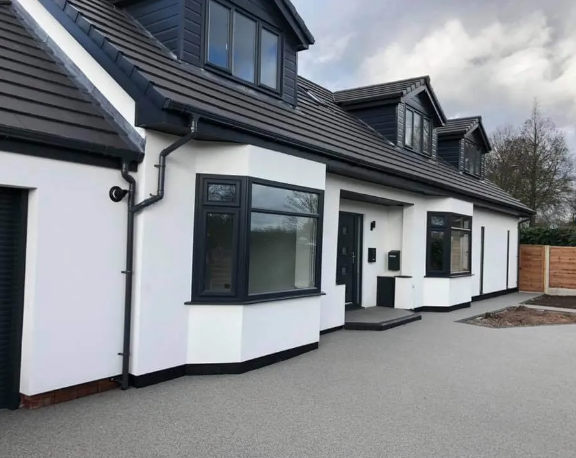
Silicone thin coat starts with primer, a polymer basecoat with glass fibre mesh bedded into it, then a through-coloured silicone topcoat floated to a scraped texture. Slightly flexible, self cleaning in rain, and the usual answer on newer blockwork and on the flats and converted buildings around Walhampton and Portmore. Beads and stop ends at every opening and a bellcast at the base.
Monocouche. A single through-coloured coat laid on thick and scraped back the next day. Fast on a plain elevation, hard wearing, and fussy about background and weather. It is not the system for a wall that is a patchwork of previous repairs.
Sand and cement, pebbledash and Tyrolean. Scratch coat, float coat, then a smooth finish, a dry dash thrown while the coat is green, or a Tyrolean flicked on. Matching an existing dash is aggregate size and colour, so we mix and hang a sample panel before the main wall.
Lime on the older fabric. A pre-1919 solid wall in Walhampton and Portmore has no cavity and dries out through its own face. It wants a soft breathable coat, which means lime in two or three coats, hair gauged in the base. On the older cottages a cement coat is the single most common cause of damp appearing inside a house that was dry for two hundred years.
Hacking off blown render. Blown means parted from its background. We tap the Walhampton and Portmore elevation and mark the hollow areas, because the extent of them decides whether panels get cut out or the wall is stripped. It is the part nobody can price from a photograph.
Cracks, delamination, algae and staining. Crazing is shrinkage and cosmetic. An open crack is movement or a failed bead and needs cutting out and reinforcing. Green and black staining on a shaded elevation is algae, and it comes off with a soft wash, never a lance.
Render over external wall insulation. Insulation board fixed as a render carrier, then mesh, basecoat and topcoat over the top. It changes the thermal performance of the wall and it changes the look of the building, so in the Park it is a design question as well as a technical one. Approved Document L sets what a renovated wall is expected to reach.
How it runs
Re-rendering a period house or a converted block
Thomas comes out and sounds the whole elevation to find what is sound and what has blown, then writes the quote himself. It covers scaffold, protection, preparing the wall, the render system coat by coat, beads and stop ends, and making good, each on its own line. Thomas is your one contact from first sheet to last coat.
Older solid walls in Walhampton and Portmore need a breathable lime render or similar, not a dense sand and cement that locks water in. On converted houses and blocks the scaffold normally stands in shared parking, and the freeholder must sign off the work. Windows, paths and planting are covered, the scaffold boards are cleared each evening, and old render leaves with us. If hacking off exposes crumbling brick or a failed lintel, you get pictures of it and the cost of the repair, and it waits for your yes.
Renewing a Walhampton and Portmore render finish like for like is maintenance and needs no application. Changing its material or colour on a wall seen from a road alters appearance, and that is a matter for the National Park Authority, not the district. Walhampton lies in the Forest South East Conservation Area; for a Portmore address it is worth asking them, and the Park publishes what is designated and what it means. We check the address before quoting.
Cost
What decides the cost of new render on your walls
Area is the simple part. What is on the wall already decides the price, so we use no rate. Access. A coach house conversion down a private drive, a two storey house facing the Lymington road and a flat in a shared building each need their own scaffold and their own permissions. The platform stays up for the whole system rather than a day, and the work at height rules put it on a separate line.
What is coming off. Rendering over sound brick is one job. Stripping blown sand and cement, or pebbledash that has lost its grip, is another, and none of it shows from the road. We sound every elevation before pricing.
Choosing the system. Silicone thin coat, monocouche and traditional sand and cement all cost different amounts. On older solid walls a breathable lime render is usually right, because a plastic-rich finish holds moisture in and drives damp indoors.
The weather side. South west walls facing the Solent take the most rain, so beads, a bellcast over the damp course and drips over openings matter most there.
Ask other renderers what system they propose, whether the old render comes off or is covered over, which beads, bellcast and stop ends are included, and how sills and pipework will be dealt with.
If it has started to come away
Render cracking, bulging or falling away
Call; do not use the form. Render that rings hollow when you tap it, or a crack that is visibly opening up, lets water behind, and frost then levers it off. If a piece has dropped near a path or an entrance, keep people back.
We make the loose area of a Walhampton and Portmore wall safe, sheet it if the weather is poor, and price the elevation once we can see how far the damage runs. Exposed brick wants covering before the next wet week. Rendering is booked Monday to Friday, 8am to 6pm. If the call is not picked up, we return it as soon as we can.
Worth knowing
The National Park is the planning authority here, not the district
The planning boundary is what trips people up in Walhampton and Portmore, and it costs weeks, not pounds. For most of the coast the district council handles planning. Inside the National Park boundary the Authority takes that role itself, and the boundary runs close to the built-up edge of Lymington, so two houses a few hundred metres apart can answer to different offices.
If you send a form to the wrong one it does not get forwarded quietly; it comes back, and the render job waits.
About a dozen listed entries lie within 1 km, mostly Walhampton House, now Walhampton School, and its garden structures, so most homes are not listed. What most people are dealing with is the conservation area, and there the test is appearance. Renewing an existing render in the same finish and colour is repair. Rendering a brick or stone elevation that has never been rendered, or going from a muted colour to a bright one on a road frontage, is a change worth asking about first. Ring us with the postcode and we will tell you which side of the line you are on before you pay anybody for drawings.
Who you are dealing with
Rendering around Pilley and east of Lymington
We render houses in Walhampton, Portmore, Pilley, Boldre and the lanes east of Lymington, 13.7 miles from Boscombe, where planning is decided by the New Forest National Park Authority. Your contract would be with Bournemouth Roofing & Building Ltd.
It is registered in England and Wales, company number 15471719, and owned by Thomas Hannen, who comes to sound the walls and price the render himself. A verified customer has left us a 10 out of 10 on Checkatrade. The site visit costs nothing, and the itemised written quote is free too. Before you book a visit in Walhampton and Portmore, you can read our customers' Google reviews, word for word, on our reviews page.
Planning at a glance
Do you need planning permission in Walhampton and Portmore?
Most repairs in Walhampton and Portmore need no application at all. What decides whether a change to the outside of your house does is who the council is, whether a conservation area or a listing applies, and whether the place sits in a protected landscape.
| Question | In Walhampton and Portmore |
|---|---|
| Who decides | New Forest National Park Authority is the planning authority for Walhampton and Portmore. New Forest National Park Authority's heritage pages set out what it controls. |
| Conservation area | Yes: Forest South East Conservation Area. Check whether your street is inside the boundary before changing anything visible. |
| Listed buildings | Yes, there are listed buildings in and around Walhampton and Portmore. If yours is one, work can need listed building consent. |
| Protected landscape | Inside the New Forest National Park, where design is looked at more closely and permitted development rights are narrower. |
Questions
Questions about rendering in Walhampton and Portmore
Do I apply to the district council or the National Park?
The Park, if your address is inside the National Park boundary, and here almost all of them are. The Authority is the planning authority in its own right, not an extra layer on top of the district. Sending it to the wrong office does not get it forwarded, it gets it returned, so it is worth checking the address first.
We only want the same render in the same colour. Is that an application?
No, renewing an existing finish like for like is maintenance and needs nothing from anybody. What changes that is a change of material, a change of texture, or a noticeably different colour on an elevation the public can see. If you are unsure, send us the postcode and a photograph and we will tell you where it sits.
Our building is split into flats. Who instructs external render?
The freeholder or the managing agent, almost always. External walls are usually retained by the freeholder, not demised with the flat, so a leaseholder cannot order the work on them. We are happy to quote for an agent or a residents group, and to send the same written quote to more than one person so nobody is guessing.
How long does the render itself need before it is finished?
Longer than the trowel work suggests. The basecoat has to cure before the topcoat goes on, and cold or wet weather stretches that. A lime job is slower again, and it should not be rushed with heaters. We put the sequence and the likely waiting days in the quote rather than leaving you to find out.
Nearby, and next door
Rendering near Walhampton and Portmore
Nearby places we also cover for rendering, with straight-line distances from Walhampton and Portmore, and the other trades we offer in Walhampton and Portmore itself.
Rendering nearby
Our other trades in Walhampton and Portmore
Rendering guides
Silicone, cement or lime: which render? Cracked render: which cracks matter Listed building consent for repointing and re-renderingEverything we do in Lymington Rendering, all areas Every area we cover
Free quote
Know which office to ask before you start
Thomas taps the elevation, works out the right system for the wall and tells you what needs asking first. The visit and the written quote are free.