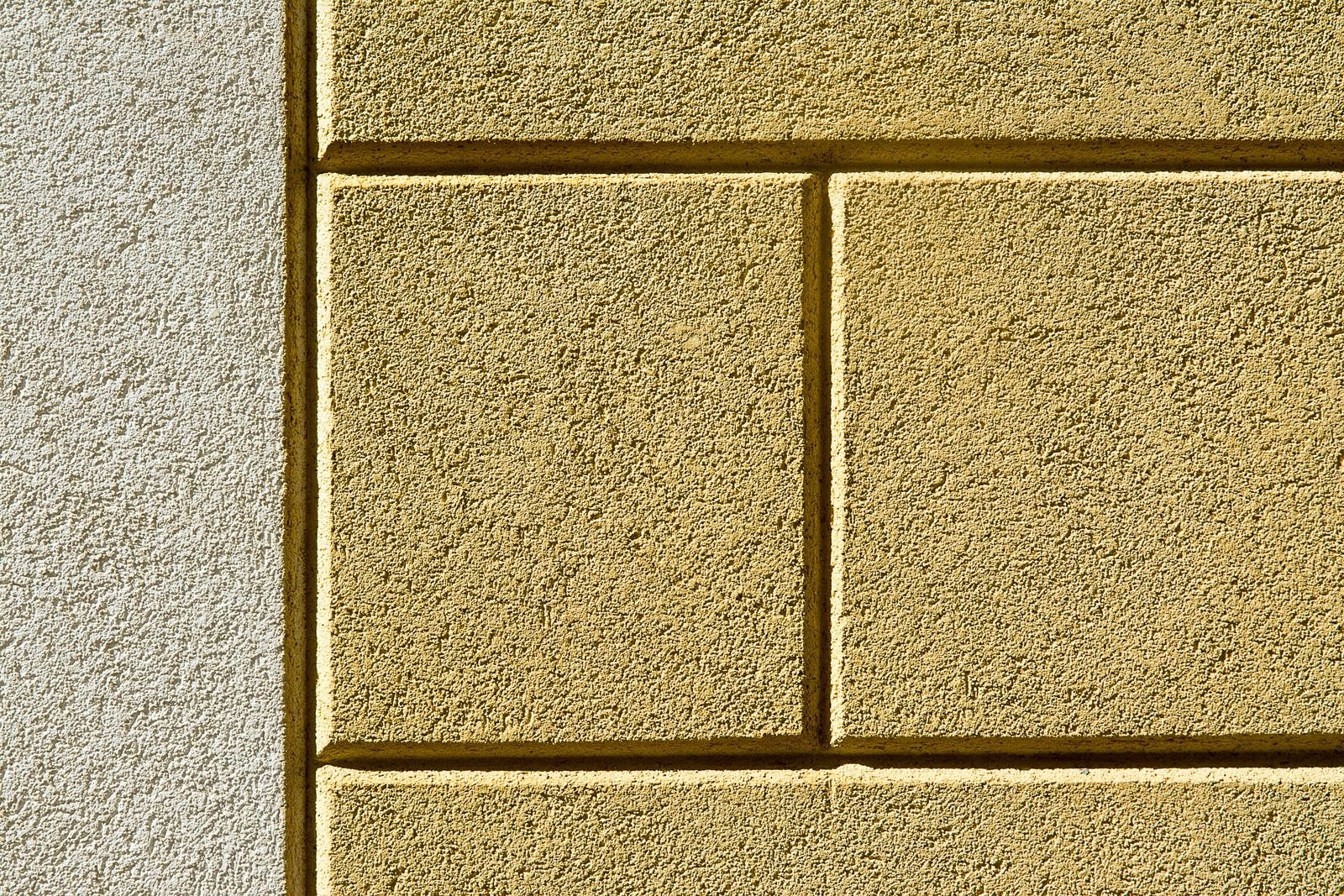
Rendering in Boldre, forty year old finishes
Much of the render around here dates from the 1980s and 1990s, which is about the age at which a dash or a painted cement finish stops being tired and becomes a job.
The site visit is free and so is the written itemised quote. Thomas Hannen prices every job himself.
Four homes in ten around here went up between the early 1980s and the late 2000s, which means a large share of the render we look at is now thirty or forty years old. That is roughly when a dash or a painted cement finish stops being tired and starts being a job.
The symptoms arrive in order. The colour goes flat and patchy. The topcoat starts chalking and comes off on your hand. Stones begin dropping off a dry dash, or fine crazing appears across a panel. Last comes the hollow note when you tap it, and by then water is already getting behind the render.
The question then is whether the wall can carry a new finish over what is there, or whether the old render comes off first. It is the biggest decision on the quote and it is settled by tapping, not by looking. We sound every elevation, tell you what we find, and itemise the access, preparation, system, beads and making good. The visit and the written quote are free.
The work
Overcoat or strip, and how we decide
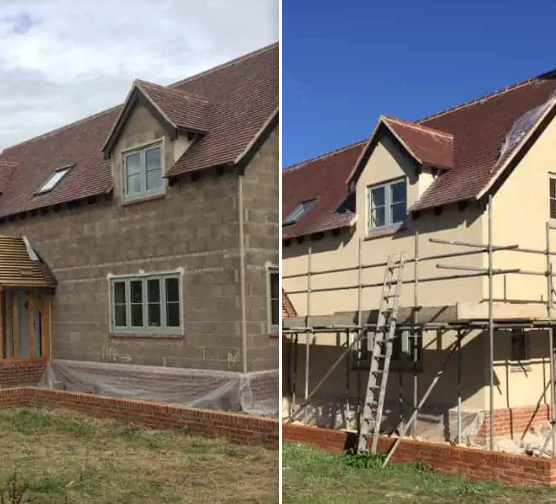
Tapping the whole elevation. Render still bonded to the background rings hard. Render that has blown sounds hollow and drummy. We work across the wall in a grid rather than testing one spot, and chalk the edges of the hollow areas so you can see how much of the elevation is actually loose.
Overcoating a sound background. Where the existing render is firmly stuck across the whole wall, it can be prepared, cleaned down and used as the background for a new system. That saves the mess and cost of a strip out, and it is a legitimate answer provided the tapping supports it.
Hacking off. Where the render has parted from the wall there is nothing to bond to, and anything put over the top goes when it goes. Blown areas come off back to sound masonry, open joints are repointed, the background is stabilised where it is dusty, then a mesh reinforced basecoat and a finish go on in coats.
Dry dash that is shedding. The commonest 1980s failure. The topcoat has lost its grip on the coat below and the aggregate starts arriving on the drive. Small areas can be cut out and rethrown, matched to a sample panel where the stone can still be got. A whole elevation that is going is better taken off in one go.
Crazing and chalking. Fine crazing across a panel is shrinkage in an old cement render and is not urgent on its own. A topcoat that comes off on your hand has chalked, and washing will not improve it. That wall needs a recoat rather than a clean.
Silicone thin coat. The usual replacement here. A stabilising primer where needed, a mesh reinforced basecoat that bridges old hairline cracking, then a through coloured silicone topcoat that sheds rain, washes down and never needs painting again.
Monocouche. One thick through coloured coat, ruled and scraped back to an even texture. Hard wearing on a plain elevation, needs a stable background, and the day joints get planned before the first mix so no seam lands mid wall.
Beads, bellcast and stop ends. Bellcast at the base above the damp proof course, stop beads at reveals and eaves, angle beads on corners, and a movement joint where an elevation is long or two structures meet. Old beads that have rusted through get cut out rather than covered.
Older and solid walls. A small number of houses here predate 1919. Those are solid walls, built breathable so moisture soaks in and dries back out through the face, and a plastic rich modern system leaves it trapped. Those get lime, which stays open and moves with the period fabric.
External wall insulation. Board fixed outside and rendered over, on a render carrier where the background will not take a direct fix. If an elevation is coming off anyway that is the moment to consider it, because the access is already paid for and the thermal gain is permanent.
How it runs
From your call to a written price
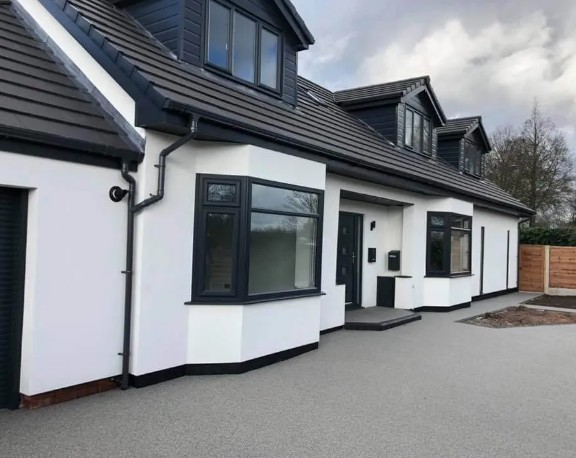
Same team from first visit to last, one person to ring, and no sub-contracting your work out to somebody you have never met. The quote is itemised, not a figure on the back of a card: access and scaffold, protection, preparation of the existing wall, the system and number of coats, beads and stop ends, and making good on separate lines, so you can compare it properly against anyone else's.
Nothing is left open or unusable overnight. The site is swept at the end of each day rather than the end of the job, and what comes out leaves with us. If something turns up once we start that nobody could have seen, you get a photograph and a price before we carry on.
Planning here goes to the New Forest National Park Authority rather than the district council, and while there is no conservation area covering the village, design is looked at more closely inside a national park than outside one. The Park publishes an interactive property map so you can see what applies to your address. There are 11 listed entries nearby. Building control engages once a whole elevation is renewed, because Approved Document L asks for the thermal element to be improved at that point.
Cost
What decides the price of a rendering job
No rate per square metre, because the square metres are the easy part; what is already on the wall decides the price.
Getting to it. A terraced house with a shared side path, a semi with a garage in the way of the gable, and a detached house with open ground round it are three different platforms before any material is ordered. A bungalow gable comes off a tower, a three storey elevation wants a scaffold, and the platform has to stand for the whole system rather than a day. The work at height rules are why it is a priced line rather than something folded into a rate.
What is already on the wall. Rendering over sound brick is one job. Hacking off blown sand and cement, or a pebbledash that has parted from the background, is another, and it is the part nobody can see from the road. We tap the whole elevation before quoting, because the hollow areas set the hours.
The system, and what the wall behind it needs. Silicone thin coat over insulation, monocouche through-coloured, or traditional sand and cement all price differently and behave differently. On a solid wall that has to breathe, a plastic-rich modern system traps moisture and moves the problem inside, so the right system is a wall decision rather than a colour decision.
Comparing quotes? Ask which system is being quoted and how many coats, whether the old render is being hacked off or overlaid, whether beads, bellcast and stop ends are included, whether the scaffold is in the price, and what happens to the existing sills and pipework. Two quotes for the same job are usually two different jobs.
If it has started to come away
Render that has blown or cracked open
Ring rather than use the form. A section that sounds hollow when you tap it, or a crack you can get a coin into, is letting water behind the render and the frost does the rest. We make the loose area safe, sheet it if the weather is against us, and price the elevation once we can see how far the blown area actually goes. Dash that has started dropping stones goes quickly once frost gets behind it, so a wall shedding onto a drive is worth looking at before the winter rather than after. The phone is answered 24 hours for emergencies; scheduled work runs Monday to Friday, 8am to 6pm.
Worth knowing
When a forty year old render can be covered, and when it cannot
Every quote for a tired elevation comes down to one question: can the new system go over the old render, or does the old render come off first. Overcoating is cheaper, quicker and less mess, so it is what most people hope for. It is also perfectly sound when the existing render is genuinely stuck to the wall across the whole elevation, because then it is simply another background.
The test is tapping, and it has to be the whole wall rather than a couple of spots. A hollow area means the render has let go of the masonry, so whatever you fix to it is fixed to something that is falling off. A new system over that looks excellent for two or three years and then comes away in sheets. So ask whoever priced it how much of the wall they tapped and what they found. Anyone who quoted an overcoat from the pavement has not answered the question.
Who you are dealing with
A local firm you can check
We cover the village, Pilley, Norleywood and the lanes down towards the river, broadly SO41, under the New Forest National Park Authority. You are dealing with Bournemouth Roofing & Building, the trading name of Bournemouth Roofing & Building Ltd, registered in England and Wales, company number 15471719, which you can look up in a minute. Thomas Hannen's business, and he is the one who comes out to price the job, not a salesman. A verified customer's 10 out of 10 on Checkatrade. The visit and the written quote are both free.
Questions
Boldre questions we get asked
When is it safe to leave the existing render on the wall?
Only where it is stuck fast across the whole elevation. Then it is simply another background, and using it saves a great deal of mess. Where any part sounds hollow it has already let go, and a new system fixed to it will come away when it does.
How much of the wall do you tap before quoting?
All of it, in a grid rather than a few spots, and both storeys. Hollow areas do not announce themselves from the pavement and are usually wider than the crack that prompted the call. It is the check that decides the price.
Why is our dry dash dropping stones?
Because the coat holding the aggregate has lost its grip on the coat beneath. Once water gets into that gap, frost lifts the rest off, so it accelerates. Small patches can be cut out and rethrown to a matched sample. A whole elevation that has started is better taken off.
The topcoat comes off on my hand. Is that serious?
It is chalking, which means the surface has weathered away rather than the render failing. It is not structural, but washing will not fix it and repainting a chalked surface without preparing it properly just peels. That wall wants preparing and recoating.
Does having the scaffold up change what else we should do?
It is the cheapest moment to think about insulation, since the platform is there and the wall is open. Whether it pays depends on the wall: a filled cavity may already be fine, a solid wall gains a lot. We will tell you which you have.
Nearby, and next door
Rendering near Boldre
Rendering nearby
Our other trades in Boldre
Everything we do in Lymington Rendering, all areas Every area we cover
Free quote
Find out if it can be overcoated before you price it
Thomas taps the whole elevation, tells you how much has let go, and prices the strip out or the overcoat with the access, system and beads itemised. The visit and the quote are free.