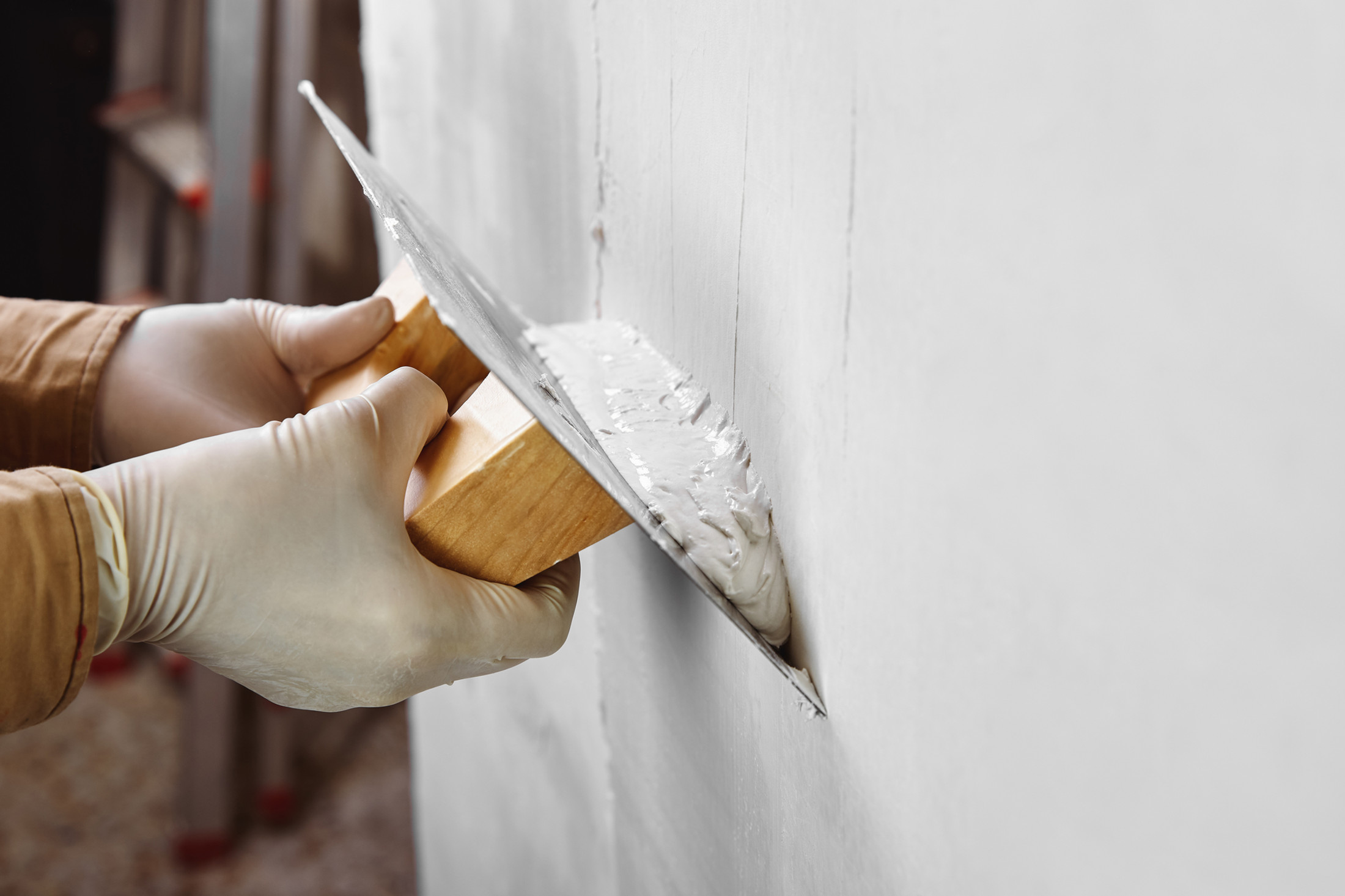
Plastering in Lymington
Skimming, board repairs, ceilings and render across Lymington, Pennington and SO41. We look at it properly, then put an itemised price in writing.
The site visit is free and so is the written itemised quote. Thomas Hannen prices every job himself.
Last updated
On the estates around Pennington the plasterboard was stuck to the blockwork on dabs, so hollow is how those walls are meant to sound. Knock one in a Lymington house and a drummy note is usually not a fault at all. What it changes is how the wall gets fixed.
Lymington houses tend to need plastering after damage, cracking or a change of owner. Something has gone through a wall, or a leak has soaked one, and the board needs cutting out and putting back. Cracks have opened along the ceiling joints and where the ceiling meets the wall. Or a house has changed hands and wants the whole of it skimmed flat before the decorator starts.
The town splits neatly for us: the older streets down towards the quay are solid walls and lath, and the housing round the edge is boarded and jointed. We come out, knock on it, and tell you which you have before we price anything.
The work
Water runs sideways behind the dabs
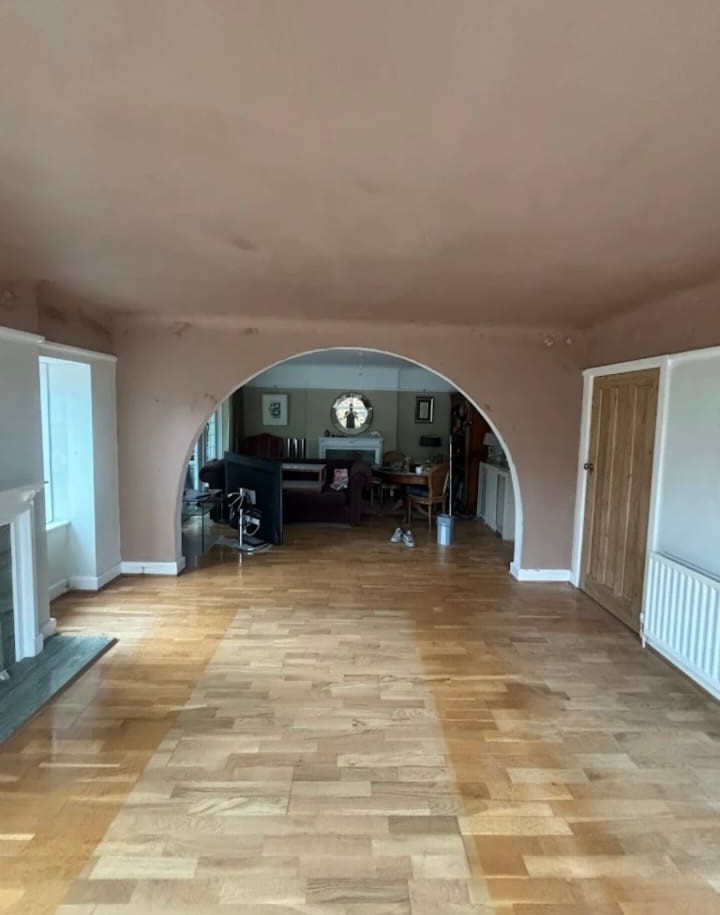
Water runs sideways behind the dabs. Most houses in Lymington from the eighties on are plasterboard on dabs against a block inner leaf, and the eighties are the biggest single slice of the town. A damaged area does not get filled.
It gets cut out square back to sound board, a new piece fitted and fixed, then taped and skimmed so the repair does not print through the paint later. Where a leak has been at it the board comes out further than the stain, because the void behind the dabs carries water sideways.
The fault to expect in the newer housing is a line of cracking along a board joint or round the perimeter where the ceiling meets the wall. That is movement in a taped joint, not a failing ceiling: cut out, re-taped and skimmed, with the whole ceiling skimmed after if you want to be sure the repair never shows. Older ceilings towards the town centre are lath and plaster, where the key breaks off the laths and the ceiling sags: down, boarded and skimmed, or fixed from above where it is worth keeping. Artex on the seventies houses skims flat over the top, and we never sand it.
A taped and jointed finish is flat but thin, and after thirty years of fixings and knocks it looks it. A full skim over the existing board gives you one hard surface, and it is quick because there is nothing to hack off: two to four days for a three bedroom house with the rooms empty.
Solid walls in the older streets. Down near St Thomas Street and the quay the walls are solid brick with lime plaster on them and no cavity behind, and Lymington carries something like a hundred and sixty listed entries, a good number of them in those streets. Those walls get lime plaster back, not gypsum, in a scratch coat and a render coat where the wall is bare, because a solid wall has to dry out through its own surface.
Extensions and garden rooms get dry lining on dabs where the blockwork is fair, stud partitions where a wall has to be built, then tape and joint or a full skim over the lot, with angle bead on every external corner and stop bead where the plaster stops against a frame. Kitchens and bathrooms get moisture resistant board first, then a skim and a mist coat before any proper paint.
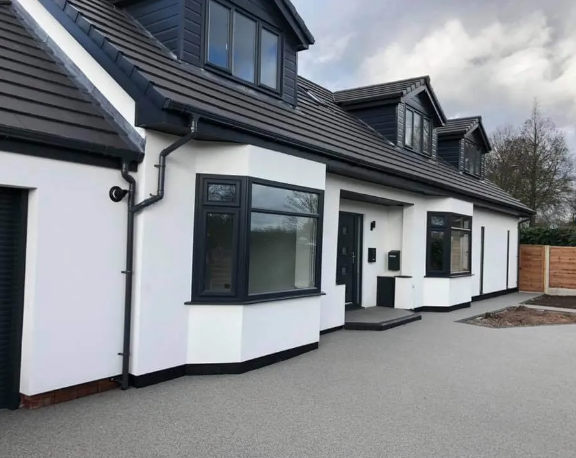
The older bungalows and semis around the edge of the town carry painted sand and cement render and pebbledash, and four kilometres from the water, on the south west face, it goes blown and hollow at the top of the wall first. Small areas are cut out, primed and patched. Whole elevations come off and go back as a mesh reinforced basecoat with a silicone thin coat topcoat, or a through-coloured monocouche if you would rather never paint it again, over a bell cast bead clear of the damp course and with the scaffold on its own line in the quote. For the outside walls, see rendering in Lymington.
How it runs
Skimming, patching and replastering rooms in the town
Thomas comes out and looks at every wall and ceiling in the rooms involved, tapping for hollow plaster and checking for damp. In most Lymington homes, built after the war, that means plasterboard on dabs or gypsum on block, often with an old textured ceiling to deal with.
In the pre-1919 houses in the centre of Lymington you may have lime plaster on solid brick or on lath, which is repaired in lime. A gypsum patch on it will not hold. The itemised quote covers preparation and protection, boarding, bonding or lime backing coats, the skim, making good and waste.
Floors, stairs and furniture are covered, dust is kept to the room, and each day ends with the room swept. In a flat reached by a shared staircase, we agree times with you so neighbours are not blocked. If a ceiling turns out to be hanging on failed laths, we show you a photo and agree a price before taking it down.
Nothing inside an unlisted house needs planning permission, and repairing render like for like is repair. On a listed building, and the town has a great many, consent may be needed before plaster comes off inside as well as out. Changing the outside finish can be permitted development, and Planning Portal guidance on external walls sets out the limits, which are tighter in the conservation area over the historic centre. Re-rendering a whole elevation brings building control in, because Approved Document L treats it as renovating a thermal element. New Forest District Council is the authority, not the National Park.
Cost
Board, lime or a wet wall: what shapes a plastering price
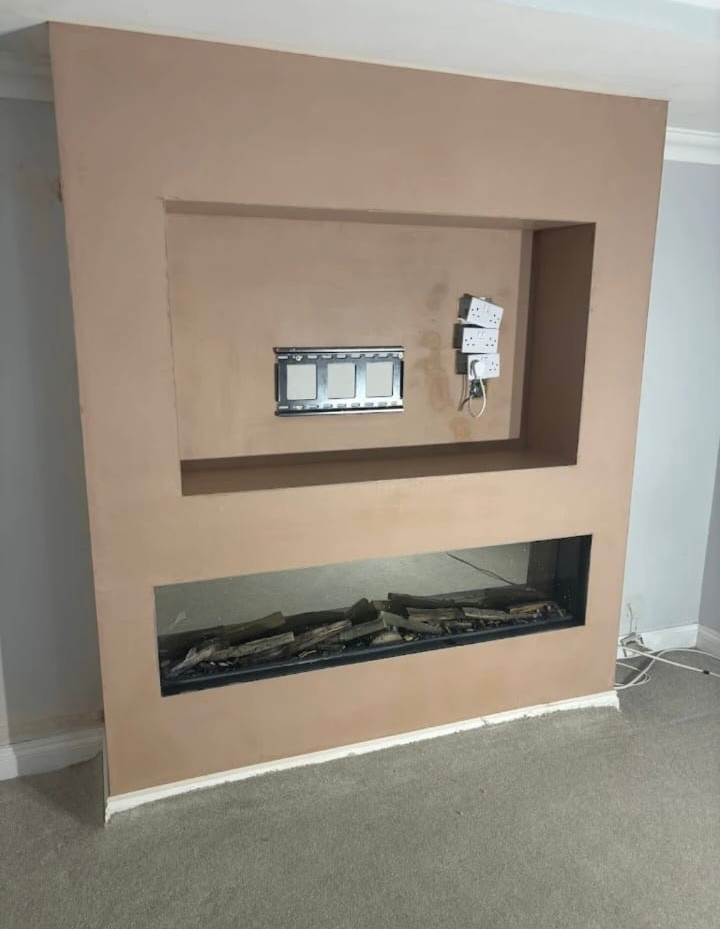
Plastering in Lymington has no useful rate per square metre, because what is behind the surface decides the job. What the wall is. Plasterboard on dabs in an eighties house can usually be skimmed. A textured ceiling in a post-war semi may need boarding over first. Lime plaster on solid brick in an older town house needs lime repairs, with longer waits between coats.
Whether it is wet. A wall that has had a leak through it, or damp coming in from outside, has to dry before it is plastered, and the cause has to be fixed. Plastering over it only brings the stain back.
How much comes off. A skim over sound plaster is a short job. Hacking back blown plaster to brick or taking down a ceiling makes dust and waste that has to be bagged and carried out.
Getting in and out. A terrace off the High Street with residents' parking, a semi on an estate with its own drive, and a first floor flat up a shared stair each change how materials come in and waste goes out.
Ask any other plasterer whether it is a skim or a full replaster, whether boarding or lime work is included, and who takes the waste.
If it has just gone
A ceiling that has come down or plaster off a wall
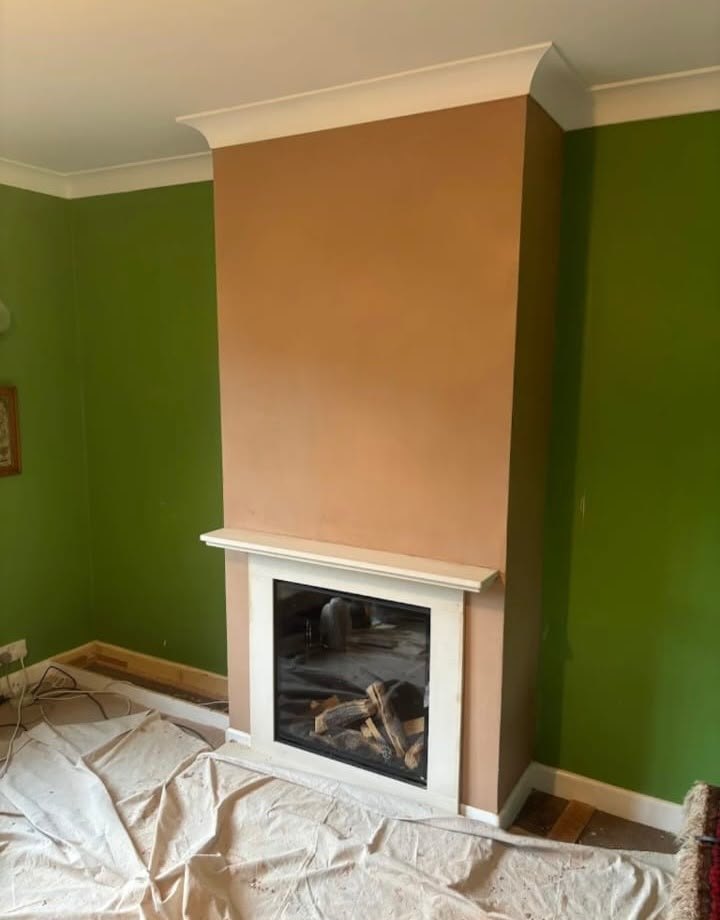
If a ceiling is bulging with water, get people out of the room and switch off the lights on that circuit. If it has already come down, leave the debris until the water has stopped and the rest of the ceiling has been looked at.
Render that has dropped off a gable wants the area below fenced off. Give us a ring rather than using the form. The first visit makes it safe by propping or taking down what is loose, and finding the leak if it came from above. We price the repair once the plaster has dried. Our plastering days run Monday to Friday, 8am to 6pm. If no one picks up, we ring you back as soon as we can.
Worth knowing
Hollow walls are dot and dab, not a defect
Dot and dab is worth understanding because it changes what you can do to your own walls. The board is stuck to the blockwork on fist sized dabs of adhesive, which leaves a void of ten or fifteen millimetres behind the whole wall. So it drums when you knock it, and that is normal, not a sign of anything letting go.
It also means a plasterboard fixing on its own holds a picture and nothing heavier. A television bracket or a wall unit has to go through the board and into the block behind with a long fixing, and the socket boxes and cables you cannot see run in that same void, which is why hacking blind into a hollow wall is a bad idea.
It changes repairs as well. Water from a window head or a leak upstairs runs down the void and shows up on a wall two rooms away, so the wet patch and the fault are rarely in the same place. We find the source before we quote the finish. Damaged board is cut out and replaced, never filled, because filler over a void cracks straight back out.
If you would rather have a solid feeling wall, the honest options are a full skim over what is there, which is quick and cheap, or taking the board off and plastering the block, which is neither. We would normally talk you into the first one.
Who you are dealing with
Your plasterer from Boscombe, working across SO41
We are 12.5 miles from Lymington at our base in Boscombe, and cover the town and Pennington, Walhampton, Boldre and Sway, out to Everton and Milford on Sea. All of it is within New Forest District Council's area.
You are dealing with Bournemouth Roofing & Building Ltd, registered in England and Wales, company number 15471719. Plastering jobs are priced by Thomas Hannen himself, whose firm it is, after he has looked at the walls and ceilings. A verified customer's review on Checkatrade gives us 10 out of 10. The survey visit and the itemised written quote are free. Before you book a visit in Lymington, you can read our customers' Google reviews, word for word, on our reviews page.
Planning at a glance
Do you need planning permission in Lymington?
Most repairs in Lymington need no application at all. What decides whether a change to the outside of your house does is who the council is, whether a conservation area or a listing applies, and whether the place sits in a protected landscape.
| Question | In Lymington |
|---|---|
| Who decides | New Forest District Council is the planning authority for Lymington. The National Park boundary runs close by, and the Park's property map shows which side an address falls. |
| Conservation area | Yes: Lymington Conservation Area. Check whether your street is inside the boundary before changing anything visible. |
| Listed buildings | Yes, there are listed buildings in and around Lymington. If yours is one, work can need listed building consent. |
| Protected landscape | No National Park or National Landscape covers Lymington. |
Questions
Questions about plastering in Lymington
There are 160 listed entries in Lymington. Is ours one?
Possibly, so it is worth checking instead of assuming. The entries include the parish church of St Thomas the Apostle and Ivy House, and they cluster in the historic centre, even though only about 7% of the town's housing predates 1919. Listing covers the inside as well as the outside, which means original plaster, lath ceilings and mouldings are part of what is protected from the day it is listed.
Terraced house with a party wall. Will the neighbours feel it?
They will hear it while the old plaster is coming off. Terraced houses are 22.7% of Lymington's stock and semis another 25.1%, so nearly half the town shares a wall with somebody, and hacking off a backing coat carries straight through the brickwork. It is worth a word next door before the start date. The noisy part is the strip out, and it is measured in hours, not days.
Why does render crack around the window reveals first?
Because that is where the weather concentrates and where the movement is. The exposed elevation faces south west and the town sits 4.1km from open water, so wind driven rain runs across a wall and gets forced into the edges of openings rather than soaking the middle of a panel. Add the stresses around a frame and the reveals and the head are where it goes first, every time.
How many days for a three bedroom house of ceilings?
For skimming over sound existing ceilings, three or four working days in a house that size, plus drying time afterwards. Lymington stock peaks in the 1980s at 17.1% and 26.1% went up between 1983 and 2008, so most ceilings here are already boarded and need a skim rather than a strip out. If they turn out to be lath, or the boards have dropped, it becomes a bigger job.
Which council handles a render application in Lymington?
New Forest District Council, which surprises people who assume anything near the water is dealt with in Christchurch or Poole. The historic town centre is the Lymington conservation area, so a change of external finish there can need permission. Elsewhere, on an unlisted house, an external repair in the same material is not something you apply for. On a listed one it is listed building consent you need, from the same council but through a different process.
Nearby, and next door
Plastering near Lymington
Nearby places we also cover for plastering, with straight-line distances from Lymington, and the other trades we offer in Lymington itself.
Plastering nearby
Our other trades in Lymington
Plastering and rendering guides
Silicone, cement or lime: which render? Cracked render: which cracks matter Hollow-sounding wall: blown plaster or dot and dabBuilders in Lymington: all our building work Everything we do in Lymington Plastering, all areas Every area we cover
Free quote
Get a price for plastering in Lymington
Tell us the address and what you have noticed. We will come out, sound the walls, and put an itemised price in writing. No charge, and no obligation.