Roof repairs in Crossways
Loose bungalow hips, slipped concrete tiles, washed-out verges, split valleys and leaking garage roofs, repaired across Crossways, DT2.
The site visit is free and so is the written itemised quote. Thomas Hannen prices every job himself.
Last updated
Roof repairs
One fault, found and put right
Yes, we repair roofs across Crossways, from a rocking hip tile on a bungalow to a split valley or a dripping garage roof. We find the one place the water gets in, fix that place, and put the price in writing after a free site visit.
If water is coming through a ceiling now, ring 07435 839745 and tell us which room it is in and whether the house is a bungalow or two storeys.
A hip tile on the bungalow has shifted and there is old mortar on the drive below it. A brown mark has appeared in a bedroom ceiling corner. Or the soffit has gone dark and soft along one side of the house.
Thomas comes out, looks over the slopes from a ladder and puts a torch through the loft hatch. You get photographs of the fault and a written quote to put it right. If the roof has gone past repairing, he says so and shows you why.
The repairs
Faults on seventies tile, bungalow hips and garage felt
Crossways grew fast in the early 1970s, when the council put up flats, houses and bungalows, and later estates carried on into the late 2000s. So the roofs here are mostly concrete interlocking tile on trussed rafters with bitumen felt under the battens, plus a few older cottages under clay plain tile or slate.
Hip and ridge bedding letting go. A hipped bungalow has four hips running down to its corners and a ridge along the top, every tile sat on a bed of sand and cement. Decades of frost crack the bedding until it loses its grip. A hip tile starts to rock, a piece of mortar lands on the path, and water runs down the hip line to show as a stain in a bedroom corner. We either rebed the loose tiles in fresh mortar with a clip or screw in each, or fit a mechanically fixed dry hip and ridge, as BS 5534 now asks for. A full set of hips and the ridge is about a day.
Slipped and cracked concrete tiles. An interlocking tile stays in place through its side lock with the next tile and the nail or clip under it. On a seventies roof the nails rust and the clips corrode, so a tile drops far enough to open its lap. Others crack where someone stood on them to reach an aerial. We lift the tiles above, fit a tile of the same profile, and fix it and its loose neighbours, so the next gust does not move them. A few tiles take a morning.
Felt perished at the eaves. The felt on these roofs is the old non-breathable bitumen kind, and the strip that runs out over the fascia into the gutter is the part that sees daylight. It goes brittle and tears, and rain running down the felt drops behind the gutter. You notice it as a stained soffit or a fascia soft enough to push a thumbnail into. We lift the bottom courses, cut away the perished felt, fit an eaves support tray that carries water into the gutter, and dress a new strip of underlay over it. The boards themselves are covered on our page for fascias, soffits and guttering in Crossways. If the felt crumbles wherever a tile is lifted, a tray only moves the leak along the eaves, and that is a conversation for our roofers in Crossways.
Verges on the two storey houses. On a gable-ended house, the edge tiles sit on a mortar bed over a strip of undercloak. The village stands on open former heath about 62 metres up, and rain driven sideways across open ground like that hits the gable ends hard. The mortar washes out and the verge tiles loosen. We either rebed the verge on new undercloak or fit dry verge units clipped over each end tile and screwed to the batten ends, which leave nothing to wash out. Both gable ends of a house take about a day.
Valleys on L-shaped bungalows and extensions. Where two slopes meet in an inside corner, one valley carries the water off both. Here that is a row of mortar-bedded valley tiles, or a lead or GRP trough. Mortar cracks, lead splits, and a trough silts up with moss and needles until water spills under the tiles. We clear it first, since sometimes that is the whole repair. A split trough means new GRP or lead with the tiles either side lifted, a day or two.
Where an extension, garage or porch meets the house. The joint against the wall is sealed with lead flashing or a sand and cement fillet. Fillets crack away from the brick and lead creeps out of its chase. The sign is a stain on the extension ceiling tight against the house wall. We cut the fillet out, chase in stepped lead with soakers under the tiles, and point the joint. Most flashings are a day.
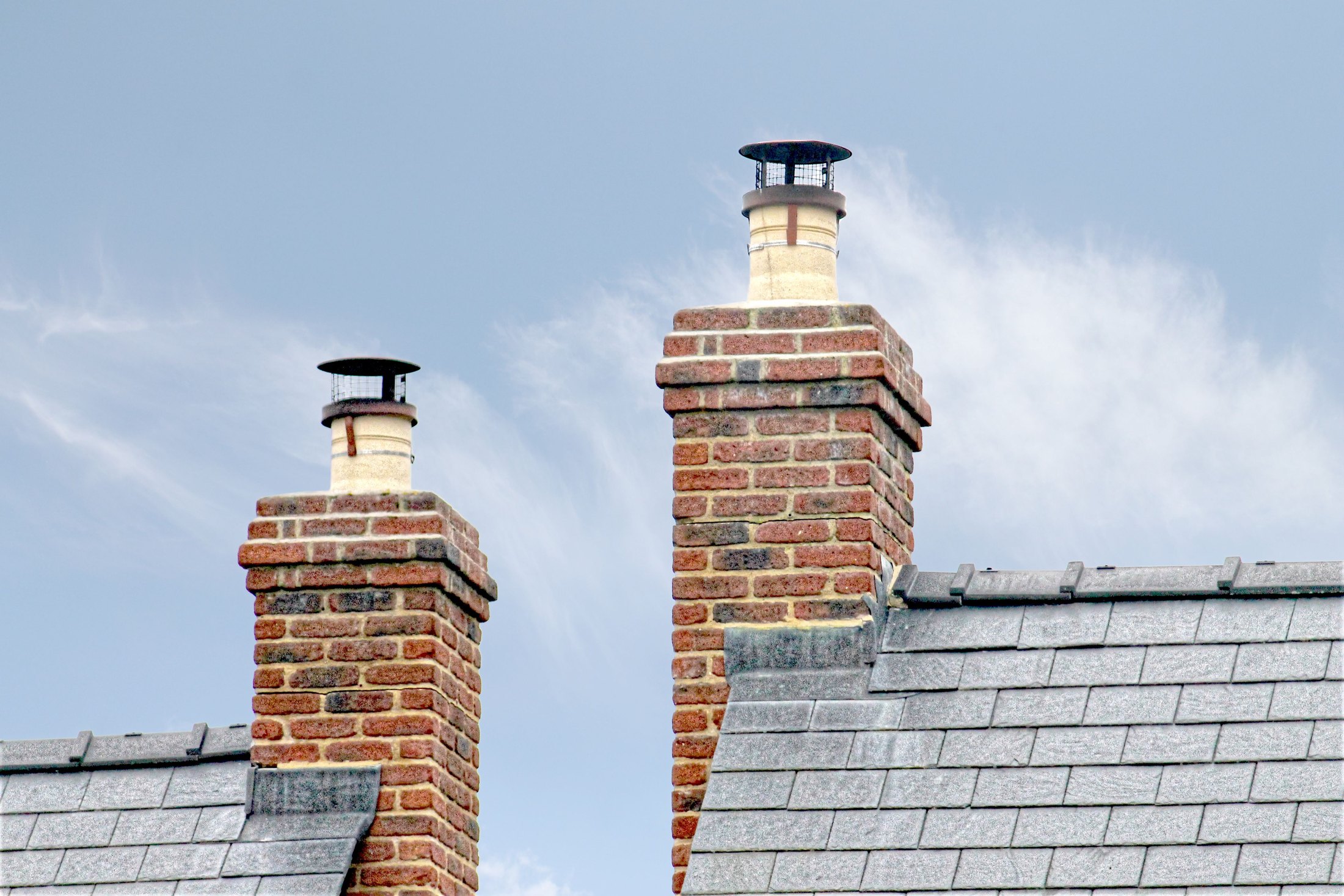
A chimney, where the house has one. On a cottage with a stack, suspect it early: the side flashings, the back gutter behind it, and cracked flaunching on top letting water down through the brickwork. See chimney repairs.
Garage, porch and extension flat roofs. Felt, GRP and EPDM give way at blisters and splits, at the upstand where the covering turns up the wall, and at an outlet that lets water pond round it. Where the boards underneath are still dry and firm, a split takes a patch and a few hours. A deck that gives underfoot has soaked up water and will not hold a patch. More on flat roofing in Crossways.
The older cottages. A cracked clay plain tile is slid out and replaced with a reclaimed one of the same colour. A slate whose nail has rusted through goes back on a tingle, a strip of lead or copper hooked under its bottom edge.
After a storm. A handful of lifted tiles and a length of ridge are a repair. When a slope has lost tiles, the felt under them has torn and the battens have snapped or gone soft, patching has stopped making sense, and it is a re-cover for our roofers in Crossways.
How it runs
From your call to a written price
One person to ring from the first visit to the last. The quote is itemised, not a figure on the back of a card: access, where the fault is and what is being opened up to reach it, each tile, slate, ridge or flashing being renewed and what with, making good, and disposal on separate lines, so you can compare it properly against anyone else's.
Nothing is left open or unusable overnight. The site is swept at the end of each day rather than the end of the job, and what comes out leaves with us. If something turns up once we start that nobody could have seen, you get a photograph and a price before we carry on.
A like for like repair in Crossways needs no planning application, as the village has no conservation area and nothing in it is listed, and the Planning Portal guidance on roofs sets out where that line sits. If you own a flat, the freeholder or managing agent has to instruct any roof work. If you rent, report it to your landlord or housing association.
Cost
What decides the price of a roof repair
No rate per square metre, because a slipped tile over a porch and the same tile above a three storey gable are one repair and two very different jobs.
Getting to it. In Crossways that might be a hipped bungalow whose hips can be reached from a roof ladder, a two storey gable-ended semi with both verges needing a platform, or the flat roof over an attached garage. A tile over a porch or a bungalow eaves can often be reached from a ladder and a roof ladder. A ridge, a chimney or a valley on a two storey house usually wants a tower or a scaffold, so a small repair can still need a proper platform. The work at height rules decide that, which is why access is its own line on the quote and not hidden inside the repair.
Finding the cause, not the stain. Water runs along the battens and the underlay before it drips, so the mark on the ceiling is rarely under the fault. Tracing it back to a cracked tile, a lifted flashing, a perished valley or a ridge joint that has opened is part of the job, and a repair priced before anyone has looked is a guess.
What the repair uncovers. Lifting a few tiles shows the battens and the underlay around them. If they are sound the repair stays small. If the felt has perished or the battens have rotted, you get a photograph and a separate written price before anything more is done. Where patching stops being worth it is a conversation you have with the facts in front of you.
Comparing quotes? Ask what fault they actually found and where, whether access is included, what is being replaced and with what (a matched tile, new or reclaimed slate, which code of lead), whether the ridge and verge are being bedded in mortar or mechanically fixed, and what happens if more is found once the roof is open. Two quotes for the same job are usually two different jobs.
If it is leaking now
Water coming through a ceiling
Ring rather than use the form. Put a bowl under the drip, keep anything electrical away from the wet patch, and if a ceiling is bulging keep everyone out from under it. The first visit is about finding where the water gets in and making the roof weathertight, and the permanent repair is priced in writing once the fault can be seen properly. If it is safe to open the loft, shine a torch above the drip and see whether the felt is wet down at the eaves or higher up the slope, because that tells us whether to start at the gutter edge or the tiles above. Scheduled work runs Monday to Friday, 8am to 6pm. For anything urgent, ring rather than use the form, and if we cannot pick up we ring you back as soon as we can.
Worth knowing
A dripping downpipe is not a small job on this ground
On a Crossways bungalow the gutters and downpipes are low and easy to ignore: a split downpipe, a missing shoe, a gutter joint dripping at one corner, or a valley outlet that overflows in a downpour. Any one of those tips a winter's roof water onto the same patch of ground beside the wall.
Ground mapping for the village rates the soil as one that can shrink as it dries and swell as it wets, and soaking one spot next to a wall is what you want to avoid on ground like that. So a small leak at the roofline matters more here than its size suggests. We count a repair as unfinished until the water reaches a gully or a drain, which is where Approved Document H expects roof water to go, and not the soil or a path beside the house.
After rain, check where each downpipe ends and look for a wet patch or splash marks at the foot of the wall. Ask for the shoe or gully connection to be included in the repair price. If a downpipe vanishes into the ground with no visible gully, have that connection checked. The gutter side is on our page for guttering in Crossways.
Who you are dealing with
A local firm you can check
Crossways, DT2, from the estates off Warmwell Road to the houses along Moreton Road, is 21.8 miles from our base in Boscombe, and Dorset Council handles planning and building control here. You are dealing with Bournemouth Roofing & Building, the trading name of Bournemouth Roofing & Building Ltd, registered in England and Wales, company number 15471719, which you can look up in a minute. Thomas Hannen's business, and he is the one who comes out to price the job, not a salesman. A verified customer's 10 out of 10 on Checkatrade. The visit and the written quote are both free.
Nearby, and next door
Roof repairs near Crossways
Nearby places we also cover for roof repairs, with straight-line distances from Crossways, and the other trades we offer in Crossways itself.
Roof repairs nearby
Our other trades in Crossways
Everything we do in Wareham Roof repairs, all areas Every area we cover
Questions
Questions about roof repairs in Crossways
Is a roof from the seventies worth repairing, or is it time to replace it?
If the tiles are sound and the fault sits at the hips, verges or eaves, repair it. It tips towards a re-cover when tiles are cracking across the slopes, the felt tears wherever you lift a tile and the battens are soft. That is work for our roofers in Crossways.
What does a roof repair cost?
It depends on what the fault is, how we reach it, and what we find once the tiles are lifted. You get a free site visit and a written, itemised quote before anything starts, and our page on how we price a job sets out every line.
How can I tell whether a roofer is genuine before they go up?
Check the limited company name and number on Companies House. Ask for a written, itemised quote naming the fault and where it is. Agree that any extra work is photographed and priced before it is done.
When is the best time of year for a roof repair?
Any dry spell, in any season. Tile, lead and dry fix work go ahead through winter. Mortar should not go on in frost, so in a cold snap we make the roof weathertight first and bed the hips later.
Free quote
Book a look at your Crossways roof
Send your postcode and what you have noticed, whether it is a loose tile, a ceiling stain or a wet patch by the wall. We come out, find the fault and put the repair in writing.