Block paving in Poole, from the dig to the last joint
New block paved drives, paths and parking bays across Poole, and sunken or rutted block drives lifted and relaid.
The site visit is free and so is the written itemised quote. Thomas Hannen prices every job himself.
Last updated
We lay new block paved drives, paths and parking bays in Poole, and we lift and relay block drives that have sunk or rutted. What keeps a block drive flat is the dig, the compacted base and an edge that cannot move, so that is where the time goes.
Perhaps you want to park on a front garden where the kerb has never been dropped. Perhaps the drive has dipped where the car stands, the joints have lost their sand to weeds, or the edge blocks have crept out into the border.
Ring 07435 839745 or send us the details. Thomas comes out, measures up, takes the levels off the house and checks where the water will go. You get a written quote with every stage on its own line, and if relaying part of the drive will do, that is what we price.
How a block drive is built
What goes under the blocks, layer by layer
When a block drive sinks, the fault is nearly always in the base, not the blocks. This is the order we build in.
The dig. Turf, topsoil and any old surface come out down to firm subsoil, called the formation. Soft spots are dug deeper and filled. The depth depends on the ground and the load, and it is written on the quote.
The membrane. On soft, wet or mixed ground a geotextile goes on the formation to stop the stone being pressed into the soil. The government guidance on front garden paving describes the same step, with about 150mm of compacted sub-base above it.
The sub-base. MOT Type 1 crushed stone, spread and compacted in layers. Compacting only the top of a deep fill is how a drive gets wheel ruts in its first year.
The edge restraint. A kerb or a soldier course of blocks, set on a concrete bed with a haunch behind it. Block paving holds because each block is wedged against the next. With no fixed edge the surface creeps outward under the car, and on a cheap drive the edges fail first.
The laying course. Sharp sand, screeded to the finished fall. It is a bed for the blocks, not a way to hide bad levels underneath.
Laying and jointing. Blocks laid to the pattern, cut clean at the edges and around drains and covers, then run over with a plate compactor. Kiln dried sand is brushed in and compacted again until the joints are full. Full joints are what lock the blocks together.
Pattern and block
Choosing the pattern and the block for the job it does
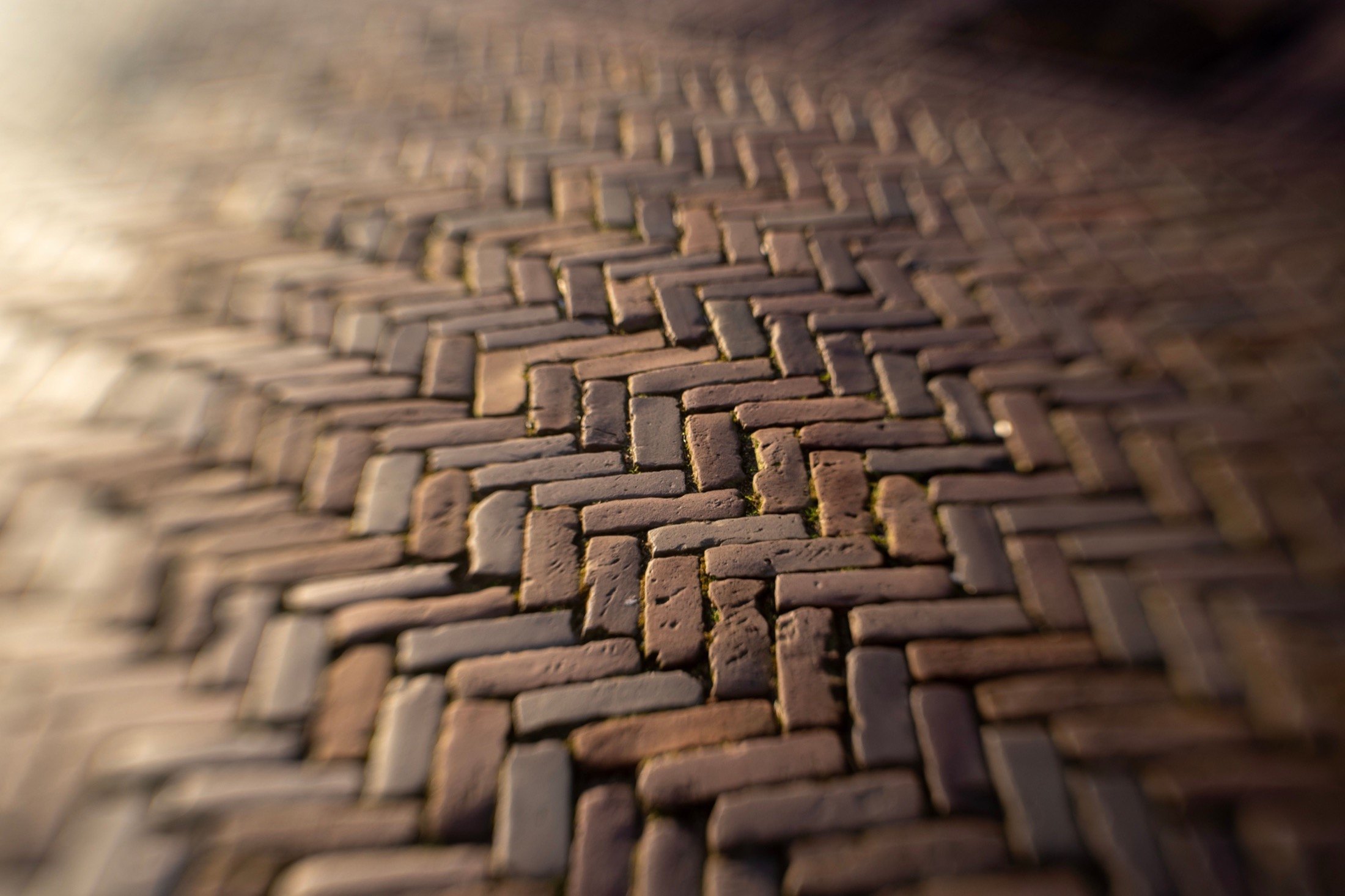
Pick the pattern for the traffic first and the look second. Herringbone, at 45 or 90 degrees to the kerb, locks best under a turning wheel, so it suits a drive where cars swing in off the road. Stretcher bond suits a straight path. Basketweave looks good on a path or patio but is weaker under a car. A contrasting border frames the drive and hides the cuts.
Concrete block or clay paver. Concrete comes in more colours and costs less, but some colours fade in the sun. Clay keeps its colour because it runs right through, and it suits an older house, but it costs more and takes longer to cut. Tumbled blocks hide small level changes; crisp-edged ones show every lip. A drive needs a thicker block than a path, and a busy pattern means more cut waste.
Sunken and rutted drives
Lifting and relaying a block drive that has dropped
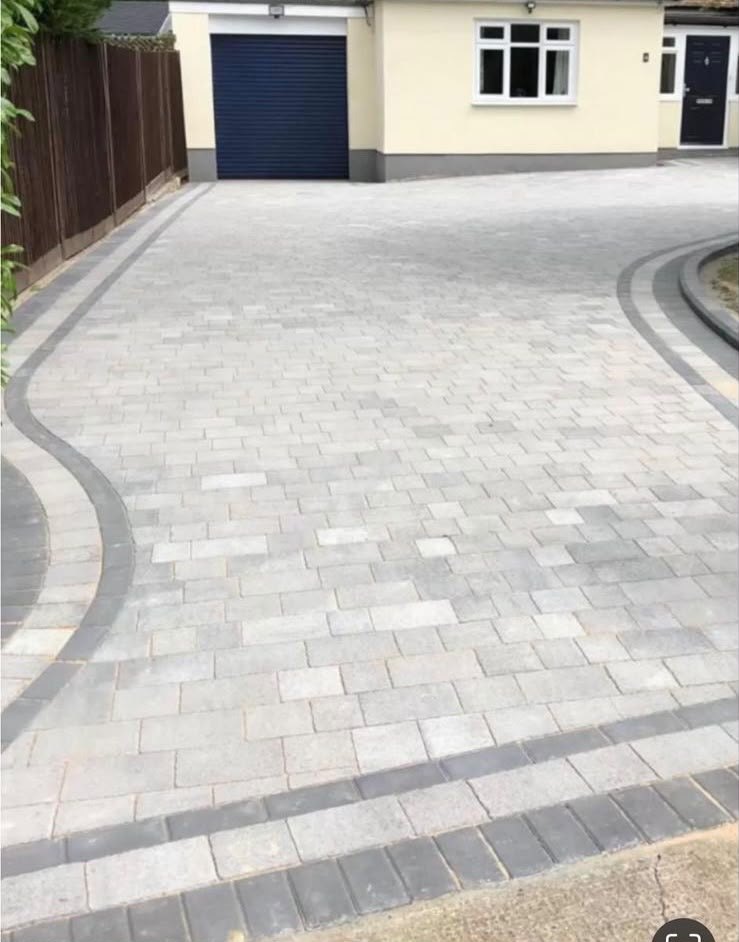
Block paving can be taken up and put back, which tarmac and concrete cannot. Where one part has sunk, we lift and stack the blocks and find the cause, whether a soft patch, a collapsed drain, an old service trench or roots. Then the base is rebuilt and the same blocks go back, with any broken ones replaced.
If the whole drive was laid on sand over soil, there is no base to repair, and patching one dip just moves it along. The honest answer then is a full relay on a proper base, reusing the sound blocks. We tell you which you have before you pay for anything. For other surfaces, see our page on drives in Poole.
Water and planning
Is block paving permeable, and does it need planning?
Standard block paving is not permeable. Tight sand joints and a Type 1 base full of fines slow water right down, and the government guidance treats block as a conventional hard surface, like tarmac.
Under the permitted development rules for front gardens, a house can pave more than five square metres of front garden without planning permission only if the water stays on your land. With block, that means one of three things:
- Permeable block, with wider grit-filled joints over an open graded stone base, designed to BS 7533-103.
- A channel drain to a soakaway on your plot, where a test pit shows the ground will take it.
- Falls to a planted border or rain garden.
All three are sustainable drainage, or SuDS. On low ground near the Quay, the Old Town or Holes Bay, where BCP Council is building new tidal defences, fall the drive away from the house and check your address on the government flood risk service. In a conservation area such as Ashley Cross, Poole Park, Heckford Park or the Town Centre Heritage area, ask BCP before a front wall or hedge comes out. The council lists every conservation area.
How the job runs
From the free visit to the walk round
Thomas Hannen comes out himself to measure, take levels and see where the water goes. Where the ground is unknown we dig a small test hole. The written quote lists the dig, muck away, membrane, sub-base, edging, drainage, blocks, jointing and any kerb side work, each on its own line.
Before the dig we agree the edges, the finished levels at the door and garage, and the falls, on site with you. The surface stays below the damp proof course, with a channel at the threshold if the levels are tight.
Spoil goes into a grab lorry or a skip. A skip on the road needs council permission under section 139 of the Highways Act, arranged before the first morning. With no side gate or room for a machine, it is barrow work, and the quote says so. No open hole is left overnight and the pavement is swept each evening. Anything hidden, such as an old soakaway or a broken drain, gets a photograph and a price before we touch it. At the end we walk the drive with you.
Cost
What decides the price of a block drive
We do not put prices on this page, because the ground decides most of the cost and we have not seen yours. These are the things that move it, and our itemised quote sets them out line by line.
- Area and shape. Curves, steps and long edges mean more cutting.
- Dig depth and muck away. How deep we go and how many loads leave.
- Breaking out. An old concrete or tarmac drive has to come up first.
- Access. Room for a machine, a skip or a grab lorry, or barrow work.
- Levels. A sloping plot needs more fill or a retaining edge.
- Drainage. A channel and soakaway, or permeable block on a deeper stone base.
- Block and pattern. Clay costs more than concrete, and herringbone wastes more in cuts.
- The kerb. A new dropped kerb is a separate council job with its own cost.
Ask every firm: how deep is the dig? What is the sub-base, and is it compacted in layers? Is there a membrane? How are the edges held? Where does the water go? A quote that cannot answer those is cheaper for a reason.
Before it gets worse
A dip by the door, loose edges or water standing
A dip that holds water gets worse every winter. If a puddle sits by the door or runs back toward the house, photograph it while the water is there. It shows exactly where the fall has gone. Do not jet wash a drive that is already sinking: it strips the last sand from the joints and lets the blocks move more. Lift any rocking block that could trip someone.
Then ring 07435 839745. Scheduled work Mon to Fri, 8am to 6pm. Something urgent? Ring, and if we miss you we call back.
Aftercare
Keeping a block drive tight and clean
Top up the joints with kiln dried sand once the drive has settled over its first months, and again after every jet wash. Hold the lance low and keep it moving along the blocks, never straight down into a joint. A joint stabiliser brushed in after cleaning slows weeds and sand loss.
Weeds grow from seed that lands in the joints, so full, firm joints and a brush now and then are the cure. Blot fresh oil at once with sand. Old stains need a degreaser, and a block that will not clean can be swapped. For a full clean and re-sand, see exterior cleaning in Poole.
The one local thing
Check the dropped kerb rules before you build the drive
In Poole the drive and the dropped kerb are separate jobs, and the kerb can stop the plan. BCP Council will only drop a kerb if the space behind it is at least 5.5 metres by 2.6 metres with the car facing the road, or 2.8 metres by 6.5 metres side-on. The kerb must be 1 metre clear of a street light, sign or tree, and 10 metres from a junction or crossing.
Nearly one home in five near the town centre is terraced, and some of those frontages will not make the size, so measure before you design anything. BCP says the kerb usually needs planning permission if the drive is sealed block that sheds water, the road is classified, or the home is a flat, maisonette or listed. Check your deeds allow parking; if you rent, get the landlord's permission in writing.
The council's contractor normally builds the crossing. Your own contractor would need street works qualifications and an S171 licence, because the council controls vehicle crossings as highway authority. We build the drive to meet the back of the footway and drain it on your plot. The Planning Portal guide to dropped kerbs has the national rules.
Who you are dealing with
The company laying your drive
We work from our base in Boscombe and lay block paving across Poole, from Longfleet and Parkstone to Oakdale, Hamworthy and Canford Heath. See everything we do in Poole, or block paving across the whole area.
The business is Thomas Hannen's, and he measures and prices every drive himself. We trade as Bournemouth Roofing & Building Ltd, registered in England and Wales, company number 15471719. We have a verified 10 out of 10 on Checkatrade. The site visit and the itemised written quote are both free. For garden paving, see patios in Poole.
Questions
Questions about block paving in Poole
How much does a block paved drive cost in Poole?
We do not publish a figure, because two drives the same size can need very different work. Most of the cost sits under the surface: how deep we dig, how much spoil leaves, what old concrete comes out and what the water needs. Your written quote shows each of those on its own line, so you can compare it fairly with anyone else's.
Do I need a membrane under block paving?
On soft, wet or mixed ground, yes, laid on the soil under the sub-base. On firm sandy ground it does less, but it costs little next to the dig. What we will not do is lay a weed membrane just under the sand bed. The sand slides on it, the blocks creep, and it does nothing for weeds, which grow from seed blown into the joints from above.
What are the downsides of a block paved drive?
Weeds and moss in the joints, sand washing out, oil soaking into concrete block, and more labour than tarmac because every block is laid and cut by hand. The upside is that it can be lifted, relaid and patched block by block. If you want a surface you never think about, resin or tarmac may suit you better, and we will say so.
Do I need planning permission to block pave my front garden in Poole?
For a house, not if it is five square metres or less, drains to a lawn, border or soakaway on your land, or is permeable block. Flats and maisonettes have no permitted development rights for this, so they need permission at any size.
Can you relay my sunken block drive with the same blocks?
Usually, yes. We lift and stack them, rebuild the base under the dip, relay them and re-sand. Older ranges are often discontinued, so a replacement for a broken block can look brighter than its neighbours for a year or two until it weathers in.
How long does it take to lay a block paved drive?
It depends on the size, the access and what comes out of the ground, and your quote gives a realistic run of days. You can walk on it once it is jointed. With a new dropped kerb, BCP Council's timetable decides when you can drive on, so apply early.
Nearby, and next door
Drives near Poole, and our other trades here
Drive and paving pages for the places around Poole, and the other work we do in Poole itself.
Drives nearby
Builders in Poole: all our building work Everything we do in Poole Block paving, all areas Every area we cover
Free quote
Want a block drive that stays flat?
Tell us the size of the frontage and whether the kerb is already dropped. We will come and look, and you get an itemised written quote.