Tarmac Driveways in Bournemouth
New tarmac drives and resurfacing across Bournemouth, Poole and Christchurch. Dug out, properly based, edged and drained, with the planning and dropped kerb questions settled before a shovel goes in.
The site visit is free and so is the written itemised quote. Thomas Hannen prices every job himself.
Last updated
Tarmac and asphalt drives
Tarmac driveways, dug out, based and drained
We lay tarmac driveways in Bournemouth from the ground up: dig out, a compacted Type 1 sub-base, a firm edge, then tarmac in two hot rolled courses, falling to a drain or a border. The site visit is free, and the written itemised quote says how deep each layer goes and where the water ends up.
Maybe the old drive has sunk in the wheel tracks and holds a puddle after rain, or the concrete has cracked into slabs. Or you are turning a front lawn into parking and want it done once, and legal.
Tarmac, tarmacadam or asphalt, as the trade calls the modern mix, is hard wearing, quick to lay and easy to patch. It fails for one reason above all: what is underneath it. A thin layer rolled over soil or a tired old drive will rut and crack, however neat it looks on day one.
So we start below the surface: where the water goes, how the drive meets the pavement, and whether you need a dropped kerb or planning permission. If tarmac is the wrong answer for your house, we say so and price block paving or a resin drive instead.
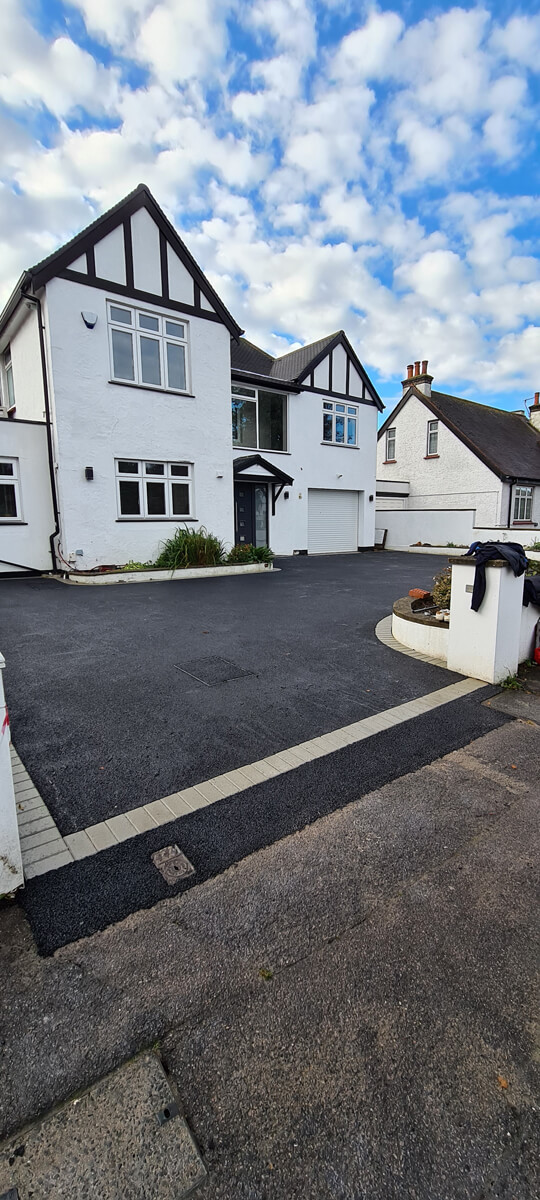
The work
New tarmac drives, overlays and repairs
A new drive, from the ground up
A proper tarmac drive is mostly work you never see. We dig out the old surface and the soft topsoil down to firm ground, the formation. On a front lawn that is a lot of muck away, so the quote says whether it leaves in a skip or a grab lorry.
Where the ground is soft, a geotextile membrane goes down first. Then the sub-base: Type 1 MOT crushed stone, laid in layers and compacted between each one. This is what carries the car. Skimp on its depth and the drive starts rutting in the wheel tracks, whatever goes on top.
Next, the edges. Tarmac spreads and crumbles at a free edge, so every side is held: a kerb or a row of blocks set on concrete and haunched behind, or treated timber edging on a simple path.
Then the tarmac goes down in two courses. The binder course is a coarser, stronger layer that takes the load. The surface course, or wearing course, is a finer mix for the smooth closed finish. Both are laid hot, raked to level and rolled before they cool. The falls are set in the sub-base, so water runs away from the house to a channel drain, a gully or a soft border, never to your door or across the pavement.
A typical house drive takes a few working days from dig-out to the last roll, longer with walls or drainage. We keep the finished level at least two brick courses below your damp proof course, clear of air bricks, and meeting door and garage thresholds cleanly.
Overlay or full dig-out
An overlay is new tarmac laid on the old drive. It works when the existing tarmac or concrete is level, firm and draining, and only the surface is worn or stained. We clean it, fix loose patches, apply a bond coat and lay a new surface course.
It is the wrong answer when the drive has sunk, the base has cracked, roots are lifting it or water stands on it. A thin overlay on a failing base just moves the cracks up to the new surface. It also raises the level, and if the drive already sits close to the damp proof course there is no room. Then we will talk you out of it and price the dig-out.
Repairs, patches and edges
A pothole or a failed patch can be cut out square, the base made good, and new tarmac laid and sealed at the joints. A crumbling edge can be cut back to sound tarmac and given a proper kerb or block edge. If the patches would cover half the drive, we tell you it is time for a new one.
The walls, steps and drainage around it
We are a building firm that also lays drives, so the work around it can go on the same quote: a dwarf front wall, a rebuilt gate pier, steps to the front door, a soakaway or a channel drain across the entrance. One company, one written quote, and the levels of wall, steps and tarmac worked out together.
Choosing the surface
Is tarmac the right surface for your drive?
Tarmac suits a practical, hard wearing drive you want down quickly and can repair simply. It has no joints, so there is no jointing sand to top up and weeds have nowhere to seed across the middle, and a damaged area can be cut out and patched.
The downsides are real. It stays soft for the first weeks and again on hot days, so turning the wheel with the car standing still, a kickstand, a skip or a caravan jockey wheel can dent it. It is black unless you choose red or buff, which cost more, and black fades to grey. Diesel and oil soften it and leave staining. And plain tarmac is impermeable: every drop of rain runs off, which brings in drainage and planning.
For a pattern, block paving lifts and relays in one spot, though its kiln dried sand joints need keeping full. For a smooth finish that lets water through, resin bound or porous asphalt may suit. We lay these and patios too, so we have no reason to push one surface. The driveways page compares them.
Planning and drainage
Do you need planning permission for a tarmac drive?
On a house, a tarmac front drive needs no planning permission if the rain drains to a permeable area on your own land. It does need permission if it covers more than five square metres and the water runs onto the road. That is the national rule in the Planning Portal guidance on paving your front garden.
So the real question is where the water goes. Fall the drive to a lawn or planted border. Collect it in a channel drain and send it to a soakaway, once a test hole shows the ground takes water. Or lay porous asphalt on a free draining sub-base. The government guidance on permeable front gardens shows each one, and our quote always says which we are using.
Flats and maisonettes, and plenty of Bournemouth homes are one or the other, have no permitted development for this, so a new drive needs permission. Some converted houses and homes under an Article 4 direction are the same. In a conservation area, check the council list of conservation areas before you take out a front wall or hedge.
How we work
From the site visit to the last roll
You have one person to ring from the first call to the finished drive, and Thomas Hannen prices the job himself. The site visit is free. We look at the old surface, the levels against the house, the falls, the edge to the pavement, and access for a mini digger and a lorry.
Then you get a written itemised quote. It sets out:
- how deep we dig out, and what happens to the spoil
- any geotextile membrane, and the depth of the Type 1 sub-base
- the binder course, the surface course and the finish
- the edging, kerbs or blocks, on every side
- where the water goes: falls, channel drain, gully or soakaway
- any walls, piers or steps, each on its own line
If we find something under the old drive that nobody could see, such as a soft spot, an old drain or a buried slab, we stop that part, photograph it and price it, and it goes ahead only when you say yes.
The site is swept at the end of each day, the pavement kept clear, and the waste leaves with us. At the end we walk the drive with you and go through the first few weeks: roll before you turn the wheel, keep kickstands and skips off it, and wash away any fuel or oil. Scheduled work runs Mon to Fri, 8am to 6pm.
The price
What decides the price of a tarmac drive
We do not publish prices, because two drives of the same size can cost very different amounts once you know what is under them. These are what move it:
- the area and shape, and how many edges need restraining
- how much must come out, and whether a skip or a grab lorry takes it
- access: a side gate too narrow for a mini digger means barrow work
- the ground under it, and the sub-base depth needed to carry a car
- drainage: a fall to a border costs less than a channel drain and soakaway
- the edging, and black or coloured tarmac
- levels, steps and any wall, pier or boundary work
When you compare quotes, ask each firm the same things. How deep is the sub-base? Two courses of tarmac or one? What holds the edges? Where does the water go? Is the dropped kerb included or left to you? Is the price written and itemised?
If someone knocks saying they have tarmac left over from a job down the road, say no. Hot tarmac on an unprepared drive with nothing in writing is how drives fail. A contract agreed on your doorstep also carries a legal right to cancel.
Before it gets worse
When an old drive starts to fail
A drive rarely fails overnight, but it goes faster once water gets into the base. Watch for ponding in the same place after rain, sinking along the edges, potholes and loose chippings, and cracks spreading from a tree or lifting over roots.
What to do now: keep cars off a soft edge, and photograph the worst areas after rain so we can see where water sits. If water runs towards the house or into an air brick, say so when you ring, because that part comes first. Something urgent? Ring, and if we miss you we call back.
Bournemouth dropped kerbs
BCP dropped kerbs and your new drive
If you will drive across the pavement to reach your new drive, you need a dropped kerb, and in Bournemouth that goes through BCP Council. The council builds the crossing on a quote, or a street works contractor holding a section 171 licence to work on the highway can do it. Under the Highways Act the council controls vehicle crossings, so apply early and run it alongside the drive.
BCP's rules shape the drive. The parking space must be at least 5.5 by 2.6 metres if the car faces the road, or 2.8 by 6.5 metres side on. The drive must be level with the back of the pavement, and with tarmac BCP wants a drain on your property so no water spills onto the highway. You will usually need planning permission for the kerb if you front a classified road, such as Christchurch Road through Boscombe, which is the A35, or if the parking area does not let water drain.
BCP's site inspection fee is not refunded, so first check your deeds allow parking at the front, and if you rent, get the landlord's consent in writing. The Planning Portal guidance on dropped kerbs covers the national side. Our quote takes the drive to your boundary, sized and drained to fit the crossing.
Who you are dealing with
Bournemouth Roofing & Building Ltd
Bournemouth Roofing & Building Ltd, company number 15471719, registered in England and Wales, 80a Wolverton Road, Boscombe, BH7 6HX. The owner is Thomas Hannen. We have one verified Checkatrade review, scored 10 out of 10. The site visit is free and so is the written itemised quote.
We lay drives across Bournemouth, including Boscombe and Southbourne, and into Poole and Christchurch, all under BCP Council. Ring 07435 839745 or send the details online.
Questions
Questions about tarmac driveways
Do I need planning permission to tarmac my drive?
Not on a house, if the rain drains to a lawn, border or soakaway on your own land, or if you use porous asphalt. Over five square metres of plain tarmac draining onto the road does need it. Flats and maisonettes need permission either way.
Is a tarmac drive cheaper than block paving?
On the same ground it usually is, because there are no blocks to cut and lay. The dig-out, sub-base, edging and drainage cost much the same under either, so ask us to price both on one itemised quote.
What are the downsides of a tarmac drive?
It marks while new and on hot days, the black fades to grey, oil softens it, and it does not let water through, so the falls and the drain have to be right.
How soon can I drive on a new tarmac drive?
You can walk on it once it has cooled and put a car on it gently after a few days, longer in hot weather. For the first few weeks, roll the car before you turn the wheel and vary where you park.
Can you lay tarmac over my old concrete or tarmac?
Only if the old drive is level, firm and draining, and there is room below the damp proof course for the extra layer. If the base is cracked or sinking, an overlay just brings the cracks back up, so it has to come out.
Can you do the dropped kerb as well?
The crossing over the pavement is BCP Council's to build or license. You apply to BCP, and we lay the drive to meet their crossing at your boundary, with a drain so no water reaches the pavement.
Related work
Other driveway work and next steps
- Driveways and patios: every surface we lay, compared side by side
- Block paving: patterned drives that lift and relay in one spot
- Resin driveways: a smooth finish that lets water through
- Patios: porcelain and stone patios to go with a new drive
- Driveways in Bournemouth: the housing and the local points, town by town
- Brickwork: front walls, gate piers and steps
Free site visit
Tell us about the drive
Roughly how big it is, what is there now, and whether you need a dropped kerb. We will come and look, and put a written itemised quote in front of you.