Natural slate or fibre cement: how to tell a good slate from a cheap one
One three-letter code on the paperwork tells you more about a slate roof than anything else on the quotation.
Both are proper roof coverings. The real question is not natural against fibre cement, it is whether the natural slate you have been offered is any good. Ask for the Declaration of Performance and look for the codes A1 T1 S1 under BS EN 12326-1. Fibre cement wins on weight, at roughly 20 kg per square metre against 35.
The short version
- Natural slate is graded under BS EN 12326-1 by three codes: A for water absorption, T for thermal cycling, S for sulphur dioxide. Ask for the Declaration of Performance and look for A1 T1 S1. Everything else on the quotation is negotiable. That is not.
- T3 is the code that ruins roofs. It means the thermal cycling test changed the slate, and the standard’s own note is that T3 may result in water penetration.
- The codes narrow the risk, they do not remove it. Two slates can carry the same declaration and behave differently on a roof, so the quarry still matters.
- Fibre cement is much the lighter covering: 20.4 kg per square metre at a 100 mm lap against roughly 35 for the commonest natural format. On a marginal structure that is a real argument.
- Never mix natural and fibre cement on the same elevation. They weather differently and the patch is obvious from the pavement inside ten years.
The three codes
Ask for the Declaration of Performance and look for A1 T1 S1
Natural slate is not one material. It is whatever came out of one quarry, and the spread between best and worst is enormous. That is why the standard grades it. BS EN 12326-1:2014, the product specification for slate and carbonate slate, sets three type tests, and the supplier declares each result as a code on the Declaration of Performance.
| Code | What the test does | Grades | What the grades mean |
|---|---|---|---|
| A | Water absorption | A1, A2 | A1 absorbs under 0.6% of its own weight in water. A2 absorbs more, but has shown adequate freeze-thaw resistance |
| T | Thermal cycling, in effect a test of whether the metallic minerals oxidise | T1, T2, T3 | T1 shows no change in appearance. T3 carries the standard’s own note that it may result in water penetration |
| S | Sulphur dioxide exposure, applied where the carbonate content is 20% or less | S1, S2, S3 | S1 shows no damage |
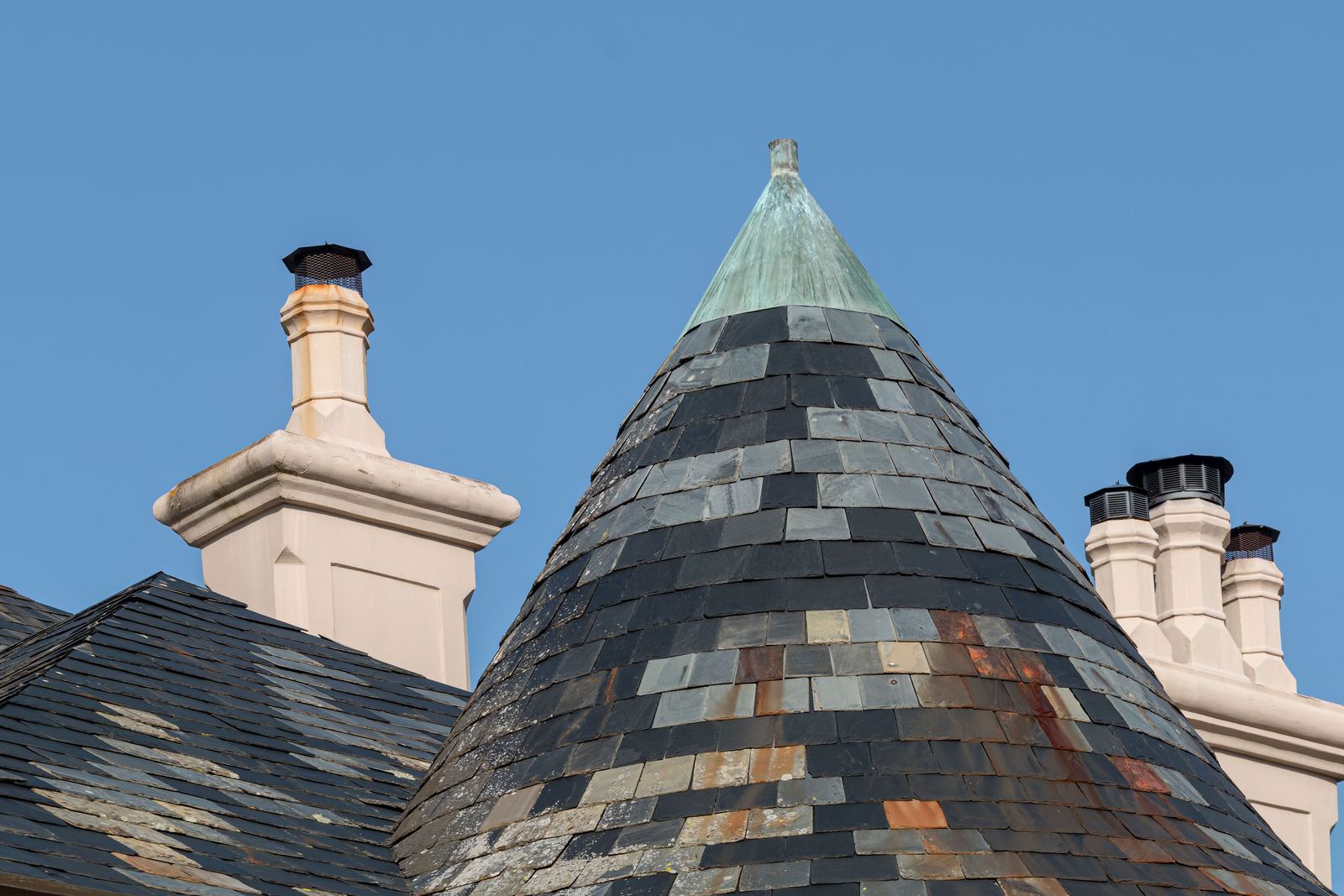
The T code is the one to care about. Slate contains iron sulphide, which roofers call pyrites. In a poor slate those inclusions oxidise once they are up in the weather: a rust-coloured tear stain first, then splitting around it, then a hole. It does not look like a leak for years, and then it looks like several at once.
So the sentence to say out loud is this: which slate is it, and can I see the Declaration of Performance. A supplier holding A1 T1 S1 material will produce it without blinking. Anyone who cannot tell you the codes is selling slate they never asked about.
Now the honest limit, because overselling those three letters would be the same mistake in the other direction. Conformity does not settle quality. NBS puts it plainly: it is not sufficient to specify slates to BS EN 12326-1 only, since the standard includes several different levels of conformity. Slates can conform, carry the right marking, and still behave differently on a roof facing the prevailing wind. The codes narrow the risk. They do not eliminate it. Ask for the quarry too, and handle a slate before the pallet is ordered.
Weight
Weight is where fibre cement has the genuinely strong argument
Fibre cement is roughly 40% lighter than natural slate in the commonest formats, and on a marginal structure that is a real point rather than a marketing one. Both figures below carry their condition, because a weight without its lap is not really a figure.
- Fibre cement, 20.4 kg per square metre. Cedral publishes 20.4 kg/m² for the Thrutone Smooth slate at 600 by 300 mm laid to a 100 mm lap, rising to 22.8 at a 150 mm lap: same slate, different weights, because the lap changes how many go on.
- Natural slate, roughly 35 kg per square metre. Cupa Pizarras gives about 35 kg/m² for the commonest UK format, 500 by 250 mm at 5 mm thick: 1.889 kg a slate, 18.8 slates to the square metre at a 75 mm lap. A 6 to 7 mm slate is 2.76 kg, heavier again.
That gap decides the job when you are re-covering a structure never built for the heavier material: a garage, an outbuilding, a dormer cheek, or an older roof with light, widely spaced rafters. Taking fibre cement off and putting natural slate on raises the dead load by about three quarters, which is a question for the structure before it is one of taste. Same conversation as a change of covering on a tiled roof, in concrete against clay roof tiles.
Fibre cement has its own standard, and it is worth naming because “cheap fake slate” is lazy. BS EN 492 is the product specification and test method for fibre cement slates and fittings. A slate made to it carries a declared bending strength class, and Cedral publishes Class B for Thrutone Smooth, 4 mm nominal thickness and a minimum density of 1,700 kg per cubic metre. Its real limitation is colour, not strength.
Side by side
Natural slate and fibre cement compared, dimension by dimension
Every row carries the condition that changes it. A comparison that hands you one weight and one minimum pitch per material is one you cannot use.
| Dimension | Natural slate | Fibre cement slate |
|---|---|---|
| Product standard | BS EN 12326-1:2014 | BS EN 492 |
| The declaration to demand | A1 T1 S1 on the Declaration of Performance, plus the quarry name | The declared bending strength class, e.g. Class B for Cedral Thrutone Smooth |
| Weight of covering | Roughly 35 kg/m² at 500 by 250 mm, 5 mm thick, 75 mm lap | 20.4 kg/m² at 600 by 300 mm, 100 mm lap. 22.8 at a 150 mm lap |
| Thickness | 3.5, 5 or 6 mm by grade and size, and it varies slate to slate because slate is split, not moulded | 4 mm nominal and consistent |
| Minimum pitch | Depends on slate size, lap and exposure. Read the supplier’s table | 22.5° at a 100 mm lap and 20° at 110 mm in moderate exposure, 25° at 100 mm in severe |
| Colour with age | Weathers rather than fades. The variation between slates is the point of the roof, not a defect | A pigmented surface that fades slowly and evenly |
| Repair and patching | Slates go back in with a tingle or a rehook, and a reclaimed slate of the same origin blends | Slates replace easily, but colour-matching a fifteen year old roof is difficult |
| What goes wrong | Bad slate rusting at the pyrites, and nail sickness long before the slate is finished | Colour drift, and breakages from foot traffic |
| Relative cost | Higher, and it varies enormously by origin | Lower and predictable |
The row homeowners underrate is colour with age. Read it next to the repair row: together they are the reason for the first “neither” below.
Pitch
Minimum pitch is never a single number, on either material
Do not accept one minimum pitch figure for slate. Pitch depends on the lap and on the exposure of the site, and neither of those is a property of the material.
Cedral’s figures for one product show the shape of it. The Thrutone Smooth slate is 22.5 degrees minimum at a 100 mm lap in moderate exposure, 20 degrees at a 110 mm lap, and 25 degrees at a 100 mm lap once the exposure is severe. One slate, three answers, five degrees apart. Increase the lap and the roof takes a shallower pitch, because water has further to travel before it can find a way past a joint. Increase the exposure and the pitch comes back up, because the wind drives rain up the roof instead of letting it run down.
Natural slate works the same way with one extra variable, the size of the slate: a large slate carries a large lap and still covers economically, so it goes lower than a small one. There is no universal figure. Ask for the published minimum pitch of the specific slate at the lap and exposure proposed, in writing.
Exposure is not a judgement call either. It follows the site: how high, how near the coast, how sheltered by other buildings. A roof behind a row of houses and one on an open clifftop are not in the same category, and the second needs the steeper pitch or the bigger lap. If the quotation names no exposure category, close that gap. What a roofing quote should include lists the other lines that ought to be on it.
The verdict
Which one belongs on your roof
Natural slate belongs on a period, listed or conservation area roof, and fibre cement on a modern roof or outbuilding where weight matters. Neither is right mixed on one elevation, or as natural slate with no paperwork or a T2 or T3 code.
Natural slate is right when
The house is a period property, listed, in a conservation area, or already in natural slate and you want it to look the same in fifty years. Slate is often the thing a conservation officer is protecting, so on those houses the material is not a free choice, and re-roofing in a conservation area goes through how that works.
Fibre cement is right when
The roof is modern, or it is a garage, an outbuilding, an extension or a rear elevation nobody looks at, and the weight of natural slate is a genuine structural constraint. At 20.4 against roughly 35 kg per square metre it is the lightest common pitched covering by some way, and on a rear extension it is the sensible answer.
Neither: do not mix them on the same elevation
This is the common mistake and the one we would talk you out of. The two materials weather differently, so a fibre cement patch on a natural slate elevation goes from invisible to obvious over about ten years, and by then the scaffold is gone and putting it right means doing the whole side. If you need a partial re-slate, source second-hand slate of the same origin, or do the elevation in one go.
Also neither: natural slate with no paperwork, or a T2 or T3 code
Do not accept natural slate with no Declaration of Performance, and do not accept T2 or T3 on a roof you intend to keep. Cheap imported slate that rusts at the pyrites is the most expensive mistake available here, and the reason is the failure pattern rather than the price. It fails at about fifteen years and it fails all over at once, because every slate came from the same seam and has had the same weather. You do not get a repair. You get a second re-roof and the first roof in a skip.
The related trap is fixings. Slate outlives its nails, so on a roof leaking with sound slate the answer is often a strip and re-lay using what is up there. Ask before anyone orders a pallet. Same logic as the dry ridge argument: the covering is rarely the part that failed.
Before anyone touches an old fibre cement roof. Fibre cement slates made before the mid 1980s may be asbestos cement, and HSE’s position is that any building built or refurbished before the year 2000 can contain asbestos. Do not cut, drill, break or pressure wash old cement slates, and do not let anybody strip them without establishing what they are. Intact, they are not the problem. A grinder is.
Next steps
What to do next
Before choosing slate, work out what is on the roof now, measure the pitch and exposure, and check the paperwork for whichever slate is quoted. Those first four cost nothing. Then ask whether the existing slates could be re-laid.
- Work out what is up there now. Natural slate rings when tapped and varies in thickness and shade. Fibre cement is uniform, with a flat edge rather than a split one.
- Measure the pitch and note how exposed the roof is. Both rule slates in and out before anything else does.
- If natural slate is quoted, ask for the Declaration of Performance and the quarry name, check for A1 T1 S1, and ask to hold a slate.
- If fibre cement is quoted, ask for the published minimum pitch at the lap and exposure proposed, and the declared bending strength class.
- Ask whether the existing slates could be re-laid rather than replaced. If the roof has been shedding slates in a gale rather than leaking, read how wind gets under a covering first.
- Get the second quotation written to the same scope, slate and lap, so you are comparing two prices for one job, not two different jobs.
If you want the roof looked at properly first, that is what our roofing work covers, and a free written itemised quote comes out of it either way. Thomas Hannen comes out and prices the job himself. If he finds your slates are sound and the roof needs fixings and underlay rather than new slate, that is what the quote will say, and it is the cheaper job.
Questions
Common questions
What does A1 T1 S1 mean on a slate?
A1 T1 S1 are the three classification codes under BS EN 12326-1. A1 means the slate absorbs under 0.6% of its own weight in water, T1 means the thermal cycling test produced no change in appearance, and S1 means no damage in the sulphur dioxide test. A1 T1 S1 is the best of each and it is the string to ask for on the Declaration of Performance.
Is fibre cement slate as good as real slate?
For strength and weather resistance it is a specified, tested product made to BS EN 492 with a declared bending strength class. Its real limitation is colour: the surface is pigmented and fades slowly, so a patch repair on a weathered roof is hard to match. Natural slate weathers instead of fading.
How much lighter is fibre cement than natural slate?
Roughly 40% in the commonest formats. Cedral publishes 20.4 kg per square metre for its Thrutone Smooth slate at a 100 mm lap, against about 35 kg per square metre for natural slate at 500 by 250 mm and 5 mm thick. Always check which lap and format a weight figure is stated at.
What is the minimum pitch for a slate roof?
There is no single figure. Pitch depends on the lap and on how exposed the site is, so the same fibre cement slate can be 20 degrees at a 110 mm lap in moderate exposure and 25 degrees at a 100 mm lap in severe exposure. Ask for the manufacturer's published minimum for the actual slate at the lap proposed.
Can I patch a natural slate roof with fibre cement slates?
You can, and you should not. The two materials weather differently, so the patch becomes obvious from the pavement within about ten years. Source second-hand natural slate of the same origin, or re-slate the whole elevation in one go.
Read next
Related advice
The guides below pick up where this one leaves off, and the roofing page covers the work itself and the places we cover, if you would rather have the job looked at.
Who wrote this
Thomas Hannen
Thomas owns Bournemouth Roofing & Building and prices every job himself instead of sending somebody else. The company is Bournemouth Roofing & Building Ltd, number 15471719, registered in England and Wales. If you want to talk something through before you commit to anything, the site visit and the written itemised quote are both free.
Free quote
Been quoted for a slate roof and not sure about the slate?
Thomas comes out, looks at what is up there and puts in writing what he found, including which slate is being proposed and what its paperwork says.