Exterior cleaning in Rockbourne
Soft washing, roof cleaning, gutters and valleys cleared and paving brought back along the village street at Rockbourne and the SP6 downland lanes.
The site visit is free and so is the written itemised quote. Thomas Hannen prices every job himself.
Almost everything along the street at Rockbourne is cleaned at low pressure or not at all. In a village this size with more than fifty listed entries in it, the wrong nozzle costs a great deal more than the clean ever saved.
People ring us here for one of three reasons. A wall has gone dark and green on the side that never gets the sun, and it is old enough that nobody wants a machine near it. A roof slope is carrying moss and dropping it into the gutter and the valley. Or the paving and the path are slippery from the first wet spell of the autumn onwards.
We come out and survey it surface by surface, because old brickwork, flint, lime render and a modern tiled roof want four different methods and most of them want almost no force at all. You are told what will come up, what needs a treatment and then time to work, and what we would leave well alone. The site visit is free and the written price puts every surface on its own line.
What the work involves
Cleaning old fabric on a village street
Brick, flint and lime. The older buildings along the street are soft brick, flint panels and lime mortar, some of them under painted or colourwashed render. A wall like that was built to let water back out through the joints, so anything that takes the fired skin off a brick face does damage that will not come back. It is soft washed with a weak solution, given time to work and rinsed at low pressure, with a test patch on a hidden elevation first. Where the pointing has already opened, get the mortar done first and the clean second.
The north side is the side that greens. Rockbourne sits with its worst exposure to the north, and a slope that gets no direct sun stays damp between showers, so moss and algae establish far faster there than on an open south elevation. That is why the shaded half of a building is priced differently from the sunny half.
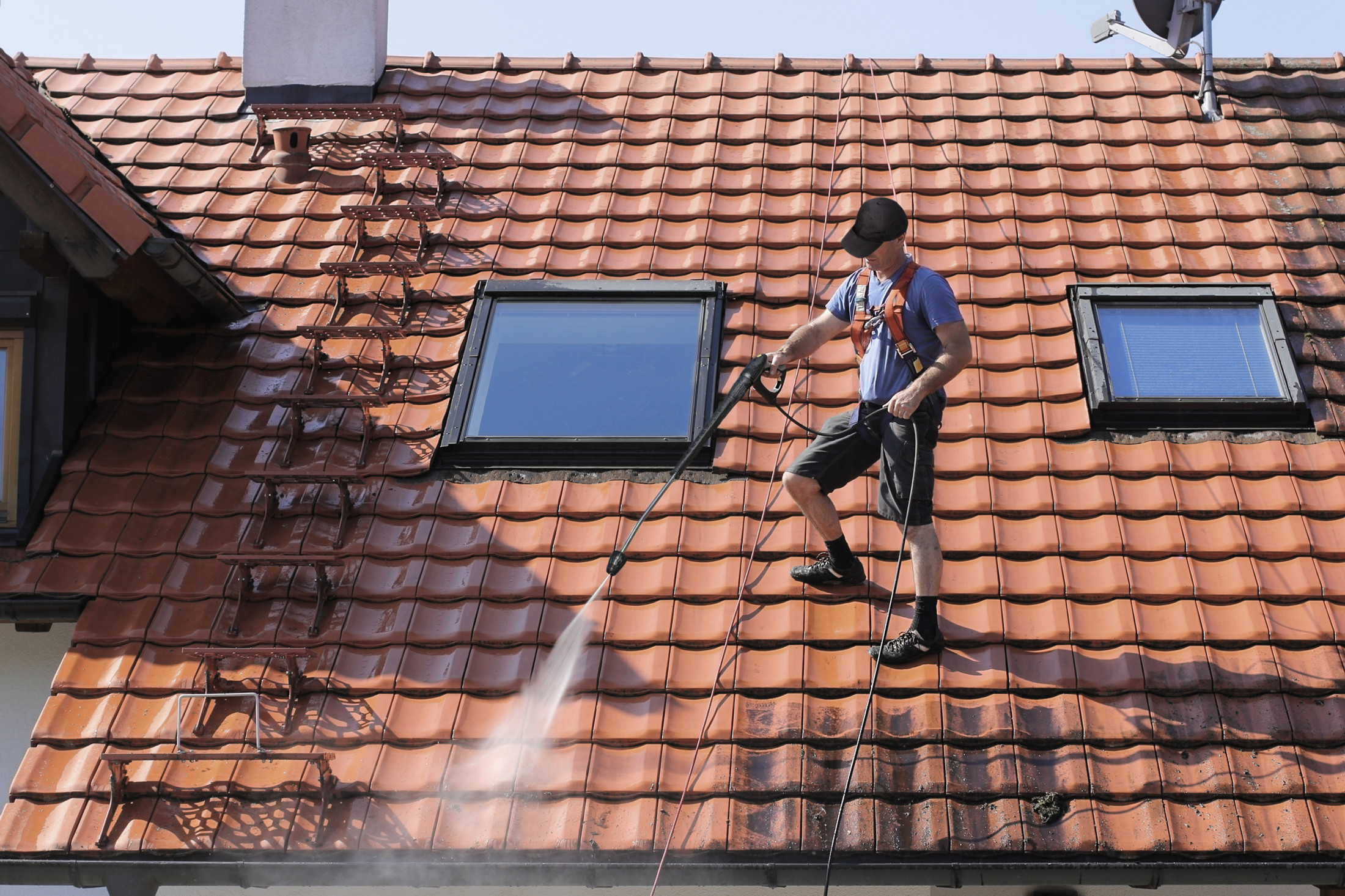
Roofs, and what is next to them. Clay tile on the older buildings, concrete interlocking on the newer houses and bungalows. The growth is scraped off dry, the tile soft washed at low pressure and treated with a biocide so the spores left in the surface do not bring it straight back. Nothing is forced up under the lap. Where a roof runs up to thatch the work stops well short of it and no spray goes anywhere near.
Garden and boundary walls along the street are brick, flint or cob under a tile or a thatched cap. They green on the shaded face and at the base, and they are the easiest thing on the property to wreck with a pressure washer, because the mortar in an old free standing wall is doing structural work. Low pressure or nothing, and if the capping has failed a clean is not the job.
Sweatfords Water runs a few yards from the street and the low ground here sits in flood zone 3, so where the wash water ends up is a real question rather than a form of words. Mature trees fill the gutters and valleys every autumn, and those are cleared by vacuum or by hand and the outlets rodded. Planting is soaked and sheeted, gullies are covered, and everything we spray is approved for the job and used to its label, which is what the biocides regime the HSE administers requires.
How it runs
From your call to a written price
Thomas Hannen prices it himself and the quote is itemised: method by surface, protection, access, and where the water and residue go, each on its own line. Rockbourne is a conservation area and the parish carries more than fifty listed entries, the church of St Andrew among them, so a good deal of what stands along the street is protected in one way or another. The wash itself is maintenance and needs no application. Painting, coating or sealing a surface that has never been treated that way is a change of appearance, and on a listed building consent comes before the work. Planning Portal guidance on external walls sets out where maintaining a wall ends and altering it begins.
Cost
What decides the price of a clean
The same square metre can take two minutes or twenty, so there is no rate for it. What we look at on the visit is the reach: a cottage hard on the street with nowhere to park, a farmhouse behind a wall with room for the van, and a bungalow with a conservatory across the back are three different set ups. work at height rules decide where a pole stops and a tower starts. After that it is the surface, since lime pointed flint takes no pressure at all, and how long the growth has been left, because old lichen wants a treatment and time.
If there is a date
A viewing, a visit or a deadline
Ring rather than use the form, and say what the date is for. Nearly seventeen miles out, Rockbourne goes into a day with the villages up that way, so a fortnight of notice buys a firm date rather than a hopeful one. If a sale or an inspection is driving it we will tell you honestly what can be done properly by then. Outside Monday to Friday, 8am to 6pm, by arrangement.
The one local thing
The bottom metre of the wall is a different problem
Rockbourne sits along the Sweatfords Water, and the stream runs within a few metres of some of the plots here. Parts of the village fall inside flood zones two and three, which you can check yourself on the government flood risk service. What that means in practice, most years, is not flooding at all. It is that the ground stays wet.
Low walls beside the street take splash back off the road and the puddles every time it rains, the base of a wall wicks damp up out of ground that never really dries, and green and black growth come back at the bottom of a wall long before they come back anywhere else on it. Cleaning that band looks brilliant for a few months and then goes again, which is why we say so on the visit rather than after the second wash.
So the useful conversation here is about the cause rather than the clean. Is the ground level up against the brickwork where it used to be lower. Is a downpipe discharging onto the path instead of into a gully. Has a border been built up over the years so soil now sits against the wall. Sort those and the wash lasts. Leave them and it will not, whoever does it.
The stream also decides where the residue goes: with open water that close we contain and take it away rather than run it to the nearest grid, and we follow pollution prevention guidance on that. On the plots nearest the water we work with less product and more dwell time, and will tell you honestly when that means coming back a second time.
Who you are dealing with
A local firm you can check
Rockbourne, Whitsbury, Breamore, Damerham, Fordingbridge and the SP6 villages along the downs and the Avon, worked from our base near Bournemouth. Bournemouth Roofing & Building Ltd, registered in England and Wales, company number 15471719, which you can look up in a minute. Thomas Hannen's business, and he is the one who comes out to price the job, not a salesman. A verified customer's 10 out of 10 on Checkatrade. The visit and the written quote are both free.
Questions
Rockbourne questions we get asked
Rockbourne is a conservation area. Does that cover a wash?
A clean is maintenance, so the designation does not stop you having the walls or the roof washed. What it controls is a change of appearance. Stripping lichen off old stone and then painting or sealing it is a change, and so is swapping a covering while you are up there. Like for like is fine. Where the work touches one of the 52 listed entries, the Church of St Andrew among them, we speak to New Forest planning first.
Why is the north side green when the front is clean?
Because the village lies on a north facing slope and that elevation never gets an hour of direct sun on it. The surface stays damp right through the year, so algae and moss establish there while the open side has dried out by mid morning. There is no sense washing the whole building at one strength. The shaded side gets a longer biocide dwell and the sunny elevations get a lighter pass.
Sweatfords Water runs past our garden. Does that change anything?
It changes where the run off is allowed to go. Sweatfords Water is about thirteen metres away at the nearest point and Rockbourne sits in flood zones 2 and 3, so nothing carrying biocide goes near a ditch, a field drain or the stream itself. We bund the low side, run the wash to a foul gully where the property has one, and on the places with no mains drain we collect it and carry it away.
What do you look at before quoting an old Rockbourne cottage?
The mortar, first. On the older buildings in Rockbourne the joints are lime and the stone is soft, so we wet a test patch on a hidden elevation and see what comes away before anything else happens. Then the gutter line, the valleys, the state of the render at low level, and where water can run once it leaves the wall. On a listed building we also note what cannot be wetted, such as exposed timber or an open joint.
Can you reach the back of the house without a scaffold?
Usually. Most of this work is done off the ground with a telescopic pole and a soft brush fed by filtered water, which reaches a two storey gutter line comfortably. Where a rear elevation backs onto a paddock or a narrow lane we may want a tower rather than a scaffold, and that goes on the quote as its own line. Nobody walks a fragile old tiled slope when a pole will do the same job from the lawn.
Nearby, and next door
Exterior cleaning near Rockbourne
Exterior cleaning nearby
Our other trades in Rockbourne
Everything we do in Verwood Exterior cleaning, all areas Every area we cover
Free quote
Find out what will come up, and what will not
A free site visit in Rockbourne, then a written itemised price with every surface on its own line. Tell us if there is a date to work to.