Exterior cleaning in Ashmore
Moss, algae and blocked gutters on old buildings in Ashmore and the Cranborne Chase villages. Free site visit, free written itemised quote.
The site visit is free and so is the written itemised quote. Thomas Hannen prices every job himself.
In a village where a lot of the buildings are older than the pressure washer by a couple of centuries, the honest answer to half the enquiries we get is that the surface should be treated and left, not cleaned. Ashmore is one of the few places on our patch where we talk people out of work more often than into it.
The calls we do take here are usually one of three. Gutters and valleys that have filled with leaf litter off the surrounding woodland and are now running down the face of the wall. Paths, paving and steps that have gone green and genuinely slippery, which up on this ground happens for most of the year rather than for a few weeks of it. And a roof carrying enough moss that lumps of it are coming off into the gutter and down onto the path.
What we do about it is the same order every time. The site visit is free, and on a building of any age it is the important part: we look at the mortar, the state of the render and what the roof covering actually is before anybody talks about method.
Where a surface is doubtful we put a small test area somewhere out of sight and let you see how it behaves. Then you get a written itemised quote with the method named against each surface, including the surfaces we are recommending you leave alone and why.
The work
What can and cannot be cleaned on an old Ashmore building
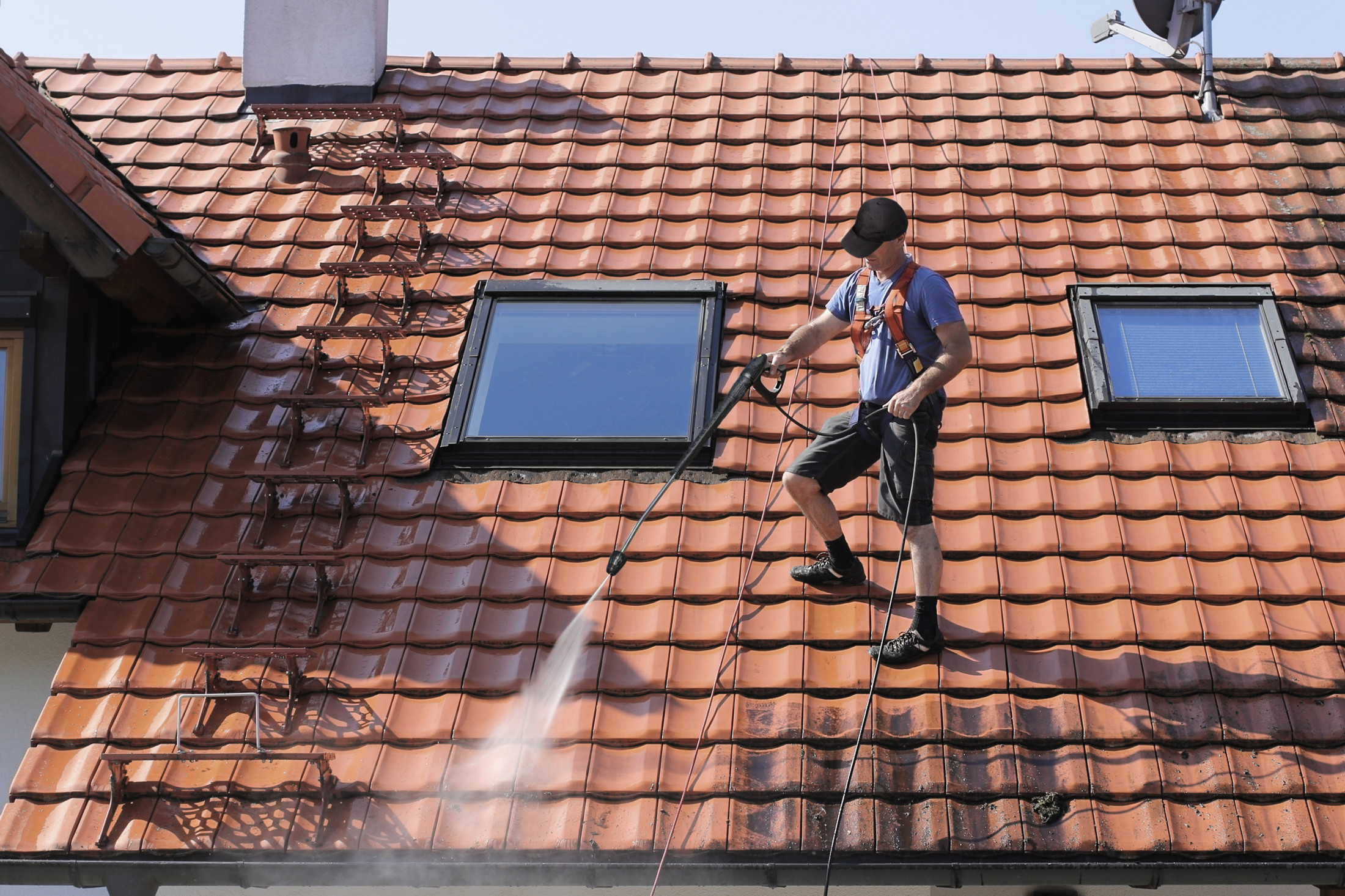
Old roof coverings. There are twenty six entries on the national list in and around this village, and plenty of unlisted buildings of a similar age beside them. Where a roof is hand made clay tile or stone slate, no pressure goes near it at any setting. Old clay is porous and softer than it looks, and a lance drives water under the lap, lifts tiles off their nibs and takes the weathered face off in strips. Moss is lifted off dry by hand and by scrape, the ridge is checked rather than scrubbed because the mortar under it is usually lime and already tired, and treatment is used sparingly. Lichen on old clay is a different question. It is slow, largely harmless and part of how the roof looks, so we will say when a roof clean is simply not worth buying.
Flint, soft brick and lime mortar. Where a wall is flint panels and lime rather than brickwork and cement, the joint is softer than the stone either side of it. Force does not clean that surface, it excavates it: mortar comes out of the joints, water is driven into the wall behind, and the damage does not show until the following winter. That work is a low pressure rinse and a brush, sometimes a treatment and nothing else. Limewashed and lime rendered elevations are the same argument, since the coating is meant to weather and wash off slowly.
Not everything here is old. The later houses round the village carry concrete tile, pebbledash and painted masonry, and they get the ordinary handling: moss off dry, biocide on to kill the spore, and a soft wash at low pressure on the walls.
Up here the gutters fill with leaf and seed off the trees round the village as much as with moss, and a good number of the older buildings still run cast iron. Cast iron is heavy, brittle at the ear and unforgiving of a ladder leaned against it, so it is cleared off a tower or a proper standoff. We check the downpipe discharges into a gully rather than soaking the foot of a solid wall, which up here is the commonest cause of damp inside. Old stone flags delaminate under force, so they get low pressure and a treatment for the black spot lichen, while block paving on the newer drives takes a wash and fresh kiln dried sand back into the joints. Anything shaded and sloping is done first, because that is where somebody actually slips.
How it runs
From your call to a written price
Ashmore has its own conservation area over the village and twenty six entries on the national list around it, so this is one address where the paperwork question is real. Washing a wall is maintenance and needs nothing. Changing how it looks is another matter: taking limewash or a historic finish off, or putting a coating, a paint or a sealer on afterwards, can need listed building consent on a listed building, and Dorset Council takes an interest in appearance across the conservation area generally. The Planning Portal page on external walls sets out where that line falls, and we check which side of it a job sits on before we quote rather than after.
Cost
What decides the price of a clean
Age, not area. A cottage on the village street with a hedge between the van and the wall, a farmhouse with a long low roof and no level hardstanding to stand a tower on, and a newer house at the edge of the village you can pole from the drive are three different jobs before any water moves. Reach poles do part of it, the rest wants a tower, and the work at height rules decide which. Ask what is treated, what is only rinsed, and where the run off goes.
If there is a date
A viewing, a visit or a deadline
Ring rather than use the form. The date is usually a sale, an inspection or scaffolding due off. Ashmore is the far end of our patch, up on the Chase, so village work is planned into a run and you get a day, not a vague week, and we will say straight if the weather up there makes it unrealistic. The phone is answered 24 hours for emergencies; scheduled work runs Monday to Friday, 8am to 6pm.
Worth knowing
The conservation area changes what a clean is allowed to do
Everything inside the Ashmore conservation area is looked at for how it affects the character of the place, and that includes the outside of buildings that are not listed themselves. For cleaning, the line is usually easy to find once somebody points at it. Taking dirt, moss and algae off a surface and leaving the surface as it was is maintenance, and nobody needs to be asked. Changing the surface is not.
Removing a limewash or an historic finish, taking the weathered face off old brick or stone, or following a clean with a coloured coating, a paint or a masonry sealer all change the appearance, and on a listed building that can need consent from Dorset Council in its own right. The number of listed entries around this village means the odds of that applying to you are far higher here than in a modern village down on the greensand.
What that should change for you as a buyer is what you ask for. Get the method in writing per surface, not a single line saying the house will be cleaned, and be wary of anyone who offers to clean and seal an old wall in the same breath, because a sealer on a solid lime built wall traps the water it is supposed to keep out.
Ask for a test panel somewhere nobody looks. And do not be talked into a full roof clean because the roof looks old: on hand made clay a good deal of what is being sold as dirt is weathering, and weathering is what has kept the tile alive.
Who you are dealing with
A local firm you can check
We cover Ashmore and the Cranborne Chase villages, out through Sixpenny Handley and Tollard Royal towards Shaftesbury and down to Blandford, with Dorset Council as the authority for this address. Bournemouth Roofing & Building Ltd, registered in England and Wales, company number 15471719, which you can look up in a minute. Thomas Hannen's business, and he is the one who comes out to price the job, not a salesman. A verified customer's 10 out of 10 on Checkatrade. The visit and the written quote are both free.
Questions
Ashmore questions we get asked
Does the conservation area stop a straightforward wash?
Cleaning is maintenance, so Ashmore Conservation Area does not stop it. What the designation controls is appearance, and that bites the moment a wash turns into a change: a coating over old tiles, a fresh colour on render, a slate swapped for something modern. We keep what we do reversible. If you want the finish altered rather than simply cleaned, that is a conversation with Dorset Council before anyone starts.
Much of the village is old. Is jetting ever used?
Not on anything old up here. Ashmore has twenty six listed entries and a good deal of stone and lime mortar alongside them, and a lance drives water into an open joint and blows the binder straight out of it. We work at low pressure with a biocide and let it do the job over the following weeks, which is slower to watch but leaves the joints where they belong.
Ashmore is a long way out. Is that a problem?
It is roughly twenty miles up onto the Cranborne Chase, so we group work out that way instead of making single trips, which means a booked date rather than a same week call out. The visit to price it is still free. In practice the lanes and the gateways matter more than the mileage, and Thomas checks where the van and the water can safely stand.
The lane is under trees. Does that change the gutters?
It fills them faster than anything else does. Beech and hedgerow on the Chase drop leaf and mast into the runs and the valleys, and once a valley silts up the water travels sideways under the covering instead of down into the outlet. We clear by hand into bags rather than flushing it through, because out here the run off has nowhere to go except the verge and the ditch.
What can I check myself before you visit?
Look at the wall below the gutter after heavy rain. A dark stripe down stone or render, or a green streak running from one joint, tells you where it is going over the front edge. Look along the ridge line too, and at the top of any chimney. On the older Ashmore properties growth on the north face is ordinary, but a slipped stone slate is not.
Nearby, and next door
Exterior cleaning near Ashmore
Exterior cleaning nearby
Our other trades in Ashmore
Everything we do in Blandford Forum Exterior cleaning, all areas Every area we cover
Free quote
Ask us what should be left alone
We will look at the roof, the mortar and the render before anyone talks about method. Free site visit, free written itemised quote, and a test panel where it matters.