Patios in Highcliffe
Two hundred metres from the sea a patio stays damp between showers, so grip, jointing and the fall matter more here than the colour of the slab.
The site visit is free and so is the written itemised quote. Thomas Hannen prices every job himself.
Last updated
In Highcliffe, close to the coast, a patio spends the winter damp, so it greens over and turns slippery faster than one inland. Choosing a slab with real grip, filling the joints properly and giving it a generous fall are what keep it safe.
In Highcliffe a patio that has gone green and treacherous, and needs jet washing every spring, is closely tied to the fall that tends to follow: somebody slips on it, or watches a parent do so, and wants the whole thing taken up and done properly.
Both are about how long water sits on the surface. We come out to Highcliffe, look at the aspect and the shade, take a survey of the levels, work out where the water is going and price the dig, the base, the drainage, the jointing and the paving on separate lines in a written itemised quote. The site visit and the quote are free.
The work
Paving for a garden that never quite dries
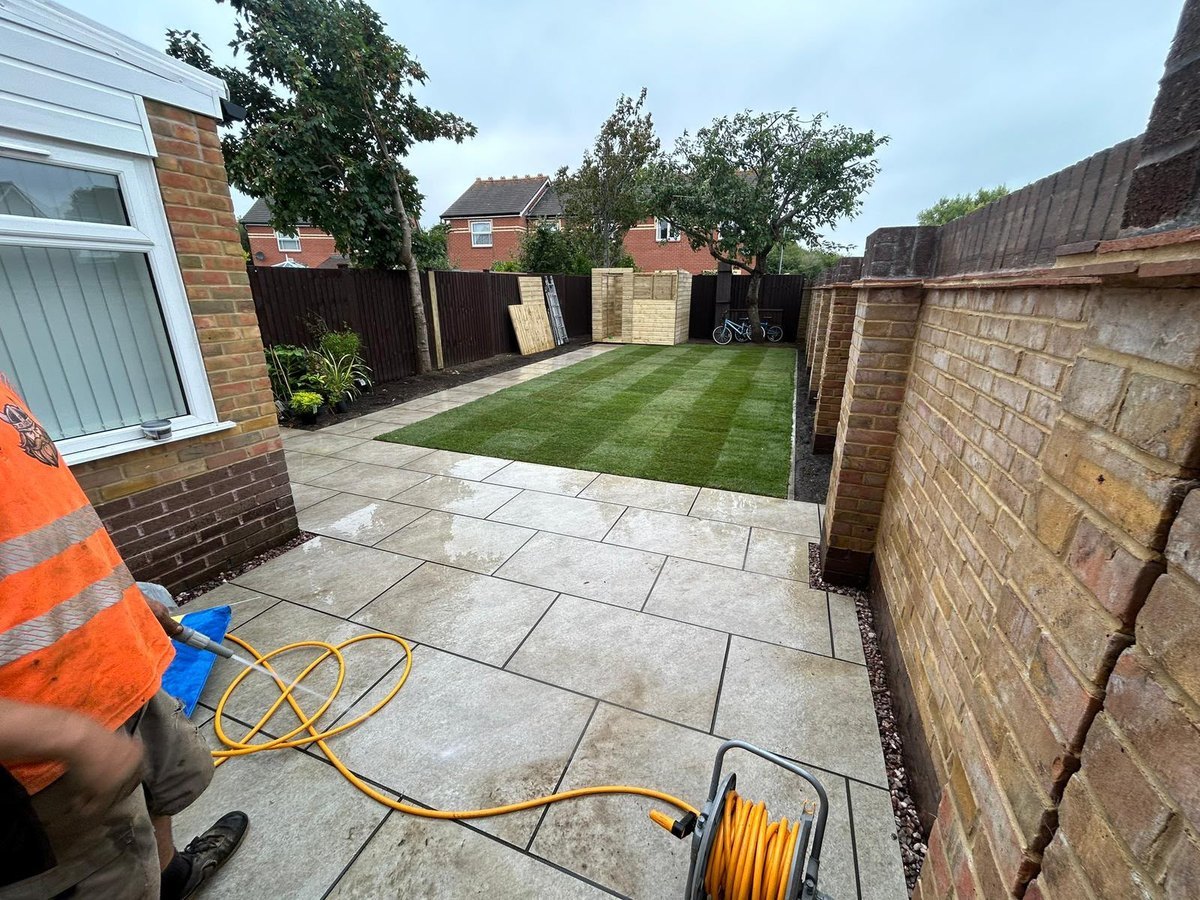
The surface you will walk on in January. Slip resistance is the first question in Highcliffe, not the last. We look at where the patio sits and how wet it stays, then pick a slab with the grip to match. A textured porcelain and a honed limestone can look similar in a brochure and behave completely differently underfoot in a wet February.
Taking out what is there. Usually mid century concrete flags on sand or a slab left by a greenhouse. It is excavated to formation, with any made ground and roots taken with it, and the spoil loaded to a skip. Access decides how: a bungalow with a side gate is barrow work, a corner plot takes machinery.
Levels and the damp proof course. We scrape back, chalk the DPC on the brickwork and set the finished paving two courses below it, falling away from the wall. On the single storey Highcliffe stock that is often the tightest dimension on the job, and where a threshold has to stay flush we use a recessed channel instead of a step.
Base and bed. Geotextile membrane, MOT Type 1 hardcore compacted in layers, a sharp sand screed to level it, then a full bed of mortar under the whole slab with a slurry primer on the back. Not dabs. A proper mortar bed does not go hollow; slabs on dabs do, and hollow slabs end up rocking, cracked and holding water where you step out of the door.
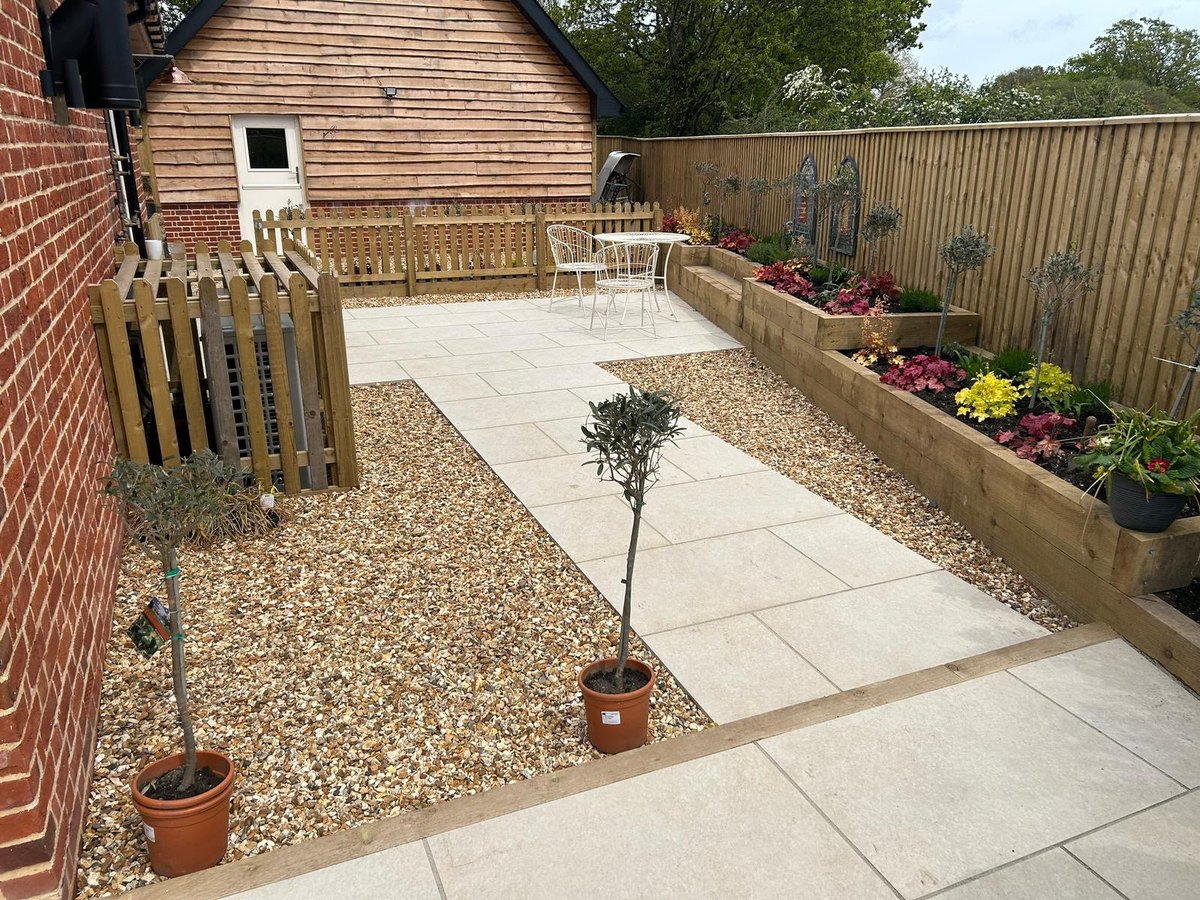
What salt air does to the choice. Porcelain is calibrated, takes on almost no water and is the easiest surface to keep clean within sight of the sea at Highcliffe. Sandstone and limestone are warmer to look at and will green up. Granite is dense and dark. Travertine holds water and we would talk you out of it on an exposed plot.
Joints that do not wash out. Driven rain finds a loose joint and empties it. Everything gets a brush in resin compound, a grout slurry or hand pointing in mortar, never loose sand. Full joints keep weeds out, stop the bed washing and are most of the reason a patio still looks new after five winters.
Falls, channels and edges. A generous fall away from the house, into an ACO channel, an existing gully or a soakaway set clear of the foundations, and permeable construction where the runoff has nowhere to go. Open edges are held with a haunched kerb, a coping where it stands proud and a shingle border along the wall.
Lifting and relaying. Not every tired patio near the cliff at Highcliffe needs replacing. A bay that has sunk, two slabs lifted by a root, algae, efflorescence and staining after a wet winter: we say honestly when that is a clean, a re-joint and a lift and relay rather than a rebuild.
How it runs
Laying a patio behind a bungalow or a block
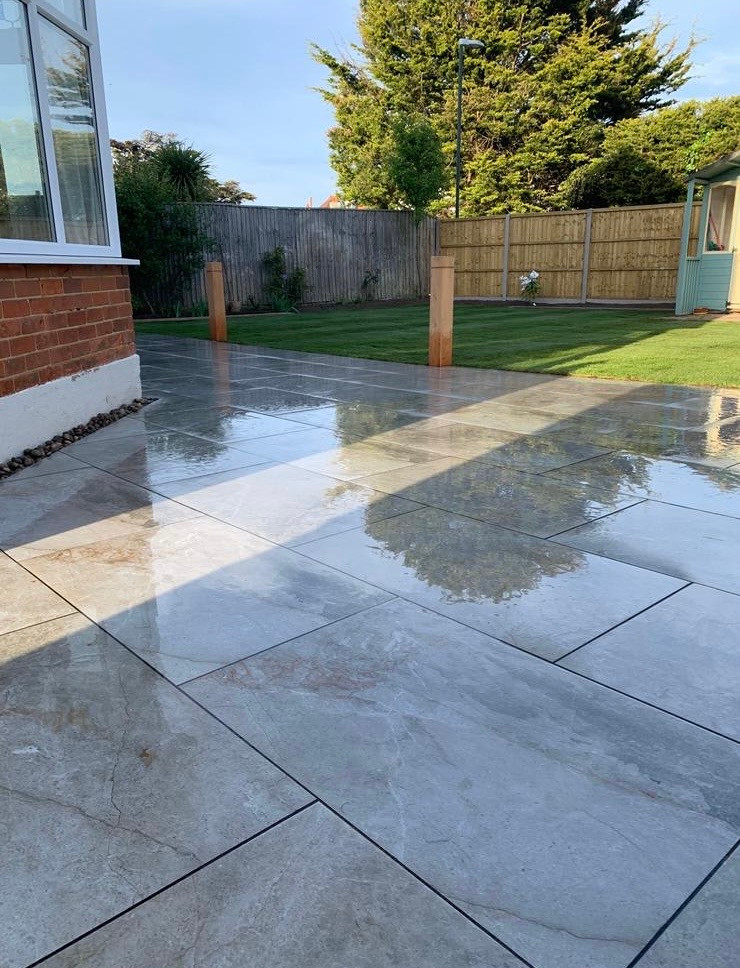
Thomas comes out, looks at the garden and the damp course line on the house, and works out how everything will get in and out. His written price breaks down the dig and removal of spoil, the sub base, falls and drainage, edgings and any steps, the slabs, and the jointing. Thomas is the person you deal with from first spade to last joint.
Behind a Highcliffe bungalow the only way in is often a narrow side gate, so the dig comes out by barrow and every slab is carried round. A corner plot may take a small digger and a skip on the drive. A shared terrace behind flats is common ground, so the freeholder or managing agent has to agree the work first.
Nothing is left as an open trench at night, paths stay clear, and spoil goes away with us. If the dig finds an old drain, a buried slab or roots, you will see a photo of it and a price for it before the dig goes any further.
Laying a patio at garden level normally falls within permitted development, so you seldom need planning permission; raised decks and platforms are what usually trigger an application. The finished level must stay below the damp proof course, a building regulations point from Approved Document C. In the grounds of a listed building such as Highcliffe Castle, the council's listed building pages apply, and Bramble Lane and Verno Lane are on the list of conservation areas.
Cost
Slabs are the small part: what a patio price is made of
Of everything on a patio quote, the slabs are the part you pick and the smallest share of the money, so we do not work to a metre rate.
Carrying it in. If everything goes through a side gate by barrow, or across a shared terrace, the dig and the materials take far longer than on an open plot where machinery can reach. That is the biggest swing between two gardens of the same size.
Clearing the ground. Old concrete, raised beds, roots and buried rubble all have to be broken out and carted away, and that is charged by the load.
Clay and falls. The clay under much of Highcliffe holds water. The surface must shed water away from the house to a gravel margin, a channel or a soakaway that will actually work, and on heavy ground that can mean a deeper crushed stone sub base or a drain.
The damp proof course. The patio should finish at least two courses below it. On a bungalow with low floors that may mean a step down or a retaining edge, and it is the most expensive mistake to get wrong.
The slab and how it is laid. A full wet bed of mortar under each slab takes longer than dabs, and lasts. The jointing compound matters too. Near the sea, shaded slabs go green fast, so a denser stone or porcelain is worth thinking about.
Questions for other quotes: how deep is the dig and which sub base is specified; are edgings, steps and drainage included; what falls and levels are proposed; is each slab bedded on full mortar?
If it has become a hazard
A slab that has lifted, or a patio gone green and slippery
A slab lifted proud at a corner, or a step that has sunk, will trip someone, and a north facing Highcliffe patio gets slippery. One that stays shaded and damp all winter can be treacherous for anyone unsteady on their feet.
Put a pot or a chair on the loose slab so it is obvious, and use the dry side. On the first visit we re-lay the worst of it and check whether the bedding under the rest has given way. If someone could fall, a call is better than the form, and if you catch us on a job, we call you back as soon as we can put the tools down. Scheduled work runs Monday to Friday, 8am to 6pm.
Worth knowing
Salt air keeps a patio damp for longer
Highcliffe is a couple of hundred metres from the water. Salt air does not damage paving, but it changes how a patio behaves, and it changes it in the one way that matters for safety.
Salt draws moisture and holds it. A surface within reach of the sea stays damp between showers instead of drying properly between them, and anything damp for long enough grows algae. That is why patios in Highcliffe go green faster than the same slab five miles inland. Green paving is slippery paving, and on a bungalow the people using it every day are often the ones who can least afford a fall.
So this close to the coast we would spend money on grip, joints and falls before spending it on a fancy slab: a textured surface with real grip, full resin or mortar joints because wind driven rain empties a sand joint and then the bed starts moving, and a fall generous enough that the water is gone in minutes. Get those right and a yearly wash keeps it safe.
Who you are dealing with
Where we are based, and what you can check
Gardens across Highcliffe, Chewton Common and the roads down towards the cliff are where we lay patios, and the local authority is Bournemouth, Christchurch and Poole Council. Our base in Boscombe is 5.7 miles away. Thomas Hannen owns the business and comes to your garden to measure up and price it himself.
A verified reviewer on Checkatrade scored us 10 out of 10. You are not charged for the visit, and the quote you get in writing, item by item, is free as well. Search Companies House for Bournemouth Roofing & Building Ltd, registered in England and Wales, company number 15471719. Salt air greens a front drive as fast as a terrace, and driveways in Highcliffe get the same attention to grip. Before you book a visit in Highcliffe, you can read our customers' Google reviews, word for word, on our reviews page.
Planning at a glance
Do you need planning permission in Highcliffe?
Most repairs in Highcliffe need no application at all. What decides whether a change to the outside of your house does is who the council is, whether a conservation area or a listing applies, and whether the place sits in a protected landscape.
| Question | In Highcliffe |
|---|---|
| Who decides | BCP Council is the planning authority for Highcliffe. BCP Council's heritage pages set out what it controls. |
| Conservation area | Yes: Bramble Lane Conservation Area and Verno Lane Conservation Area. They cover parts of Highcliffe, so check whether your street is inside one. |
| Listed buildings | Yes, there are listed buildings in and around Highcliffe. If yours is one, work can need listed building consent. |
| Protected landscape | No National Park or National Landscape covers Highcliffe. |
Questions
Questions about patios in Highcliffe
What gives the most grip underfoot when it is wet?
A textured or grip finished porcelain, by a distance. It absorbs almost no water so there is nothing for algae to live in, and the surface texture is engineered rather than incidental. Polished or honed stone is the one to avoid on a shaded coastal plot.
Why is the green so much worse this near the sea?
Salt in the air holds moisture, so the surface stays damp between showers rather than drying out. Algae needs only damp and shade. It is not a fault in the paving and it is not dirt; it is a growing thing, and it returns unless the water leaves faster.
Is jet washing bad for paving?
Used too close or too strong it takes the surface off soft sandstone and blows the joints out, and once the joints go the slabs start to move. A wide fan, a sensible distance and a re-joint afterwards is safer.
Can you just re-joint my existing patio?
Often, yes, and it is the cheapest useful thing you can do. If the slabs are still bedded and only the joints have gone, we rake them out and fill with a resin compound. If the bed has washed and the slabs rock, jointing alone will not hold it.
How long does a coastal patio last before it needs work?
The bed and the base should outlive all of us if they were built right. Jointing is the part that wears, and cleaning is annual this close to the sea. Most of what shortens a patio's life here is a joint left open.
Nearby, and next door
Patios near Highcliffe
Nearby places we also cover for patios, with straight-line distances from Highcliffe, and the other trades we offer in Highcliffe itself.
Patios nearby
Our other trades in Highcliffe
Patios guides
Driveway planning permission and where water goes Frost damage to brickwork: why it shows later Resin bound, block paving or tarmac comparedEverything we do in Highcliffe Patios, all areas Every area we cover
Free quote
Get a patio you can walk on in February
Thomas comes out, looks at the shade and the falls, and prices the grip, the jointing and the drainage in writing. The visit and the quote are free.