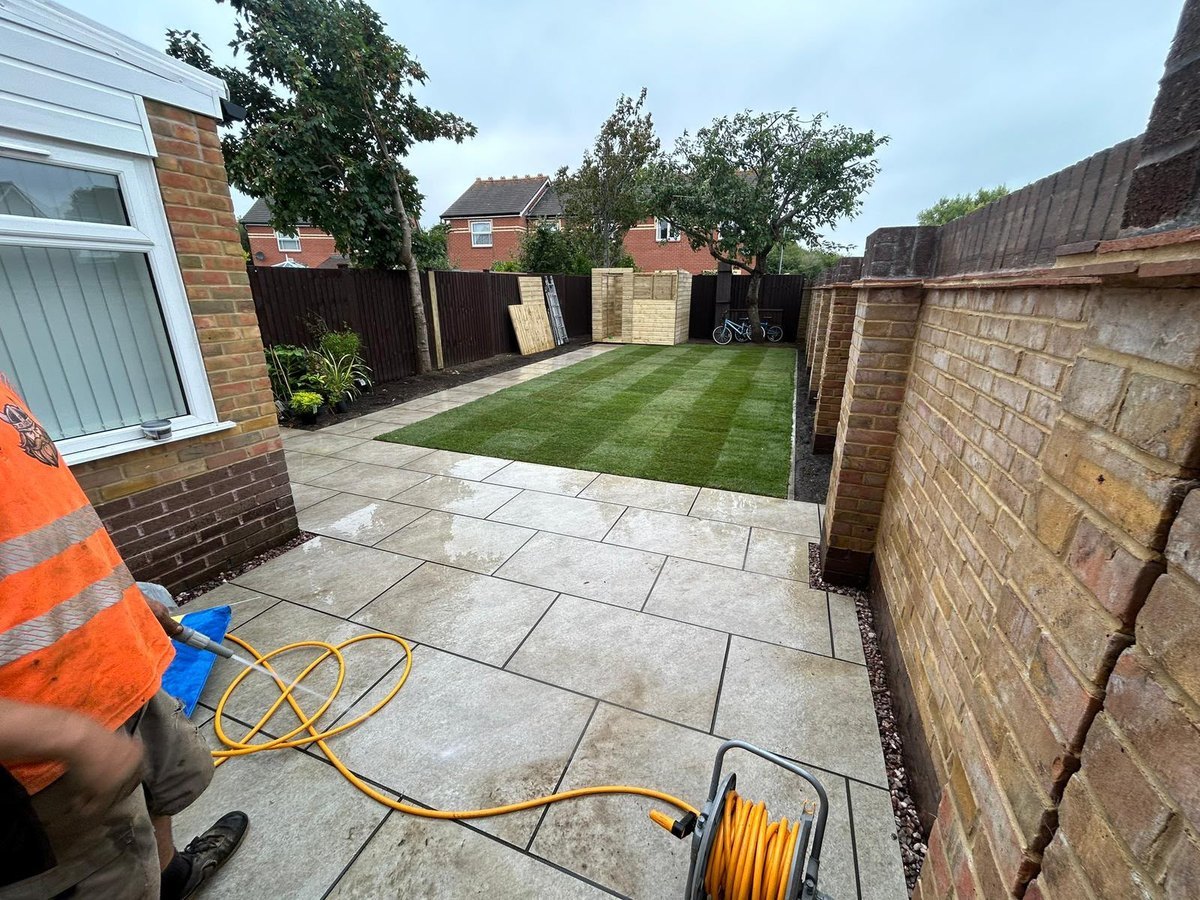
Patios in Hamworthy
Old concrete slabs lifted and replaced with porcelain or stone across Hamworthy, laid level, drained properly and priced in writing.
The site visit is free and so is the written itemised quote. Thomas Hannen prices every job himself.
Last updated
A patio in Hamworthy is usually a replacement: the grey concrete slabs laid when the house was new, now rocking, sunk by the back door or green all winter. We lift the old paving, rebuild the base, set the falls away from the house and lay porcelain or stone on a full mortar bed, priced in writing.
Rocking slabs and a dropped step are the commonest faults on a Hamworthy patio, along with water sitting against the back wall after rain because the patio now falls the wrong way. At a bungalow, the step from the back door onto the garden can become the hardest part of the day, and the aim is to make it level.
We come out to Hamworthy and look at the garden in the round: the levels against the damp course, how water leaves the paving, and how materials and spoil get in and out. Then it goes into one written, itemised price. If the base is sound and only a few slabs have moved, we say so and price the repair.
The work
Taking up the old slabs and laying a patio that stays put
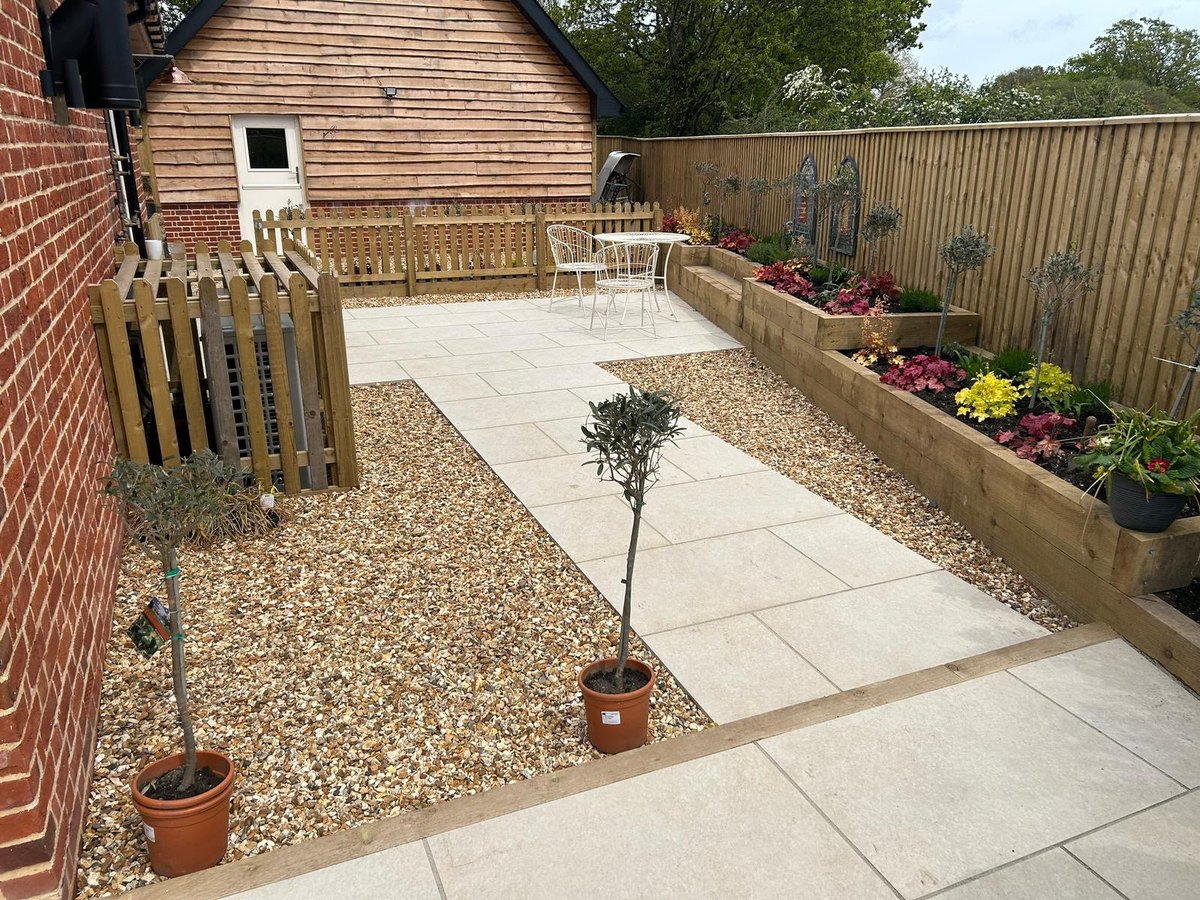
The original paving comes up. Plenty of gardens in Hamworthy still have the paving laid when the houses went up in the late sixties and seventies, with pre-cast concrete slabs laid on a few dabs of mortar or straight onto sand.
Fifty years on, the dabs under Hamworthy patios have let go, the sand has washed out and the slabs rock. We lift them, break out any old concrete underneath and dig down to a firm formation. Roots, old footings and made ground come out too, and the muck away is priced by the load.
The base. MOT Type 1 sub base, laid and compacted in layers, is what stops a patio sinking. Over soft ground we put a geotextile membrane under it. Then every slab goes on a full wet mortar bed, never on dabs, because a slab supported at five points cracks and rocks, which is exactly what you are replacing.
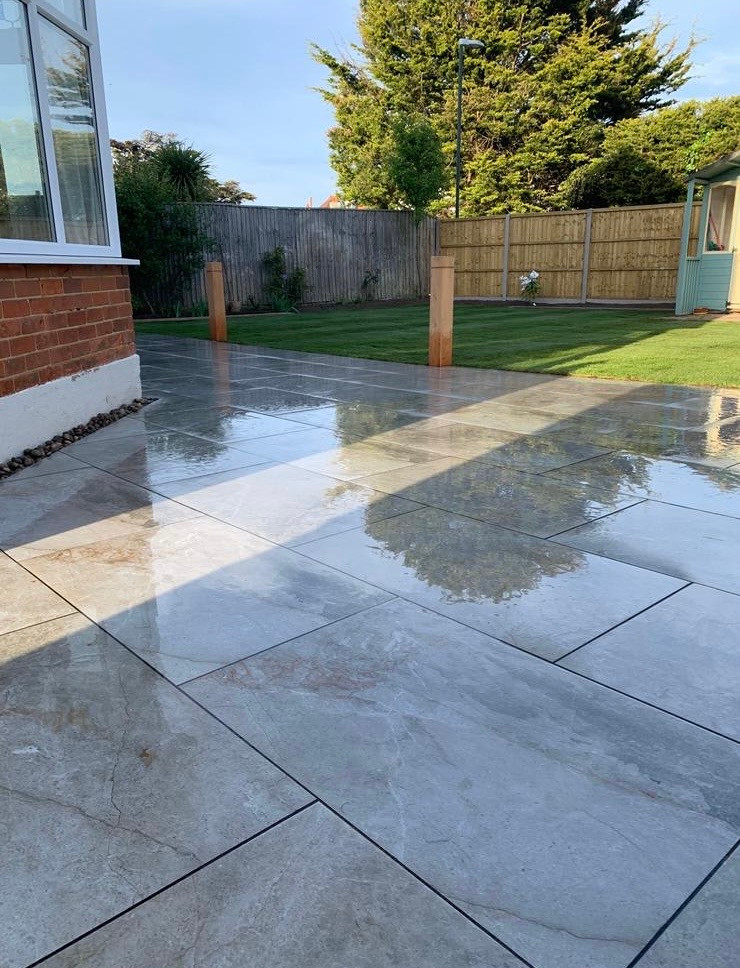
Porcelain. Dense, hard wearing and nearly non-porous, so it does not stain and it sheds algae better than most stone. It needs a slurry primer on the back of each slab for the bed to grip, and a textured finish rather than a smooth one so it is not slippery in the wet. Calibrated slabs are all one thickness and lay faster and flatter.
Sandstone, limestone and granite. Sandstone has the warmth and the variation, but it is porous, so it marks and greens faster in a shaded corner. Limestone is calmer in colour. Granite is the hardest of the three and keeps its grip wet. We show you samples wet as well as dry, because that is how they look for half the year.
Level access for bungalows. Hamworthy has a good number of bungalows, and the most useful patio on one is often the plainest: step-free from the back door, laid to a gentle fall, with a channel drain across the threshold so the paving can meet the door without sending water under it.
Falls, steps and edges. The paving falls away from the house and finishes two courses below the damp proof course, the level Approved Document C works to. Where a garden slopes, that means steps with a bullnose or coping edge, or a low retaining wall, and edgings haunched in concrete so the border does not creep onto the paving.
Jointing and repairs. Joints are brushed in with a jointing compound and finished off, because open joints fill with weed in a season. On their own we lift and re-bed rocking slabs, replace cracked ones, re-point washed out joints and clean off efflorescence and algae.
How it runs
From your call to a written price
One person to ring from the first visit to the last. The quote is itemised, not a figure on the back of a card: excavation and muck away, the sub base, the falls and where water goes, edgings and steps, the slabs themselves, and jointing on separate lines, so you can compare it properly against anyone else's.
Nothing in a Hamworthy garden is left open or unusable overnight. The site is swept at the end of each day rather than the end of the job, and what comes out leaves with us. If something turns up once we start that nobody could have seen, you get a photograph and a price before we carry on.
A patio at ground level in a back garden is normally permitted development. A raised terrace, a retaining wall or a large change in level can bring in planning or building control, and we tell you at the visit. No conservation area covers Hamworthy, though the council keeps the list.
Cost
What decides the price of a patio
No rate per square metre, because the slabs are the part you choose and the smallest part of the price.
Getting to it. A semi with a side gate, a mid-terrace where everything comes through the house, and a ground floor flat whose garden is shared with the block are very different to barrow into. Everything comes in and goes out through the garden, often through a side gate or the house. A patio you can barrow to directly is a different job from one where every slab is carried. Any step down from a back door, or a raised edge left open overnight, is covered by the work at height rules, and the plan for the dig allows for it.
What is coming out before anything goes down. An old concrete slab, a raised bed, tree roots or made ground all have to be dug out and taken away, and that is priced by the load rather than by the metre. The dig is where a patio quote is won or lost.
Falls, levels and the damp course. A patio has to fall away from the house and finish at least two courses below the damp proof course, and getting that right often means steps, a retaining edge or a drainage channel. Laying a new patio up against a wall at the wrong level is the single most expensive mistake on this kind of job.
Comparing quotes for a Hamworthy patio? Ask how deep the dig goes and what sub base is specified, whether the slabs are laid on a full wet bed or on dabs, what the falls are and where the water goes, whether edgings and steps are included, and what the jointing compound is.
If it has become a hazard
A patio that has lifted, sunk or turned slippery
Ring rather than use the form. A slab that has lifted at one corner or a step that has dropped is a trip, and a north facing patio in winter can be genuinely dangerous.
We can usually lift and re-lay the worst of it quickly, then look properly at whether the base under the rest has gone. If a step by the back door has dropped, put a bright marker on it or keep that door out of use until it is re-set. Scheduled work runs Monday to Friday, 8am to 6pm. For anything urgent, ring rather than use the form, and if we cannot pick up we ring you back as soon as we can.
Worth knowing
Where the slurry goes, on a peninsula in a protected harbour
Hamworthy sits in Poole Harbour, which is protected for its birds and its wetlands and already struggles with what drains into it. On a peninsula the surface water drains do not have far to go. The gully in the road and the drain at the bottom of your garden are for rainwater, and that rainwater generally ends up in the harbour, not at a treatment works.
Cement and mortar washings, the grey slurry from wet cutting porcelain and stone, and the cleaning products used to finish the job should never go down those drains from a Hamworthy patio job. So we cut on a board that catches the slurry, wash out tools and mixers into a container rather than the gully, and take the waste away, in line with the pollution prevention guidance for businesses. It is worth asking any contractor how they deal with it. It also shapes the design: a permeable joint or a channel to a soakaway on your own land keeps the runoff out of the harbour as well as off your back wall.
Who you are dealing with
A local firm you can check
We build patios across Hamworthy in BH15, from Lower Hamworthy by the port through Central Hamworthy, Lake and Rockley to Cobbs Quay and Turlin Moor, about 7.7 miles from our base in Boscombe. BCP Council is the planning and building control authority.
You are dealing with Bournemouth Roofing & Building, the trading name of Bournemouth Roofing & Building Ltd, registered in England and Wales, company number 15471719, which you can look up in a minute. Thomas Hannen's business, and he is the one who comes out to price the job, not a salesman. A verified customer's 10 out of 10 on Checkatrade. The visit and the written quote are both free. Before you book a visit in Hamworthy, you can read our customers' Google reviews, word for word, on our reviews page.
Planning at a glance
Do you need planning permission in Hamworthy?
Most repairs in Hamworthy need no application at all. What decides whether a change to the outside of your house does is who the council is, whether a conservation area or a listing applies, and whether the place sits in a protected landscape.
| Question | In Hamworthy |
|---|---|
| Who decides | BCP Council is the planning authority for Hamworthy. BCP Council's heritage pages set out what it controls. |
| Conservation area | None covers Hamworthy, so a like-for-like repair is ordinary maintenance. |
| Listed buildings | Yes, there are listed buildings in and around Hamworthy. If yours is one, work can need listed building consent. |
| Protected landscape | No National Park or National Landscape covers Hamworthy. |
Questions
Questions about patios in Hamworthy
Can you re-lay my old slabs instead of buying new ones?
Sometimes. If the slabs are sound and you like them, we can lift them, rebuild the base and relay them on a full bed. Old pre-cast concrete often cracks as it comes up, so we tell you at the visit how many are likely to survive.
How long does a new patio take?
A typical back garden patio takes a few days to a week, depending on the dig, the steps and how materials get in. Carrying everything through the house adds time.
Is porcelain slippery?
Smooth porcelain can be in the wet. We lay outdoor grade porcelain with a textured finish, which grips well, and keep polished finishes for indoors.
Will you make a mess?
Floors and doorways on the barrow route are covered, the work area is swept every day, and the spoil and old slabs leave with us. Cutting slurry is caught, not washed down the drain.
Nearby, and next door
Patios near Hamworthy
Nearby places we also cover for patios, with straight-line distances from Hamworthy, and the other trades we offer in Hamworthy itself.
Patios nearby
Our other trades in Hamworthy
Patios guides
Driveway planning permission and where water goes Frost damage to brickwork: why it shows later Resin bound, block paving or tarmac comparedEverything we do in Hamworthy Patios, all areas Every area we cover
Free quote
Get a price for your Hamworthy patio
Tell us the address and what you have in mind. We will check the levels, the base and how the water leaves, and put an itemised price in writing.