Patios in Furzehill
Mature trees and old hedgerows come with the plots here, and the roots under a patio decide the build far more than the slab on top of it does.
The site visit is free and so is the written itemised quote. Thomas Hannen prices every job himself.
Where a patio meets a mature tree, the roots decide the job. Moving the sitting area, building up over the roots rather than digging through them, and jointing flexibly are what keep the paving flat, and cutting the roots is the one thing we will not do.
Two calls come in more than any other here. A patio laid five or ten years ago that has developed a hump and a rocking slab in one corner, always the corner nearest a tree. And somebody planning a new terrace on a plot with an oak or a beech on it who has been told, correctly, that it is not straightforward.
Both come down to what is under the ground rather than what goes on it. We come out, work out where the roots run, take a survey of the levels, then price the dig, the base, the edging, the drainage and the paving on separate lines in a written itemised quote. The site visit and the quote are free.
The work
Building a patio where the roots already are
Looking up before looking down. On a plot with a mature tree the first thing we do is work out how far the roots reach. As a rough rule they go out at least as far as the branches. Where the patio you want and the root plate overlap, that overlap decides the build.
What we will not do. We will not saw through a structural root to get a level, and we will not concrete over one and hope. Cutting into the roots of a protected tree is an offence as well as a bad idea, so if there is any doubt about a preservation order we check before anything is dug, and the other permissions you may need is the sensible starting point.
Designing around them instead. The usual answers are to move the patio a couple of metres, to build up over the roots on a shallower construction rather than excavating down through them, or to run a root barrier at the edge. Sometimes the sitting area simply belongs somewhere else.
The dig and the muck away. Where we can dig, we dig properly: turf, topsoil, old concrete, flags on sand and any made ground excavated to formation and taken off site. Access here is usually good, so spoil leaves by machinery into a skip rather than by barrow through a side gate.
Base and bed. Geotextile membrane, MOT Type 1 hardcore compacted in layers, a sharp sand screed to level it, then a full bed of mortar under every slab with a slurry primer on the back. A proper mortar bed stays put. Slabs on dabs go hollow, and a hollow slab is the one that ends up rocking, cracked and holding water.
Levels, edges and steps. We chalk the DPC on the brickwork and finish two courses below it, with the threshold detailed so nothing washes back to the door. Perimeters are held with a haunched kerb or an edging in concrete, retaining walls sit on a footing with a coping, and a gravel border takes the splashback.
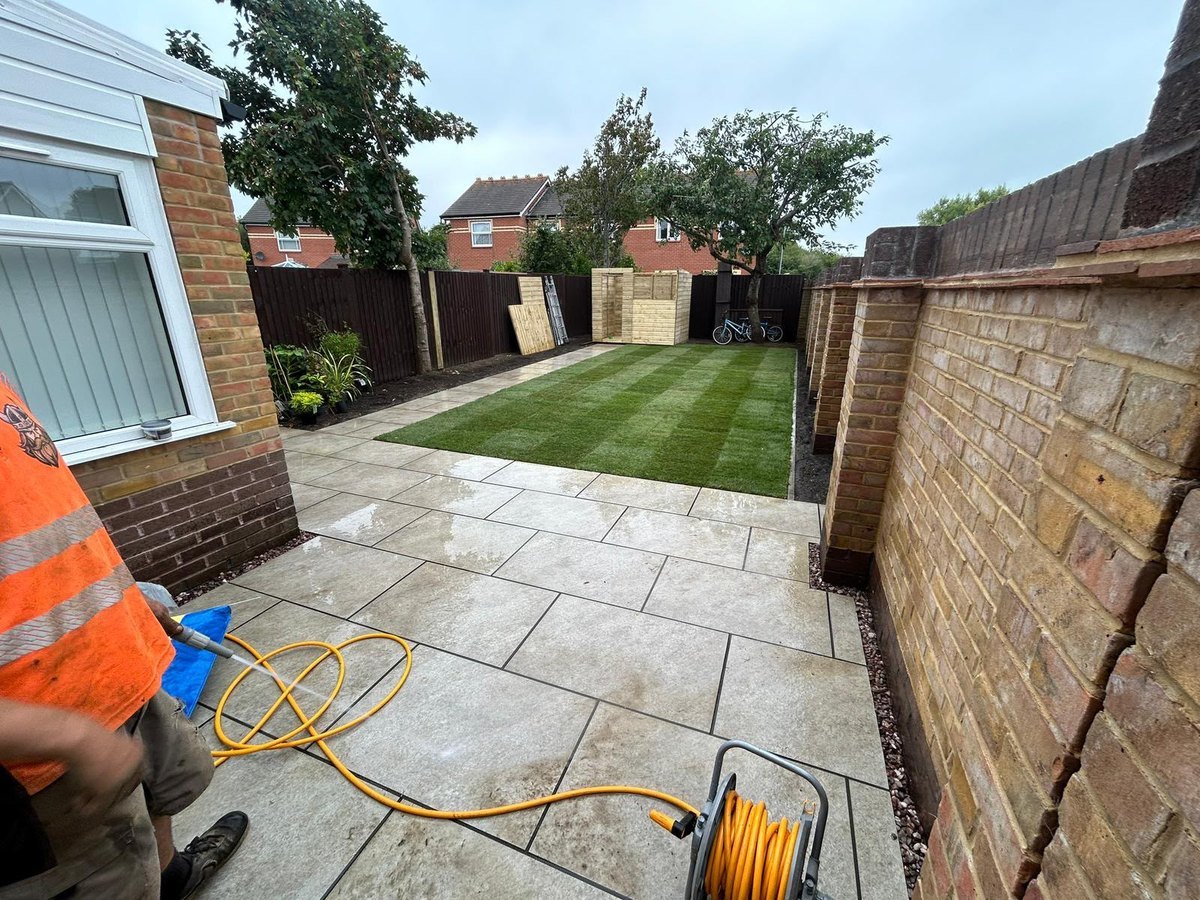
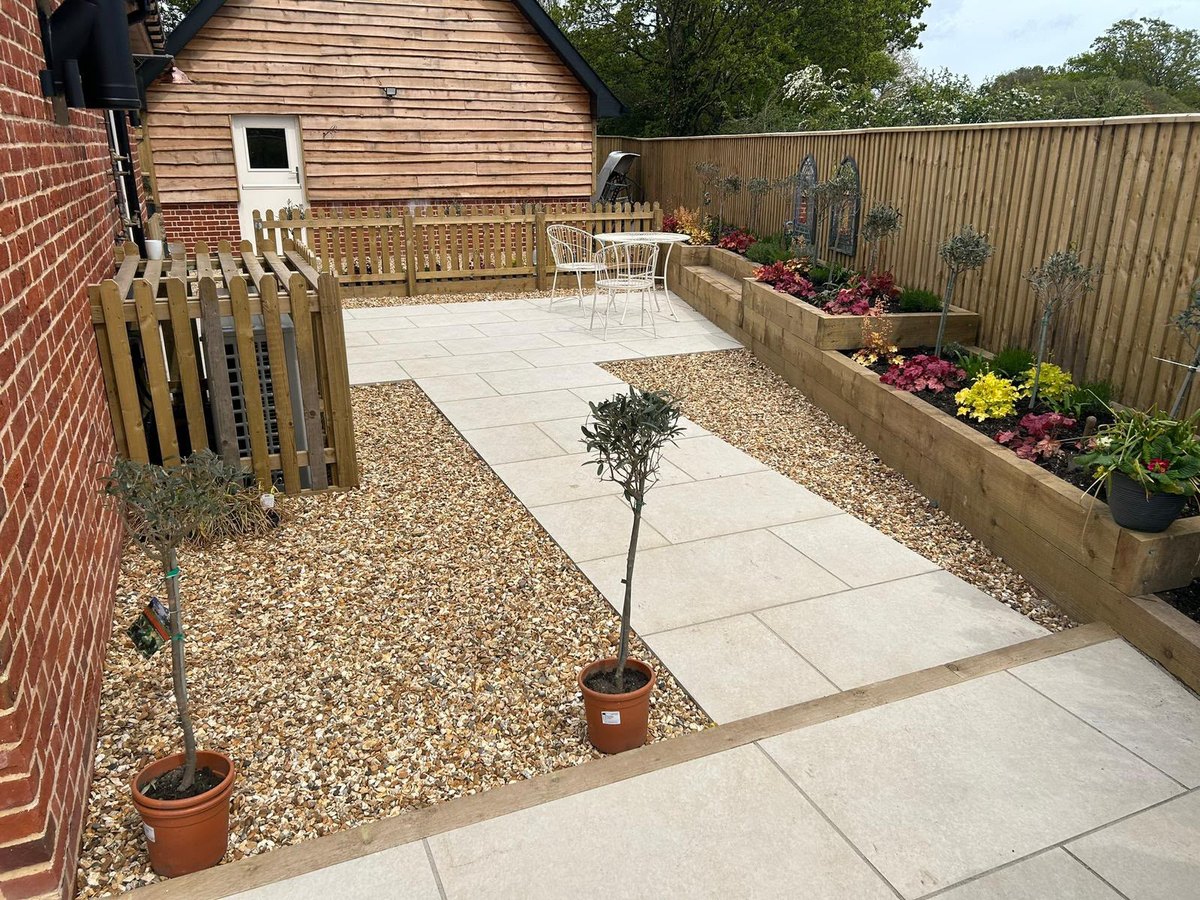
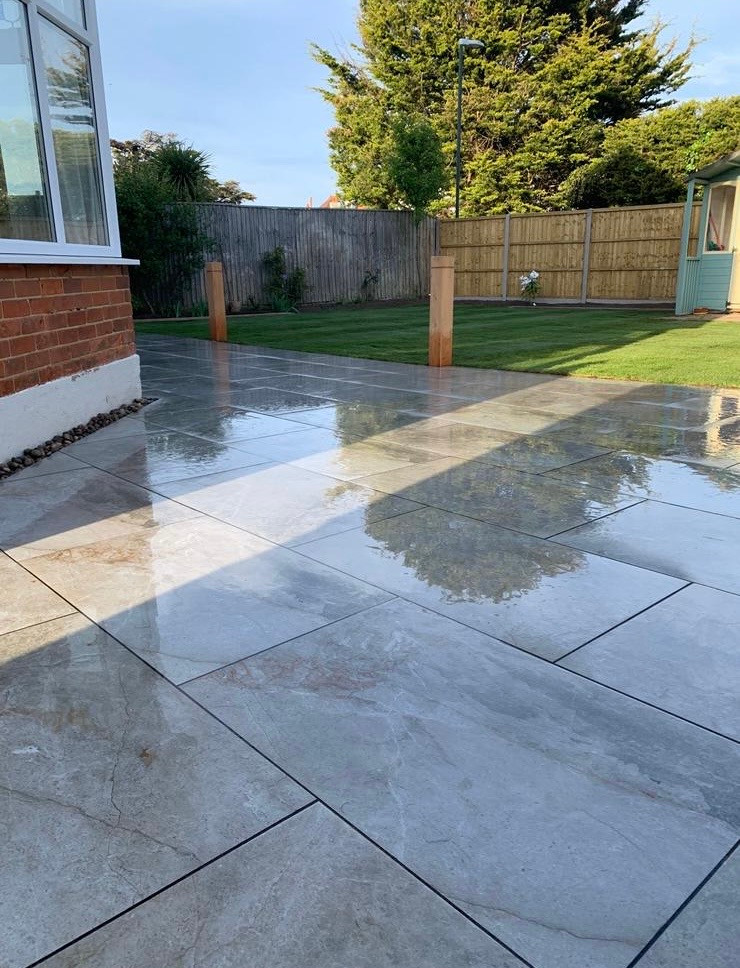
The paving. Porcelain is calibrated, sheds leaf litter and stays clean under a canopy, which is why it wins on a wooded plot. Riven sandstone is warmer against old brick, limestone and granite wear hard, and travertine holds water. Under trees the jointing matters as much as the slab: a brush in resin compound, a grout slurry or hand pointing in mortar.
Where the water goes, and lifting what has moved. The fall runs into an ACO channel, an existing gully or a soakaway set clear of foundations and roots alike, with a permeable build up where the runoff has nowhere to travel. Where two slabs have lifted over a root, or a bay has sunk and gone slippery with algae, efflorescence and staining, we quote the lift and relay.
How it runs
From your call to a written price
Same team from first visit to last, one person to ring, and no sub-contracting your work out to somebody you have never met. The quote is itemised, not a figure on the back of a card: excavation and muck away, the sub base, the falls and where water goes, edgings and steps, the slabs themselves, and jointing on separate lines, so you can compare it properly against anyone else's.
Nothing is left open or unusable overnight. The site is swept at the end of each day rather than the end of the job, and what comes out leaves with us. If something turns up once we start that nobody could have seen, you get a photograph and a price before we carry on.
Paving a garden at ground level is ordinarily permitted development, so planning permission is rarely needed and the government guidance on when permission is required sets out where that stops. There is no conservation area over the village; there are listed farmhouses and cottages around Furzehill, Wilksworth Farmhouse among them, and work in the grounds of a listed building needs listed building consent. Trees can be protected in their own right, and the level against the house is building control rather than planning, from Approved Document C.
Cost
What decides the price of a patio
No rate per square metre, because the slabs are the part you choose and the smallest part of the price.
Getting to it. A modern plot you can bring machinery and a skip onto, a cottage down a lane with one narrow side gate, and a long garden behind a hedge are three different jobs. Everything comes in and goes out through the garden, often through a side gate or the house. A patio you can barrow to directly is a different job from one where every slab is carried. The work at height rules still apply to the dig and the machinery.
What is coming out before anything goes down. An old concrete slab, a raised bed, tree roots or made ground all have to be dug out and taken away, and that is priced by the load rather than by the metre. The dig is where a patio quote is won or lost.
Falls, levels and the damp course. A patio has to fall away from the house and finish at least two courses below the damp proof course, and getting that right often means steps, a retaining edge or a drainage channel. Laying a new patio up against a wall at the wrong level is the single most expensive mistake on this kind of job.
Comparing quotes? Ask how deep the dig goes and what sub base is specified, whether the slabs are laid on a full wet bed or on dabs, what the falls are and where the water goes, whether edgings and steps are included, and what the jointing compound is. Two quotes for the same job are usually two different jobs.
If it has become a hazard
A patio that has lifted, sunk or turned slippery
Ring rather than use the form. A slab that has lifted at one corner or a step that has dropped is a trip, and a north facing patio in winter can be genuinely dangerous. We can usually lift and re-lay the worst of it quickly, then look properly at whether the base under the rest has gone. Furzehill is about eight miles from us, so a slab lifted proud of its neighbour by a root, which is a genuine trip, is normally looked at within a day or two. The phone is answered 24 hours for emergencies; scheduled work runs Monday to Friday, 8am to 6pm.
Worth knowing
The tree was here before the patio
Furzehill is a place of large plots, old hedgerows and mature trees, and rather more than a third of the housing is detached with a decent garden round it. Trees are the reason we get called back to patios here more often than anything else.
Roots do not push a slab up in one go. They thicken season by season under a bed with no give in it, and a patio that was flat when it was laid develops a hump, then a rocking slab, then an open joint that lets water into the base. The instinct is to cut the root out. That turns a paving problem into a tree problem, because those roots are often the ones holding the tree up.
The better answers are unglamorous. Move the sitting area clear of the root plate. Build up over the roots rather than digging down through them. Put a root barrier along the edge so nothing new gets under the paving. And use a flexible jointing compound so the joints take a little movement instead of cracking open. If a builder quotes you a patio under a mature tree without mentioning the roots at all, that is the question to ask.
Who you are dealing with
A local firm you can check
We cover Furzehill, Colehill, Leigh, Holt Road and the lanes north of Wimborne, broadly BH21, under Dorset Council. You are dealing with Bournemouth Roofing & Building, the trading name of Bournemouth Roofing & Building Ltd, registered in England and Wales, company number 15471719, which you can look up in a minute. Thomas Hannen's business, and he is the one who comes out to price the job, not a salesman. A verified customer's 10 out of 10 on Checkatrade. The visit and the written quote are both free.
Questions
Furzehill questions we get asked
Can you cut the roots that are lifting my slabs?
Not the structural ones. They are often what keeps the tree standing, and on a protected tree cutting them is an offence rather than a shortcut. We lift the paving, build back over the roots with a shallower construction, or move that part of the patio.
How far do roots reach from a tree?
Further than most people expect. As a working rule at least as far out as the branches spread, and on a thirsty species a good deal further, mostly in the top half metre of soil. That is exactly the depth a patio wants, which is why the two argue.
Will a root barrier stop the problem coming back?
It helps a lot at the edge of a patio, stopping new growth getting underneath. It will not do anything about a root that is already there. On a plot with a big tree it is one part of the answer rather than the whole of it.
Should I just build a deck instead?
It is a fair question and sometimes the right answer, because a raised structure can span roots that paving cannot. It is a different trade with different upkeep and it goes green in shade.
Does working around roots add much time to the job?
Some, because the build gets adapted as we uncover what is down there. People ask how long in total: about a week for a straightforward patio, and ten days or so where the area has to move or a retaining edge and a soakaway go in.
Nearby, and next door
Patios near Furzehill
Patios nearby
Our other trades in Furzehill
Everything we do in Corfe Mullen Patios, all areas Every area we cover
Free quote
Find out what the roots will let you build
Thomas comes out, works out where the roots run, takes the levels and prices the honest options in writing. The visit and the quote are free.