
Bricklaying and repointing in Furzehill
Repointing, brick repairs, garden walls and chimney work around Furzehill. We come out, look at the joints properly, and put a written price in front of you.
The site visit is free and so is the written itemised quote. Thomas Hannen prices every job himself.
Most brickwork in Furzehill wants repointing, not rebuilding. If the joints have eroded back but the bricks either side are still sound, that is a rake out and a repoint, and we would rather tell you that than sell you a wall.
People ring us out here for one of three things. Joints on a gable that have washed back far enough to put a finger in. A crack over a window, or one running down from a corner, that nobody can say is finished moving. Or a boundary wall along one of the lanes that has been caught by a wing mirror and now leans.
All three want looking at close up rather than from the road, because on a wall the bit you can see and the bit that is actually wrong are often several courses apart. We come out, get a ladder or a tower on it, scrape a joint to find out what the mortar really is, and say what the wall honestly needs. Then it goes in writing, itemised, so you can hold it against anyone else's price.
The work
The brickwork we are called to in Furzehill
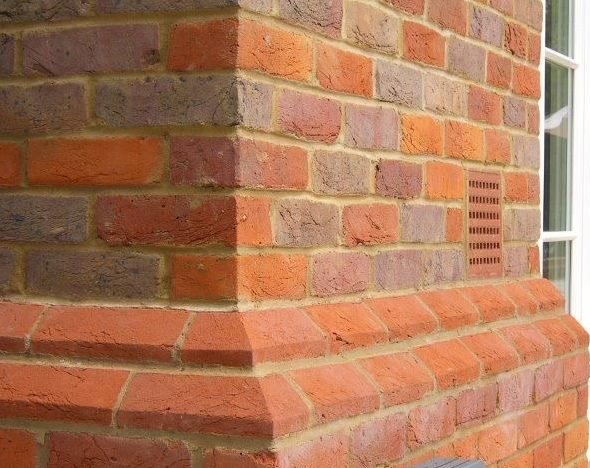
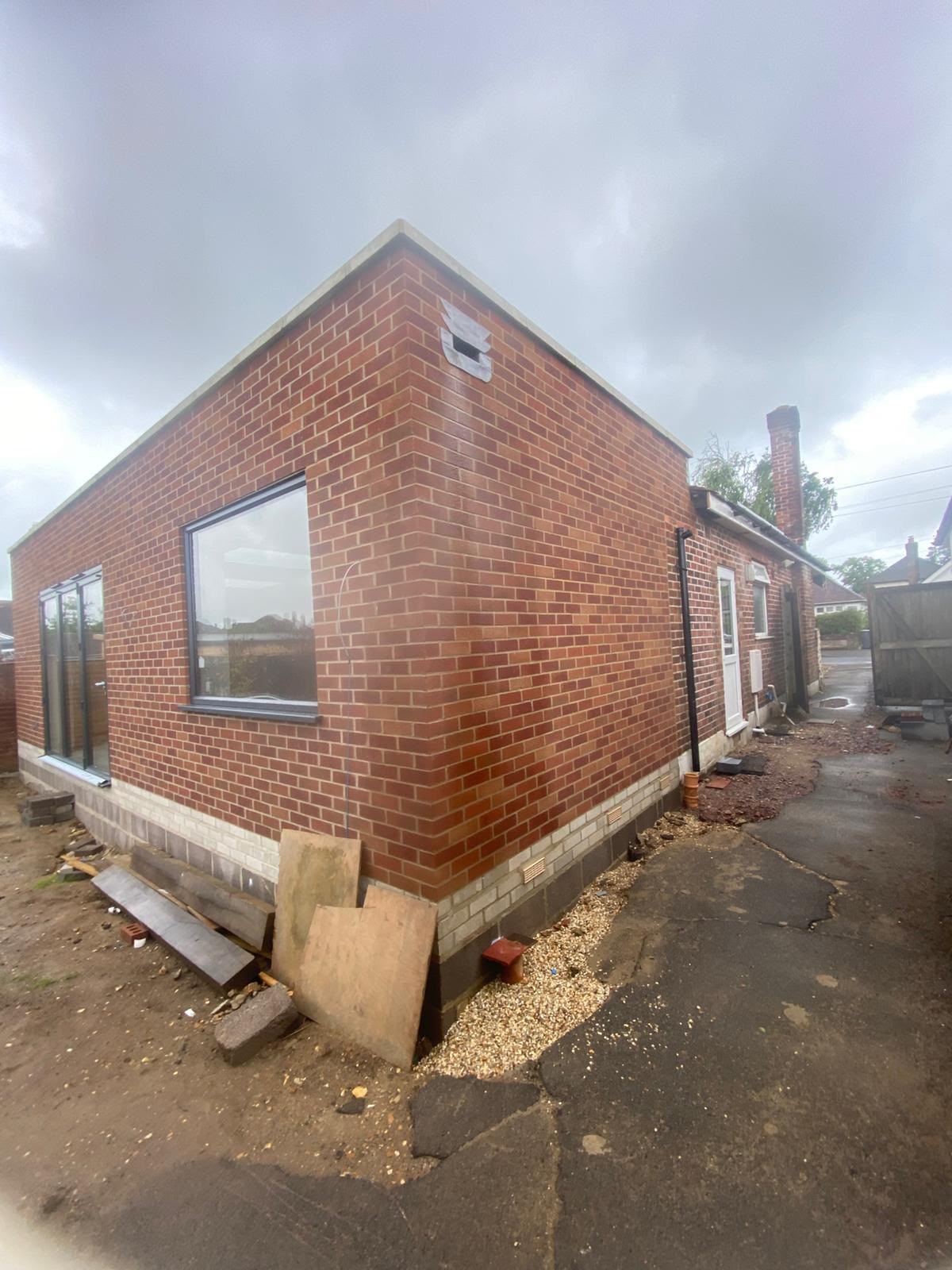
The post-war lanes. Getting on for half the houses and bungalows strung along the lanes here went up between 1945 and 1982, in cavity brickwork bedded in a gauged sand and cement mortar. What goes first is the joint on the elevation that takes the weather and the joints around the chimney. Raking out to roughly twice the width of the joint and repointing to the profile that is already there, normally a bucket handle or a flush joint, is a couple of days on one elevation. A weather struck finish is worth asking about on the face that gets driven rain.
Where you have a solid wall rather than a cavity, and soft handmade brick in it, the mortar has to be lime: NHL lime and sharp sand, no cement in the mix. Lime stays breathable and lets a period wall dry through the joint. A hard cement joint does the opposite, pushing the moisture out through the brick, and after a couple of hard frosts the faces start spalling and you are into cutting out and replacing brick rather than pointing it.
Stepped cracking down from a corner is usually ground movement, and the ground here shrinks and swells, so where the rainwater ends up beside a foundation matters more than it does on free draining sand. Horizontal cracking that repeats every fourth or fifth course, with the wall slightly bowed when you sight along it, is the wall ties rusting inside the cavity, and that is remedial tie work rather than pointing. Cracked joints in a straight line over a wide window are normally the concrete lintel below them; the brickwork over it comes out, the lintel gets checked and it goes back on a proper bearing. We will tell you which one you have got.
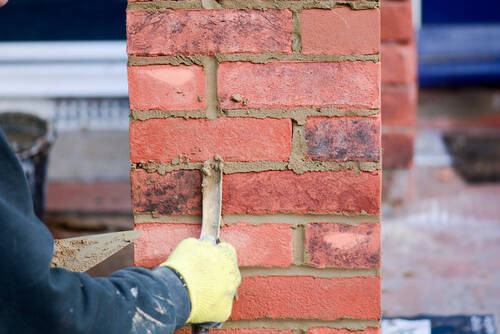
Then there are the long boundary walls beside the lanes, low retaining walls where a plot steps down, gate piers, and the screen walls and planters that came with the bungalows. A lot of them were built straight off the ground with no damp proof course, so they draw water up and blow out at the base. Anything we build new gets a foundation dug to firm ground, proper footings, a dpc, stretcher bond brickwork or blockwork behind a facing skin, and a coping that throws water clear. On a stack it is repointing, renewing cracked flaunching around the pots and swapping frost damaged brick out of the top courses, all in one visit rather than three, because getting up there is most of what it costs.
How it runs
From your call to a written price
Same team from the first visit to the last, one person to ring, and the quote itemised: access, raking out, the mortar mix, the area of each elevation, brick replacement and disposal on separate lines. Repointing and repairing brickwork like for like is repair, so there is nothing to apply for. That changes on a listed building, where even repointing needs listed building consent from Dorset Council. Furzehill has no conservation area of its own and its 14 listed entries sit mostly around the old farms, so for most addresses there is nothing to apply for. The two that catch people are a new wall taller than the limits in Planning Portal guidance on garden walls, and work on a wall you share with a neighbour, which brings in the Party Wall etc. Act 1996.
Cost
What decides the price of a brickwork job
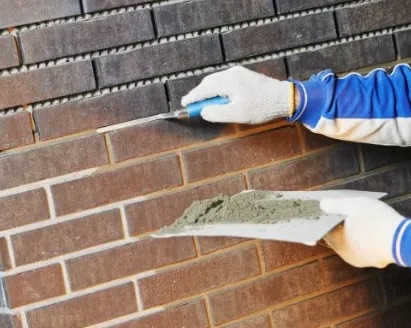
No rate per square metre: the metre of wall tells you nothing until you see the joints. A gable on a detached house, a bungalow you can walk a tower around and a garden wall down a lane are three different jobs. How long the platform stands matters as much as its size, and the work at height rules are why it is a priced line. Raking by hand is slow, so joint depth and spalled faces decide the hours, and matching a mortar or sourcing a brick takes trial panels. Ask how deep joints are raked, by hand or disc, and whether the scaffold is in.
If something has moved
Loose brickwork, or a wall that has shifted
Ring rather than use the form. Anything overhead or leaning goes to the front of the queue. Furzehill is a short run for us at eight miles, so a leaning boundary wall or a stack with movement in it normally gets seen the same day or the next. The first visit is about making it safe. The phone is answered 24 hours for emergencies; scheduled work runs Monday to Friday, 8am to 6pm.
Worth knowing
Where your rainwater lands decides what your brickwork does
The ground around Furzehill is cohesive, and cohesive ground shrinks as it dries out and swells again as it wets. That movement is small and seasonal and mostly harmless, right up until something concentrates water in one spot beside a wall. A downpipe running onto the ground instead of into a gully.
A gully silted up with leaves. A soakaway put in too close to the house. A border that gets watered all summer. The brickwork tells you about it as a crack that opens in one season and closes in the next, usually stepped through the joints near a corner or an opening.
So before we price you for pointing a crack, we look at what is putting water there. Approved Document H sets out where surface water is allowed to go, and the short version is away from the footings rather than beside them.
Sorting the downpipe out first is cheaper than pointing the same crack twice. Trees work on the same ground for the same reason: a big one close to a wall pulls water out all summer, and felling it can move the ground as much as leaving it there. Where a crack still looks live, we say so and tell you to watch it through a season rather than fill it and hope.
Who you are dealing with
A local firm you can check
We cover Furzehill, Colehill, Holt, Wimborne Minster and the lanes out towards Wilksworth, all BH21. Bournemouth Roofing & Building Ltd, registered in England and Wales, company number 15471719, which you can look up in a minute. Thomas Hannen's business, and he is the one who comes out to price the job, not a salesman. A verified customer's 10 out of 10 on Checkatrade. The visit and the written quote are both free.
Questions
Furzehill questions we get asked
Our detached house is late sixties. What goes first?
Wall ties, then the mortar on the weather side. Nearly half of Furzehill, 46.8%, was built between 1945 and 1982 with the concentration in the late 1960s and early 1970s, so the cavity walls here went up with galvanised ties of much the same age. As those rust they expand and lift the bed joint, which reads as horizontal cracking at a regular spacing along the wall. We drill and inspect a few before assuming the pointing is the whole story.
Does the Green Belt stop us building a garden wall?
Not a wall in your own garden at a normal height. Green Belt policy here bites on new outbuildings and on extensions judged disproportionate to the original house, not on repair or on a boundary wall within permitted limits. Furzehill has no conservation area and only 14 listed entries, Wilksworth Farmhouse among them, so control is lighter than people expect. Dorset Council decides. If you want an outbuilding rather than a wall, check that before we set out a footing.
There is stepped cracking by our back corner. What now?
First we work out whether the ground moved or the wall did. Furzehill sits on cohesive ground with a significant shrink and swell rating and impeded drainage, so a soakaway or a split gulley near a foundation leaves the soil swelling in winter and shrinking in summer, and the corner of the house tracks it. Stitching the crack without dealing with the water puts you back where you started next year. Drainage gets sorted first, then the brickwork.
Will you come out for one collapsed pier?
That is a normal job. A gate pier, a cill, half a dozen spalled bricks or a section of garden wall are all worth a visit, and Furzehill is close enough to us that a small repair is a morning rather than an expedition. Thomas Hannen prices it on site himself. The written quote is itemised so you can see brick, mortar, access and labour separately, and decide whether to do the pier alone or the whole run while we are there.
Do you grind the joints out or cut by hand?
It depends what the wall is made of. Against the hard cement mortar on most Furzehill houses a small disc run down the centre of the joint is the only sensible way to reach depth, after which the edges are squared with a chisel so no blade ever touches a brick arris. On anything softer or older it comes out entirely by hand. Reaching twice the joint width in depth matters far more than which tool got you there.
Nearby, and next door
Bricklaying and repointing near Furzehill
Bricklaying and repointing nearby
Our other trades in Furzehill
Everything we do in Corfe Mullen Bricklaying and repointing, all areas Every area we cover
Free quote
Get a price for your brickwork in Furzehill
Tell us the address and what you have spotted. We will come out, scrape a joint, and put an itemised price in writing. Free site visit, no obligation.