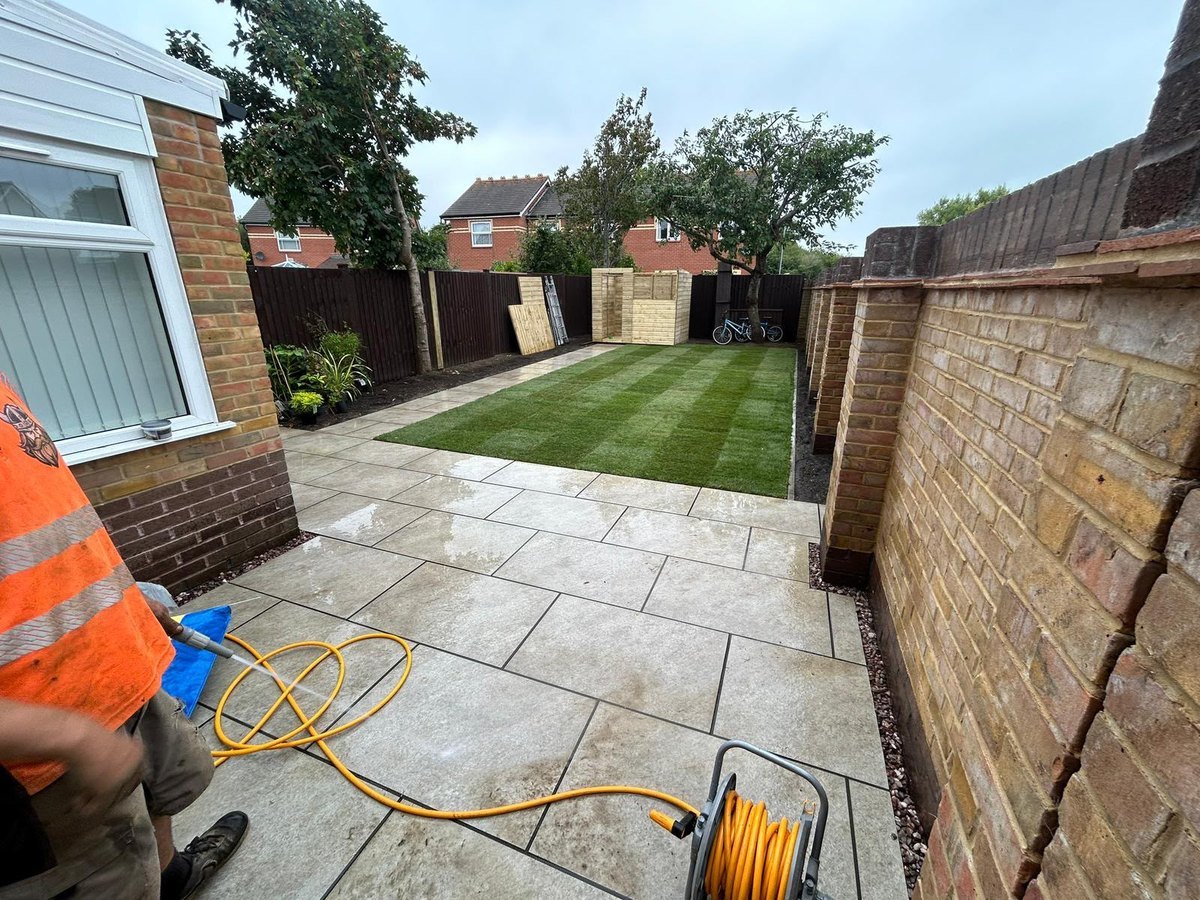
Patios in Fordingbridge, private and communal
A shared terrace has to carry constant foot traffic, drain a whole building and be signed off by somebody other than the person who rang, so it is quoted differently from a private garden.
The site visit is free and so is the written itemised quote. Thomas Hannen prices every job himself.
A shared terrace behind a block is a different job from a private one. The area is bigger, it gets walked on all day, the falls have to work for a whole building rather than one back door, and somebody other than the person ringing us usually has to approve the spend.
Around one home in six here is a flat, and many sit behind a communal garden with paving nobody has touched since it went down. The calls are the same every time. A sunken bay that ponds by a fire door. Rocking flags on a shared path. Joints washed out until the surface has started to move.
We survey the whole area rather than the worst corner, lift slabs in two or three places to see the bed and the base, and take levels off the building. Then it is written up so it can go to a freeholder or a managing agent: the dig, the muck away, the sub base, the falls, the drainage, the edgings, the paving and the jointing on separate lines. The site visit and the itemised quote are free.
The work
Communal terraces, shared paths and private gardens
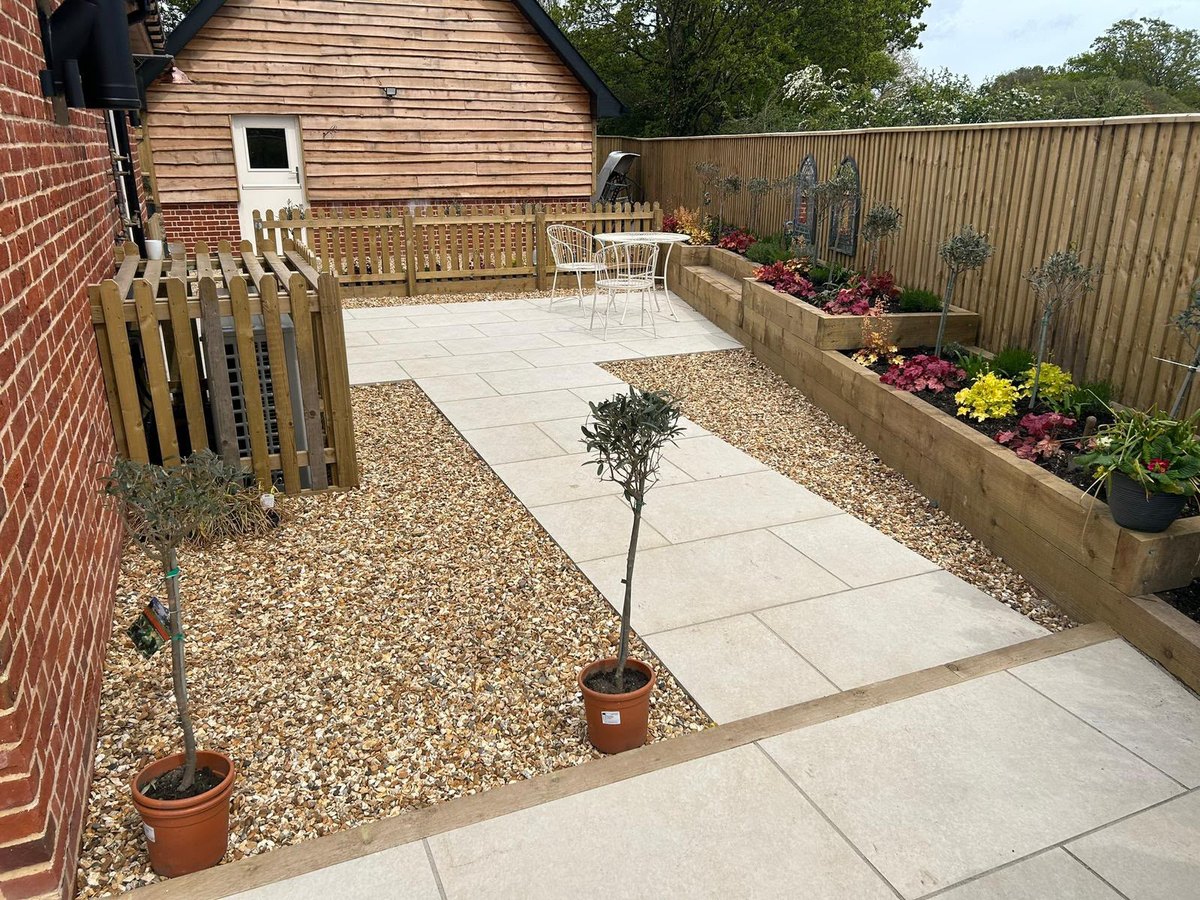
Surveying the whole area. On a shared surface the fault you can see is rarely the only one. We check the falls across the whole area, lift flags in several places and look at where the water is meant to go.
The dig and the muck away. Old paving, bedding sand, concrete and soft made ground get excavated out to a firm formation. On a communal site the spoil route and the material storage are planned first, because access has to stay open for residents and the bin store all week.
The sub base. MOT type 1 in compacted layers with a geotextile below where the subgrade is soft. A path walked every day by everyone in a building takes more punishment than a private terrace, so the base is built for the traffic.
Full bed, never dabs. Every slab on a full wet mortar bed, with a slurry primer on the back of porcelain. On a communal surface a hollow slab becomes a rocking slab and a rocking slab becomes a trip, so nothing goes down on dabs.
Porcelain paving. Calibrated to a single thickness, almost no absorption and made in slip rated finishes. On a shared area where somebody else is responsible for what happens on the surface, a rated slip resistance is worth having in writing.
Sandstone, limestone and granite. Riven sandstone and limestone suit the older buildings in the town. Travertine is softer and less suited to heavy use. Granite is the toughest and the sensible choice for step treads and a bin store apron. None is calibrated, so each piece is bedded to its own thickness.
Falls, levels and thresholds. A fall away from the building, a finished level at least two courses below the damp proof course, and level thresholds at doors where they are needed. Where a doorway has to stay flush, a recessed channel across it takes the water instead.
Drainage. An ACO channel across an entrance or the low side into a gully with a positive outfall, or a permeable build up over a stone reservoir where the ground takes it. On a larger shared area the runoff volume is far greater, so it is designed rather than assumed.
Edges, steps and retaining. A haunched kerb or edging where paving meets grass or a border, a retaining edge with a coping where ground is held back, and steps on a full bed with an overhang so water drips clear of the riser.
Jointing and repairs. A resin grout brushed into damp joints stands up to foot traffic and washing far better than sand. On riven stone we point in mortar. We also relay sunk bays and rocking flags, cut out cracked ones and deal with staining, efflorescence and a slippery green surface.
How it runs
From your call to a written price
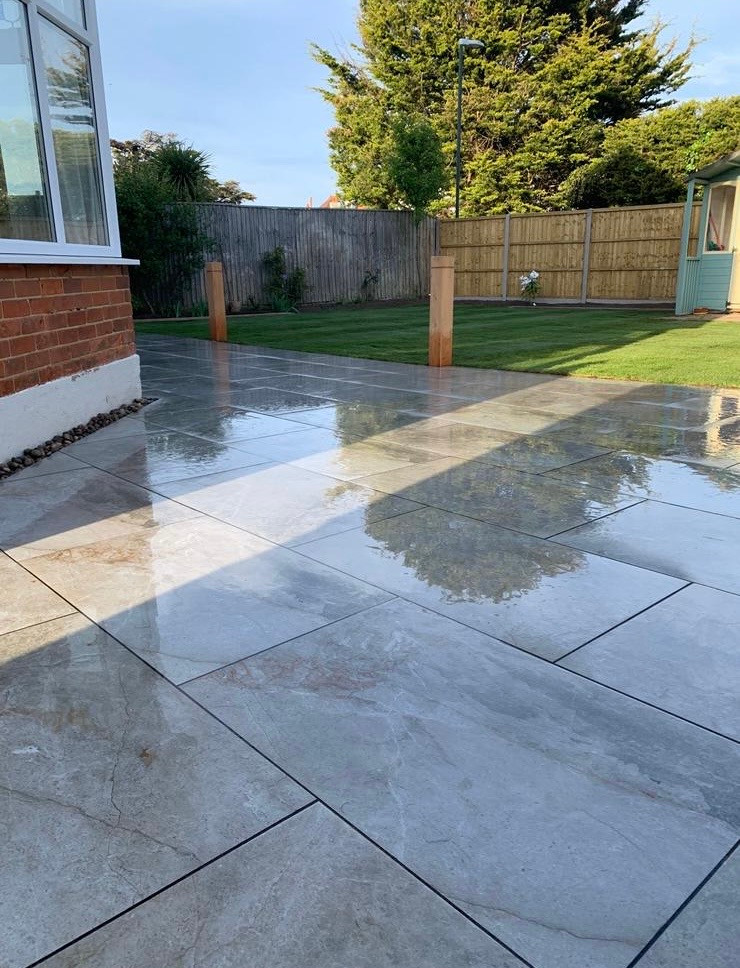
Same team from first visit to last, one person to ring, and no sub-contracting your work out to somebody you have never met. The quote is itemised, not a figure on the back of a card: excavation and muck away, the sub base, the falls and where water goes, edgings and steps, the slabs themselves, and jointing on separate lines, so you can compare it properly against anyone else's.
Nothing is left open or unusable overnight. The site is swept at the end of each day rather than the end of the job, and what comes out leaves with us. If something turns up once we start that nobody could have seen, you get a photograph and a price before we carry on.
New Forest District Council is the planning authority and there is no conservation area covering the town, though the forty nine listed entries in the area mean an address is worth checking before work near an old building. Paving at ground level is normally permitted development. Where the cost of communal work is being recharged to leaseholders, a freeholder has to consult under section 20 of the Landlord and Tenant Act 1985 once one leaseholder's share passes the statutory limit, so we write the quote in a form that can go straight out with that notice. Building control engages where levels or drainage change.
Cost
What decides the price of a patio
No rate per square metre, because the slabs are the part you choose and the smallest part of the price.
Getting to it. A terraced house reached through the hall, a semi with a side gate and a block of flats with a shared rear garden and a service road are three different jobs before a slab is priced. Everything comes in and goes out through the garden, often through a side gate or the house. A patio you can barrow to directly is a different job from one where every slab is carried. The work at height rules still apply to the dig and the machinery.
What is coming out before anything goes down. An old concrete slab, a raised bed, tree roots or made ground all have to be dug out and taken away, and that is priced by the load rather than by the metre. The dig is where a patio quote is won or lost.
Falls, levels and the damp course. A patio has to fall away from the house and finish at least two courses below the damp proof course, and getting that right often means steps, a retaining edge or a drainage channel. Laying a new patio up against a wall at the wrong level is the single most expensive mistake on this kind of job.
Comparing quotes? Ask how deep the dig goes and what sub base is specified, whether the slabs are laid on a full wet bed or on dabs, what the falls are and where the water goes, whether edgings and steps are included, and what the jointing compound is. Two quotes for the same job are usually two different jobs.
If it has become a hazard
A patio that has lifted, sunk or turned slippery
Ring rather than use the form. A slab that has lifted at one corner or a step that has dropped is a trip, and a north facing patio in winter can be genuinely dangerous. We can usually lift and re-lay the worst of it quickly, then look properly at whether the base under the rest has gone. On a communal path a rocking flag is somebody else's liability as well as a nuisance, so those get made safe on the first visit rather than left for the main works. The phone is answered 24 hours for emergencies; scheduled work runs Monday to Friday, 8am to 6pm.
The one local thing
Paving that belongs to more than one household
Close to one in six of the homes in the town is a flat, a high proportion for a place this size, and it changes how a paving job happens. The person who rings is often not the person who decides, and the money comes from a service charge rather than a bank account.
Where communal work is recharged to leaseholders and one leaseholder's share goes over the statutory threshold, the freeholder has to consult formally before the work can be recovered in full. Skipping it does not stop the job, it stops the recovery. So we itemise these quotes properly, keep the wording plain enough to send out with a notice, and price options rather than one figure.
The build changes too. A communal terrace is walked on constantly, so the base is specified for traffic and the slip resistance chosen deliberately. We work in sections rather than closing the whole area, keep access open for residents and the bins, and leave nothing as a trip hazard overnight.
Who you are dealing with
A local firm you can check
We cover the town, Sandleheath, Godshill and the lanes down the Avon valley, broadly SP6, under New Forest District Council. You are dealing with Bournemouth Roofing & Building, the trading name of Bournemouth Roofing & Building Ltd, registered in England and Wales, company number 15471719, which you can look up in a minute. Thomas Hannen's business, and he is the one who comes out to price the job, not a salesman. A verified customer's 10 out of 10 on Checkatrade. The visit and the written quote are both free.
Questions
Fordingbridge questions we get asked
Can you quote communal paving for a managing agent?
Yes, and we write it so it can be sent out as it stands. The dig, the base, the drainage, the paving and the jointing are on separate lines, and we are happy to price options side by side rather than give one figure with no detail behind it.
What is the section 20 consultation and does it apply here?
It applies where a freeholder wants to recharge communal works to leaseholders and one leaseholder's share passes the statutory limit. The consultation has to happen before the work, not after. Our quote is written to go out with the notice.
Which paving is best for a path everyone uses?
Something with a rated slip resistance and no absorption, so external porcelain in a textured finish, or granite where a really hard wearing tread is wanted. Both are laid on a full mortar bed, because a rocking flag on a shared path is a genuine hazard.
Can residents still get in and out while the work is done?
Yes. We work in sections rather than closing a whole area, keep a route to the doors and the bin store open, and sheet or barrier anything that is open. Nothing is left as a trip hazard at the end of a day.
Is jointing compound better than sand on a communal surface?
For shared paving, clearly. Kiln dried sand washes out under foot traffic and disappears entirely the first time somebody takes a pressure washer to it. A resin grout brushed in damp stays put, keeps weeds down and holds the slabs steady.
Nearby, and next door
Patios near Fordingbridge
Patios nearby
Our other trades in Fordingbridge
Everything we do in Verwood Patios, all areas Every area we cover
Free quote
Get communal paving priced line by line
Thomas comes out, surveys the whole area, lifts slabs to see the base and prices the dig, the drainage, the paving and the jointing in writing. The visit and the quote are free.