
Driveways in Fordingbridge
Off street parking, block paving, resin bound, tarmac and stone patios across Fordingbridge and the SP6 villages. Free site visit, free written itemised quote.
The site visit is free and so is the written itemised quote. Thomas Hannen prices every job himself.
Last updated
In Fordingbridge a new driveway usually starts as a parking problem, not a paving problem. Getting a car off the street is two pieces of work, not one: the crossing over the footway, which is the highway authority's decision, and the surface behind your boundary, which is ours to build.
Fordingbridge paving jobs take three shapes. A town house or cottage with nothing but the kerb outside it, where the front garden is the only place a car could ever go. An estate drive laid decades ago, tarmac or concrete, now rutted, cracked and holding water at the low end. And a back garden where the flags have rocked and sunk and the whole thing tips gently towards the house instead of away from it.
All three are worth a look before you commit to anything. The free site visit covers the ground and the geometry: we measure whether a car will actually stand clear of the pavement, open a trial hole to see what the sub-base is sitting on, and tell you honestly if the answer is that the crossing is not worth building. Then it goes into writing with the method on it as well as the figure.
The work
Front gardens, estate drives and parking by the river
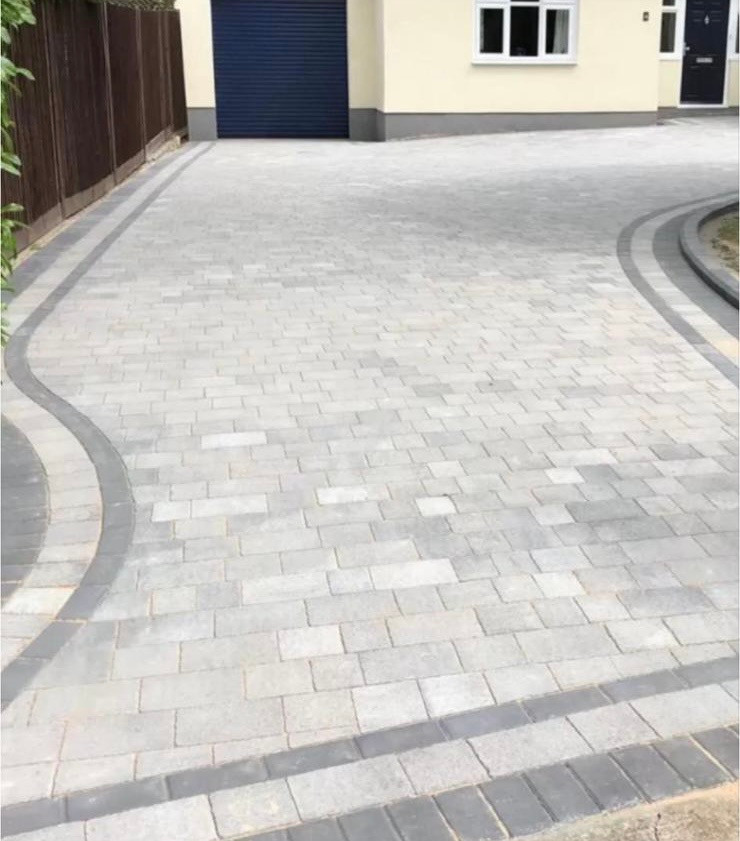
Front gardens turned into parking. The older streets of Fordingbridge were built when nobody owned a car, so the terraces and cottages have a low wall, a gate and a few square metres of garden.
Making that into a standing is careful work in a small space: the wall opened up and rebuilt or lowered, an edge restraint haunched in concrete, a proper excavation and sub-base, never slabs on sand, and block paving or resin bound laid to a fall that keeps water off the pavement. Most of the material comes in by barrow because there is nowhere for a lorry to stand.
Around four in ten homes in Fordingbridge went up between 1945 and 1982, with the biggest single burst between 1973 and 1982, and those estate drives came with thin tarmac or bay-laid concrete that is now at the end of it: ruts where the wheels park, cracking along the joints, staining, and weeds through everything. Where the base is sound, resin bound or a tarmac overlay is the honest answer. Where it has failed we break out, dig to formation, lay a geotextile membrane and build a compacted sub-base, then surface. Shared drives get done in halves so both households keep a car on the road side.
Ground near the Avon. Gardens on the low ground either side of the river can be soft and slow to drain, and a drive built there needs more depth in the dig and a base built in thinner, better compacted layers, not one thick one. It is also where we are most careful about levels, because a patio that raises the ground against an old wall is the fastest way to give a dry house a damp problem. Approved Document H is what the drainage design is set against.
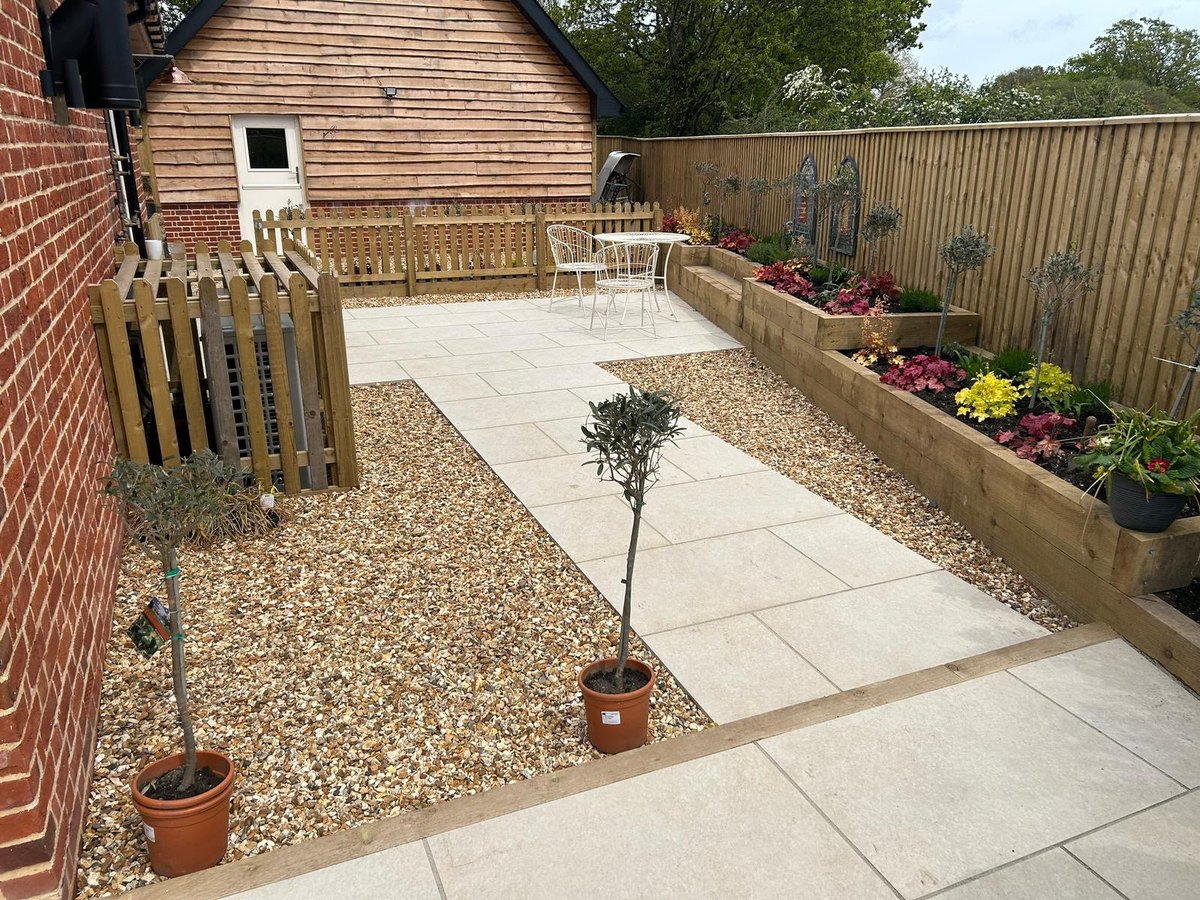
Patios and paths are sawn or riven natural stone, porcelain and clay pavers on a full mortar bed, joints pointed, laid with a fall away from the building and kept clear of the damp proof course and the threshold. Steps get rebuilt where a garden drops, and a channel drain goes in at the door where the level cannot come down any further. For that side of the work, see patios in Fordingbridge. A lot of this town has no room for a skip on the plot, and a skip standing on the highway needs a permit from the council, so we would rather muck away straight into a grab lorry on the day of the dig, keep the spoil off the pavement and sweep at the end of each shift.
How it runs
Digging out and laying a drive, step by step
Thomas measures the drive, watches where the rain runs now and asks where you would like it to go. His quote shows digging out, carting the spoil away, the sub-base, edgings, the surface you have chosen and the drainage as separate items. The clean up at the end is on it too.
A lot of drives in Fordingbridge belong to post-war estate houses, with room at the front for a small digger and a grab lorry. A cottage in the centre may only have a gate wide enough for a barrow, so the spoil goes out by hand to a skip, and a skip standing on the road needs a permit. The site is tidy every evening and you can still get in and out. An old soakaway, a drain run or soft ground turned up by the digger is photographed and priced for you before it goes any deeper.
Paving within the curtilage, behind your own boundary, is normally permitted development. The catch is the front garden: over five square metres of impermeable paving there needs planning permission unless the rain soaks away within your own land, as the Planning Portal page on front gardens explains. A new or wider dropped kerb is a separate application, covered in the guidance on dropped kerbs. New Forest District Council handles both planning and building control here. Near the centre, with its conservation area and listed houses, work within a listed building's curtilage is checked before we start.
Cost
What sits under a drive decides most of what it costs
A Fordingbridge drive has no rate per square metre. The surface is what you see, but what goes underneath it decides more of the cost.
The dig and the ground. On firm ground a drive needs a normal dig and a compacted sub-base of crushed stone. On the low ground by the Avon the soil holds more water, so the dig goes deeper, more spoil leaves by lorry, and a geotextile membrane goes under the stone to stop it sinking.
Getting machines in. A detached house on an estate with an open front can take a digger and a tipper. A terraced cottage with a narrow gate means everything is barrowed, which is slower. A semi on a shared estate drive means agreeing access with the neighbours first.
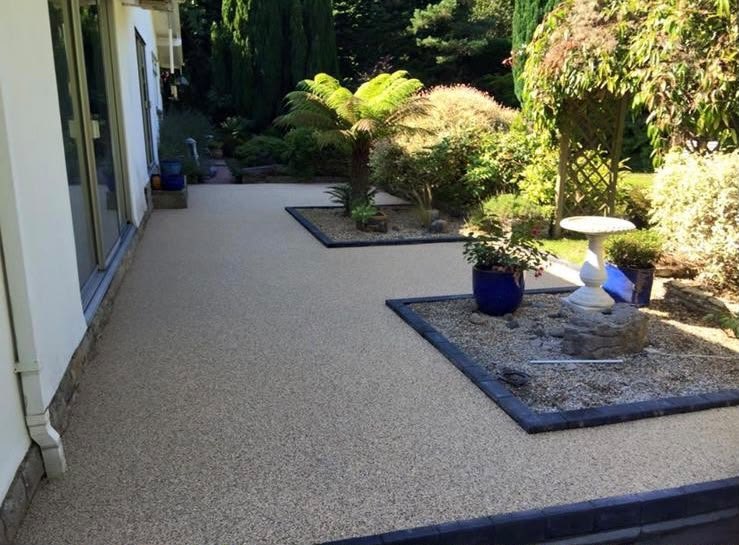
Choosing the surface. Block paving, tarmac, resin bound gravel and loose gravel in a grid all take a different amount of work, and block paving needs haunched edgings to stop it creeping.
Where the water goes. A permeable surface lets rain through. An impermeable one needs a channel drain and a soakaway or an outfall, priced as its own item.
Ask each firm quoting how deep they are digging, which sub-base and at what thickness, where the rainwater will drain to, and who takes the spoil.
If it is urgent
A lifted block, a sunken bay or a drive that floods
A raised block, a sunken bay by the front door or a gully that no longer takes water can trip someone up or push rain towards the house. Mark the spot with something bright, or stand a planter on it, so nobody catches a foot in the dark.
Phone us about it rather than sending the form. We come out to make it safe and get water draining away from the walls: lifting and relaying the worst blocks, clearing a blocked channel, and checking whether the sub-base has washed out underneath. Our scheduled days are Monday to Friday, 8am to 6pm. Leave a message if no one picks up, and we will call back as soon as we can.
Worth knowing
The crossing is a separate job from the driveway
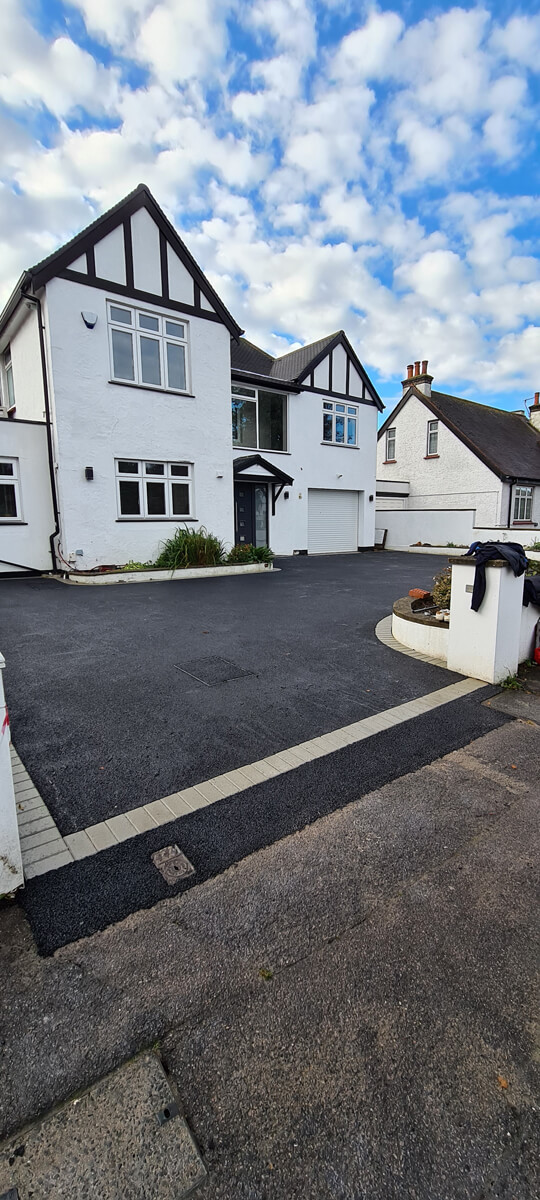
The vehicle crossing is what trips people up in a town with narrow frontages like Fordingbridge. The paving inside your boundary is yours to build. The bit between your gate and the road is the public footway, and driving over it without a proper vehicle crossing is not allowed however low the kerb looks.
That crossing is an application to the highway authority, who will look at visibility in both directions, what is buried under the footway, whether there is a street tree, lighting column or gully in the way, and whether the pavement build-up can take a car.
They set how it is constructed and who may build it. Planning Portal guidance on dropped kerbs explains the process, and where the property fronts a classified road the access itself can need planning permission on top, which is the sort of thing the permissions that sit outside the planning system covers.
Before any of that, measure the garden. A car needs somewhere near five metres of clear depth to stand without its nose or its tail over the pavement, and a good many front gardens in the older streets in Fordingbridge are shallower than that. If yours is, we will say so at the visit and turn the work down: a beautifully built standing that leaves your car hanging over the footway has cost you money and annoyed your neighbours.
Where the depth is there, two details are worth insisting on. The fall must run into your own ground, not out to the road, both because it is the rule and because a sheet of ice across a public pavement is your problem. And the gate has to swing inwards, or come off altogether, since a gate opening over a footway is a hazard to everybody walking past it.
Who you are dealing with
Who you deal with on your drive, and their details
Our base in Boscombe is 14.1 miles south of Fordingbridge. We lay drives in the town and the villages round it, Sandleheath, Alderholt, Godshill, Hyde and Breamore, with New Forest District Council as the council for any planning or building control question in the town.
The company is Bournemouth Roofing & Building Ltd, registered in England and Wales as number 15471719. The business is Thomas Hannen's, and he comes out himself to measure the drive and price it. Checkatrade carries a 10 out of 10 for us from a verified customer. You pay nothing for the visit or for the written quote, which itemises every part of the job. Before you book a visit in Fordingbridge, you can read our customers' Google reviews, word for word, on our reviews page.
Planning at a glance
Do you need planning permission in Fordingbridge?
Most repairs in Fordingbridge need no application at all. What decides whether a change to the outside of your house does is who the council is, whether a conservation area or a listing applies, and whether the place sits in a protected landscape.
| Question | In Fordingbridge |
|---|---|
| Who decides | New Forest District Council is the planning authority for Fordingbridge. The National Park boundary runs close by, and the Park's property map shows which side an address falls. |
| Conservation area | Yes: Fordingbridge Conservation Area. Check whether your street is inside the boundary before changing anything visible. |
| Listed buildings | Yes, there are listed buildings in and around Fordingbridge. If yours is one, work can need listed building consent. |
| Protected landscape | No National Park or National Landscape covers Fordingbridge. |
Questions
Questions about driveways in Fordingbridge
Will a soakaway work in the ground here?
Usually it will, because the ground on this side of the River Avon is on the free draining side, not heavy clay. It still gets tested first. We dig a trial pit at the low end, fill it, and time how long it empties before sizing anything. Where it drains slowly we run a positive outfall instead, and the quote says which of the two we have priced.
Does the River Avon nutrient rule affect a driveway?
No, Fordingbridge sits in the River Avon nutrient catchment, but that rule bites where a scheme adds somewhere for people to sleep, so it lands on a loft conversion or an annexe, never on paving. What does apply to a drive is surface water. If you are replacing a lawn with a hard surface, the rain that soaked in before has to be dealt with on the plot.
Our house is next to a listed building. Does that matter?
It can. There are 49 listed entries in and around Fordingbridge, from the Old Manor House to the road bridge over the Avon, and a listing covers the curtilage as well as the building itself. If your paving runs up to a listed wall, or you want to lift an old stone threshold, that needs consent from New Forest before a spade goes in. We flag it on the visit, not afterwards.
What is on the quote besides the paving itself?
Excavation depth, the tonnage of stone going back in, edgings, the drainage detail and the disposal, each on its own line. Thomas Hannen measures and prices it himself on the visit, so the figures come from what he has seen rather than something guessed off a plan. If a section of the existing base is sound and can stay, that shows as a deduction rather than sitting hidden inside one lump sum.
Which part of an old drive gives out first?
The edges, almost always. A drive laid in the 1970s or early 1980s around Fordingbridge usually has no proper edge restraint, so the blocks or the tarmac creep sideways every time a car turns on them and the surface opens along the sides while the middle is still flat. That is why we price haunched edgings as a separate line, and why a relay without them will not last.
Nearby, and next door
Driveways near Fordingbridge
Nearby places we also cover for driveways, with straight-line distances from Fordingbridge, and the other trades we offer in Fordingbridge itself.
Driveways nearby
Our other trades in Fordingbridge
Driveways and patios guides
Driveway planning permission and where water goes Sunken or ponding driveway: base or drainage Indian sandstone vs porcelain paving: an honest comparisonEverything we do in Verwood Driveways, all areas Every area we cover
Free quote
Get a written price for your Fordingbridge drive
A free site visit, the garden measured properly, and an itemised written quote with the method on it.