
Driveways and patios in Sandleheath
Gravel entrances that rut, patios against old walls and drives that hold water, priced in writing after a free visit.
The site visit is free and so is the written itemised quote. Thomas Hannen prices every job himself.
We build drives, parking and patios in Sandleheath and around Fordingbridge. A fifth of the housing here went up before 1900, so on a lot of these properties the finished level against the wall matters more than the surface you choose.
The calls come in three shapes. An old cottage where the path or terrace has crept up the brickwork over the years and the inside wall has started to show it. A long gravel entrance that has rutted and washes stone out onto the road every winter. Or a patio behind a newer detached house that has settled at one end and now keeps a puddle for days.
We come out and dig before we price. What is under the surface, what level the wall can take and where the water goes are the three things that decide the job, and none of them can be guessed from a photograph. You get an itemised written quote afterwards, and an honest answer about whether yours needs rebuilding or just lifting and relaying.
The work
Cottage margins, long gravel entrances and settled terraces
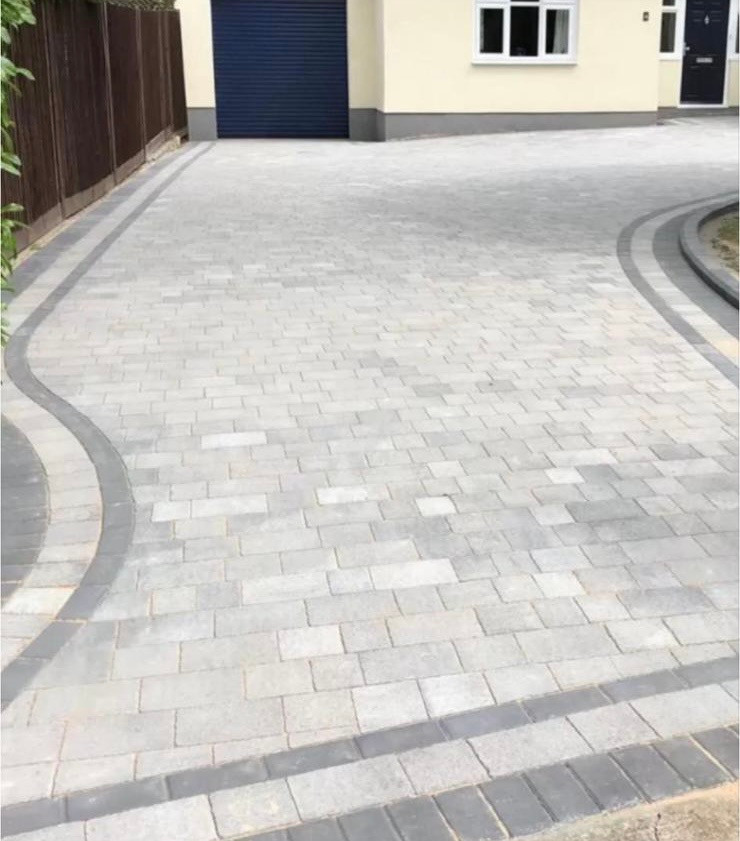
Paving up to an old wall. A fifth of the houses here predate 1919 and their brickwork often sits on a soft plinth with the ground close under it, so the worst thing you can do is run a solid surface hard against it. We take the finished level down rather than up, keep it clear of the damp proof course where there is one, fall everything away from the building, and leave a gravel margin along the wall so rain off the roof soaks down instead of splashing back. Where a threshold has to stay usable, a channel drain and a real outfall do the job that another lift of hardcore cannot.
Entrances and gravel that will not stay put. Plots here are wide and a good few drives run some distance in from the road, over a verge rather than a footway, and loose gravel spread on topsoil ruts into two tracks and ends up in the hedge and the gutter. Built properly it is excavated to a firm formation, a geotextile membrane, then a sub-base compacted in layers to the depth the trial hole shows, an edge restraint both sides, and a camber that puts water into a border rather than out onto the road. The ground here drains badly, so a soakaway needs a percolation test rather than an assumption and may want a positive outfall instead.
Parking and turning at a detached house. Nearly three in ten homes here are detached, and plenty have room to turn and simply were not laid out to. Getting a car out forwards onto a lane with no footway to see over is worth more than an extra bay, so we set the turning circle out on site with your own vehicle. Anything taking an oil delivery or a horsebox gets a deeper sub-base and either concrete or a heavy duty block rather than a thin tarmac skin that ruts where the wheels always stop.
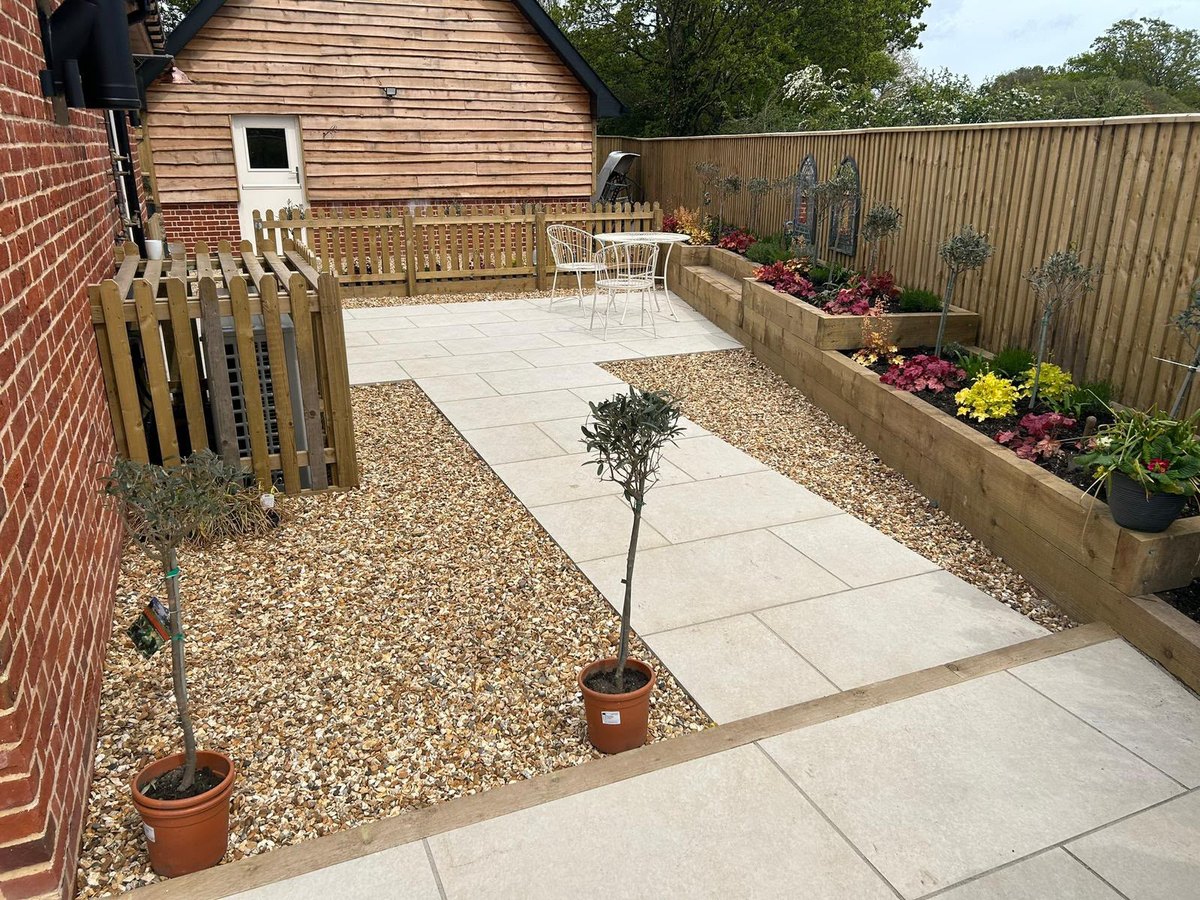
Terraces, steps and the small stuff. Stone flags or porcelain bedded on a full mortar bed and jointed with a mortar that stays in, steps with matched risers, and levels set out before anything is cut. We take repairs on their own too: a sunken bay re-laid, a crack across a concrete apron, a re-sand in kiln dried sand, or a gully that has silted up. Working out which single thing has failed is what the site visit is for.
How it runs
From your call to a written price
One person to ring, and an itemised quote. New Forest District Council is the planning authority for Sandleheath, and if you are close to the National Park boundary it is worth checking which one you are dealing with, because the National Park Authority keeps a property map that answers it in a minute. Hard surfacing at the front stays permitted development while the rain stays on your own land, and more than five square metres draining out to the road needs planning permission, which is the front garden rules in a sentence. Forming or widening the access is a separate highway application and a dropped kerb takes the longest of anything on the job, so it starts first.
Cost
What decides the price of a driveway
No rate per square metre, because what is under it decides more than what goes on top. A roadside cottage with no frontage, a house set back up a long entrance and a modern detached with a gate at the side are three different jobs before a machine turns a wheel. Ground conditions, the depth of the dig and how much muck goes away are the real variables. On ground that drains slowly, where the water goes is a design decision with a cost. Ask the depth of dig, the sub base, the drainage and who takes the spoil away.
If it is urgent
A trip hazard, or a drive that floods
Ring rather than use the form. A lifted slab, a sunken bay by a doorway or a gully that has stopped taking water will not wait, because somebody falls or water ends up against the house. If water is running off a drive towards a doorway, ring while it is doing it, because seeing where it goes beats any measurement taken afterwards. The phone is answered 24 hours for emergencies; scheduled work runs Monday to Friday, 8am to 6pm.
The one local thing
Building against a house that never had a damp proof course
A house put up before about 1900 usually has no damp proof course in it at all. It was built to take a bit of water and let it back out through soft brick and lime mortar, and it stays dry as long as the ground outside is lower than the floor inside and the wall can breathe.
Almost every damp problem we get shown at an old cottage here starts outside, not in: a path re-laid a little higher each time, a concrete apron poured tight against the plinth, or a smart new patio finished level with the back door. Once the outside ground is up near the floor, water has an easy route across and no way out.
So on those houses we work downwards. The ground beside the wall comes off rather than gets built up, the finished paving sits a good two courses below the internal floor, and the fall runs away from the building on every side. Along the wall itself we leave a permeable margin, gravel over a land drain taken to a proper outfall, so nothing seals the base of the brickwork. Bedding and pointing stay soft rather than a hard cement mix that traps moisture in the wall.
Where the ground is slow to take water, and much of it here is, that outfall matters more than the soakaway: Approved Document H expects a percolation test at the depth the crates would sit, and if the answer is no, the water needs somewhere else to go. If your cottage is listed, and a couple here are, that consent question is settled before a spade goes in the ground.
Who you are dealing with
A local firm you can check
We work across Sandleheath, Fordingbridge, Alderholt, Rockbourne and the SP6 villages up the Avon valley, fifteen miles from us. Bournemouth Roofing & Building Ltd, registered in England and Wales, company number 15471719, which you can look up in a minute. Thomas Hannen's business, and he is the one who comes out to price the job, not a salesman. A verified customer's 10 out of 10 on Checkatrade. The visit and the written quote are both free.
Questions
Sandleheath questions we get asked
Why does the lawn stay wet where the drive drains onto it?
Because the ground here has impeded drainage and will not take water away as fast as a hard surface delivers it. Every square yard you pave has to send its rain somewhere, and tipping it onto grass that is already holding water only moves the puddle. On Sandleheath plots we either build permeable, with a stone reservoir under the surface doing the storing, or pipe the run to an outfall. A percolation test settles which of those it is.
Our cottage has no damp course. Where does the patio finish?
Below the inside floor, with a gap left along the wall. One home in five here predates nineteen nineteen, and a solid wall of that age gets rid of moisture by breathing rather than by a barrier. Butt a new slab against it at door height and the wall is bridged. We drop the paving, run a free draining margin or a channel along the building, and fall the surface away from it.
Can a long gravel entrance be made to stay put?
Loose stone on a slope migrates, and it ends up in the ditch and out on the road. What stops it is a bound edge and a cellular grid, so the gravel sits down in the cells and locks together while still looking like gravel. Nearly three in ten properties around Sandleheath are detached with long entrances, and raking stone back up the slope every winter is nobody's idea of a garden.
Who approves a new opening onto the road?
The highway authority, not the planners. A new or widened crossing over the footway is a separate application from anything the planning side of New Forest deals with, and it gets inspected before and after. Resurfacing an opening that already exists needs none of it. Plenty of frontages at Sandleheath have a crossing that was cut for a smaller car than people drive now, and that is the part that adds time to the job.
Will the front garden be churned up by machines?
Some of it, and it is better to plan the route than pretend otherwise. Tracked plant runs on boards where it crosses grass, and the arisings leave the same way the stone came in rather than across the whole frontage. Fifteen miles out from the yard we bring what is needed in one go instead of running back and forth, which keeps the movements down. Anything lifted out of the way, a gate or a bed edging, goes back.
Nearby, and next door
Driveways and patios near Sandleheath
Driveways and patios nearby
Our other trades in Sandleheath
Everything we do in Verwood Driveways and patios, all areas Every area we cover
Free quote
Want a straight price for the drive or the terrace?
Tell us what the ground does after rain and we will come and dig a hole in it. Free visit, free itemised written quote, no salesman.