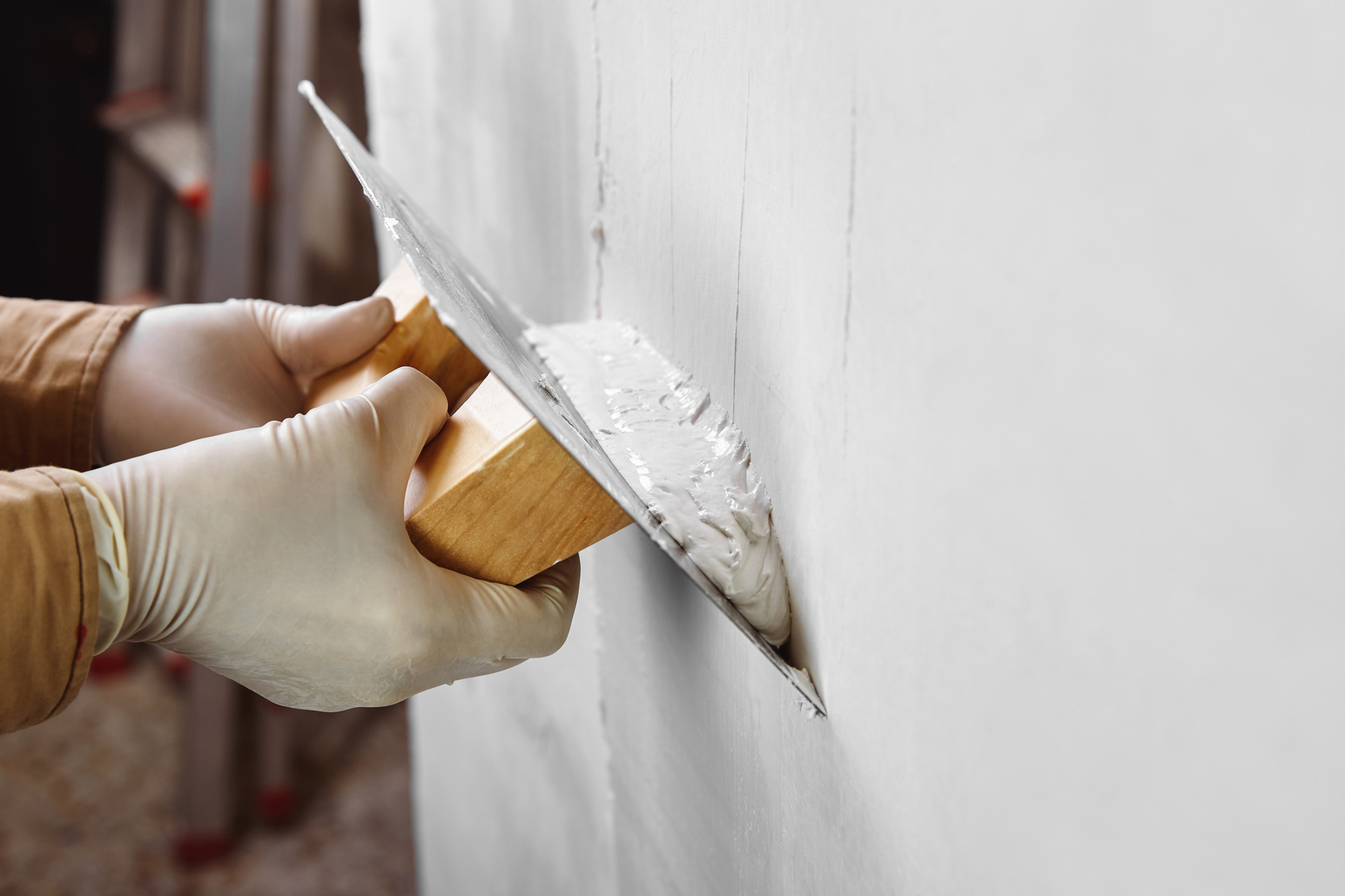
Plastering in Sandleheath
Skimming, ceilings, lime repairs, damp work and external render for both halves of the village.
The site visit is free and so is the written itemised quote. Thomas Hannen prices every job himself.
Before we price anything in Sandleheath we work out which kind of house you are in, because the village has two and they take different plaster. In the older cottages the walls are solid, with no cavity, and they need a breathable lime finish. In the post-war and modern half they are gypsum on block or plasterboard, and an ordinary skim is the answer. Put the modern material on the old wall and it blows off again, which is the single commonest thing we get called back to look at.
Most calls out of the village are one of three things. A room that has been papered and painted over tired plaster too many times and now wants skimming flat. A textured ceiling that has begun to crack along the board joints. Or damage: a patch of wall soft and powdery after a leak, or blowing off at skirting height with a white bloom on it.
We take on the inside and the outside, and the making good afterwards is part of it. The site visit is free, the written quote is itemised, and if the honest answer is a morning of patching rather than a room of new plaster, that is what it will say.
The work
Find the water before anything gets mixed
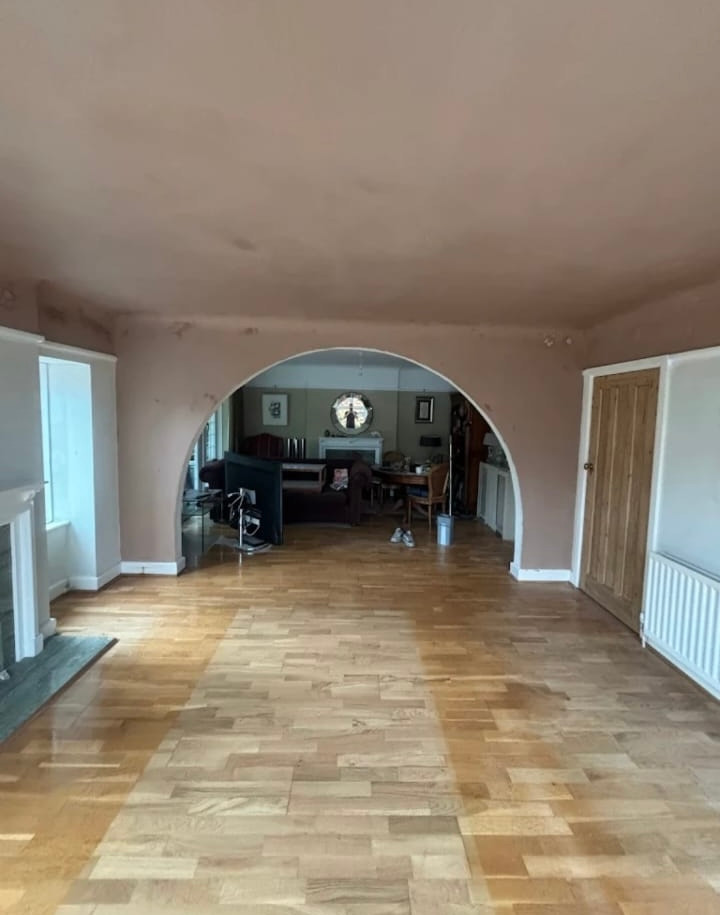
Find the water before anything gets mixed. Plaster blowing in the first half-metre above the floor with salts showing through the paint is being fed by water, and it is very common here. We look for where it is coming from before anything is mixed: ground and path levels raised above the damp proof course, a hard cement skirt of render at the base of an old wall, a blocked gully. Once that is dealt with and the wall has dried, the repair is a breathable lime replastering on an old wall, or a backing coat and skim on a modern one.
A fifth of the houses in the village predate 1919. Behind the paper you find lime plaster laid on riven lath, and outside a soft render or limewash over brick. That fabric has to stay breathable, so what goes back is a haired lime backing coat and a fine finish, given proper drying time between coats. Outside, the traditional job is scratch coat then render coat and float in a mix soft enough to move with the wall.
Where the background is sound we seal it and lay on two coats of finish. An ordinary bedroom is a day. Where a wall has blown it comes off back to the brick or block and a backing coat goes on first, browning or hardwall on solid work and bonding where the background is a patchwork of brick, block and old infill. The ceilings in the fifties to early eighties houses are plasterboard with scrimmed joints, very often with a textured coating over the top: shallow patterns get skimmed over, heavy ones are over-boarded and taped, and anything from before 2000 is sampled rather than sanded.
Plots here are generous and a lot of people build on rather than move. Extensions, annexes and garage conversions are dry lining on dot and dab where there is blockwork to fix to, board on stud where there is not, then tape and joint or a full skim, with angle bead on every external corner and stop bead at each reveal. Outside, the pebbledash and roughcast on the post-war houses is nearly all sand and cement, which sounds hollow once water is behind it. Local damage is cut out square and patched in a matching mix. Where an elevation has largely gone we strip it and put back a thin coat silicone system: primer, a mesh reinforced basecoat, then a coloured topcoat, with a bell cast bead at the base.
How it runs
From your call to a written price
Same team from the first visit to the last, one person to ring, and none of it sub-contracted. We survey the walls in front of us rather than a photograph, because the diagnosis is done with a knuckle and a damp meter, not by eye. Outside, the thing to know here is where the boundary runs. Sandleheath has no conservation area of its own and two listed entries in the parish, so for most addresses the finish is your choice, and Planning Portal guidance on external walls sets out where that stops. Fordingbridge next door is a different matter, so at the eastern end of the village check other permissions you may need as well.
Cost
What decides the price of a plastering job
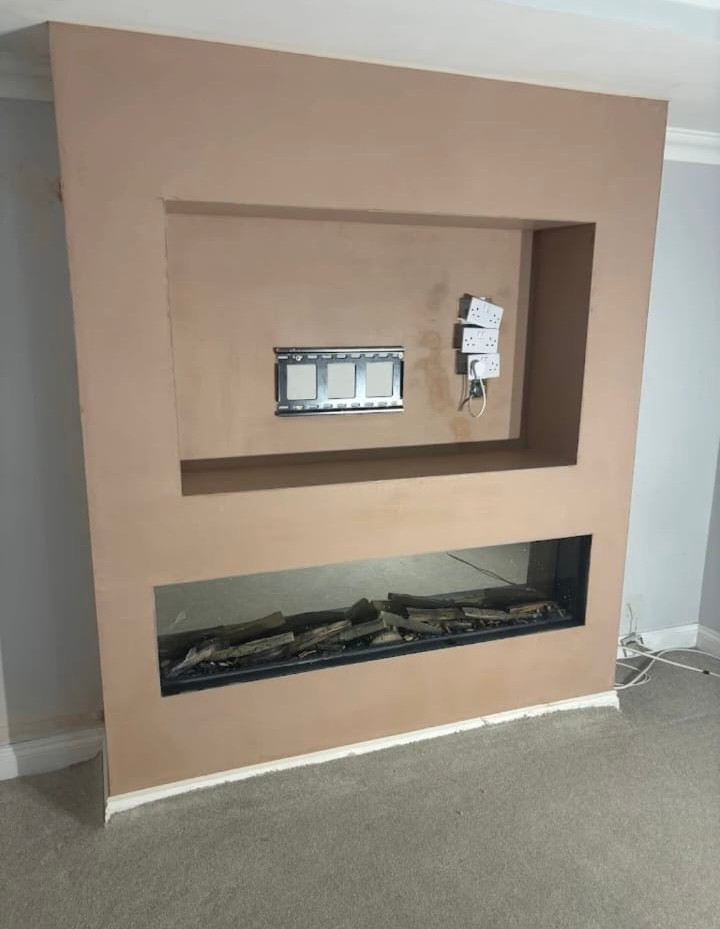
There is no rate per square metre, because the background decides it. A skim over sound plaster is the cheap end. A blown wall comes off, which brings a backing coat and a float back into the job. A solid old wall replastered in lime is slower again, not because the material costs more but because it needs real waiting between coats. Outside, a full elevation wants a scaffold, which is why work at height rules make access a priced line, and re-rendering the whole of one counts as renovating a thermal element, so Approved Document L can ask for the insulation behind it to be improved.
If it has started to come down
A ceiling sagging, or plaster blown off a wall
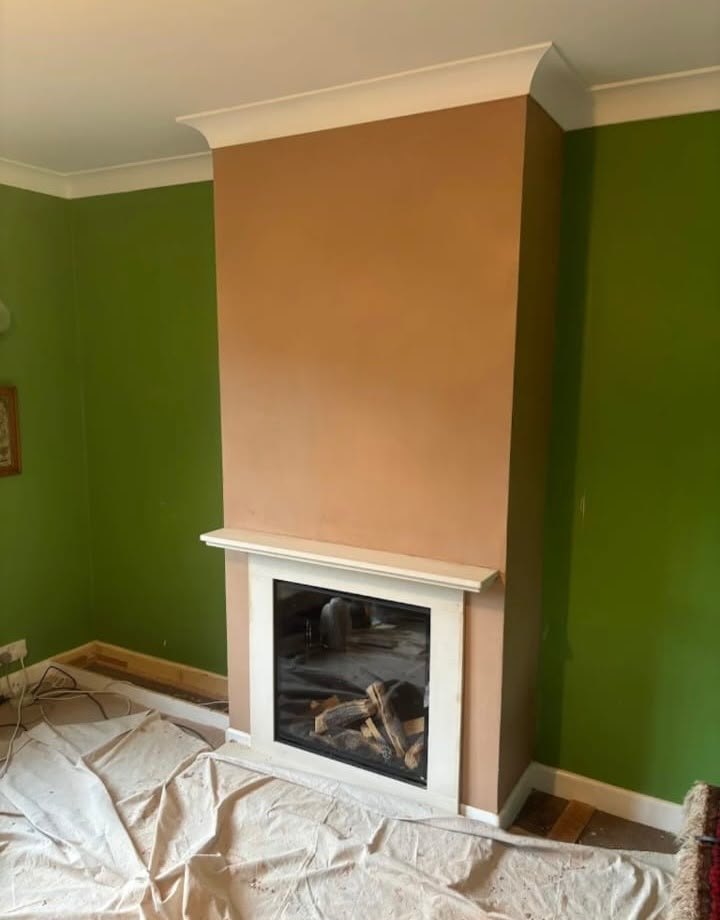
Ring rather than use the form. A ceiling that has begun to bow, a lath ceiling pulling away from its joists, or plaster coming off a wall in sheets goes to the front of the queue. Do not push at it, because old lath holds and then lets go all at once. Sandleheath is about fifteen miles from us up the A338, so tell us how much has already come away.
Worth knowing
Two kinds of wall in one village, and it matters which you have
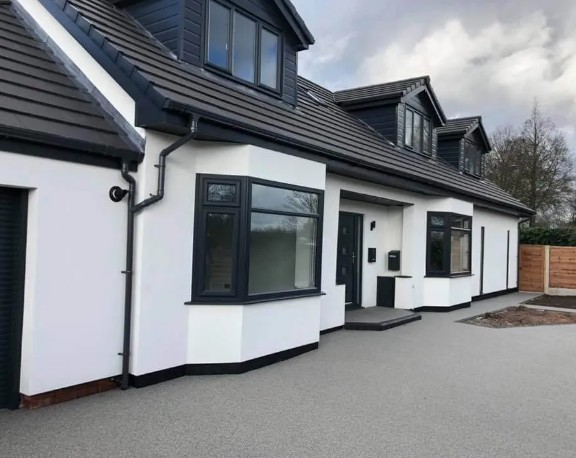
A fifth of Sandleheath predates 1919 and most of the rest went up after the war, so the village runs two entirely different building systems side by side and the same symptom means different things in each. In an old cottage the wall is solid brick with no cavity. It gets wet from outside and from the ground and it is supposed to dry back out through its own surface, so the plaster on it has to let moisture through.
In a post-war or modern house the wall is a cavity with an outer skin, an air gap and an inner block, and the plaster is only ever a finish. Damp plaster in the first house is often the wall doing its job badly; in the second it means something has actually broken.
What that changes for you is the question to ask when someone quotes. On a solid wall, a gypsum skim, a cement backing coat or a waterproof render at the base will hold the moisture in, push it sideways and upwards, and blow the new plaster off within a winter or two, and it takes the face of the old brick with it when it goes. The right answer is lime, and lime needs waiting time built into the programme.
On a modern cavity wall gypsum is entirely correct and lime would be a waste of your money. So the first thing to establish is not the finish, it is the wall. If the person pricing your job has not tapped it, looked at the thickness at a window reveal, or asked how old the house is, they are guessing, and it is your wall that pays for the guess.
Who you are dealing with
A local firm you can check
We cover Sandleheath, Fordingbridge, Alderholt and Damerham across the SP6 postcode, and work across the New Forest, east Dorset and the coast from a base near Bournemouth. Bournemouth Roofing & Building Ltd, registered in England and Wales, company number 15471719, which you can look up in a minute. Thomas Hannen's business, and he is the one who comes out to price the job, not a salesman. A verified customer's 10 out of 10 on Checkatrade. The visit and the written quote are both free.
Questions
Sandleheath questions we get asked
Sandleheath has almost nothing listed. Are we free to alter?
Inside, generally yes. There are only two listed entries in Sandleheath and no conservation area over it, so unlike the villages further up the Avon there is no appearance control on an ordinary house and internal replastering needs no consent from anyone. What still governs the job is the wall itself. A pre-1900 solid wall has to be treated as a solid wall whether or not anyone is watching, because a cement backing on it will blow.
One in five houses here is pre-1900. Is mine?
Roughly a fifth of Sandleheath predates 1919 and the largest single band is pre-1900, so it is a fair bet on the older lanes and unlikely on the later estates. The tell is the wall thickness at a window reveal and whether the ceiling flexes when you push it. Solid brick with a deep reveal and a springy ceiling means lath and lime, and that changes the backing coat we mix and the time it takes to dry.
Why put lime back rather than a cement backing coat?
Because a solid wall gets rid of its moisture through the plaster. On the older Sandleheath stock there is no cavity, so rain and ground moisture move into the wall and have to leave through the inside face. Lime lets that happen and moves a little without cracking. Cement seals it, the damp then finds the next weak point, and you get a blown patch a foot higher up the following winter.
How long does a lime backing coat need before skimming?
Longer than gypsum, and the wall sets the pace rather than the calendar. A lime backing coat wants roughly a week for each coat before the next one goes on, and on a thick Sandleheath cottage wall that means two visits with a gap between them instead of one continuous week. We leave it ventilated and unheated in between. Rush it and you trap water behind the finish, then read the map of it through the paint.
Where will you park and mix on a detached property?
Close to the door, on the hard standing if there is one. Getting on for three in ten homes in Sandleheath are detached, which usually means room for the van beside the house and a dry spot for the mixer and the boards. That saves carrying plasterboard through your living room. Where there is no drive I bring smaller boards and more of them rather than dragging full sheets down a shared path.
Nearby, and next door
Plastering and rendering near Sandleheath
Plastering and rendering nearby
Our other trades in Sandleheath
Everything we do in Verwood Plastering and rendering, all areas Every area we cover
Free quote
Get a price for your plastering in Sandleheath
Tell us which room, or send a photo of the wall, and we will book a look. The visit and the written quote cost nothing.