Plastering in Alderholt
Skimming, ceilings, blown plaster, dry lining and external render across Alderholt and the SP6 villages. Free site visit, free written itemised quote.
The site visit is free and so is the written itemised quote. Thomas Hannen prices every job himself.
Last updated
In an Alderholt house the fault is usually in the finish, and the wall behind it is sound. The village is largely postwar and eighties housing, so what sits behind the wallpaper is usually sound board or sound backing, and the honest answer is a skim. The exceptions are the older brick houses at the top of the village, and those are a different job with a different material.
Plaster in Alderholt gives trouble on artexed bungalow ceilings, low on solid walls, in garage conversions and on pebbledashed gables. New owners want a swirled ceiling made flat. A wall drums under a knuckle for the first metre up from the skirting and rings solid above it. A garage that has become a bedroom stands in bare board waiting for somebody to finish it. And a pebbledashed gable crazes and starts holding water behind itself.
None of those improve on their own. What we do about them is the same each time. The free site visit comes first: we go round with a knuckle and a bolster, ceilings included, not only the patch you rang about, and you get told on the spot whether you are buying a skim, a hack off and replaster, or a ceiling that has to come down. Then the survey goes into writing with the method on it as well as the figure.
The work
Low winter sun finds every ripple in a ceiling
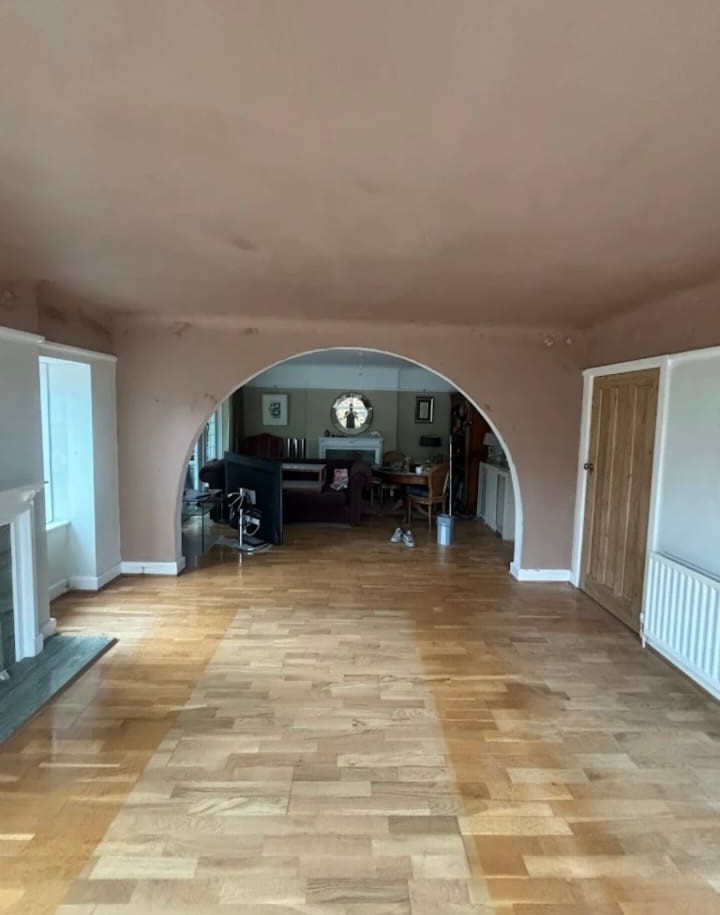
Bungalow ceilings. Close to a quarter of Alderholt is bungalows, and in a bungalow the ceilings are most of the plastering. Low winter sun through a wide window finds every ripple in a long unbroken ceiling.
Where the artex is shallow and stuck fast we clean it, stabilise it and take a finish coat over the top. Where it stands proud, or somebody has already painted it twice, it is faster and flatter to overboard and skim the new board.
The detached and semi-detached houses that filled in through the seventies and eighties are plasterboard on dabs and on stud, with taped joints and bonded board over the blockwork. That backing is normally sound, and a hollow note on a dabbed wall is how it was built rather than a fault. What has gone wrong is everything on top: woodchip, three coats over paper, and a patch somebody filled with the wrong material. We prepare it, prime with thinned PVA or a grit primer depending on how much suction is left, then bring the finish up in two passes off the trowel.
Blown plaster on the older brick. Close to a quarter of the village predates 1919, and the cottages and pairs out towards Daggons and Cripplestyle are solid wall with nothing behind them. When plaster there lets go it goes at the bottom of the wall, because that is where the water is. Anything hollow comes off back to a clean background and a backing coat goes on to suit what is behind it: browning where the brick keys well, bonding on dense block or an old painted face, hardwall where a harder surface earns its keep. Above those rooms you find riven lath, and what holds a lath ceiling up is not the plaster you can see but the keys curled over the back of the laths. A ceiling that has lost most of them comes down and is boarded; one that is merely tired can be helped from above and skimmed from below, and we will say so rather than take the easier money.
Outside it is gables, porches and the odd fully rendered bungalow, sand and cement or pebbledash on the older houses and a thin coat silicone or monocouche on the newer. New work is a scratch coat, mesh bedded into the basecoat, then primer and topcoat onto a bell cast so water drips clear of the damp course. The rest is making good after other trades: chases after a rewire, reveals after new windows, the scar where a chimney breast came out.
How it runs
How plastering is done in a house you are living in
Before any price, Thomas goes through the rooms with you and knocks on the walls and ceilings with his knuckles. Where the sound goes dull, the plaster has let go. He then writes the quote himself, with protection, the number of coats, the area of each wall and ceiling, beads and stop ends, and disposal each shown. Hacking off, the backing coat and the skim all go on the one quote.
Alderholt's eighties houses and bungalows mostly have plasterboard ceilings, and walls in blockwork or dot and dab board. The cottages may still have lath and lime. The van goes on your drive where there is one, floors and stairs are sheeted, and we move what we can. Old plaster is bagged and leaves with us, and the rooms are swept each evening.
If a ceiling is loose beyond the patch you showed us, or a wall hides a problem, you get a photograph of it and a price, and nothing more is done until you agree. Work on inside walls needs no planning permission, though stripping more than half the plaster off an outside wall back to the masonry can count as renovating a thermal element. Rendering a whole outside wall does too, and then Approved Document L applies, with Dorset Council as the authority.
Cost
Two rooms the same size can be a day apart
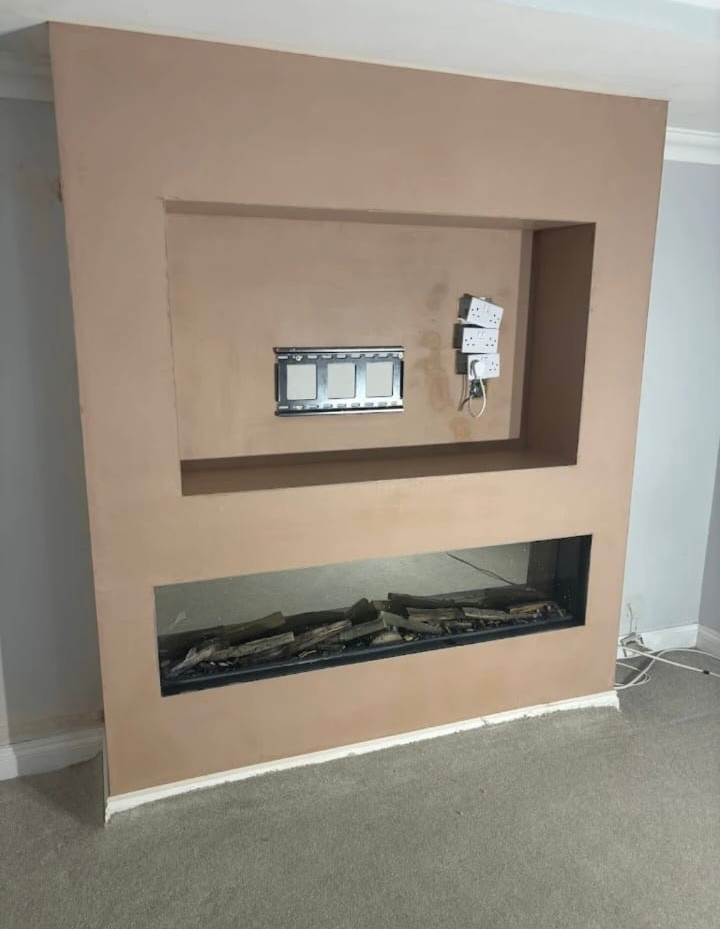
Room size is a poor guide to a plastering price. What is on the wall now decides the day. What is under the surface. Lath and lime in a cottage, old bonding on an older wall, dot and dab plasterboard in an eighties house and bare block in an extension each need different preparation. What sounds solid gets a skim, and what drums comes off.
The room and the house. An eighties detached with a drive to park on, a bungalow where every ceiling is on one level, and a cottage room that cannot be emptied are different mornings before anything is mixed. Furniture that stays in the room is moved and covered as we go.
Ceilings and height. Ceilings are slower than walls, and a stairwell needs a platform. Where the work is at height, the work at height rules apply just as they do on a roof.
Drying time. A backing coat and a skim over new board dry faster than a full lime plaster, which needs days between coats. Tell us how soon you need the room back.
Ask other plasterers how many coats they are allowing for, whether they will skim over or hack back, and whether shifting furniture is included.
If a ceiling has gone
If a ceiling starts to sag or plaster lets go
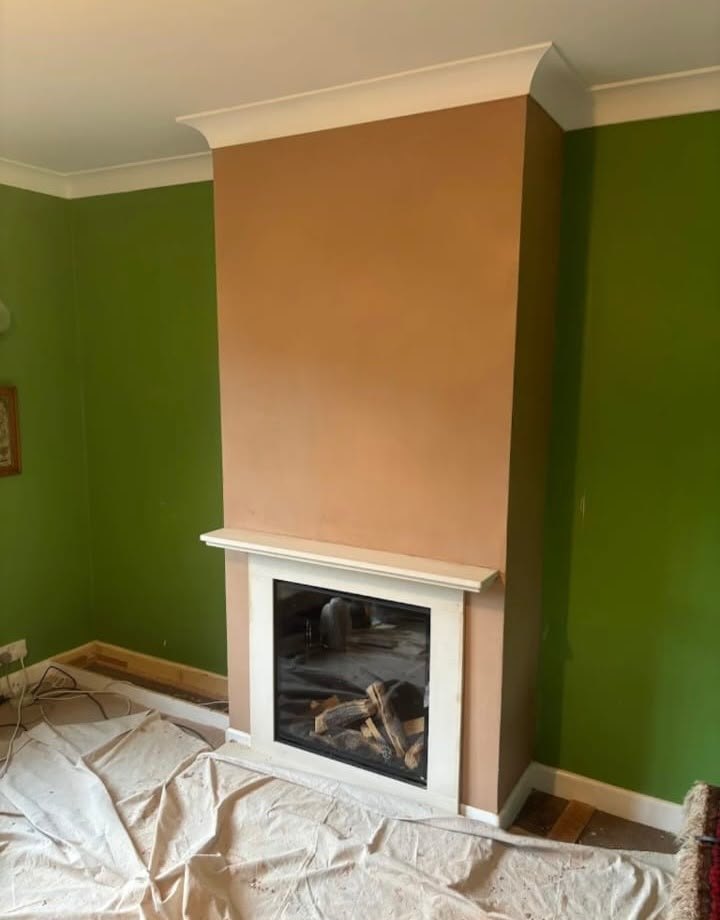
A ceiling that has started to bow, has cracked along a straight line, or is dropping fine dust is the one plastering job that cannot wait. Shut the door and keep everyone out. If water is coming through it, turn off the lights on that circuit and stop the leak before anything else.
On the first visit we bring down whatever is loose, in a controlled way, so the room can be used again, and quote the repair once we can see how much has failed. Our scheduled plastering runs Monday to Friday, 8am to 6pm. For a ceiling on the move, pick up the phone, not the form. Ring, and if we miss you we call back.
Worth knowing
No conservation area in Alderholt, and that is worth something
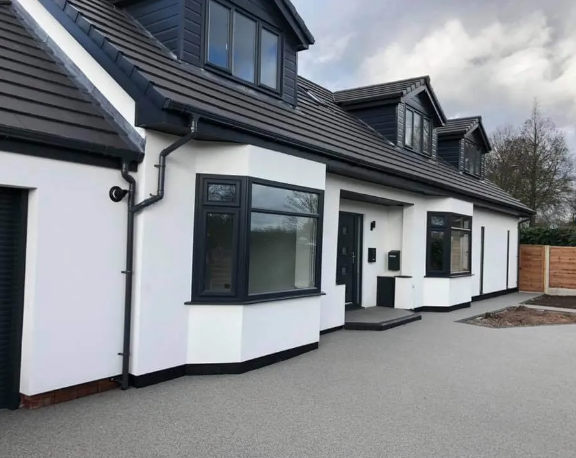
Alderholt is unusual on our patch. There is no conservation area over the village, and while it does have listed buildings, the Church of St James at Grade II among them, most houses here are not on the national list. In many of the villages round about, the outside of a house comes with an opinion attached to it. Here it does not.
If you want to render a brick elevation that has never been rendered, swap tired pebbledash for a through coloured thin coat, or simply pick a different colour from the pair next door, that is your decision on an unlisted house and there is nobody to ask. The Planning Portal page on external walls sets out where the line falls on external walls generally, and this village sits on the free side of it. For the outside walls, see rendering in Alderholt.
Some rules still apply in Alderholt. Building control takes an interest in a whole elevation, because taking render off and putting it back is work on a thermal element and the wall is expected to reach the standard in Approved Document L.
And the wall itself has an opinion even where the planners have none: the older brick houses at the top of the village are solid, they get rid of weather through their own surface, and a hard cement coat on one of those is still the wrong answer whether or not anybody can stop you. Lime plaster inside and a breathable coating outside is what those walls want. On the modern fabric, which is most of Alderholt, you genuinely do have a free hand.
Who you are dealing with
The plasterer at your door, and the firm behind him
We cover Alderholt for plastering, including Daggons and Cripplestyle, and out through Sandleheath, Fordingbridge and Cranborne. From our base in Boscombe it is 12.5 miles. Dorset Council handles planning and building control for this address.
The company is Bournemouth Roofing & Building Ltd, registered in England and Wales, company number 15471719. It belongs to Thomas Hannen, who looks at your walls and ceilings and prices the work himself. On Checkatrade, one verified customer gave a 10 out of 10. The site visit and the written, itemised quote are both free. Before you book a visit in Alderholt, you can read our customers' Google reviews, word for word, on our reviews page.
Planning at a glance
Do you need planning permission in Alderholt?
Most repairs in Alderholt need no application at all. What decides whether a change to the outside of your house does is who the council is, whether a conservation area or a listing applies, and whether the place sits in a protected landscape.
| Question | In Alderholt |
|---|---|
| Who decides | Dorset Council is the planning authority for Alderholt. Dorset Council's heritage pages set out what it controls. |
| Conservation area | None covers Alderholt, so a like-for-like repair is ordinary maintenance. |
| Listed buildings | Yes, Alderholt has listed buildings. If yours is one, or stands in the grounds of one, work can need listed building consent. |
| Protected landscape | No National Park or National Landscape covers Alderholt. |
Questions
Questions about plastering in Alderholt
Alderholt has no conservation area. Does that free our hands?
Yes, the outside of an Alderholt house is largely your call, because the village has no conservation area. The village does have listed buildings, the Church of St James among them, so check your own address on the Historic England list first; if it is not there, a change of render, colour or finish is ordinary permitted development as far as Dorset Council is concerned.
The decision on how the front of the house looks is yours to make. What limits it is the wall and the weather, not the planning department.
Why does new plaster keep blowing off our old walls?
Because the backing does the work, not the finish. Around 22.7% of Alderholt's houses predate 1919, and those are solid walls that have to pass moisture out through the surface. Put a gypsum skim on a wall that is still wet and it will part from the brick again within a winter or two. We cut back to sound material, use a breathable backing coat, and let it dry before anything goes over it.
Is a hollow sounding wall normal in 1980s Alderholt houses?
In that generation of house it usually is. About 34.3% of Alderholt was built between 1983 and 2008, and the 1980s alone account for 21.3%, so plenty of walls here are plasterboard stuck on dabs rather than plaster laid on brick. The drummy sound is the air gap behind the board. What matters is whether the board shifts under hand pressure and whether the joints have opened up.
We are adding a loft bedroom. Does the Avon affect it?
Not for a bedroom in your own house. Alderholt sits in the River Avon nutrient catchment, but that rule is aimed at new homes and separate letting units, so a loft bedroom, replastering, patching or re-rendering the house you already have does not bring it in. It is a planning matter rather than a plastering one and it gets settled before we are on site. Our part starts once the boards and the ceiling are ready.
What does the written quote break down into?
Every stage of the job, priced separately. Preparation and protection, beads and angles, any backing coat, boarding and scrim where a ceiling comes down, the skim itself, then clearing up and removing the waste. Thomas Hannen measures and prices it himself, the site visit costs nothing and so does the written quote, so you can read it line by line.
Nearby, and next door
Plastering near Alderholt
Nearby places we also cover for plastering, with straight-line distances from Alderholt, and the other trades we offer in Alderholt itself.
Plastering nearby
Our other trades in Alderholt
Plastering and rendering guides
Silicone, cement or lime: which render? Cracked render: which cracks matter Hollow-sounding wall: blown plaster or dot and dabEverything we do in Verwood Plastering, all areas Every area we cover
Free quote
Get a price for plastering in Alderholt
Tell us the address and what the wall or ceiling is doing. We will come out, knock it through and put an itemised price in writing. No charge for either.