Loft insulation in Fordingbridge
Clearing, topping up and laying to depth in Fordingbridge lofts, old roofs and new, with the ventilation looked at first.
The site visit is free and so is the written itemised quote. Thomas Hannen prices every job himself.
Short answer first
Two lofts on the same street in Fordingbridge can need two different jobs. A modern roof wants depth and a clear eaves. An old one, open to the tiles with no underlay at all, wants thinking about before a single roll goes down.
Most people ring for one of three reasons. The upstairs is cold and stays cold. The loft has been looked at for the first time in years and there is barely anything in it. Or damp has shown up on a bedroom ceiling and nobody can say whether it is the roof, the ventilation or the insulation.
We go up before we quote. That means seeing what is there, pushing a rule into it rather than guessing, checking which way the joists run, looking at the wall plate and the eaves, and finding out whether the roof is felted at all. The site visit and the written itemised quote are both free, and if the answer is that your ceiling is fine we will say so.
The work
Fordingbridge lofts, from cottage to estate house
Clearing out first. Old material has usually settled, been compressed under boards, gone patchy round cables and stopped a good way short of the edges. In an older roof it is often contaminated as well, with droppings and years of grit blown in under the tiles. That comes out in bags and leaves with us the same day. Anything sound and dry is straightened, its gaps closed, and kept underneath the new work.
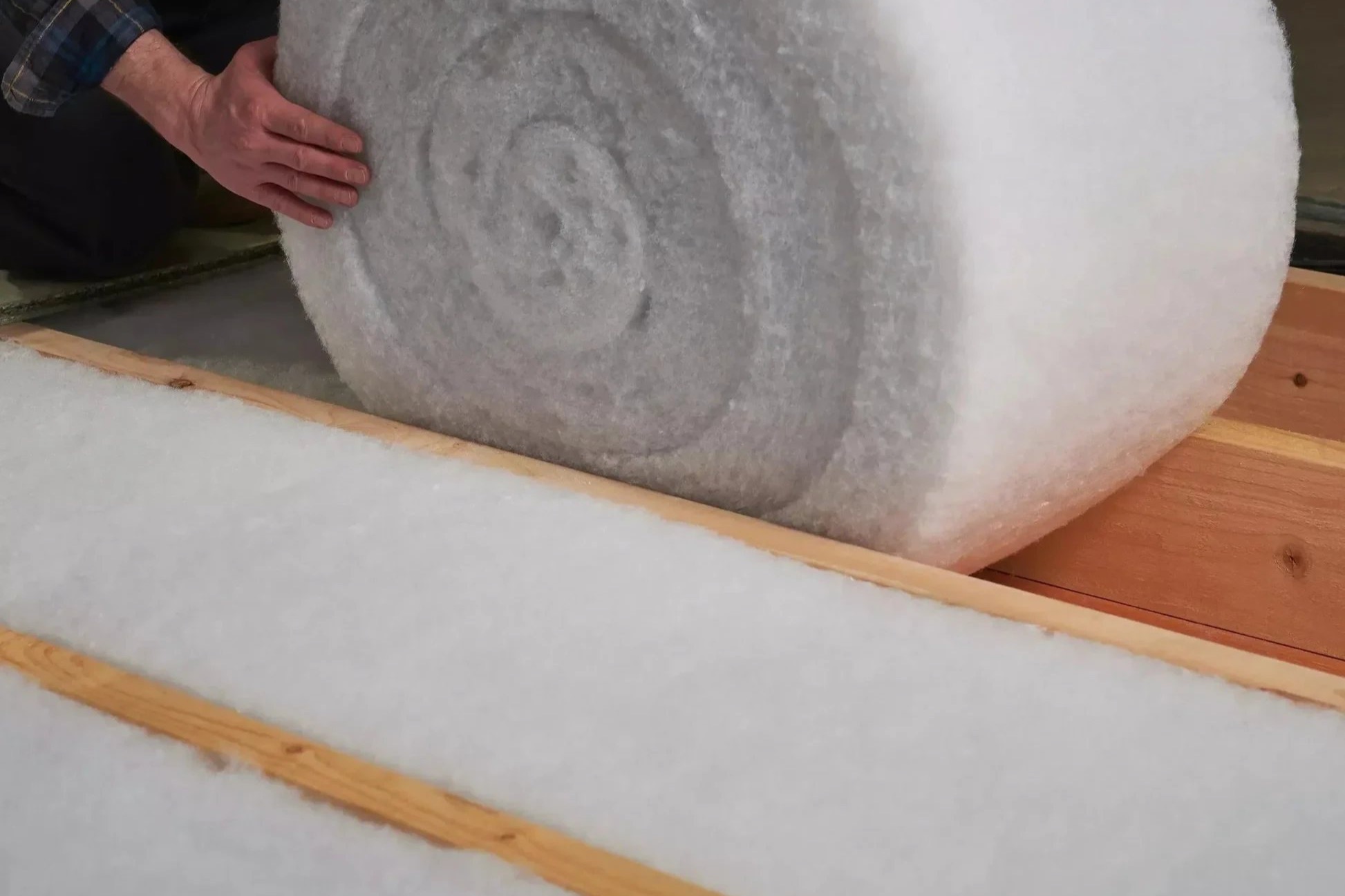
Depth in two layers. About 270mm finished, and the way it is laid decides whether you get it. First layer of mineral wool roll between the joists, pushed to a friction fit so nothing is missing at the sides. Second layer cross laid over the joists at right angles, so the timber stops being a cold bridge running through your ceiling. Glass wool roll for the long runs, rockwool batts where an old cut roof has bays of every width, and loose fill for the corners. Approved Document L sets the U value the finished ceiling is meant to reach under Part L.
Ventilation, which is not optional. Insulate the ceiling and the roof above it gets colder. The dew point moves up into the timbers, and vapour leaking out of the house condenses on whatever cold surface it finds. So the insulation stops on the wall plate, vent trays hold it off so the air gap at the eaves stays open, and cross ventilation runs from one side to the other. Where the eaves are boxed in, a ridge vent or vent tiles do the same work at the top. Approved Document F is the standard, and blocking the eaves is the quickest way to turn a warm bedroom into a wet roof.
Services and the hatch. Recessed lights get proper covers. Cables are lifted out of the wool and clipped to the joists rather than buried, because buried wiring runs hot. In an older house the cold water tank and its pipework are suddenly on the cold side of the insulation, so lagging and a jacket go on at the same time. The hatch is insulated on its back and draught sealed, and the loft ladder reset if it fouls the new depth.
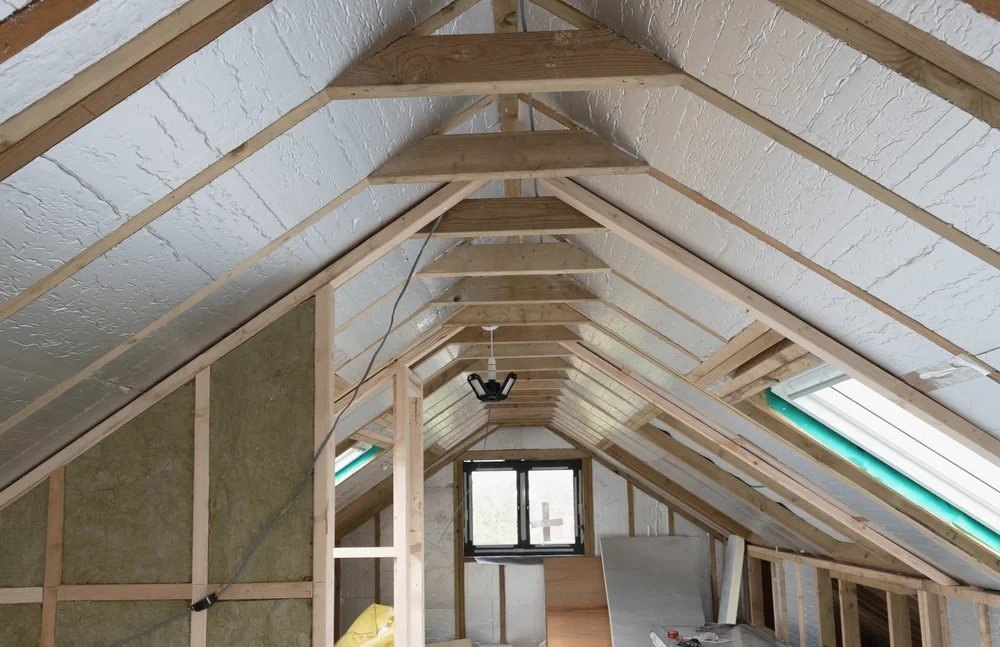
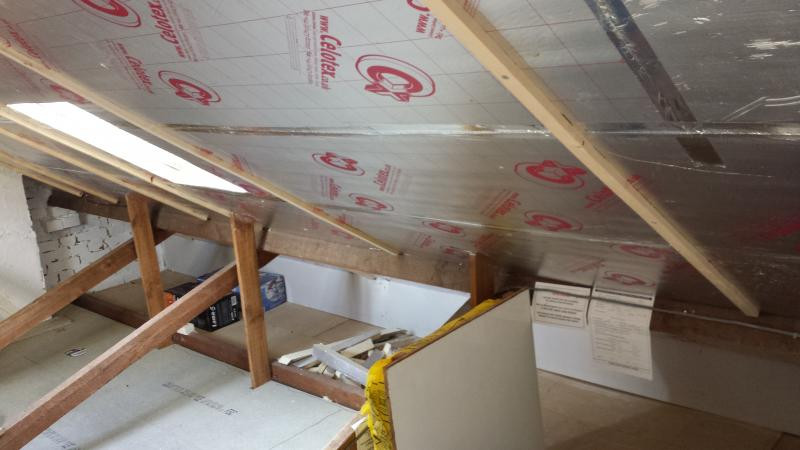
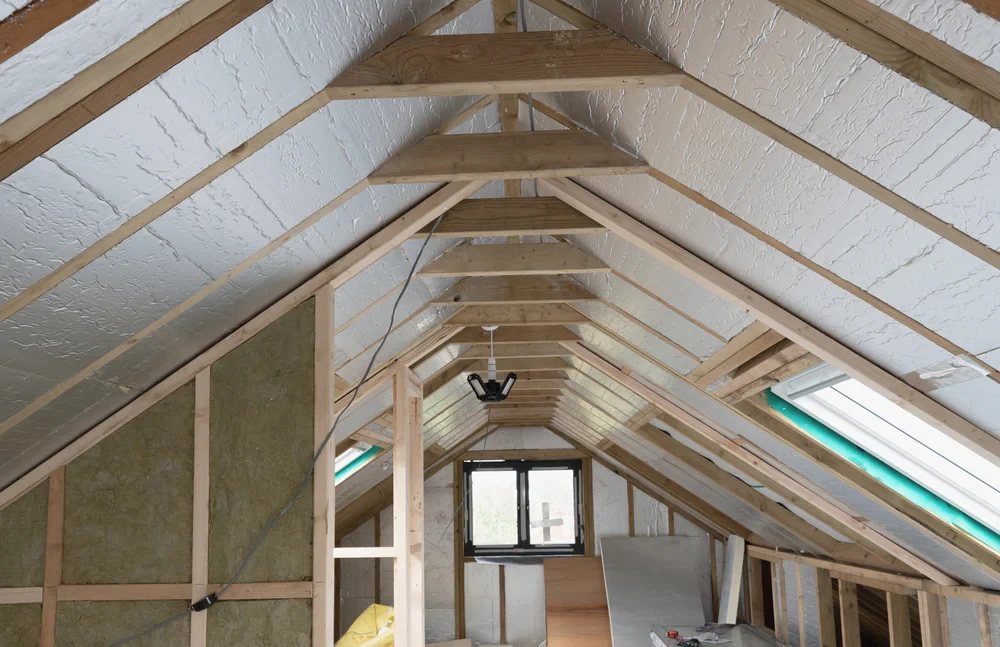
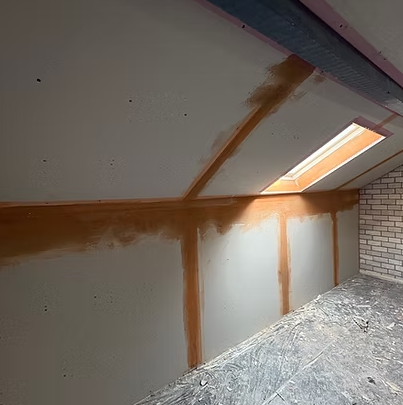
Storage and roof slopes. Boards laid on the joists crush the insulation flat, so where you want the loft usable we build a raised floor on loft legs and board the platform you actually walk on. Where there is a room in roof, a dormer or a sloping ceiling over the stairs, the job moves to rafter level. Rigid PIR board cut tight between the rafters, a clear gap kept above it under the underlay, another layer under the rafters and the joints taped, so the warm roof build up keeps interstitial condensation out of the timber.
How it runs
From your call to a written price
Same team from first visit to last, one person to ring, and no sub-contracting your work out to somebody you have never met. The quote is itemised, not a figure on the back of a card: the survey, clearing and bagging whatever is up there now, the material and its depth, keeping the eaves clear, the hatch and any pipework, and disposal on separate lines, so you can compare it properly against anyone else's.
Nothing is left open or unusable overnight. The site is swept at the end of each day rather than the end of the job, and what comes out leaves with us. If something turns up once we start that nobody could have seen, you get a photograph and a price before we carry on.
Insulating a roof space is not development, so it uses none of your permitted development rights and there is nothing to apply for, which Planning Portal guidance on insulation sets out plainly. Building control still applies, because regulation 23 brings a whole element up to current standard once more than half of it is renovated. There is no conservation area over the town, but there are a great many listed entries in and around the old streets, and on a listed building consent covers internal work as well, so we check that at the visit. The VAT rules for energy saving materials are worth reading before you order anything.
Cost
What decides the price of a loft
No rate per square metre, because the floor area is the easy part and the awkward edges are where the time goes.
Getting to it. A 1970s estate house with a landing hatch, a town centre cottage where the trap is over the stairwell, and a bungalow with a wide shallow roof are three quite different mornings. A hatch on a landing you can stand a ladder under is one job. A hatch over a stairwell, a crawl space you can only move through on your knees, or a loft full of boarding that has to come up and go back, is time before any material is laid.
What is up there now, and what it is sitting on. Old material that has to come out, be bagged and taken away is a cost before anything new goes down, and so is a loft full of boxes that has to be emptied and put back. Joists at 400 centres with a flat run across them is a different afternoon from a trussed roof full of bracing.
Ventilation, and the edges nobody reaches. Insulation stops at the wall plate and the eaves have to stay clear, or you trade a warm bedroom for a wet roof. Getting depth right into the corners and around the hatch, boxing over downlighters and lagging anything that now sits in the cold, is most of the labour. Approved Document L sets what the work is expected to reach.
Comparing quotes? Ask what depth is actually being laid and in how many layers, whether the old material is coming out or being covered over, whether the eaves are being kept clear, what happens to anything you store up there, and whether the hatch and the pipework are included. Two quotes for the same job are usually two different jobs.
If the loft is wet
Water running off the felt, or mould on the underside
Ring rather than use the form. Droplets on the underside of the felt, black mould spreading across the roof timbers, or insulation that is visibly damp are all telling you the same thing: warm wet air is getting into a space that cannot breathe. That does not wait, because it is the timbers that pay for it. We look before anything is added, because putting more insulation into a loft that cannot ventilate makes it worse. Fordingbridge is a straight run up the Avon valley for us, so a wet roof space does not sit waiting. The phone is answered 24 hours for emergencies; scheduled work runs Monday to Friday, 8am to 6pm.
Worth knowing
In the old part of town the roof has no felt under it
About a fifth of the houses in Fordingbridge went up before 1919, and a roof of that age was built without any underlay. Tiles or slates were hung straight on the battens, and if you stand in one of those lofts on a bright day you can see daylight through the joints. That roof has always ventilated itself, which is why it has stayed dry for a century with almost nothing in the ceiling below it.
Insulate it properly and two things change. Wind now blows across the top of the insulation instead of through a loft that was warm anyway, so the edges need holding down and the roll needs to sit tight rather than loose. And fine grit and dust drive in through the same joints and settle on the new material. Neither is a reason not to do it. It is a reason not to treat the roof like a modern one: we would rather add a breathable membrane or sarking when the covering is next off than seal an old roof up from underneath with something that traps vapour in the timbers. If a quote for an old Fordingbridge roof says nothing about how air moves through it, it was written from the doorway.
Who you are dealing with
A local firm you can check
We cover Fordingbridge, Godshill, Sandleheath, Alderholt and the SP6 addresses along the Avon, with New Forest District Council for planning and building control. You are dealing with Bournemouth Roofing & Building, the trading name of Bournemouth Roofing & Building Ltd, registered in England and Wales, company number 15471719, which you can look up in a minute. Thomas Hannen's business, and he is the one who comes out to price the job, not a salesman. A verified customer's 10 out of 10 on Checkatrade. The visit and the written quote are both free.
Questions
Fordingbridge questions we get asked
How long does a loft take from start to finish?
Most are half a day to a day. Clearing is what stretches it: bagging old material, emptying a loft that has been the family store cupboard for years, and lifting boarding that has to go back. That time is a line on the quote rather than a surprise at the end.
Our roof has no felt under the tiles. Is that a problem?
It is a difference rather than a problem. An unfelted roof is already well ventilated, so you are less likely to get condensation on the timbers, but you are more likely to get wind moving over the insulation and dust settling in it. We lay it tight, hold the edges, and leave the roof to breathe the way it always has.
Can you insulate a loft with a water tank in it?
Yes, and the tank needs attention on the same day. Once the ceiling is insulated the tank is in cold air, so it gets a jacket and the pipework gets lagged. We never insulate underneath a tank, which would leave it colder still. That small detail is what stops a burst pipe in the first hard frost.
What should I ask another quote about?
Ask what depth is being laid and in how many layers, whether the second layer crosses the joists, whether vent trays are included at the eaves, what happens to the old material and whether the hatch is in the price. Those five answers separate two quotes that look identical on paper.
Nearby, and next door
Loft insulation near Fordingbridge
Loft insulation nearby
Our other trades in Fordingbridge
Everything we do in Verwood Loft insulation, all areas Every area we cover
Free quote
Want a straight answer about your loft?
We will go up, measure what is really there, look at the eaves and put an itemised written price in front of you. The visit and the quote cost nothing.