
Plastering in Merley
Skimming, ceiling repairs, garage conversions and external render across Merley and BH21, priced in writing once somebody has knocked the walls.
The site visit is free and so is the written itemised quote. Thomas Hannen prices every job himself.
Last updated
More than three quarters of Merley went up between 1945 and 1982, about half of it from 1973 to 1982, so the walls and ceilings here are the same construction street after street and they are reaching the same age together. That makes the work predictable: on most of these houses the plaster is still stuck and it is the surface that has had enough.
In a Merley house the trigger is usually a ceiling, a blown wall or a sale. A ceiling has cracked along its board joints, or the Artex on it has finally lost its argument with the decorator. A wall has blown behind the paper, usually on an outside corner or in a converted garage. Or the house is being sold or redecorated and the owner wants the lot skimmed flat rather than filled again.
We come out, knock every wall and ceiling in the room, and separate the ones that only want a finish coat from the ones that have to come off. That goes into a written price with the two kept apart, so you can see what you are choosing. The site visit and the quote are free and we are about six and a half miles away.
The work
Most of the garages here have become rooms
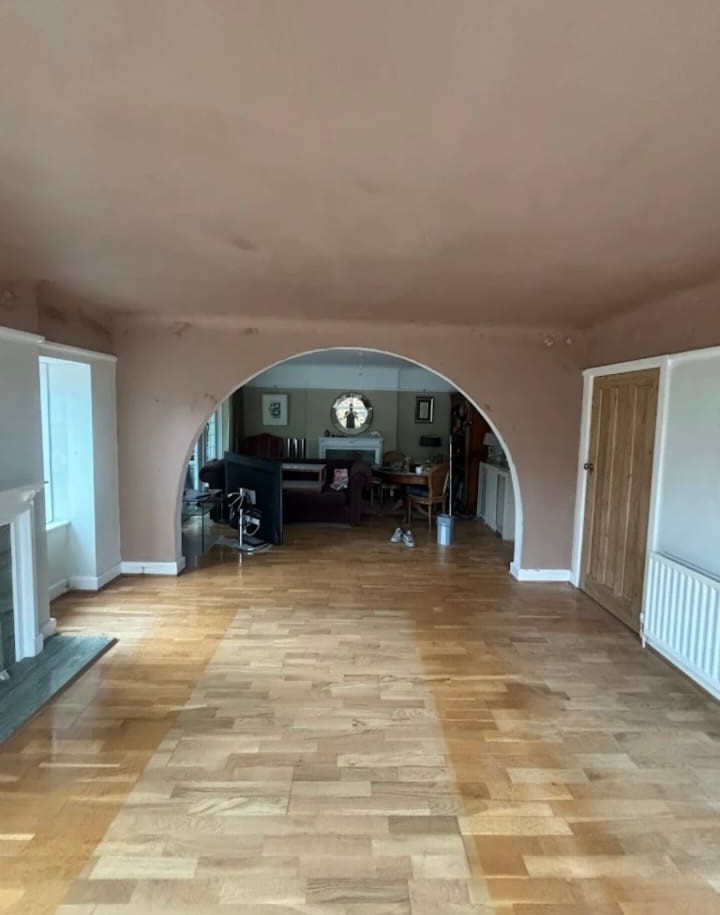
Garage conversions suit much of the housing here. Merley is one cohort ageing together: better than three quarters of it went up between the war and the early eighties, and about half the houses are detached, a type that often comes with an integral or attached garage.
Bare blockwork inside a garage was never meant to be a finished wall, so the answer is dry lining: insulated plasterboard on dabs or on a stud frame, board over the old up-and-over opening once it is filled, joints taped, then a skim. Where a lounge and dining room have been opened into one, the new beam and the old wall stubs need beading and making good properly or the crack comes back along the join within a year.
The rest is whole-house skims before decorating or selling. These are cavity walls with a block inner leaf, a float coat straightened onto the block and a gypsum finish over it, and that backing coat is usually sound half a century on. What has gone is the surface: heavy relief paper, gloss on the reveals, a chimney breast filled and sanded a dozen times. Two passes of finish coat, trowelled true. Where a wall drums over a defined patch the plaster has parted from the block and comes off, and what replaces it depends on suction, bonding on a dense or previously painted face, browning or hardwall on something more absorbent.
Textured ceilings and deep coving came as standard on Merley houses. A shallow Artex pattern can be stabilised, sealed and skimmed; a deep swirl is cheaper overboarded. Coving that is coming away takes the ceiling edge with it, so decide early whether it stays, because taking it off adds a strip of making good all the way round the room. The boards were nailed to the joists in the seventies, so a hairline running dead straight every 1200mm is board movement, not the house cracking up. Where a ceiling has been wet, or bows when you press it, it comes down and goes back new on new fixings.
Outside it is gable ends, porch returns and garage flanks. A crazed or drumming sand and cement render is either patched like for like or stripped back to a scratch coat, a mesh-reinforced basecoat, a primer and a silicone topcoat, with a bell cast bead at the base to keep water off the damp proof course. For the outside walls, see rendering in Merley.
How it runs
Skimming or replastering, from first look to dust sheets up
Before any figure is written, Thomas visits and looks at the rooms himself. He taps the walls, checks the ceilings for cracks along the board joints, and looks for damp.
Houses built in Merley in the seventies and early eighties mostly have plasterboard ceilings and blockwork walls finished in gypsum plaster, so a skim is often enough, but a blown or damp wall needs taking back further. The quote itemises protection, stripping out, any new plasterboard or backing coat, the skim, beads and disposal.
You keep one point of contact from day one to the finish. Floors and furniture are sheeted, the room is left usable each evening where possible, and the old plaster is bagged and taken away, never left on your drive. The van and the mixer can usually go on the drive. If we uncover a cracked lintel or live damp behind the old finish, you get a picture of it and a price, and you decide.
Inside work needs no permission. Outside, the estate houses are clear of the Canford Magna and Oakley Lane designations, and the council's map of conservation areas shows where they run; for an older property check the council's listed building records. Re-rendering in a similar material needs no planning permission, as Planning Portal guidance on external walls explains, but renewing render across an elevation brings in Approved Document L.
Cost
Skim, backing coat or new board: what sets the price
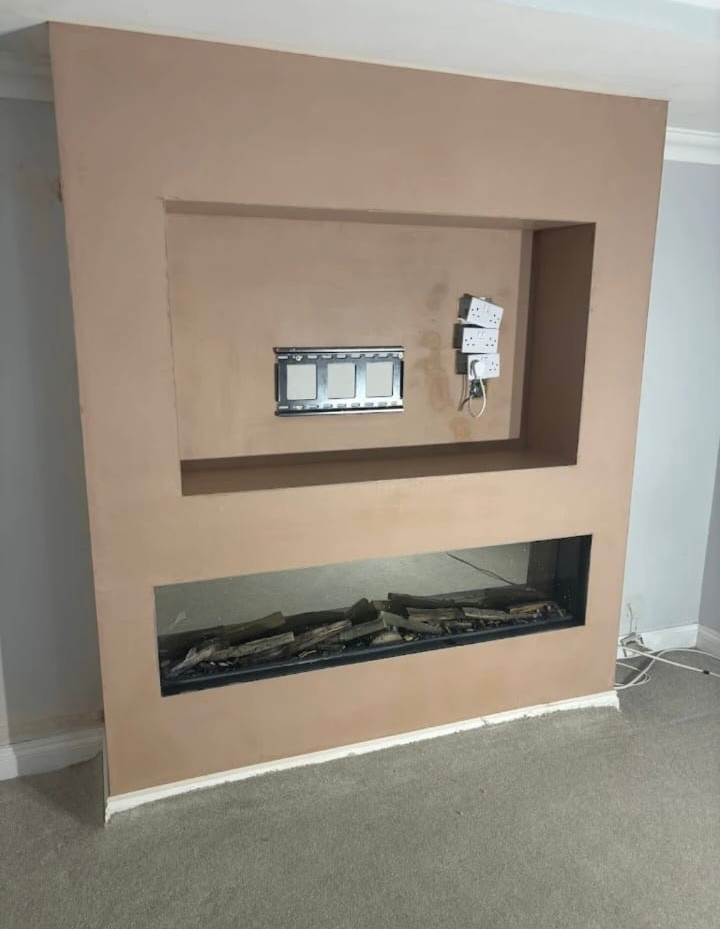
We don't price plastering by the square metre, because what sits behind the finish decides the job. The state of the wall. Sound plaster with a few cracks takes a skim. Plaster that sounds hollow when tapped has lost its key and comes off back to the block, which brings a backing coat and drying time into the job.
Ceilings. Textured coatings such as Artex were common on ceilings of this era. Skimming over a sound one is usually fine, but it should be tested for asbestos first, and that test is a line of its own.
Corners and edges. Coving, deep window reveals, a chimney breast and boxed-in pipes all need beading and more time than a plain wall.
Getting in. A detached house with a drive for the van is straightforward. A garage being turned into a room means everything comes in past the car, and new plasterboard on stud walls needs insulation behind it.
Drying. A new backing coat has to dry before the skim goes on, and fresh plaster needs weeks before a mist coat.
When comparing quotes, ask whether it is a skim or a full replaster, whether the ceiling is being tested or overboarded, which beads are used, and who takes the waste.
If it has come down
A ceiling sagging or plaster coming away
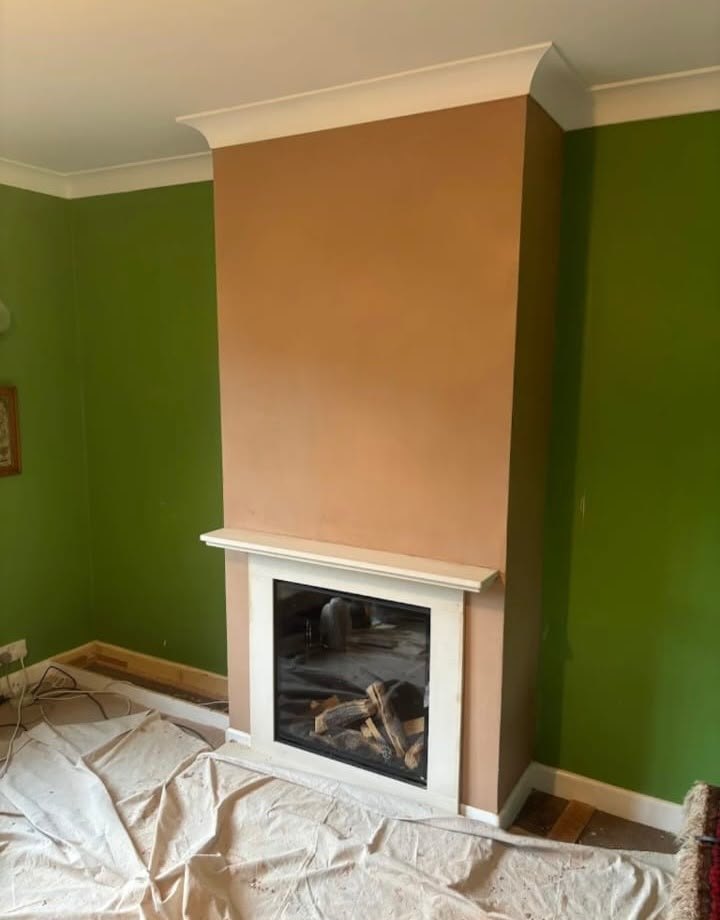
If a ceiling is bulging, cracked across and dropping, or wet from a leak above, keep everyone out of the room and switch off the lights on that circuit. Don't poke at it.
If water is still coming through, stop it at the source if you can, and tell us about the roof or pipe as well. Phone rather than use the form. First we make the room safe, taking down what is loose and propping what is not, and we find out why it failed before pricing the repair. Planned jobs run Monday to Friday, 8am to 6pm. Should nobody pick up, expect a call back from us as soon as possible.
Worth knowing
The whole estate is the same age, and that works in your favour
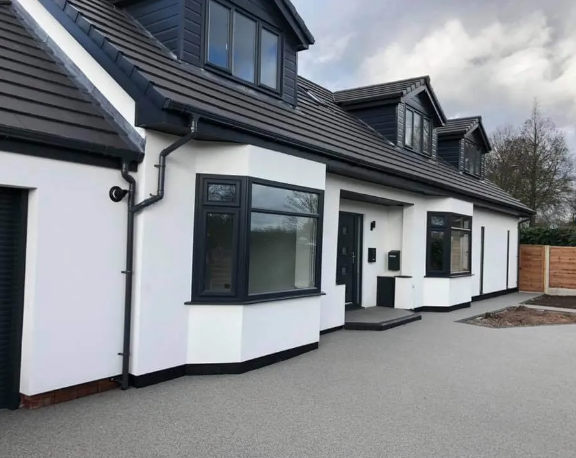
More than three quarters of Merley was built between the war and the early eighties, with the biggest single push in the 1970s.
That is unusual, and it means the house you are ringing about is very likely built the same way as the one either side of it: the same block inner leaf, the same float coat, the same board ceilings on the same joist centres, and the same textured finish put on by the same trades within a few years of each other. When everything goes up together, everything wears out together.
For you that turns guesswork into something closer to a known quantity. Because the houses are built alike, what is behind one wall is a fair guide to the next, so the price on the quote is less likely to move. It also means your neighbour's job is a fair guide to your own: if three houses on the road have had ceilings overboarded and the walls skimmed rather than stripped, yours will most likely go the same way.
The one place the pattern breaks is anywhere that has been altered since, so a garage conversion, a knocked-through lounge or an extension built in the nineties gets knocked and priced on its own rather than assumed to match the rest of the house.
Who you are dealing with
Plastering in Merley from a registered company
Our base on Wolverton Road, Boscombe, is 6.6 miles away. We plaster in Merley, Canford Magna, Bearwood, Oakley and the BH21 streets either side of the Wimborne Road; planning and building control are handled by Bournemouth, Christchurch and Poole Council.
The firm you would be dealing with is Bournemouth Roofing & Building Ltd, registered in England and Wales, company number 15471719, owned by Thomas Hannen, who taps the walls and writes the price himself. A verified customer left us 10 out of 10 on Checkatrade. Coming to look is free, and the itemised quote in writing is too. Before you book a visit in Merley, you can read our customers' Google reviews, word for word, on our reviews page.
Planning at a glance
Do you need planning permission in Merley?
Most repairs in Merley need no application at all. What decides whether a change to the outside of your house does is who the council is, whether a conservation area or a listing applies, and whether the place sits in a protected landscape.
| Question | In Merley |
|---|---|
| Who decides | BCP Council is the planning authority for Merley. BCP Council's heritage pages set out what it controls. |
| Conservation area | None covers Merley, so a like-for-like repair is ordinary maintenance. |
| Listed buildings | Yes, there are listed buildings in and around Merley. If yours is one, work can need listed building consent. |
| Protected landscape | No National Park or National Landscape covers Merley. |
Questions
Questions about plastering in Merley
Half of Merley went up in the seventies. Does that matter?
For plastering it matters a great deal. Around seventy seven per cent of the housing here dates from 1945 to 1982, with just under half of everything built in the 1970s and early 1980s, so the same materials went on the same walls within a few years of each other.
Backing coats of that age give up in the same way and at the same time, usually behind a chimney breast or on the cold external wall of a north facing room.
Our neighbours all had the same ceiling problem. Why is that?
Because the estate was boarded and skimmed in one go and every ceiling is the same age. Plasterboard of that period was nailed, not screwed, and nails work loose over fifty years of heating cycles, which is why cracks turn up in straight lines along the joists in one house after another down a road. Refixing and taping deals with most of them. A ceiling that has dropped away from the noggins needs boarding again.
We are opening the integral garage into the house. What happens?
We come in once the blockwork, the new opening and the first fix are done and the floor slab is dry. Integral garages on the detached houses in Merley have bare block walls, a beam over the old door position and no plaster anywhere, so it is dot and dab on the outside walls, boarded studwork on any new partition, then a skim throughout. Tell us early, because the boards want to be on before the heating is extended into it.
Does anything in Merley need listed building consent?
Only the twenty six listed entries in the area, and several of those sit in the Canford School grounds, John of Gaunt's Kitchen included. The estate housing is not listed and sits outside a conservation area, so internal replastering and external render are your call. The Oakley Lane and Canford Magna conservation areas are in the same ward, so if you are close to either, check the boundary first. If you own an older building near the school, check with the council before anything is stripped, because removing historic plaster from a listed building without consent is an offence, not an oversight.
You are only up the road. How quickly can you look?
Merley is about six and a half miles from our base. Scheduled work runs Mon to Fri, 8am to 6pm. Something urgent? Ring, and if we miss you we call back. Thomas Hannen does the visits himself, which means what he says on the doorstep is what ends up on the written quote.
Nearby, and next door
Plastering near Merley
Nearby places we also cover for plastering, with straight-line distances from Merley, and the other trades we offer in Merley itself.
Plastering nearby
Our other trades in Merley
Plastering and rendering guides
Silicone, cement or lime: which render? Cracked render: which cracks matter Hollow-sounding wall: blown plaster or dot and dabEverything we do in Broadstone Plastering, all areas Every area we cover
Free quote
Get a written price for plastering in Merley
A free site visit, every wall and ceiling knocked rather than glanced at, and an itemised quote that keeps a skim and a strip out on separate lines.