
Merley repointing and mortar repairs
Raking out and repointing on the estate brickwork, stacks and boundary walls of Merley and Canford Magna, in a mix matched to what came out.
The site visit is free and so is the written itemised quote. Thomas Hannen prices every job himself.
Repointing in Merley
Hard mortar does not crack, it wears away
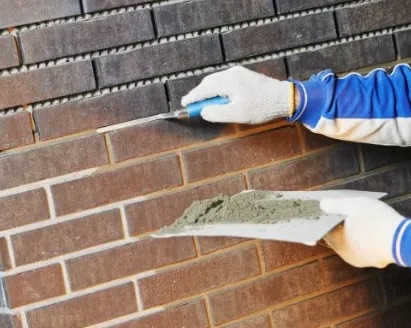
On a Merley house the mortar nearly always goes before the brick does, and it goes on one wall first. Raking out and repointing that elevation is a repair, not a rebuild, and matching the cement gauge that is already in the wall matters far more here than reaching for lime.
Merley went up mostly in the 1970s and early 1980s, and the calls arrive in a pattern. Joints on the south west gable worn back behind the brick face. A chimney with the mortar washed out of the top courses. A front or retaining wall beside the drive where the joint has gone friable and the coping is loose.
None of that is a wall in trouble. A cavity wall of that period has a hard cement mortar in it, and hard mortar erodes rather than cracks: it goes at the surface, on the elevation that takes the weather, and stops. Reading how far back it has gone is what decides the job.
We tap and probe the joints on each elevation and tell you which walls want doing now and which are ten years off. The visit and the written itemised quote are free, and we are under six miles away.
The work
Where the joints go first on a Merley house
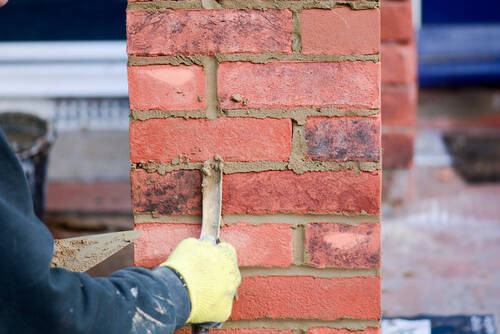
The weather side, and only the weather side. The exposed wall here faces south west, and it is the one that opens up. We rake by hand to about twice the joint width, far enough for the new mortar to key and no further. A disc cutter is tempting on stubborn seventies mortar and is still the wrong tool: it widens the joint and takes the arris off either side, on a face you will look at for thirty years. Joints are brushed out and damped down before anything is filled.
Matching the mix, which is not a lime job. A pre-1919 solid wall needs a soft breathable lime because it dries through the joint. A 1970s cavity wall does not, and an NHL lime or lime putty mix on it would wash out inside a few winters. What goes back is a cement, lime and sand gauge matched for strength first, then colour and texture. We mix a sample, leave a trial panel on the wall and look at it dry.
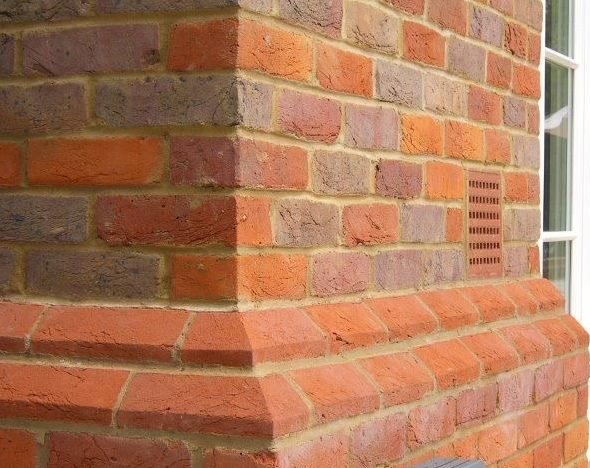
The joint profile. Most of Merley was built with a bucket handle joint struck with a rounded tool, and that is what goes back unless there is a reason to change. A weather struck joint sheds better on a badly exposed gable. A recessed joint looks sharp and leaves a ledge at every course for water to sit on. It is a decision, and it belongs in the quote rather than on the day.
Brick faces and feature panels. Where frost has lifted the fired face off a brick, pointing around it hides nothing. Those are cut out and replaced with a matched stock, or turned where the back is sound. Watch the soldier courses over openings and the panels of snapped headers of that era: they carry far more joint per square metre than the rest of the wall and open up first.
Stacks, garages and boundary walls. A chimney is the most weathered masonry on the house and sits above the flashings, so an open joint there goes into the roof rather than the wall. Single skin garages, low front walls with no coping and planters beside the drive are all pointing jobs in their own right. A stack wants a scaffold, a gable comes off a tower, a garden wall neither.
How it runs
From your call to a written price
Same team from first visit to last, one person to ring, and no sub-contracting. The quote is itemised: access, raking out, the mortar mix, the area of each elevation, brick replacement and disposal on separate lines.
Nothing is left open overnight, the site is swept daily, and what comes out leaves with us. If something turns up that nobody could have seen, you get a photograph and a price before we carry on.
Repointing like for like is maintenance: no planning permission and no building control. Merley has no conservation area of its own, though Canford Magna and Oakley Lane nearby do, and the council keeps the list for the whole of BCP. We check an address before agreeing a mix, because inside a boundary the mortar colour and the joint profile stop being a matter of preference.
Cost
What decides the price of a repointing job
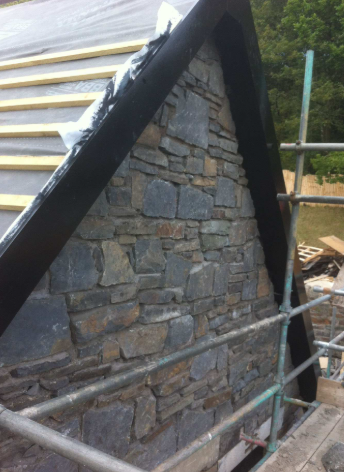
No rate per square metre. The area tells you almost nothing until somebody has looked at the joints.
Getting to it. A detached house with a drive down both sides, a bungalow gable you can reach off a tower and a stack on a three storey townhouse are three different set ups before a joint is touched. The work at height rules are why access is its own priced line.
The joints decide it, not the wall. Raking out by hand is slow, and on soft brick the only safe way: a disc widens the joint and takes the arris off. Depth, and whether faces have already spalled, sets the hours far more than area does.
Matching is the part that shows. Too strong a mix is the classic mistake: cement holds water against a soft brick and the face blows off in the first hard frost. Lime cures slower, and suits most pre-1919 walls here.
Comparing quotes? Ask how deep the joints are raked and by what, what the mix is, how many spalled bricks come out, and whether the scaffold is in the price. Two quotes for the same job are usually two different jobs.
If water is getting in
Open joints, and water coming through the wall
Ring rather than use the form. Washed out joints let driven rain straight through to the inside face, and on a chimney it finds the flashings too. We come and look, sheet or temporarily point the worst, then price the elevation once it has dried enough to show what is sound. In Merley that usually means the south west gable or the stack, and on a cavity wall it shows as penetrating damp on the inside face rather than as a drip. The phone is answered 24 hours for emergencies; scheduled work runs Monday to Friday, 8am to 6pm.
Worth knowing
One estate, one mortar, one set of joints
Nearly eight in ten homes in Merley went up between 1945 and 1982, about half of it in the 1970s and early 1980s. That is a single cohort: the same mortar out of the same mixers within a few years of itself, onto houses facing the same weather, ageing side by side ever since.
Two things follow. When one house on a road needs its south west elevation pointing, the neighbours usually do too, and a mortar matched properly on one is matched for the street. And you can plan it: no urgency in a joint gone back two or three millimetres on a sheltered wall, real urgency in one gone back fifteen on the exposed face.
The third thing is what not to do. Because none of the housing here is pre-1919, the lime argument that governs the old towns does not govern your wall. The listed entries near Merley sit on the Canford School estate and around Canford Magna, not in the housing, and there is no conservation area over the village. What is left is a technical decision, which is the right way round.
The mortar on these estates was mixed hard by the standards of the day, harder than a good deal of the brick around it, so where it fails it fails at the surface rather than through the wall. That is why so much of the work here is fifteen millimetres deep and no more, and why the honest answer to a lot of calls is that the wall will keep a few winters yet.
Who you are dealing with
A local firm you can check
We cover Merley, Canford Magna, Bearwood, Broadstone and across to Wimborne, broadly BH21 and the postcodes around it, under BCP Council. You are dealing with Bournemouth Roofing & Building, the trading name of Bournemouth Roofing & Building Ltd, registered in England and Wales, company number 15471719. Thomas Hannen prices every job himself. A verified customer's 10 out of 10 on Checkatrade. The visit and the written itemised quote are free.
Questions
Merley questions we get asked
Should a seventies house be pointed in lime?
No, and it is the commonest mistake we are called back to. Lime belongs on a soft, pre-1919 solid wall that dries through its joints. Yours is a cavity built in a cement gauge, and a soft lime in it erodes again quickly. We match the gauge that came out.
Only the back gable looks bad. Is that normal?
It is the normal pattern here. Wind driven rain arrives on one face and barely touches the others, so the exposed elevation can be fifteen millimetres open while the sheltered wall is still original. We survey all four, price them separately, and most people do the one that has gone.
Is Merley in a conservation area?
No, Merley has none of its own. Canford Magna and Oakley Lane are conservation areas, so if your address is over that way it is worth checking the boundary before agreeing a colour or a joint finish.
Can you match the colour of what is there?
Most of the time, closely. Sand does the matching more than cement does, so we choose the sand against a raked out sample and then set the gauge. A trial panel goes up first and is looked at dry. New work sits a shade fresher for a winter, then weathers in.
The top of our garden wall is crumbling. Repoint or rebuild?
Repoint, in most cases. A free standing wall takes water on the top and both faces, so its joints go long before anything structural does. If the coping is loose or missing we reset it, because that is what feeds the wall. Where whole courses have gone hollow, we say so rather than point over it.
Nearby, and next door
Repointing near Merley
Repointing nearby
Our other trades in Merley
Everything we do in Broadstone Repointing, all areas Every area we cover
Free quote
Get the exposed wall priced properly
A free site visit, an honest answer on which elevations need doing, and an itemised written quote before anything starts.