Plastering and rendering in Hangersley
Ceilings, room re-skims, damp solid walls and external render across Hangersley and BH24. We look at the wall before anybody talks about money.
The site visit is free and so is the written itemised quote. Thomas Hannen prices every job himself.
An old ceiling that sags and a modern one that has cracked are two different jobs, and the difference decides the price. Lath and lime that has lost its keys comes down. Plasterboard that has only cracked at the joints gets over-boarded and skimmed. We tell you which one you have while we are stood under it in Hangersley, on a free site visit.
Most calls out here start the same way. Somebody has pulled the paper off a back bedroom in a house they have just bought and found a surface no decorator will touch. Or a ceiling in the older part of the house has started to bow and drop dust on the carpet.
Or the wall behind the log burner has cracked away from the chimney breast again. None of that gets settled from a photograph on a phone, because the answer is in how the wall behaves when you push it. We come out, work round the room with a knuckle and a palm, and put the whole thing in writing before anybody blocks out a week.
The work
Three generations of filler under one wall of paper
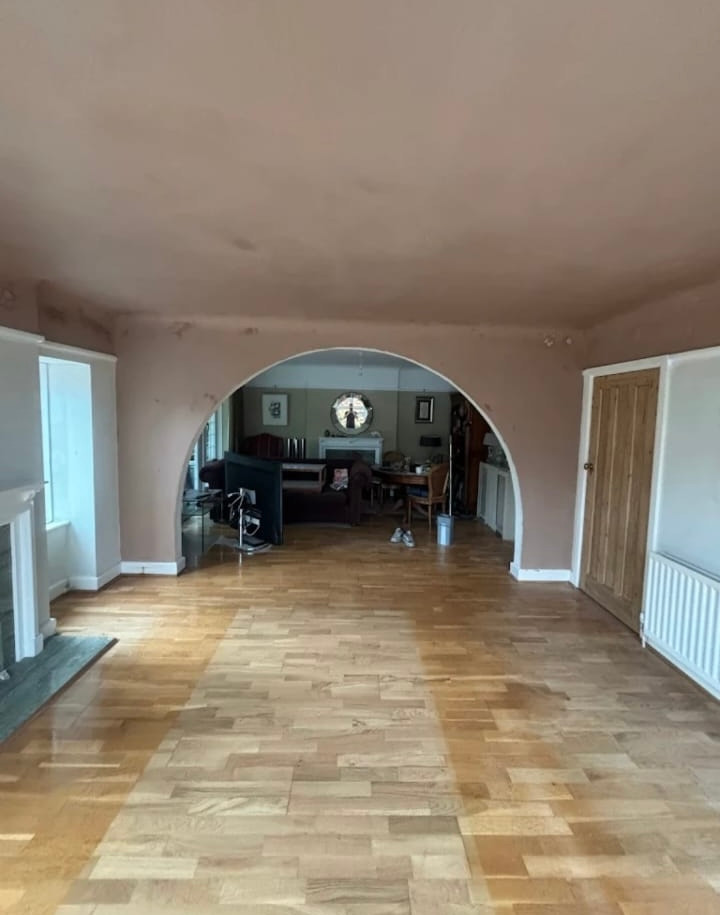
Three generations of filler under one wall of paper. The big detached houses along the lanes here change hands and get stripped back, and what turns up under the paper is usually sound but ugly: old textured coating, patched-in cable chases, three generations of filler. If the backing is firm, that is a skim. We prepare the surface so the finish will take, tape any board joints, run new beads on the corners and reveals, and bring walls and ceiling to one flat surface in a day or two a room.
Ceilings divide by age. In the post-war houses, which are better than half of what stands here, a ceiling is plasterboard and the fault is at the joints or the nails. In the older cottages it is lime plaster pushed through timber lath, and when it sags it is because the keys above have snapped off. Those do not get patched. The ceiling comes down, the joists get checked while they are open, and it goes back in board and skim, or in lime where the building calls for it.
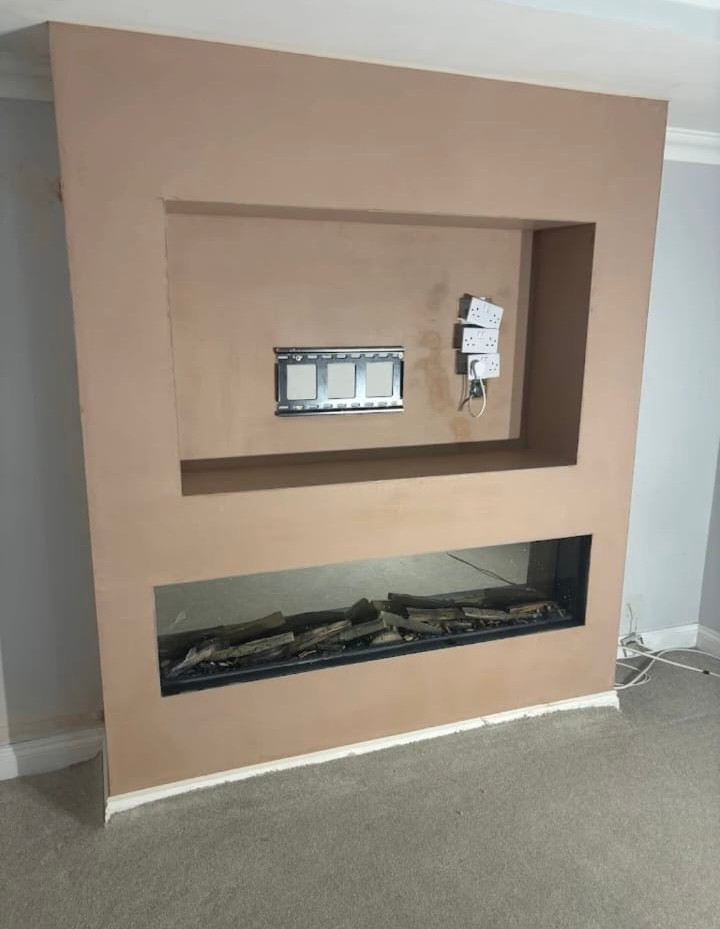
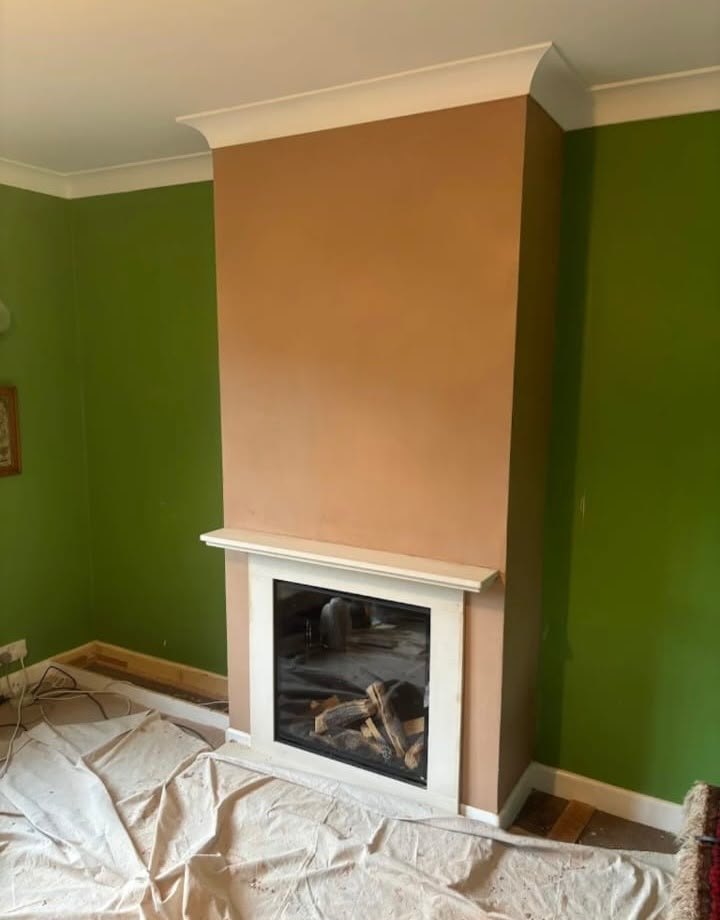
Plaster round a woodburner. Half the houses out this way have put a stove back into a fireplace, and the plaster round a new flue is the bit that gets rushed, then cracks along the chimney breast every winter as the whole thing warms and cools. Done properly it wants the right board against the heat, a movement joint where the breast meets the ceiling, and beads that let the corner move a little instead of splitting. On a cottage with no cavity, a band of blown, crumbling plaster a foot off the floor is a wall trying to breathe through a finish that will not let it. We take that back, let the wall dry, and put lime plaster and a lime render coat back so the moisture leaves through the surface instead of pushing salts through your paint.
Hangersley sits high with open ground to the west, and the weather arrives on that elevation first. Inter-war pebbledash and post-war sand and cement craze and crack there years before the sheltered side shows anything. What we put back is a primer, a mesh reinforced basecoat and a silicone thin coat topcoat with a bell cast bead at the bottom, or a monocouche or K Render where the look suits it better.
Stables, a workshop, an old brick store turned into an office: new work goes up as dry lining, board on dabs or screwed to a stud, taped and skimmed. On a single skin wall it is insulated board rather than plain board, which makes it a thermal element, so building control want to see it and Approved Document L sets what it has to reach.
How it runs
From your call to a written price
Same team from the first visit to the last, one person to ring, and the quote itemised: protection and preparation, board or backing coat, beads, finish coat, making good and disposal on separate lines. Skimming and replastering inside needs no planning permission. Outside is different here, because the National Park Authority is the planning authority for Hangersley rather than the district council, and it takes an interest in what a wall looks like. Heritage and conservation guidance sets out how it handles listed buildings, and interactive property map will tell you in a minute whether your own house is listed or sits in the Western Escarpment conservation area, which is worth knowing before you settle on a finish.
Cost
What decides the price
No rate per square metre. A back bedroom in one of the big post-war detached houses is a barrow, a dust sheet and a door kept shut; a bungalow having every ceiling done is a whole house at once with furniture moving ahead of us; a rendered gable on an old cottage behind a bank and a hedge is an access problem before it is a plastering one. Ask whether it is a skim or a full replaster, whether beads and making good are in the figure, and who takes the waste.
If it has come down
A ceiling down, or plaster blown off the wall
Ring rather than use the form. A ceiling that has cracked and dropped, or a wet patch spreading across a wall, goes to the front of the queue. Hangersley is out past Ringwood and we are on that road most days, so a first look is usually the same day if you ring in the morning. The phone is answered 24 hours for emergencies; scheduled work runs Monday to Friday, 8am to 6pm.
The one local thing
Hangersley is in a conservation area, and it only touches the outside
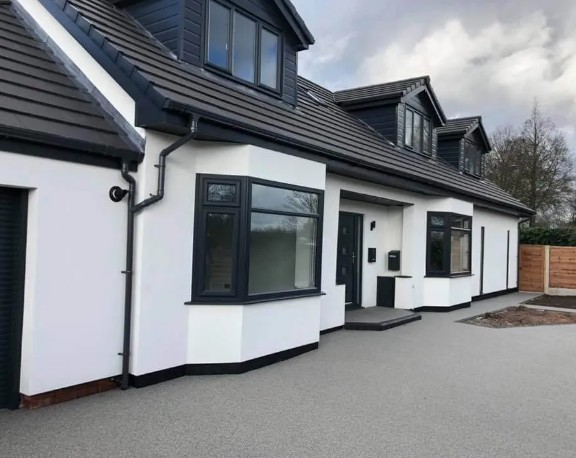
Hangersley falls inside the Western Escarpment conservation area, which runs along the ridge above the Avon valley. What that controls is appearance, and appearance means the outside. Skim a room, board a ceiling, take a chimney breast out: none of it is anybody's business but yours. Render is the one that catches people.
Patching a rendered wall and putting the same finish back in the same colour is maintenance and needs nothing from anybody. Taking a painted sand and cement elevation and covering it in a through-coloured thin coat system with a different texture is a change of appearance, and that is a different conversation.
Settle it before the scaffold goes up rather than after. If the house is listed as well as in the conservation area, assume the outside needs consent and that some of the inside does too, because on a listed building the lime plaster and the lath ceilings are part of what is protected.
Where consent is in play we price the job to match what is likely to be allowed: a lime or mineral render rather than a plastic-modified one, the same texture, the same colour, put back the way it was. That is usually cheaper than arguing about it afterwards, and on an old solid wall it is the specification the wall wanted in the first place.
Who you are dealing with
A local firm you can check
We cover Hangersley, Ringwood, Poulner, Burley, Ashley Heath and the rest of BH24, and the New Forest villages either side of the A31, out of Bournemouth. Bournemouth Roofing & Building Ltd, registered in England and Wales, company number 15471719, which you can look up in a minute. Thomas Hannen's business, and he is the one who comes out to price the job, not a salesman. A verified customer's 10 out of 10 on Checkatrade. The visit and the written quote are both free.
Questions
Hangersley questions we get asked
Are we inside the Western Escarpment conservation area?
Hangersley sits within it, so external appearance is controlled here in a way it is not a few miles down the road. That splits the work in two. Repairing render, or replacing it with the same material and finish, counts as maintenance and carries on as normal. Switching to a different system, or changing the colour of a whole elevation, is the sort of change the New Forest National Park Authority expects to see first.
Does the National Park have a say in render colour?
Sometimes, because the National Park Authority rather than the district council is the planning authority for Hangersley, and design scrutiny falls on anything visible from outside. Internal plastering is not planning work at all and never has been. Outside, the safe route is matching what is already on the building. If you want a different look, ask before the scaffold goes up rather than after the first coat is on.
Why do ceilings from the early 1970s sag at the edges?
Because the boards were nailed rather than screwed and the nails work loose. That period dominates here, with 22.5% of Hangersley homes built in the late 1960s and early 1970s and 53.2% of the stock dating from between 1945 and 1982. The board pulls down over the nail head, the joint at the wall opens, and the crack follows the perimeter. Refixing and re-skimming usually sorts it without a full strip out.
Detached and up a private lane. Is access an issue?
Rarely a stopper, but it changes how the day runs. Detached houses make up 41.6% of Hangersley and flats barely register at 2.6%, so almost every job is a single household with its own ground to mix and cut on. The awkward part is usually getting a van and full sheets of board down the track rather than anything at the house itself. Thomas checks the turning and the standing when he prices it.
Is winter a bad time to plaster an unheated cottage?
It is the hardest time, and 14.3% of the stock here predates 1919, so cold solid walls are a real part of what we work on. Fresh plaster wants background warmth and moving air to dry evenly, not a blast of heat at one end of the room. Without that it stays soft in the corners and crazes on the wall the sun never reaches. Better to hold a low steady temperature and allow an extra day.
Nearby, and next door
Plastering and rendering near Hangersley
Plastering and rendering nearby
Our other trades in Hangersley
Everything we do in Ringwood Plastering and rendering, all areas Every area we cover
Free quote
Get the room priced properly
Tell us what has gone wrong and we will come out, go round every wall and ceiling, and put a written itemised price in front of you.