
Bricklaying in Hangersley
Repointing, brick repairs, chimney work and new walls around Hangersley and Ringwood. We get proper access on it, then put a written price in front of you.
The site visit is free and so is the written itemised quote. Thomas Hannen prices every job himself.
Last updated
Start with the chimney and the gable. On the higher ground at Hangersley they take the weather first, and by the time the joints have gone there the rest of the house usually still has years left in it.
Brickwork up here shows trouble as sand under a stack, flaking faces or a pier leaning off a slope. Sand running out of the joints onto the path below a stack, so you know the pointing has finished before you have looked at it. Brick faces flaking off a wall after a hard winter, which is frost getting into brick that never dried out. And a boundary wall or a gate pier on a sloping plot that has started to lean away from the drive.
None of those tell you much from ground level. We come out, get proper access on it, scrape a joint to find out what the mortar actually is and how deep the damage runs, then put an itemised price in writing. If a wall needs watching for a season, not money spent on it, we will say that instead.
The work
What goes wrong with brickwork around Hangersley
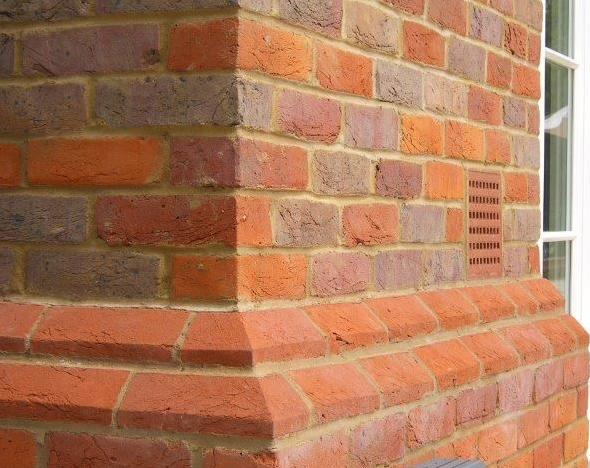
Stacks and gables that take the hill weather. Hangersley sits high and open, and the elevations facing the wind lose their pointing long before the sheltered ones do. On a chimney that means raking the joints out square, repointing the stack, and renewing the flaunching that the pots sit in once it has cracked.
On a gable it means cutting the joints back to sound mortar and repointing to the profile already there, usually a bucket handle or a weather struck joint, which sheds rain better than a flush one on an exposed face. We price each elevation on its own, because up here they are rarely in the same state.
Four in ten homes here are detached and sitting on a decent plot, which means extensions, garden rooms, wider openings and knocked through walls. New work is a blockwork inner leaf, a cavity with the insulation and the wall ties set right, and a facing skin outside laid to match. A new opening means a lintel with the correct bearing each side and the brickwork over it toothed in course by course rather than butted up against the old work, so the joint between old and new does not open up in the first winter. Part of Hangersley falls inside the Western Escarpment conservation area, where appearance is controlled, so what a new elevation looks like is a question to settle before it goes up, not after.
Cottages and outbuildings in lime. The older fabric out towards the forest edge is solid wall, often in soft handmade brick, and it has to be pointed in lime. NHL lime and a sharp sand mix, no cement anywhere in it. Lime is breathable, so a period wall dries through the joint. Point the same wall in a hard cement and the water leaves through the brick instead, the faces start spalling, and then you are cutting out and replacing brick with reclaimed stock that has to be found first.
Sloping plots mean a lot of low retaining brickwork, and retaining brickwork fails when it has nowhere to drain. The ground here shrinks and swells, so where the rainwater ends up beside a footing is a structural question and not just a damp one. A wall holding back ground needs weep holes, a proper foundation and footings dug to firm ground, a dpc, and a coping that throws the water off. Garden walls beside a lane take knocks from traffic and pressure from roots, and a leaning one is usually cheaper to take down and rebuild off a sound base than to prop and patch.
Where frost has taken the face off individual bricks, they get cut out one at a time and replaced. Where a whole section has cracked through and bowed, it comes down to a level course and goes back up in matching bond. Either way the new mortar is mixed to suit the brick, not the other way round, and on a wall that is seen from the lane we agree the brick and the mortar with you off a sample before an elevation is started.
How it runs
Building and repairing brickwork on a sloping plot
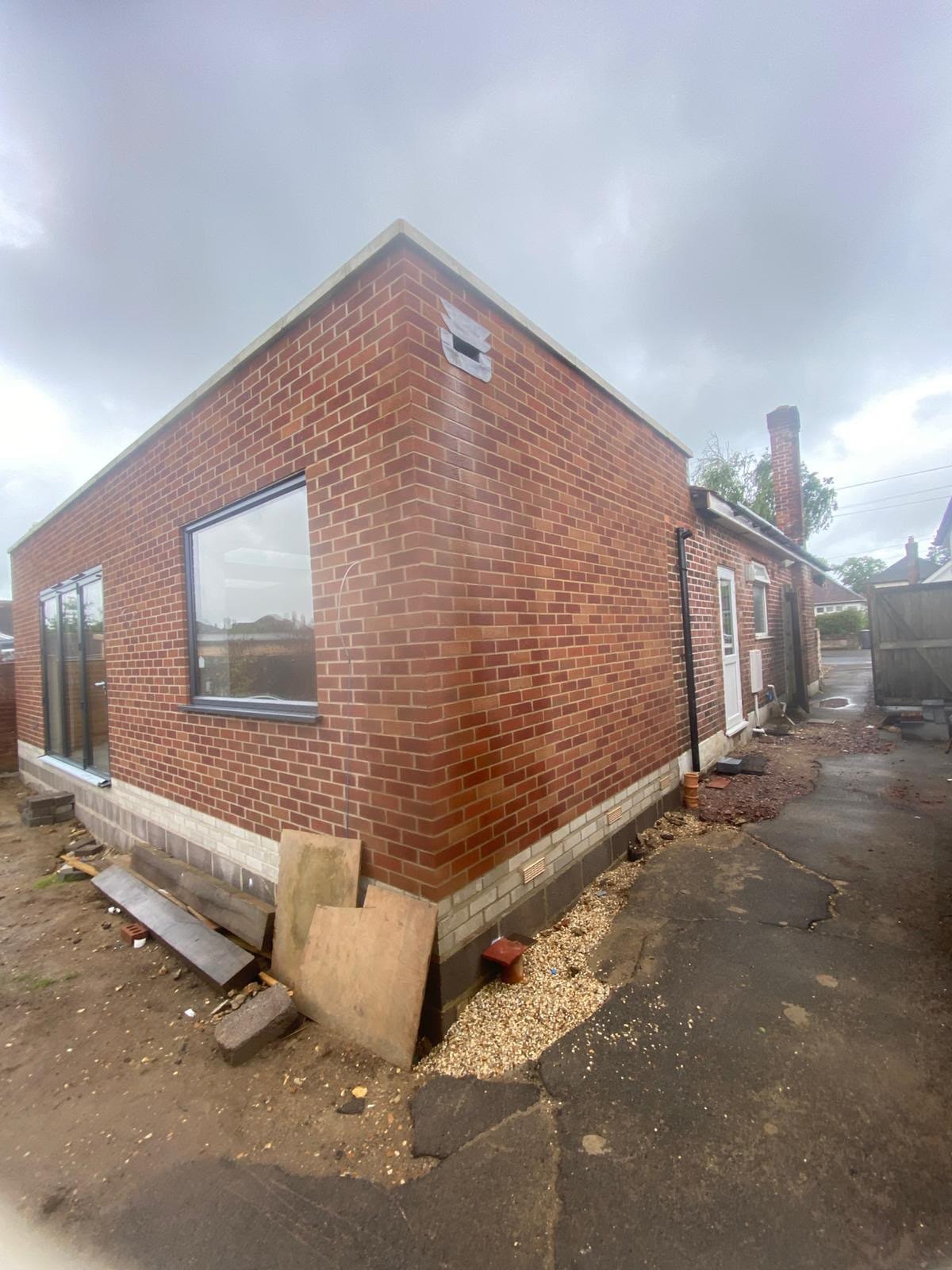
Thomas comes out to look at the wall, the bricks and the mortar and puts the price together himself. His written quote splits the job into lines: scaffold or tower, raking out, cutting out and replacing bricks, the mortar mix, how much wall on each elevation, and clearing away. You deal with one company until the job is done.
Hangersley mixes post-war detached houses and bungalows with inter-war homes and older cottages, many on sloping plots with retaining and boundary walls. Walls on the downhill side often carry more load and show movement first. A tower or scaffold is set level on the slope before work starts. The site is swept each day, spoil and broken brick leave with us, and if a lintel has failed or wall ties have rusted, that part waits until you have seen a photo and agreed a price.
Repointing and repairing brickwork like for like counts as repair, so there is nothing to apply for. Hangersley sits in the New Forest National Park, and on a listed building even repointing needs consent. We look the address up on the property map before quoting, to see whether a conservation area applies. If the wall is shared with next door, the Party Wall etc. Act 1996 may apply.
Cost
Retaining walls, brick match and access on a slope
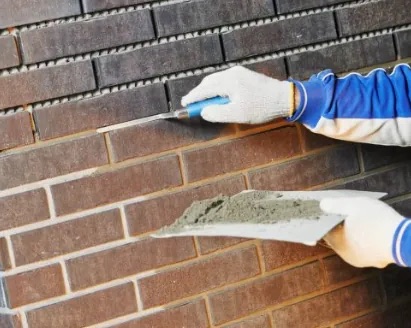
We will not quote brickwork by the square metre without seeing the joints first. The wall and the ground. A detached house on a sloping plot, a cottage tight against the lane and a stable block down a paddock each change the price before any work starts. A retaining wall may need drainage behind it as well as new brickwork. The platform is hired by the week, and the work at height rules set what it must include.
Joint depth. Hand raking takes time, so how far back the joints must come and how many faces have spalled set the hours.
Matching. Matching a mortar or sourcing a brick for an older cottage takes trial panels, and reclaimed brick can take time to find.
Movement. On clay that shrinks and swells, cracks through bricks, not joints may mean the foundation is moving, and that is investigated before anyone repoints.
Getting materials in. A long gravel drive or a garden reached down steps means bricks, sand and mortar are barrowed rather than dropped by the wall.
Height. A chimney on a two storey house is a scaffold job; a garden wall is not.
Ask any rival how deep the joints are raked, by hand or disc, and whether the scaffold is in.
If something has moved
Brickwork that has shifted or come loose
If a chimney top has loose bricks, or a garden or retaining wall is leaning over a drive or footpath, keep people and cars out of the way. Ring us; do not wait on the web form. If nobody answers, a call back comes as soon as we can make it.
Say on the phone if the brickwork is over a door, a drive or a path, because anything that could drop on somebody comes first. We make it safe, by taking down what is loose or propping and fencing the wall, and then price the repair. Bricklaying is scheduled Monday to Friday, 8am to 6pm.
Worth knowing
In the National Park, the mortar colour is a planning matter
Hangersley is inside the New Forest National Park, and part of it sits in the Western Escarpment conservation area. That does not stop you repairing anything. Like for like is maintenance and always has been.
What it controls is change: a different brick, a mortar mixed a shade lighter than the old one, a joint finished flush where the wall was always weather struck, a rendered or painted finish over brickwork that was bare. Those read as a change of appearance, and in a conservation area appearance is exactly what is protected.
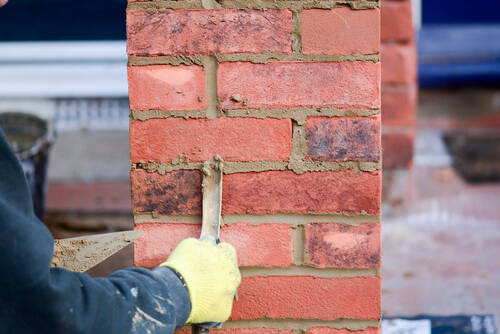
In practice that makes matching a specification, not a nicety. We mix sample panels, let them dry out properly and pick the colour off the dry panel, because wet mortar always looks darker than what you end up with.
Where a brick has to be replaced we source a match rather than settle for near enough, and we keep the joint profile the wall already has. National Park heritage and conservation guidance sets out what the Authority expects, and if your address is listed then the consent has to be in hand before a joint is raked, not afterwards. It is worth a phone call at the quote stage. Getting it wrong is not just a planning problem, it is a wall you have to look at.
Who you are dealing with
The bricklayers behind Hangersley repairs
We work across Hangersley, Ringwood, Poulner, Crow, Ashley Heath and the lanes toward Burley, all BH24. From Boscombe it is about nine and a half miles. Planning sits with the New Forest National Park Authority. The company is Bournemouth Roofing & Building Ltd, registered in England and Wales under number 15471719. Before you book a visit in Hangersley, you can read our customers' Google reviews, word for word, on our reviews page.
It is owned by Thomas Hannen, who looks at the brickwork and prices it himself. On Checkatrade a verified customer has given us 10 out of 10. You pay nothing for the site visit, nor for the written quote listing every item.
Planning at a glance
Do you need planning permission in Hangersley?
Most repairs in Hangersley need no application at all. What decides whether a change to the outside of your house does is who the council is, whether a conservation area or a listing applies, and whether the place sits in a protected landscape.
| Question | In Hangersley |
|---|---|
| Who decides | New Forest National Park Authority is the planning authority for Hangersley. New Forest National Park Authority's heritage pages set out what it controls. |
| Conservation area | Yes: Western Escarpment Conservation Area. Check whether your street is inside the boundary before changing anything visible. |
| Listed buildings | Yes, there are listed buildings in and around Hangersley. If yours is one, work can need listed building consent. |
| Protected landscape | Inside the New Forest National Park, where design is looked at more closely and permitted development rights are narrower. |
Questions
Questions about bricklaying in Hangersley
We are inside the Western Escarpment conservation area. What changes?
For repointing, less than most people fear. The Western Escarpment designation controls appearance, so putting the same mortar back in the same joint profile is maintenance and needs no application, while changing the material or the finish of a wall is a different matter. The New Forest National Park Authority is the planning authority for Hangersley, not the district. If you want a rebuilt wall to look different from the one standing, that is the conversation to have first.
Does the National Park scrutinise a new boundary wall?
Anything visible from outside gets a closer look here than it would a few miles away. Hangersley sits inside the New Forest National Park, and the design of what can be seen is part of what the Authority weighs up. A boundary wall in brick that matches the house rarely causes trouble. A tall wall, a new vehicle access or a change of material across a frontage is where you want an answer before the trench is dug, not after.
Why is our 1960s detached cracking above the windows?
Usually the lintel or the ties instead of the ground. 53.2% of Hangersley stock was built between 1945 and 1982, peaking in the late 1960s and early 1970s, and that generation used mild steel over openings and galvanised ties in the cavity. Both corrode, both swell as they do it, and the crack appears at the weakest line, which is the head of a window. We open a small section to see which of the two it is before pricing anything.
Where should our rainwater go so the wall stays put?
Away from the footing and into something that carries it right off. The ground at Hangersley is cohesive, rated significant for shrink and swell, and has impeded drainage, so standing water beside a foundation is a structural question, not a damp one. A downpipe emptying onto a border, a soakaway set too close in or a blocked gulley all show up later as movement in the brickwork above. We put that right as part of the job.
Will you work up here when the weather turns?
Not into frost: pointing stops when the wall is frozen or about to be, and lime needs protecting and keeping damp while it cures, so from late autumn to early spring we hessian and sheet the elevation and take the sheltered side first. Hangersley catches its weather from the north west and the south west, so which face gets done when is planned rather than left to chance. We would rather lose a week than point onto a cold wall.
Nearby, and next door
Bricklaying near Hangersley
Nearby places we also cover for bricklaying, with straight-line distances from Hangersley, and the other trades we offer in Hangersley itself.
Bricklaying nearby
Our other trades in Hangersley
Brickwork and repointing guides
Lime or cement mortar: which do you need? Single storey extension: planning and building regs Subsidence cracks: which ones matterEverything we do in Ringwood Bricklaying, all areas Every area we cover
Free quote
Get a price for your brickwork in Hangersley
Tell us the address and what you have noticed. We will come out, scrape a joint and put an itemised price in writing. Free site visit, nothing to pay for it.