
Bricklaying and repointing in Ringwood
Lime repointing in the old centre, wall ties out at Poulner, plus stacks, parapets and boundary walls.
The site visit is free and so is the written itemised quote. Thomas Hannen prices every job himself.
Bricklaying and repointing
Brickwork in Ringwood: an old town centre and new estates round it
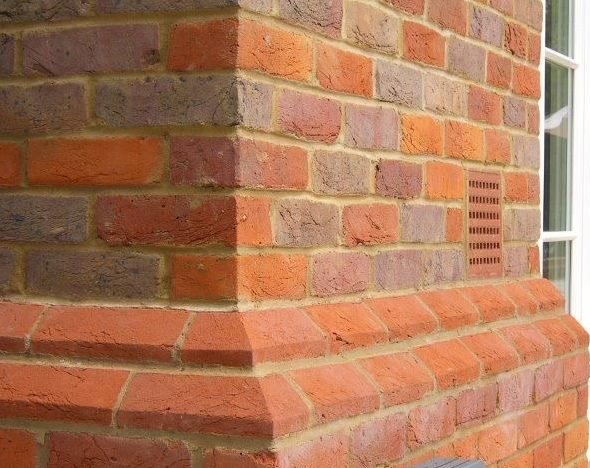
The first question on any Ringwood brickwork job is how old the wall is, because the town has two entirely different kinds. The centre is soft handmade brick built solid in lime, and it wants lime back. The estates out towards Poulner are modern cavity walls, and they want a cement mix and usually a look at the wall ties. Use the wrong one and you make the wall worse.
What brings people to the phone here is fairly predictable. Joints on a town centre frontage that have gone back far enough to see daylight in. Brick faces flaking off below a window or at the foot of a wall. A tall stack losing mortar into the valley. Or a garden wall along a lane that has bowed out and taken its coping with it.
We come out, look at the whole building rather than the patch you have spotted, and tell you which of the two Ringwoods you are living in, because the mortar, the method and the price all follow from that. If a wall has a good ten years left in it we will say so. The site visit and the written itemised quote are free either way.
The work
The brickwork jobs we do in Ringwood
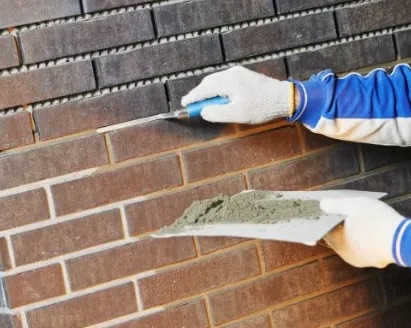
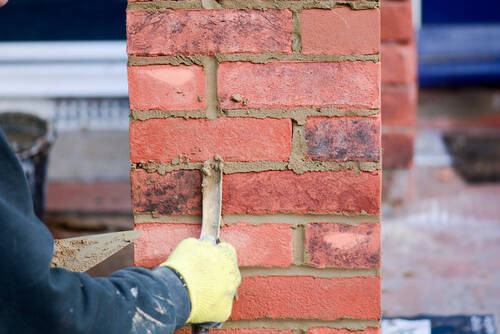
Lime repointing in the old centre. The Market Place, the High Street and the lanes off them are solid wall in soft handmade brick, some of it with flint or rubble at the plinth and a gauged arch over the older openings. Nearly a fifth of the town's stock predates 1919 and the biggest single slice is pre-1900. We rake those joints out by hand, never with a disc, because a disc widens the joint and takes the arris off a soft brick in one pass, then point back in an NHL lime matched for sand, colour and texture. The joint is struck to suit the wall, usually flush or slightly recessed on a very worn frontage rather than weather struck, so it does not stand proud of a face that has already weathered back.
A great many of those walls were repointed in sand and cement in the last fifty years. It looks tidy and it does real damage: a solid wall has to stay breathable, and a hard joint pushes the moisture out through the brick face instead, taking the face with it. Cutting hard cement out of a soft wall without damaging what is left is slow, careful work and the only repair that solves it.
Frontages, parapets and stacks over a public pavement. Flats are 28.7% of the stock and a lot of them are conversions over commercial ground floors, which brings parapets above a shop front, the brick panel between a fascia and the first floor windows, and tall multi flue stacks. Those frontages sit straight on the pavement, so the footway has to be managed and a scaffold over a public path licensed, and that appears on the quote as its own line. Repointing above roof level, cutting out perished brick, renewing the flaunching round the pots and rebuilding from the flashing up are regular work here, and the platform is usually the biggest single item on a small stack job.
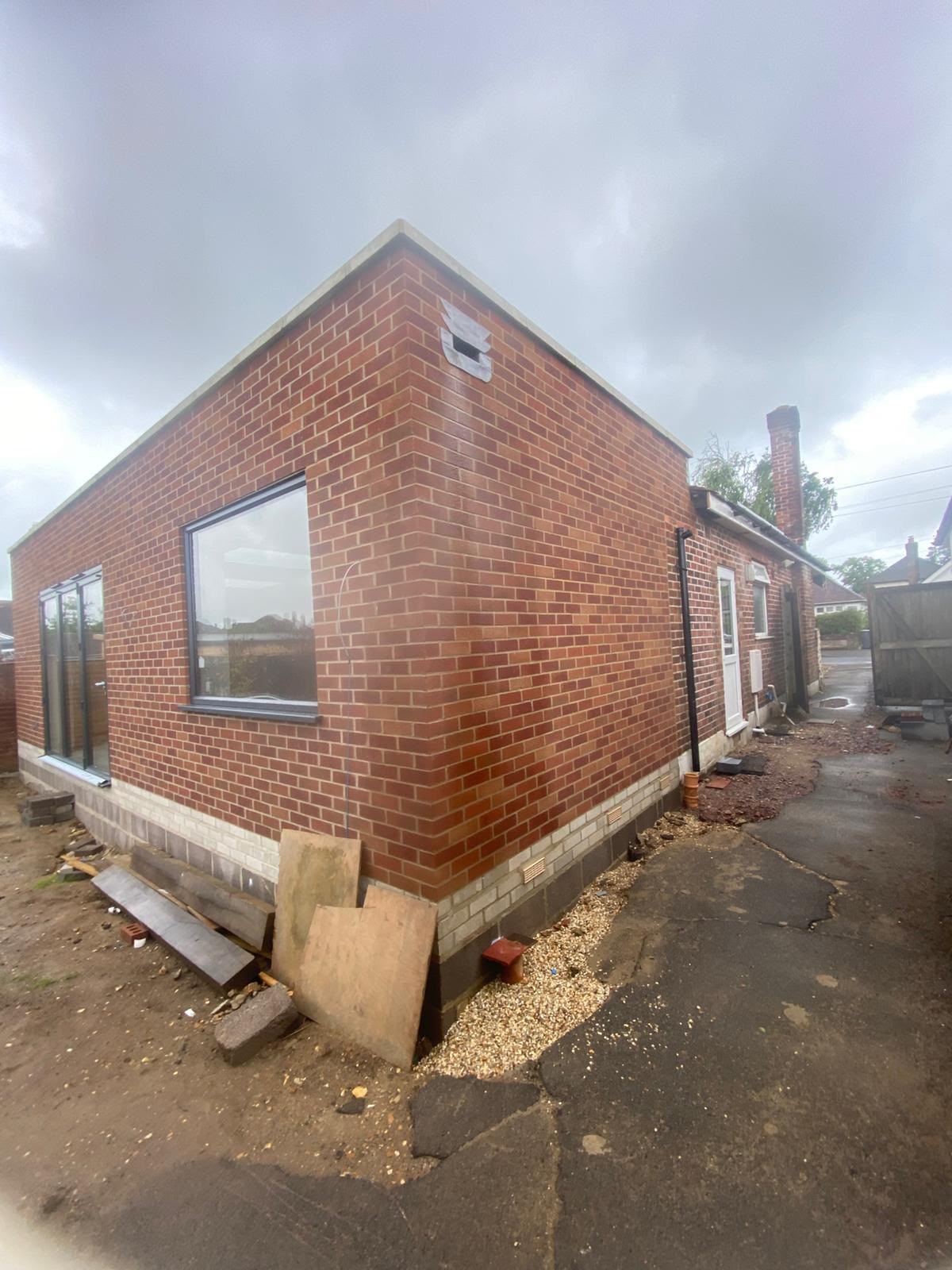
Getting on for a third of the housing has gone up since the early 1980s, mostly out towards Poulner: brick outer skin in stretcher bond, blockwork behind, cavity between. Where the ties have corroded you get fine horizontal cracking at regular course intervals, worst on the gable, and remedial ties go in from outside without taking the wall down. Newer builds bring cracked sills, movement joints never properly formed, and lintel bearings.
The walls along the older lanes and round the Bickerley are brick, and brick with flint, most with no damp proof course, so they draw water up and the bottom courses turn soft. We rebuild bowed lengths on a proper footing, reset or replace the coping so water is thrown clear of the top, put a DPC in where a rebuilt wall allows it, and rebuild gate piers so they are bonded into the wall rather than standing beside it. Where frost has taken a face off we cut out and replace, matching with reclaimed or handmade stock rather than anything off a modern pallet, off a sample taken from the wall with a trial panel left up so you can judge the weathering. New brickwork means extension skins, porches, retaining walls and piers, off a dug foundation with wall ties at proper centres.
How it runs
From your call to a written price
The quote is itemised by elevation: access, raking out, the mix, brick replacement and disposal on separate lines. Ringwood is New Forest District Council and no conservation area covers the town in our records, so for most addresses repointing is maintenance with no application. What Ringwood has is sixty one listed entries, most around the Market Place, and there even like for like repointing needs consent first; The Planning Portal note on other permissions you may require sets out what that covers. New or raised garden walls have height limits, explained in Planning Portal guidance on fences, gates and garden walls. Structural work goes through building control, and the Party Wall etc. Act 1996 covers a shared wall.
Cost
What decides the price of a brickwork job
No rate per square metre: the metre of wall tells you nothing until you know what the joints are like. A High Street frontage straight onto the pavement, a terrace behind a small front garden and a detached house at Poulner with a gable you can reach off a tower are three different set ups. How long a platform stands matters as much as its size, and the work at height rules are why it is a priced line rather than an optional extra. Ask how deep the joints are being raked, by hand or by disc, and whether the scaffold is in.
If something has moved
Loose brickwork, or a wall that has shifted
Ring rather than use the form. Anything overhead or leaning goes to the front of the queue: the first visit makes it safe, and we price the permanent repair once we can see how far the movement goes. In Ringwood that is most often a parapet, or a tall stack over a busy pavement. The phone is answered 24 hours for emergencies; scheduled work runs Monday to Friday, 8am to 6pm.
The one local thing
Your wall is probably older than you think
Ringwood is an old market town and the numbers bear it out: getting on for one home in five here was built before 1919, and the single largest slice of the housing predates 1900. That is unusual on our patch, where most settlements are overwhelmingly postwar, and it changes the first decision on any brickwork job. A pre-1900 wall is solid, not cavity.
It was built in soft handmade brick bedded in lime, and it was designed to take water in through the joints and let it back out again. It has no damp proof course and it does not want one forced on it. Everything about repairing it, the mortar, the tool used to rake it, the profile of the joint, follows from that one fact.
What to do with that. Two things, and they are both before you agree a price. First, establish the age of the wall, because the tell is not always obvious once a building has been rendered, painted or extended, and a cement repoint on a pre-1900 wall is the most expensive mistake anybody makes on a house of that period. Ask whoever is quoting how they know which they are dealing with.
Second, check whether your building is listed, because there are a great many entries in the town centre and one entry often covers a whole run of a terrace. Your neighbour's status is a clue rather than an answer. Repointing a listed building without consent is not a paperwork problem you settle afterwards, so it is worth the five minutes it takes to look it up.
Who you are dealing with
A local firm you can check
We are about ten miles from Ringwood and through BH24 most weeks, covering the town and the villages around it including Ashley Heath, Poulner, Burley and Three Legged Cross. Bournemouth Roofing & Building Ltd, registered in England and Wales, company number 15471719, which you can look up in a minute. Thomas Hannen's business, and he is the one who comes out to price the job, not a salesman. A verified customer's 10 out of 10 on Checkatrade. The visit and the written quote are both free.
Questions
Ringwood questions we get asked
Is any part of Ringwood a conservation area?
Ringwood has no conservation area of its own, so a like for like repoint on an ordinary house is maintenance and New Forest District has no say in it. What it does have is 61 listed entries, the Meeting House and the Manor House among them, and listed building consent covers the mortar as much as the brickwork. If your address appears on the list, or sits in the grounds of one that does, ask before anything is raked out.
Why do you ask how old the house is first?
Because it decides the mortar. Just under a fifth of Ringwood, 18.6%, predates 1919 and the largest single slice is pre-1900 at 13.0%. Those are solid walls with no cavity, laid in lime, and they get rid of water by letting it evaporate out through the joint. Cement seals that route and the damp leaves through the brick face instead, which is why old frontages here spall after a hard repoint. Newer cavity walls want the cement.
Where should the downpipe discharge on ground like ours?
Well away from the wall foot, and into something that carries it off rather than into open soil. The ground under Ringwood is cohesive with a significant shrink swell rating, so it swells through the winter and shrinks back in a dry summer. A gully overflowing beside a foundation feeds that movement, and the cracked bed joints above it are the symptom rather than the fault. We look at the rainwater goods before pricing a crack.
What are you actually looking at on the free visit?
The back of the joint rather than the face of it. Thomas rakes a short test length on each elevation to find how deep the mortar has gone soft, taps for hollow brick faces, checks under the cills and around the reveals where water stands, and looks at where the ground sits against the wall. That decides whether the job is a patch, one elevation or the whole house, and it goes on the written quote as separate lines.
Does the River Avon designation hold up a wall repair?
It does not. The nutrient rules for the River Avon catchment only engage where a scheme adds overnight accommodation, so they bite on a loft conversion or an annexe and not on repointing, a rebuilt garden wall or a chimney taken down and put back. Nobody has to work out mitigation for a repair. If you are converting an outbuilding into a bedroom at the same time, that part of it is a separate conversation with New Forest District.
Nearby, and next door
Bricklaying and repointing near Ringwood
Bricklaying and repointing nearby
Our other trades in Ringwood
Everything we do in Ringwood Bricklaying and repointing, all areas Every area we cover
Free quote
Find out whether your wall wants lime or cement
A free site visit, a straight answer about the age of the wall, and a written itemised quote you can compare against anyone else's.