
Driveways and patios in Ringwood
Drives, forecourts and patios across Ringwood, from the town centre streets out to the post-war estates and the lanes towards Poulner.
The site visit is free and so is the written itemised quote. Thomas Hannen prices every job himself.
Either you are making somewhere to park where the house never had one, or you are rebuilding an estate drive that has finally given up. That is nearly all the paving work in Ringwood. Both are decided by what is under the front garden, not by the surface you fancy.
Three calls come in more than any others. A terrace or a cottage near the centre with no off-street parking at all and a frontage that might just take a car. A drive on one of the post-war estates that has cracked, sunken in front of the garage and grown weeds along every joint. Or a small yard behind a town property where the paving has crept up the wall and the gully has stopped taking water.
None of those are surface problems and none of them get better under a fresh layer. We look at the access, then open a trial hole at the site visit so you know what depth we have to work with before anyone talks about block paving or resin. Where the drive is sound and a lift, relay and re-sand will do, that is what the written quote says.
The work
Front gardens, estate drives and back yards
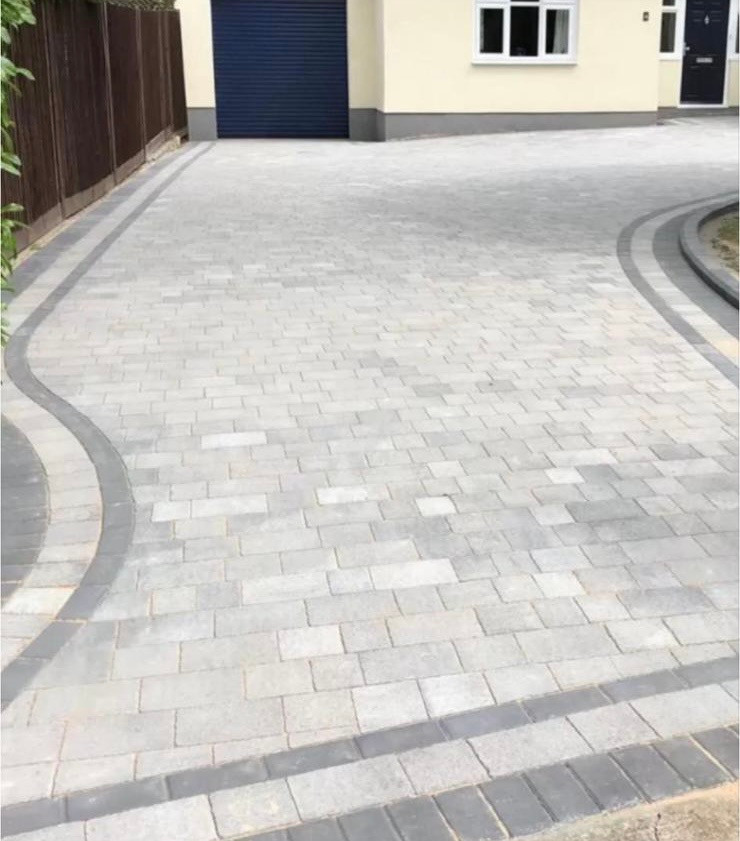
Front gardens turned into parking. On the older streets the frontage is small, walled and hard up against the footway, so the whole job happens in a few square metres and every detail shows. We take the wall down to the width you need and rebuild the ends as piers, excavate to a formation a car can stand on, lay a geotextile membrane and a sub-base compacted in layers, then finish in block paving, resin bound or a stone border with something plainer inside it. The finished level has to tie into the footway at one end and stay below the damp proof course at the other, and there is usually only one way of making both work at once.
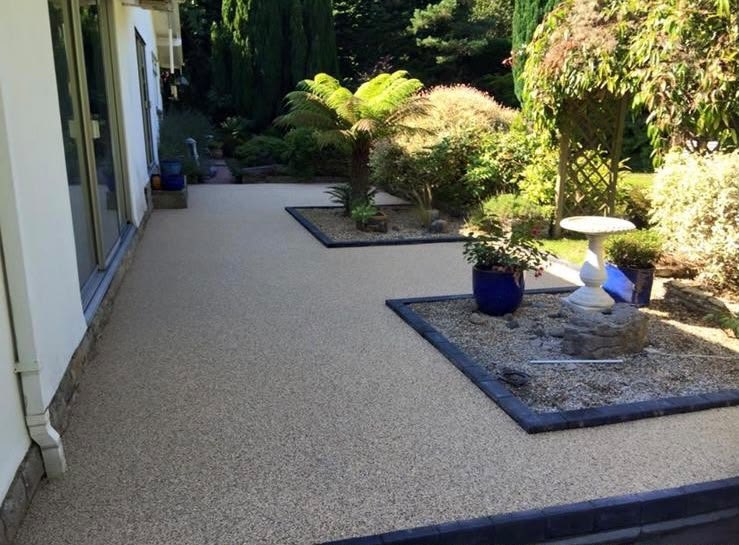
Estate drives that have come to the end. A third of the housing round the town went up between 1945 and 1982, laid in thin concrete or tarmac over very little, and they fail the same way: a crack that widens every winter, a sunken bay where the car stands, rutting along an edge that never had a restraint. Where the old concrete is flat and sound, resin bound over the top saves the dig. Where it has broken up, breaking it out and getting the depth back is the only honest answer, and we will tell you which of the two you have.
Back yards reached through the house. Plenty of town centre properties have no side gate a machine will fit through, so the spoil comes out by barrow along a hall or a shared alley and onto a grab lorry. That changes the programme rather than the design, and the handling and the disposal sit on the quote as their own lines. Close to three in ten homes in Ringwood are flats, and their parking is often a court of block paving that has rutted where vehicles turn in and ponds at the low end. Those relay well: lift the affected bays, correct the falls, re-sand the joints and haunch the edge that has spread. The awkward part is rarely the work, it is agreeing who owns the ground and who is placing the order.
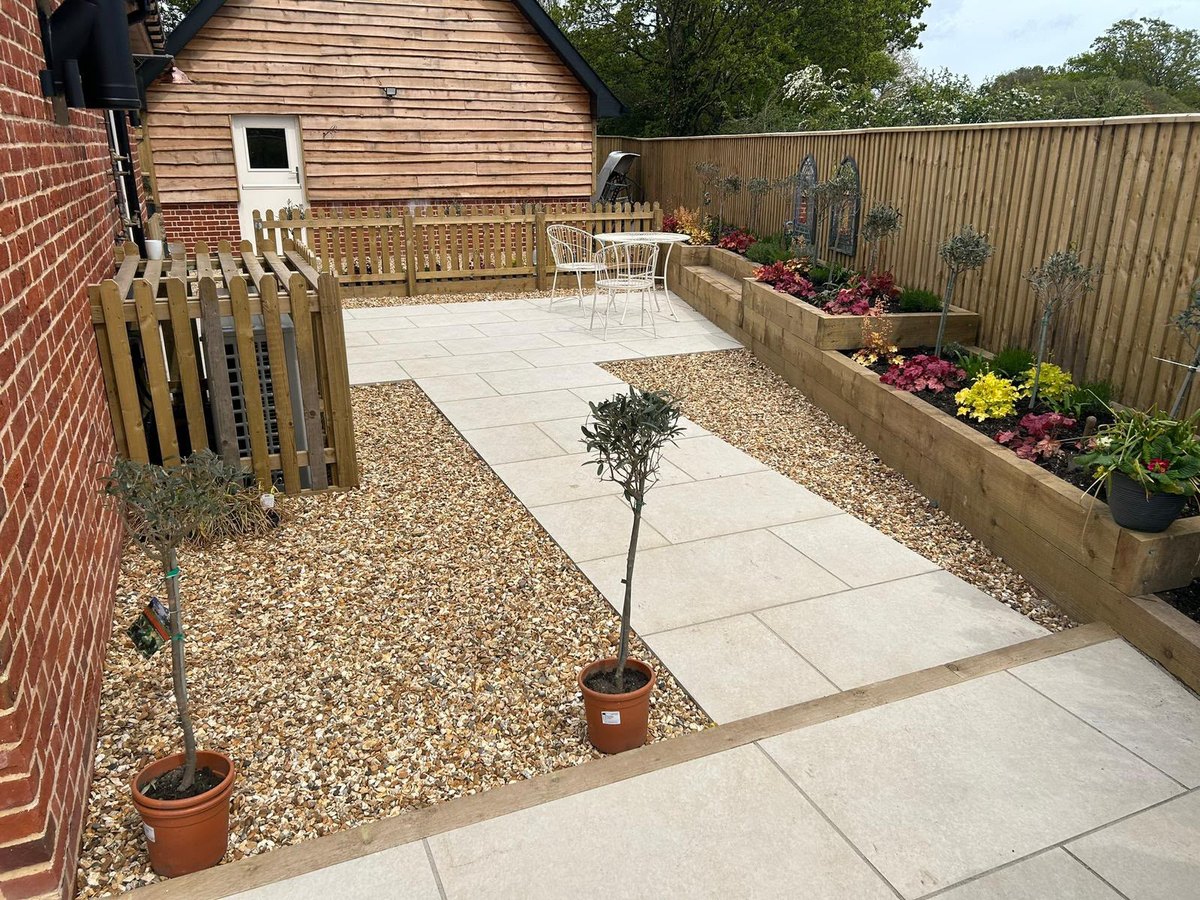
Patios, steps and thresholds. Porcelain, natural stone and pressed concrete all sit on the same build up, and all of them rock and pond if they were bedded on five dabs instead of a full mortar bed. We relay on a compacted sub-base, point the joints so they stop washing out, fall the surface away from the house and keep it clear of the threshold. Where the garden will not give us the drop, a gravel border or a channel drain along the wall does the same job. The ground here is cohesive and moves with the seasons, so where a drive sends its water is a question about the foundation and not only about the paving. One sunken bay, a lifted slab by a door or a silted gully is hours rather than days, and we would rather price that than sell you a drive you do not need yet.
How it runs
From your call to a written price
One person to ring, the same team throughout, and the quote itemised: excavation, muck away, sub base, edgings, surface and drainage on separate lines. Planning here is New Forest District Council, and anything on the highway, including the crossing at your entrance, is Hampshire County Council, so work at the front of a house runs past two desks rather than one. There are 61 listed entries along the town centre streets, and where a forecourt wall, a gate pier or a railing belongs to one of them there are other permissions you may require before it changes. For an ordinary boundary, Planning Portal covers walls, gates and piers.
Cost
What decides the price of a driveway
No rate per square metre, because what is under it decides more than what goes on top. A terraced frontage on the pavement, a post-war semi with a straight run in and a flat over a shared parking court are three different jobs before anybody lifts a slab. Ground conditions, the depth of the dig and how much muck goes away are the real variables. Surface water has to be dealt with on your own ground rather than run into the road. Ask the depth of dig, the sub base, the drainage and who takes the spoil away.
If it is urgent
A trip hazard, or a drive that floods
Ring rather than use the form. A lifted slab, a sunken bay by a doorway or a gully that has stopped taking water will not wait, because somebody falls or water ends up against the house. If a bay in a shared court has dropped and somebody has already gone over on it, say so when you ring. The phone is answered 24 hours for emergencies; scheduled work runs Monday to Friday, 8am to 6pm.
The one local thing
Making a parking space where the house never had one
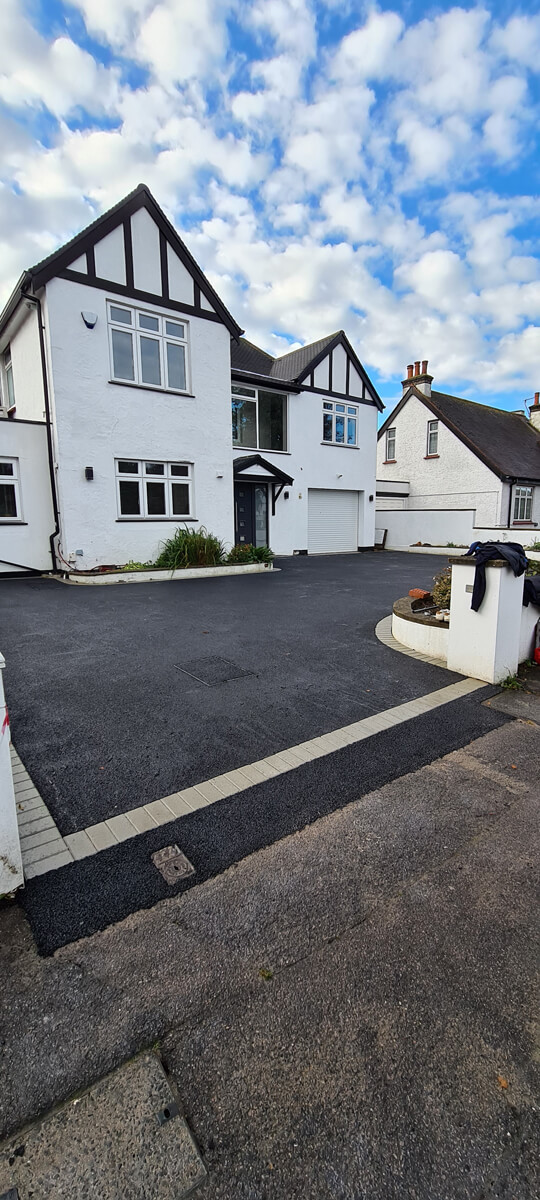
Much of Ringwood went up before anyone needed to park at the house, and a good deal of the rest is flats. So the commonest question we get in the town is whether a front garden can become parking at all. Three things settle it. Whether the frontage is deep enough to get a car fully off the road, because a car left overhanging the footway is no use to anybody. Whether the boundary can be opened up without losing a wall that is holding ground back.
And whether you can have the crossing, because our work stops at your boundary and the dropped kerb across the footway is applied for from Hampshire County Council and built by a contractor approved to work on the highway. Start that early. It is the slowest part of the job and the one part nobody else can do for you.
The second decision is where the rain goes, and it is the one that keeps the job simple. Lay more than five square metres of new hard surface at the front that drains out onto the road and you need planning permission for it. Keep the water on your own land and the work stays permitted development, which is what the Planning Portal guidance on paving a front garden sets out.
In practice that means a permeable surface over an open graded sub-base, or a soakaway where the ground will take it, or a gravel margin and a channel drain across the entrance so nothing reaches the kerb. That is all SuDS means on a domestic drive.
Who you are dealing with
A local firm you can check
We cover Ringwood and the rest of BH24, out through Poulner and Hightown to Ashley Heath, Hangersley, Burley and the villages either side of the Avon. Bournemouth Roofing & Building Ltd, registered in England and Wales, company number 15471719, which you can look up in a minute. Thomas Hannen's business, and he is the one who comes out to price the job, not a salesman. A verified customer's 10 out of 10 on Checkatrade. The visit and the written quote are both free.
Questions
Ringwood questions we get asked
Why does my drive crack along the same line every summer?
Because the ground under Ringwood shrinks in a dry summer and swells again when the rain comes back. That movement is seasonal, so a rigid slab splits in the same place year after year while a jointed surface rides it. The answer is a deeper sub-base and a surface made of units rather than one continuous pour. Where the crack runs towards the house, what worries me is the water it lets through, not the line itself.
Who has to agree before a shared parking court is redone?
The freeholder or the managing agent, not the individual flat owners. Nearly three in ten homes in Ringwood are flats, so a lot of the parking here sits on land that nobody living on it actually owns. Get the agent to confirm in writing who is instructing the work and who is paying it before anything gets priced. Thomas measures the whole court either way, and the written quote is itemised so a block can split it.
There are listed buildings on our street. Does paving need consent?
Not for the surface on its own, but Ringwood has sixty one listed entries and a listing reaches further than the front door. If your house is one of them, or the boundary wall and gate piers are covered by it, resetting those is consented work even when the paving next to them is not. A call to New Forest before we start saves finding out halfway through, with the ground already open.
Can the drive drain into a soakaway beside the house?
Not close to it. On ground that shrinks and swells, putting water beside a foundation changes how much the soil under that corner moves through the year, and that is a structural question rather than a damp one. We set the falls to carry water away from the wall, put any soakaway well out into the garden, and run a positive outfall where there is nowhere sensible to lose it.
How quickly can somebody come out and look?
Ringwood is about ten miles from the yard, so a look at a drive is usually the same week and sometimes within a couple of days if we are already out that way. Thomas does the visit himself. He measures, watches where the water currently goes, and digs a small hole to see what is under the existing surface. The visit and the written itemised quote are both free.
Nearby, and next door
Driveways and patios near Ringwood
Driveways and patios nearby
Our other trades in Ringwood
Everything we do in Ringwood Driveways and patios, all areas Every area we cover
Free quote
Find out what is under your drive first
A free site visit, a trial hole, and a written itemised quote that separates the dig, the sub-base, the surface and the drainage.