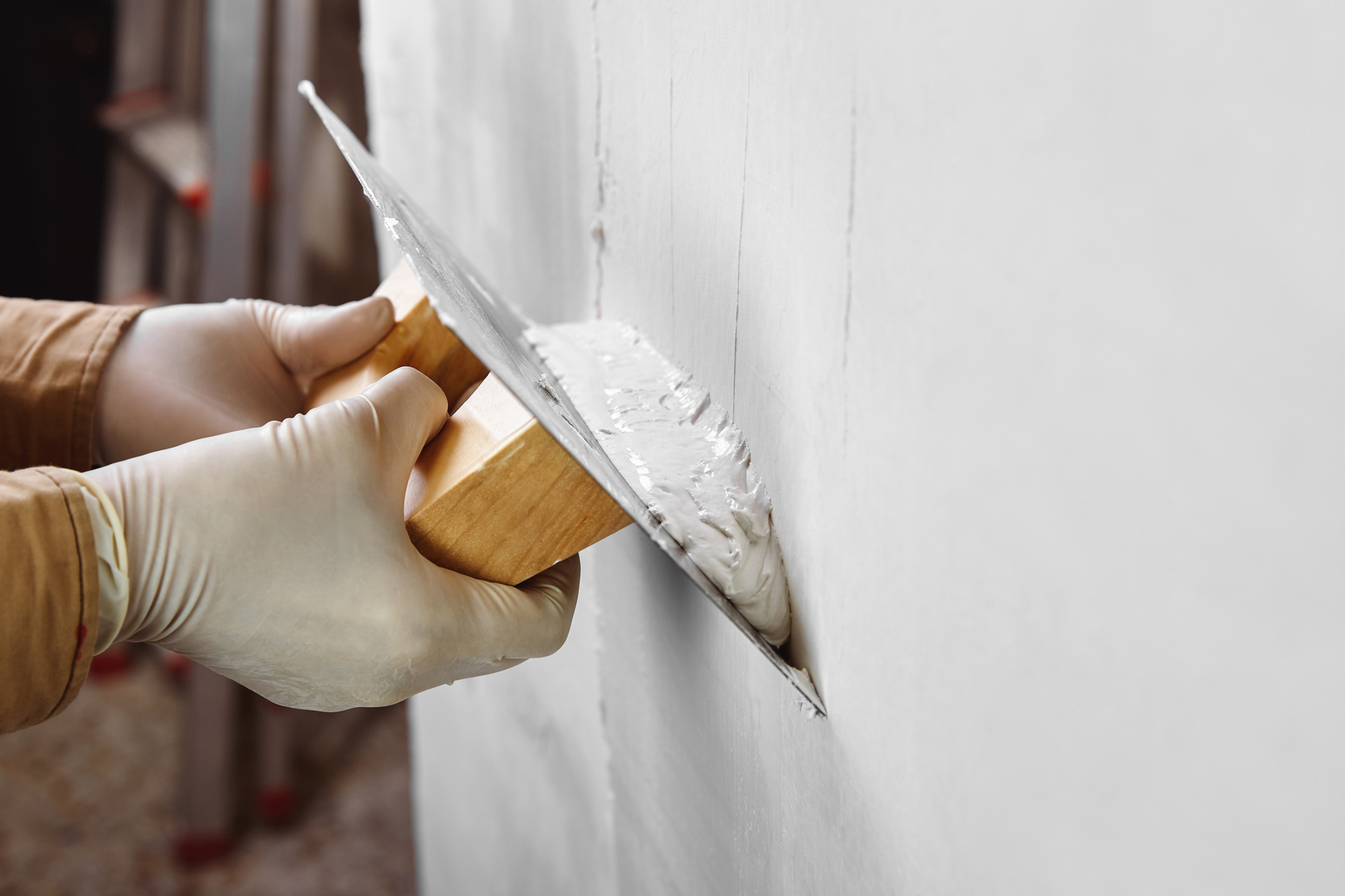
Plastering in Ringwood
Skimming, ceilings, dry lining and external render across Ringwood, Poulner and the estates around the town.
The site visit is free and so is the written itemised quote. Thomas Hannen prices every job himself.
In Ringwood the first question is what your wall is made of, because the town has both kinds. A solid plastered wall in an older house sounds dull when you knock it and takes a skim straight over the top. A wall in a newer house sounds hollow almost everywhere, because the plasterboard is stuck to the blockwork on dabs of adhesive with a gap behind. That is normal, not a fault, and it is a different job.
Most of the calls out of the town are one of three things. A ceiling with a textured coating on it that has started to crack along the board joints. A room that has been papered and painted over tired plaster once too often and now wants skimming flat before it is decorated again. And damage, whether that is a wall soft and powdery after a leak from a flat above, or an outside elevation of render that has cracked.
All of it is our work, inside and out, and the making good comes with it rather than being left for your decorator. The site visit is free, the written quote is itemised, and where a morning of patching would do we will say so instead of quoting a room.
The work
Dry lining out at Poulner, solid plaster in town
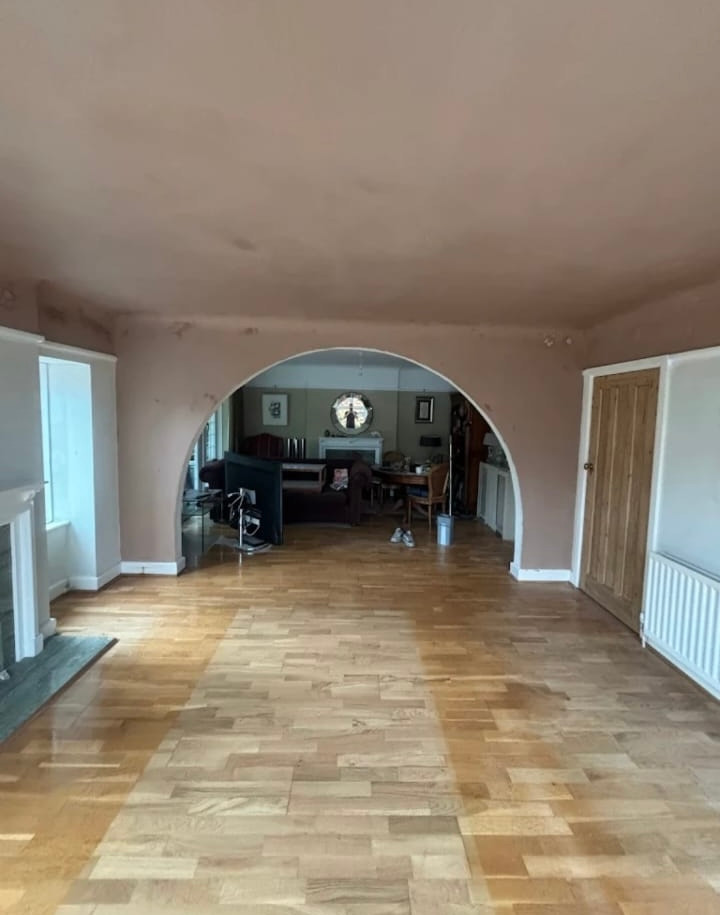
Dry lining out on the estates. A big share of Ringwood went up from the eighties onwards, out at Poulner and around the edge of the town, and those houses are dry lined rather than solid plastered. The board is already flat, so the job is preparation and two coats of finish: fill the screw heads, tape any open joints, seal a thirsty surface with PVA or a bonding primer, then lay it on and close it up. A bedroom is a day, and it is the room people put off longest.
Nearer the centre and along the older roads the houses are brick with plaster straight onto them, and the same room can be twice the work. Where the plaster is sound it takes a skim. Where it has blown it comes off back to the brick and a backing coat goes on first: browning or hardwall on solid brickwork, bonding where the background is a patchwork of brick, block and old infill, floated out and ruled straight before the finish coat. In the oldest of them it is lime on lath rather than gypsum, the wall is breathable and has to stay that way, and a hard skim over it will blow again.
Textured ceilings are everywhere in the post-war and eighties stock. Where the pattern is shallow and stuck fast we skim straight over it. Heavy swirl, or a ceiling somebody has already patched round a downlight, is better over-boarded and the joints taped. Anything textured that went on before 2000 can hold a trace of asbestos, so it is sampled rather than sanded, and boarding over it leaves it undisturbed.
Flats, and who can order the work. Close to three in ten homes in the town are flats or maisonettes, from converted town buildings to purpose-built blocks and retirement schemes, and they bring their own problems: a ceiling stained and blown after a leak from the flat above, an artexed hallway, a wall opened up by a plumber. Inside your own front door the work is yours to order. The outside walls, the render and the common parts usually belong to the freeholder and come out of the service charge, and a big block job on those is subject to section 20 of the Landlord and Tenant Act 1985, so if the damp is coming through an external wall the first call may be to the managing agent rather than to us.
Extensions, garage conversions and knock-throughs are dry lining on dot and dab where there is blockwork to fix to, board on stud where there is not, then tape and joint or a full skim. Angle bead on every external corner, stop bead at each window reveal, and the making good round a new opening so the join does not telegraph through the paint. Outside, pebbledash and sand and cement gets cut out and patched where the damage is local. Where it has largely let go we strip it and put back a thin coat silicone system: primer, a mesh reinforced basecoat and a coloured topcoat, with a bell cast bead at the base. On a solid old wall it is still scratch coat, render coat and float, in a mix soft enough to move.
How it runs
From your call to a written price
Same team from the first visit to the last, one person to ring, and none of it sub-contracted. We survey the room rather than a photograph, because a wall that sounds solid by the door and hollow by the window changes the quote, which is itemised line by line. If something turns up behind the old finish that nobody could have seen, you get a photograph and a price first. Outside is different: with sixty-one listed entries in the town it is worth checking the address, because consent on a listed building reaches the inside as well as the front. Planning Portal guidance on external walls covers the general position, and read other permissions you may need before you order materials.
Cost
What decides the price of a plastering job
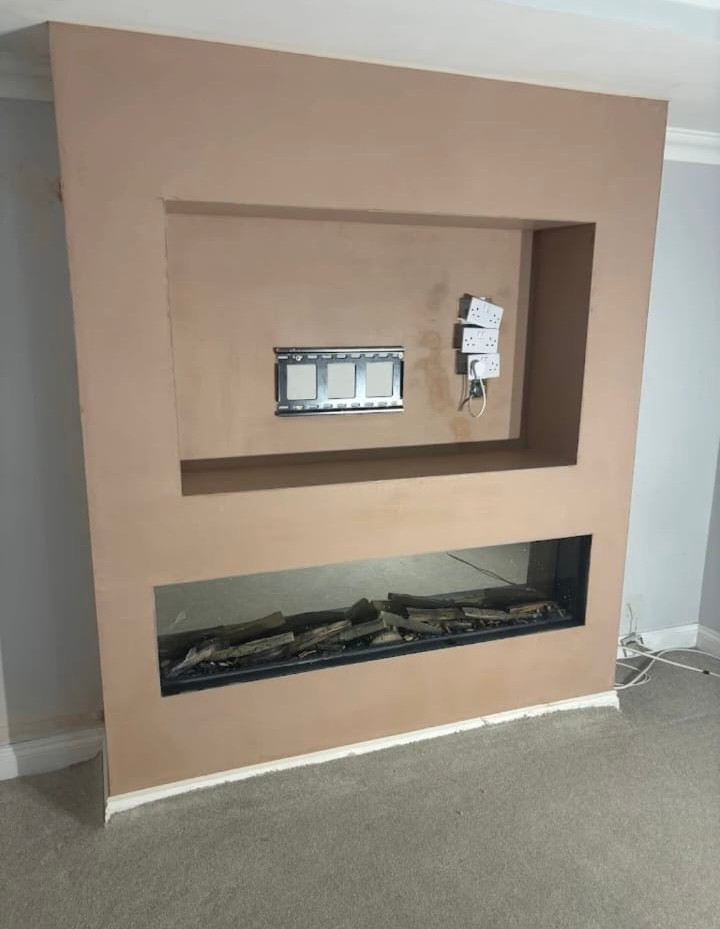
There is no rate per square metre, because the background decides it. Sound old plaster still gripping the brick takes a skim. A wall that has blown comes off, which brings a backing coat and a float back into the job. In a flat, protecting the common parts and carrying waste down goes in the price. Outside, a full elevation wants a scaffold, which is why work at height rules make access its own line, and re-rendering one counts as renovating a thermal element, so Approved Document L can ask for the insulation behind it to be improved. Ask whether it is a skim or a strip back to brick.
If it has started to come down
A ceiling sagging, or plaster blown off a wall
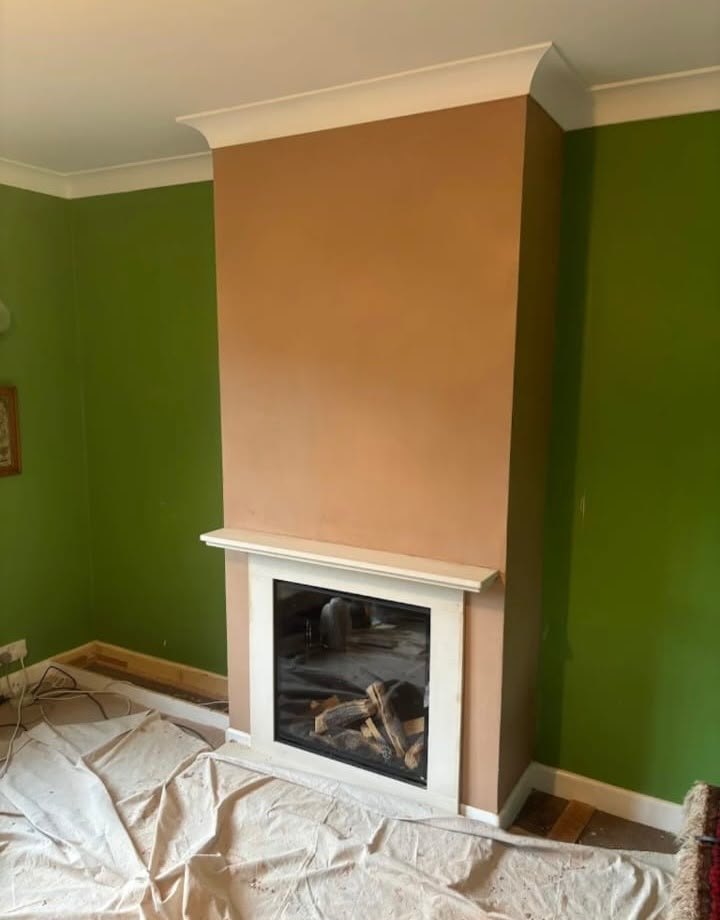
Ring rather than use the form. A ceiling that has begun to bow, one soaked by a leak from the flat above, or plaster coming off a wall in sheets goes to the front of the queue. Do not sleep under a bulging ceiling and do not push at it. Ringwood is ten miles up the road, so tell us on the phone how much has already come down.
Worth knowing
Why so many walls in Ringwood sound hollow
Knock a wall in one of the newer houses around the town and it drums. People ring us about that fairly often, convinced the plaster has blown. Almost always it has not. From the seventies onwards the trade stopped plastering blockwork solid and started dry lining it: plasterboard pressed onto dabs of adhesive, with an air gap of a finger's width behind the board.
The whole wall sounds hollow because the whole wall is hollow. Blown plaster sounds different and it gives slightly under your hand, and there is usually a crack or a bulge to go with it. If your house went up in the last forty-odd years, hollow on its own is nothing.
It changes three practical things. First, fixings: a normal wall plug spins in the void, so shelves, radiators, televisions and kitchen units need either a plasterboard fixing rated for the load or a screw long enough to reach the block behind, and finding the dabs matters more than finding a stud. Second, repairs: a hole in a dry lined wall is a board patch and a skim, not a backing coat, and filling a large one with plaster alone leaves a hard cold spot you will see through the paint.
Third, damp: because there is a cavity behind the board, water from a leak can travel a surprising distance and appear in a different room, so we find the source before anything is replastered. On a solid wall in an older Ringwood house none of that applies, which is why the first thing we do is tap the wall.
Who you are dealing with
A local firm you can check
We cover Ringwood and Poulner across the BH24 postcode, out to Ashley Heath, Hangersley and the villages along the Avon, and we work across east Dorset, the New Forest and the coast from a base near Bournemouth. Bournemouth Roofing & Building Ltd, registered in England and Wales, company number 15471719, which you can look up in a minute. Thomas Hannen's business, and he is the one who comes out to price the job, not a salesman. A verified customer's 10 out of 10 on Checkatrade. The visit and the written quote are both free.
Questions
Ringwood questions we get asked
Is Ringwood old enough that my walls are lime?
Some are. Just under a fifth of Ringwood's stock predates 1919 and the biggest single band is pre-1900, so lath ceilings and lime backing coats turn up regularly here. The rest, roughly a third of it put up between 1945 and 1982, is a sand and cement float with a gypsum finish over the top. I scratch a hidden corner at the site visit rather than guess, because the backing coat decides the material, not the finish.
Ringwood has no conservation area. Does that free up rendering?
Largely, for the outside of an ordinary house. The town has no conservation area of its own, so the appearance controls that catch the villages around it do not bite here, and re-rendering like for like is maintenance. The catch is the 61 listed entries scattered through Ringwood, the Meeting House and the Manor House among them. If your property is one of those, or joined to one, consent comes before any coating goes on.
Does the Avon nutrient rule affect plastering a loft room?
Not the plastering itself. Ringwood sits in the River Avon catchment, and the nutrient rule only engages where a scheme adds overnight accommodation, so turning a loft into a bedroom pulls it in while boarding and skimming a room you already have does not. If it is becoming a bedroom, settle the nutrient position with New Forest District before the boards go up, because plastering is the last trade in and the first one to get squeezed.
You are ten miles away. How quickly can you look?
Ringwood is about ten miles from the yard, so it is a short run out and Thomas Hannen usually gets to a first look within a few days. He measures the room, checks what the existing backing coat actually is, and leaves you with a written itemised quote. The visit and the quote both cost nothing, and no materials get ordered until you have said yes to the written figure.
Where does the old plaster go when you strip a ceiling?
Into bags and out to the van the same day. A stripped lath ceiling in one of the older Ringwood properties produces far more spoil than a re-skim, because the laths, the nails and a century of dust all come down with it. We sheet the floor, bag as we go and take it away rather than piling it up in the garden. On a terrace frontage that avoids standing a skip on the street for a fortnight.
Nearby, and next door
Plastering and rendering near Ringwood
Plastering and rendering nearby
Our other trades in Ringwood
Everything we do in Ringwood Plastering and rendering, all areas Every area we cover
Free quote
Get a price for your plastering in Ringwood
Tell us which room, or send a photo of the ceiling, and we will book a look. The visit and the written quote cost nothing.