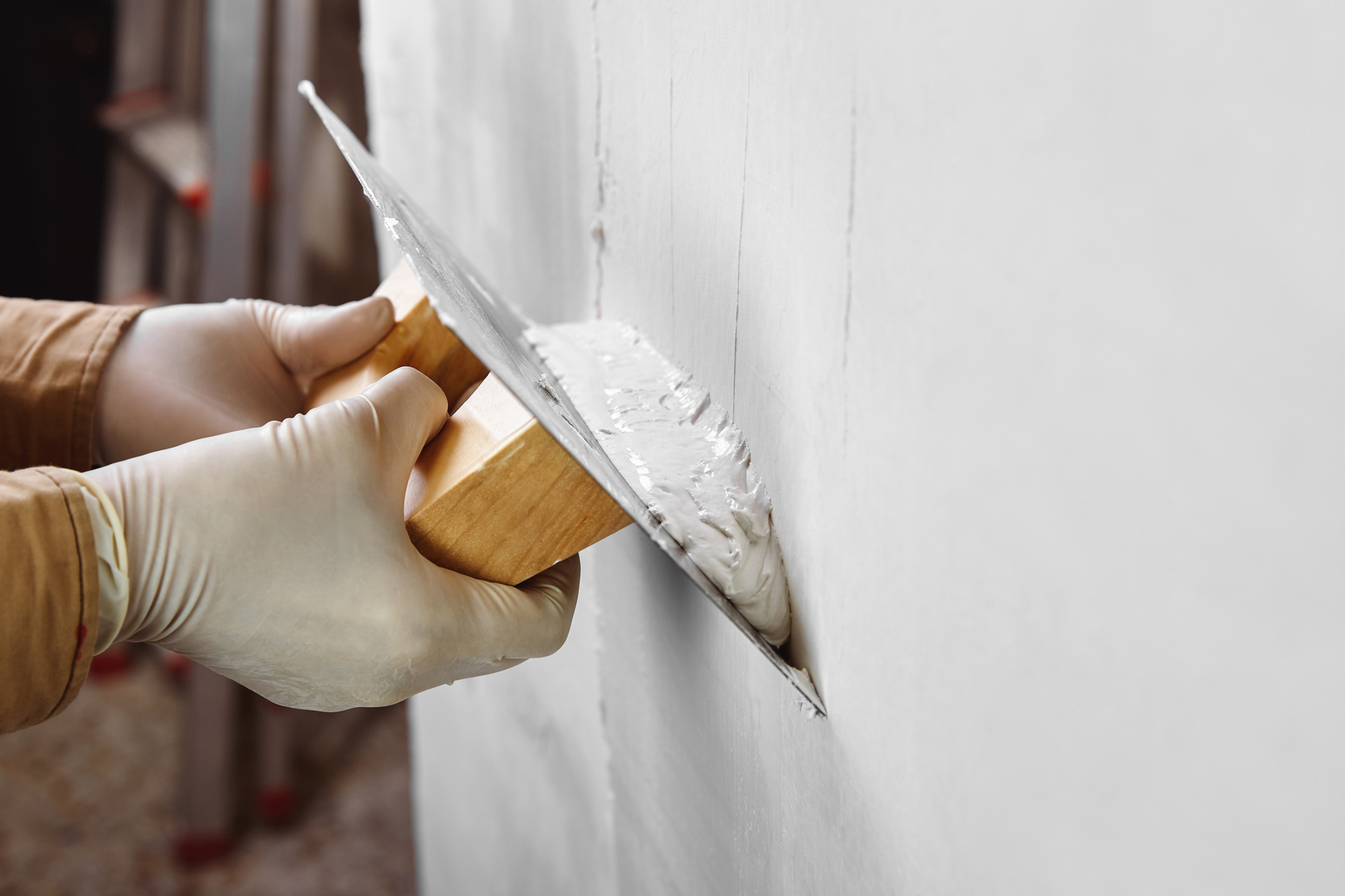
Plastering in Redlynch
Skimming, ceilings, lime repair and external render across Redlynch, Woodfalls, Morgan's Vale and Lover.
The site visit is free and so is the written itemised quote. Thomas Hannen prices every job himself.
Before anything is priced in Redlynch we settle one thing: does the wall want a skim or a strip. Knock it with a knuckle. A dull, solid note means the old plaster is still gripping the brick and two coats of finish will give you a flat, paintable wall for a fraction of the cost. A hollow, drummy note means it has blown off the background and no amount of skimming over the top will hold.
Three jobs bring most of the calls out of this village. A ceiling that has carried the same textured coating since the seventies and has started to crack along the board joints. A patch of wall under a window gone soft and powdery after water got in, where the plaster comes away on your hand. And a rendered gable, nearly always the one facing south-west into the weather, that has cracked and is now holding damp instead of shedding it.
All three are ours, inside and out, and the making good afterwards is part of the job. The site visit is free, the written quote is itemised, and if the honest answer is a morning of patching rather than a room of new plaster, that is what it will say.
The work
Post-war rooms, now on their second re-skim
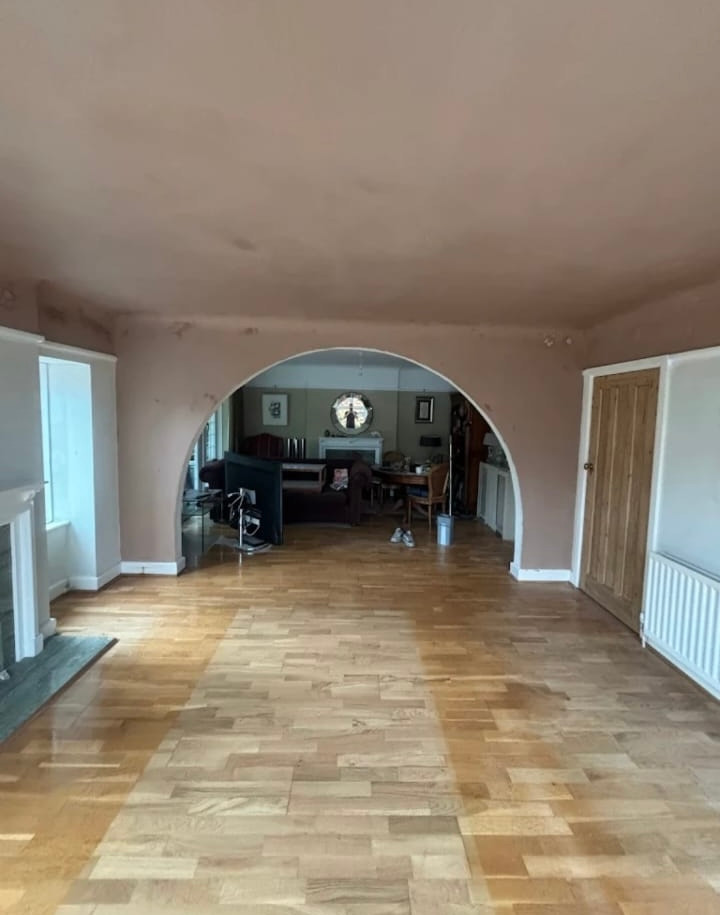
Post-war rooms, now on their second re-skim. Getting on for half of Redlynch, Woodfalls and Morgan's Vale went up between the war and the early eighties, and those houses are now on their second round of decorating over tired plaster. Where the background is sound we prepare it, brush it clean, seal it depending on how thirsty it is, and lay on two coats of finish coat. Where the wall has blown it comes off back to the brick and a backing coat goes on first, browning or hardwall on solid brickwork, bonding where the background is a patchwork of brick, block and old infill. Later extensions are board on dot and dab or on a stud, then tape and joint or a skim. Corners and reveals in that stock were run to a galvanised angle bead or a stop bead, and a rusted bead is cut out and the corner run in.
Close to a third of the houses here are single storey, so the ceilings are wide and unbroken with no floor above to work off. Textured coatings are normal on them for the age of the stock: a shallow pattern stuck fast gets skimmed straight over, and heavy swirl is better over-boarded with the joints taped. Anything textured from before 2000 can hold a trace of asbestos, so it is sampled rather than sanded.
Around a quarter of the stock in the parish predates 1919: brick and rendered cottages along the lanes, some still thatched, with a solid wall and no cavity behind the paper and a lath ceiling overhead. Those walls have to stay breathable, so lime plaster, haired in the backing coats and laid on riven lath, is what goes back, and it wants proper drying time before a mist coat goes on and the room is decorated. The pebbledash and roughcast outside is nearly all sand and cement, which is rigid and cracks in the end, and once water is behind it whole panels sound hollow, and what goes back on modern block is a silicone thin coat or a monocouche.
How it runs
From your call to a written price
You get the same two or three faces from the first visit to the last. What comes back is a written breakdown, priced line by line. Nothing we do inside a house needs planning permission. Outside is different. Redlynch sits in Wiltshire, not Dorset, so the planning authority is not the one most people assume, and while the village has no conservation area of its own there are listed cottages scattered through it, where consent reaches the inside as well as the front. Changing an external finish is covered by Planning Portal guidance on external walls, and it is worth reading up on other permissions you may need before you order materials.
Cost
What decides the price of a plastering job
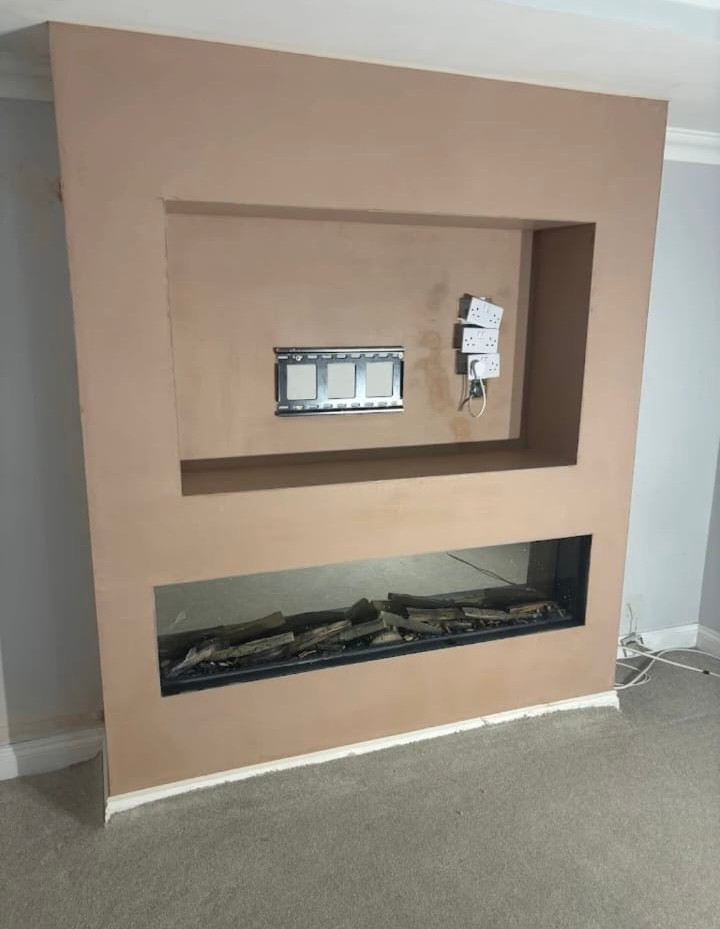
Nobody should quote you a rate per square metre. Old plaster that is still gripping wants nothing more than a skim. Once it has blown, the whole lot comes off, a backing coat has to be floated on and ruled level, and lime work on an old wall is slower still because it has to be left between coats. A ceiling is slower than a wall the same size, and a stairwell slower again. A full gable wants a scaffold, a priced line under the work at height rules, and Approved Document L can ask for the insulation behind a renewed render to be improved.
If it has started to come down
A ceiling on the move, or plaster blown off a wall
Use the phone for this one, not the form. A ceiling that has started to belly downwards, lath letting go of its joists, or plaster shedding off a wall in slabs jumps the queue. Redlynch is the better part of twenty miles up the road from us, so tell us how much is already on the carpet and you will get a realistic time rather than a promise we cannot keep.
Worth knowing
Old ceilings here are lath, not board
This is the one local thing that changes what you should do in Redlynch. In the older half of the village the ceilings are not plasterboard. They are thin riven timber laths nailed across the joists with lime plaster pushed through the gaps, and the lumps that squeeze out on top, the nibs, are the only thing holding the ceiling up. Those nibs snap with age and vibration.
So a lath ceiling does not fail gradually the way a modern one does; it holds, and then a section comes down at once. If a ceiling in an older Redlynch cottage has started to sag in the middle of a bay, or shows fine cracks running in one direction with a springy feel underfoot from the room above, that is the nibs going, not a decorating problem.
What it changes is the choice you get offered. Screwing plasterboard through a lath ceiling to hold it up is the cheap route and often works, but only where the laths and joists are sound, and it lowers the room slightly. Taking the lath down is dustier than any other job in the house and we clear the room for it. On a listed cottage the lath may need to stay, which makes the repair a lime replacement rather than a board over the top, and that is worth settling before anybody quotes.
Who you are dealing with
A local firm you can check
We cover Redlynch, Woodfalls, Morgan's Vale and Lover, across the SP5 postcode and down through Downton and Fordingbridge, and we work across Dorset, east Wiltshire and the New Forest from a base near Bournemouth. Bournemouth Roofing & Building Ltd, registered in England and Wales, company number 15471719, which you can look up in a minute. Thomas Hannen's business, and he is the one who comes out to price the job, not a salesman. A verified customer's 10 out of 10 on Checkatrade. The visit and the written quote are both free.
Questions
Redlynch questions we get asked
Over a quarter of Redlynch predates 1919. What backing coat?
A breathable one. Nearly twenty eight per cent of the housing here was built before 1919 and almost a quarter of it before 1900, which means solid walls that dry outwards through the plaster. A cement backing and a gypsum finish stop that happening, and the moisture then pushes the new work off, usually low down on the wall. Where the existing plaster is lime we go back in lime and give it the time it needs.
Which council do we deal with out here?
Wiltshire Council, not Dorset, which catches people who use Salisbury and Ringwood interchangeably. There is no conservation area over Redlynch and twelve listed entries in the area, so on an unlisted house external render and its colour are your decision alone. Where a property is listed, that consent comes from Wiltshire and covers internal plaster as well. Building control on any conversion is theirs too, not something to assume.
The ceiling is lath and plaster. Can it be saved?
Sometimes. Where the laths are sound and only the keys above them have crumbled in patches, a ceiling can be washed off, stabilised and reskimmed, and on a listed property in Redlynch that is normally the route the council expects to see. Where it has dropped, gives underfoot from the loft, or the laths are split, it comes down. You get the honest version on the visit, after we have been up in the loft.
You are twenty miles away. How does that work?
It runs as consecutive days with a single materials delivery, because Redlynch is close to twenty miles from the yard and stop start visits waste half a day at each end. Most houses here are detached with their own drive, so the van and the waste can stand on the property instead of on the lane. Worth confirming on the visit if your access is shared with a neighbour or comes off a track.
Is there anything that holds up an extension here?
Nutrient neutrality can. Redlynch drains into the Solent catchment, and where a scheme adds overnight accommodation Wiltshire Council has to be satisfied on that before granting permission. It does not touch a repair, a reskim or re-rendering an existing wall, so ordinary plastering work carries on unaffected. Where your project adds a bedroom, get it resolved before plastering dates go in the diary, because it can add months to a programme.
Nearby, and next door
Plastering and rendering near Redlynch
Plastering and rendering nearby
Our other trades in Redlynch
Everything we do in Ringwood Plastering and rendering, all areas Every area we cover
Free quote
Get a price for your plastering in Redlynch
Tell us which room, or send a photo of the render, and we will book a look. The visit and the written quote cost nothing.