
Rendering in Redlynch, two walls, two answers
A Victorian cottage and a seventies house can sit next to each other on the same lane and need completely different render systems.
The site visit is free and so is the written itemised quote. Thomas Hannen prices every job himself.
There is no single right render for this village. The lanes here mix Victorian cottages with post-war housing, and the system that is correct on one is actively harmful on the other, so the specification follows the wall rather than the fashion.
We get two very different calls from the same postcode. One is a modern house with a cracked, hollow sand and cement finish that wants taking off and replacing with something better. The other is an old cottage with damp inside and a hard grey coat outside that should never have gone on.
Both are render jobs and neither gets the other one's answer. The free site visit is a survey with a hammer: we tap the elevation, establish what the wall behind is, and only then name a system. It goes in writing after that, with the hack off, the beads, each coat, the scaffold and the waste itemised.
The work
Matching the system to the wall in front of us
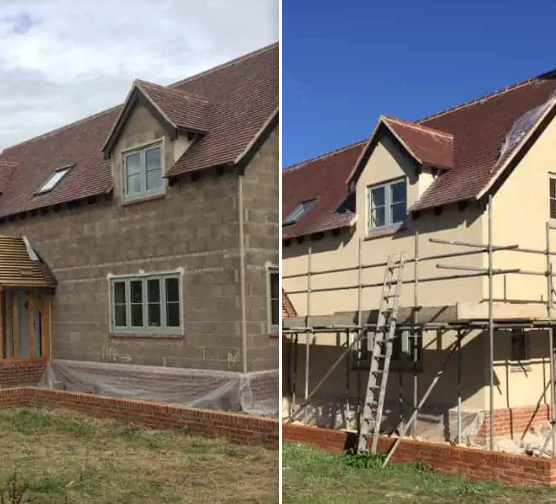
Deciding which wall you have. The quick tests are wall thickness at a reveal, the age of the building and what the render sounds like. A cavity wall built after the war can take a modern system. A solid wall built pre-1919 cannot, whatever the product literature says. Where it is not obvious we take a small square of render off out of sight and look.
Modern walls: thin coat and monocouche. Silicone thin coat is primer, a mesh and scrim reinforced basecoat and a through-coloured topcoat, scraped or floated to a texture you pick off a sample board. Monocouche is applied as one coat and stands up well on a long plain elevation. Both come coloured through rather than painted, and both need a sound background, so the prep matters more than the brand. Older acrylic and polymer rich systems are the ones you find crazed.
Old walls: lime. A haired lime basecoat worked into the background, a soft topcoat, then limewash or a breathable mineral paint. Every layer is weaker and more permeable than the one beneath, so moisture is never trapped in the wall. It is slower work and it goes on in thinner coats, and on a period cottage it is the only answer that does not shorten the life of the building.
Hacking off and preparing. Blown areas come off to a firm background, then we clean down, prepare, stabilise anything dusty with a primer and cut a key where the face is too smooth to hold a coat. Spalled brick arrises are cut out and made good. Where a third or more of a face sounds hollow, the whole elevation comes off rather than being patched around.
Insulation, where it fits. On a cold cavity wall, EWI is worth pricing next to a plain re-render: external wall insulation board fixed and dowelled on, a render carrier and mesh, then the topcoat, with Part L setting the thermal standard and building control usually involved. On solid masonry that has to breathe it is a different and much more careful specification, not the same boards.
Beads, cracking and staining. A bellcast bead at the base throws water clear of the plinth, stop beads finish the render at reveals and verges, and stainless goes wherever the wall gets wet. A crack that takes a coin lets water behind and the coat will delaminate around it. Pebbledash and Tyrolean hide the lot, so a dashed wall is tapped rather than looked at, and green algae on a shaded face is a clean unless the wall behind is wet.
How it runs
From your call to a written price
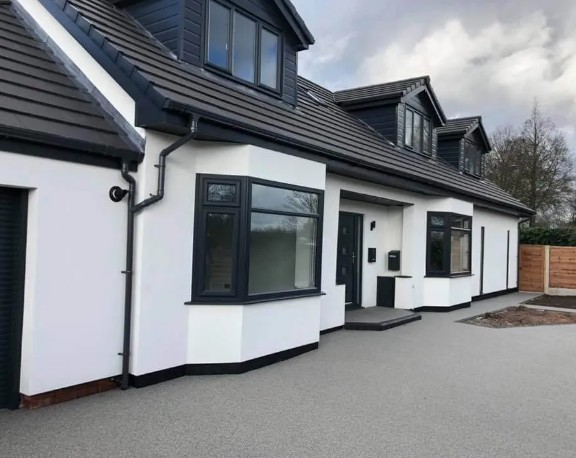
Same team from first visit to last, one person to ring, and no sub-contracting your work out to somebody you have never met. The quote is itemised, not a figure on the back of a card: access and scaffold, protection, preparation of the existing wall, the system and number of coats, beads and stop ends, and making good on separate lines, so you can compare it properly against anyone else's.
Nothing is left open or unusable overnight. The site is swept at the end of each day rather than the end of the job, and what comes out leaves with us. If something turns up once we start that nobody could have seen, you get a photograph and a price before we carry on.
Planning here is Wiltshire Council. There is no conservation area over the village and 12 listed entries in the parish, so most houses are straightforward: rendering an external wall on an unlisted house is normally permitted development where the new finish is similar in appearance to the old, and the government guidance on when permission is required explains where that line sits. On a listed building the existing render is protected in law and consent comes before anything is hacked off. We check an address before quoting a change of finish rather than afterwards.
Cost
What decides the price of a rendering job
No rate per square metre, because the square metres are the easy part; what is already on the wall decides the price.
Getting to it. A cottage tight to the lane wants the scaffold set with the verge protected, a two storey house with a lean-to needs the platform bridged over it, and a rear elevation behind a hedge has to be hand loaded. A bungalow gable comes off a tower, a three storey elevation wants a scaffold, and the platform has to stand for the whole system rather than a day. The work at height rules are why it is a priced line rather than something folded into a rate.
What is already on the wall. Rendering over sound brick is one job. Hacking off blown sand and cement, or a pebbledash that has parted from the background, is another, and it is the part nobody can see from the road. We tap the whole elevation before quoting, because the hollow areas set the hours.
The system, and what the wall behind it needs. Silicone thin coat over insulation, monocouche through-coloured, or traditional sand and cement all price differently and behave differently. On a solid wall that has to breathe, a plastic-rich modern system traps moisture and moves the problem inside, so the right system is a wall decision rather than a colour decision.
Comparing quotes? Ask which system is being quoted and how many coats, whether the old render is being hacked off or overlaid, whether beads, bellcast and stop ends are included, whether the scaffold is in the price, and what happens to the existing sills and pipework. Two quotes for the same job are usually two different jobs.
If it has started to come away
Render that has blown or cracked open
Ring rather than use the form. A section that sounds hollow when you tap it, or a crack you can get a coin into, is letting water behind the render and the frost does the rest. We make the loose area safe, sheet it if the weather is against us, and price the elevation once we can see how far the blown area actually goes. On an old cottage where damp has already come through inside, the render is doing harm every week it stays on, so that one does not want to wait for better weather. The phone is answered 24 hours for emergencies; scheduled work runs Monday to Friday, 8am to 6pm.
Worth knowing
Two houses on the same lane, two different specifications
The housing here did not arrive in one wave. Around a quarter of it predates 1919 and close to half went up between 1945 and the early eighties, which is why a lane runs from a Victorian pair to a seventies bungalow in fifty yards. From the road that is variety. From a render point of view it is two separate trades sharing a postcode.
The consequence is worth holding on to. When you ask three contractors to price a rendered elevation, listen for whether any of them tells you what your wall is made of. A quote that names a system before it describes the background is a quote for a product, not for your house. On a modern cavity wall almost any current system performs, and the differences come down to texture, colour and how well the beads and base detail are done. On a solid wall from before the First World War, choosing wrong does not show up in year one. It shows up as damp inside in year four and a wall face coming away in year eight, by which time the money has been spent twice.
Who you are dealing with
A local firm you can check
We cover Redlynch, Morgans Vale, Woodfalls, Landford and the villages between the forest and the Avon, broadly SP5, with Wiltshire Council for planning and building control. You are dealing with Bournemouth Roofing & Building, the trading name of Bournemouth Roofing & Building Ltd, registered in England and Wales, company number 15471719, which you can look up in a minute. Thomas Hannen's business, and he is the one who comes out to price the job, not a salesman. A verified customer's 10 out of 10 on Checkatrade. The visit and the written quote are both free.
Questions
Redlynch questions we get asked
How can we tell whether our wall is solid or cavity?
Measure the thickness at a window reveal and look at the bond on any unrendered section. A solid wall is usually about nine inches through with headers showing; a cavity is wider with no headers. Where the whole house is rendered we take a small square off out of sight.
Can one contractor do both kinds of work?
They should be able to, and plenty cannot. Lime is a different material with a different rhythm: thinner coats, longer waits, more protection from sun and frost. If somebody offers you the same system for a Victorian cottage and a seventies semi, that is the answer to your question.
Our neighbour had silicone render and it looks good. Why not us?
If your walls are the same construction, there is no reason why not. If theirs is a post-war house and yours is a cottage from the 1880s, the same product will behave completely differently, because it is the wall behind that decides whether a coat can be sealed.
Do you render garages and outbuildings too?
Yes, and they are priced as separate lines so you can drop one without redoing the whole quote. Outbuildings usually take a simpler specification, and traditional sand and cement is often the sensible choice on a garage or a store rather than a full modern system.
How long will the scaffold be up?
Usually a week to a fortnight for a two storey elevation, longer if the old render has to come off first or if a lime system is going on, because each coat has to be given time. We put the expected duration on the quote rather than leaving it open.
Nearby, and next door
Rendering near Redlynch
Rendering nearby
Our other trades in Redlynch
Everything we do in Ringwood Rendering, all areas Every area we cover
Free quote
Find out what your wall is before you pick a finish
Thomas comes out, taps the elevation, works out what the background is and prices the right system for it. The site visit and the written itemised quote are free.