
Bricklaying and repointing in Winfrith Newburgh
Repointing in a matched lime mix, brick and flint wall repairs and new brickwork in Winfrith Newburgh, starting with what is keeping the wall wet.
The site visit is free and so is the written itemised quote. Thomas Hannen prices every job himself.
When brickwork fails in Winfrith Newburgh it usually fails from the ground up. The Win runs through the middle of the village and a good deal of the older fabric sits low beside it, so the bottom metre of a wall stays wet long after the rest has dried, and that is where the brick faces go first.
Three things bring people here to the phone. A base course crumbling away behind a border or a path, where the wall has been wet for years and the frost has finally taken the faces off. Damp showing on the inside of a solid wall that somebody pointed in cement at some point, so the water that used to leave through the joint now leaves through the brick. Or a boundary wall along one of the lanes that has bowed, dropped its coping, or been clipped by a tractor.
We come out and survey the wall properly before anybody quotes it. That means looking at what is keeping it wet as well as at the joints, because pointing a wall that is still standing in water is money spent twice. You get told plainly whether this is a morning of work, a wall to watch for a season, or a job that needs consent before a chisel goes near it.
The work
The jobs we do on walls in the village
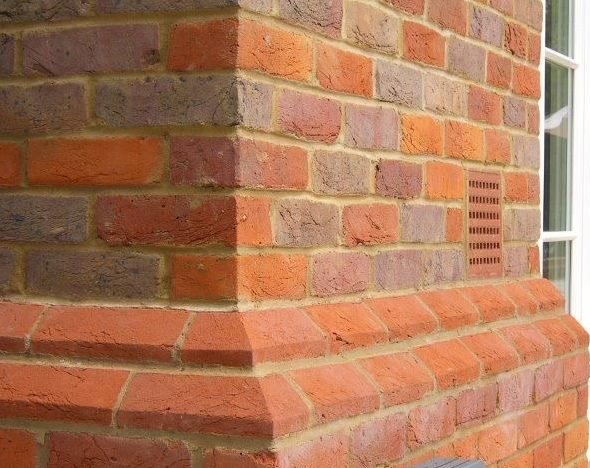
Repointing solid walls in a matched lime mix. Much of the older village is handmade brick, often banded with flint, with a lime mortar behind it. On that fabric the joint is the sacrificial part: water goes in and comes back out through the mortar and the brick stays sound. We rake out by hand with a chisel and a hacksaw blade rather than a disc, back to sound material, and point in a lime mix such as an NHL 3.5 knocked up to match the existing for colour, sand and strength, with a sample panel run up on your own wall so you can see it dry before an elevation is committed to. The joint goes back to the profile the wall already has, normally flush or slightly recessed. Where somebody has pointed one of these walls in sand and cement, the moisture that used to leave through the joint leaves through the face instead and the faces blow at the first hard frost. Getting it out is slow hand work and the only way to let the wall dry.
The bottom of the wall. The River Win runs through the village and it is in flood zones 2 and 3, so the base of a wall here spends longer wet than anywhere on higher ground. Where a base course has spalled we cut the dead bricks out and replace them with a reclaimed brick of the same size and bedding depth so the repair carries the same weathering as the wall around it rather than standing out. Where there is no damp proof course, and on a lot of these walls there is not, we deal with what we can control: lowering ground that has crept up above the internal floor, getting a path or a border away from the wall, and making sure rainwater is going somewhere other than the footing.
The walls along the lanes and around the churchyard take ivy, vehicles and water sitting where the coping has gone. Flint bedded in lime does not tolerate being pushed, and once a section is bowed the honest answer is usually to take it down and rebuild it off the same footing with the flint reset and the coping put back so it sheds. Stacks stand clear of everything and take weather from every side, so the joints go first and then the flaunching cracks and starts feeding water down inside; on a thatched roof the access is planned around the thatch, and that is a conversation before the quote rather than after it. For new work, whether that is a wall rebuilt from its foundation up or a lintel cut into a new opening, Planning Portal guidance on garden walls covers what you can build without planning permission, and building control inspects the structural stages.
How it runs
From your call to a written price
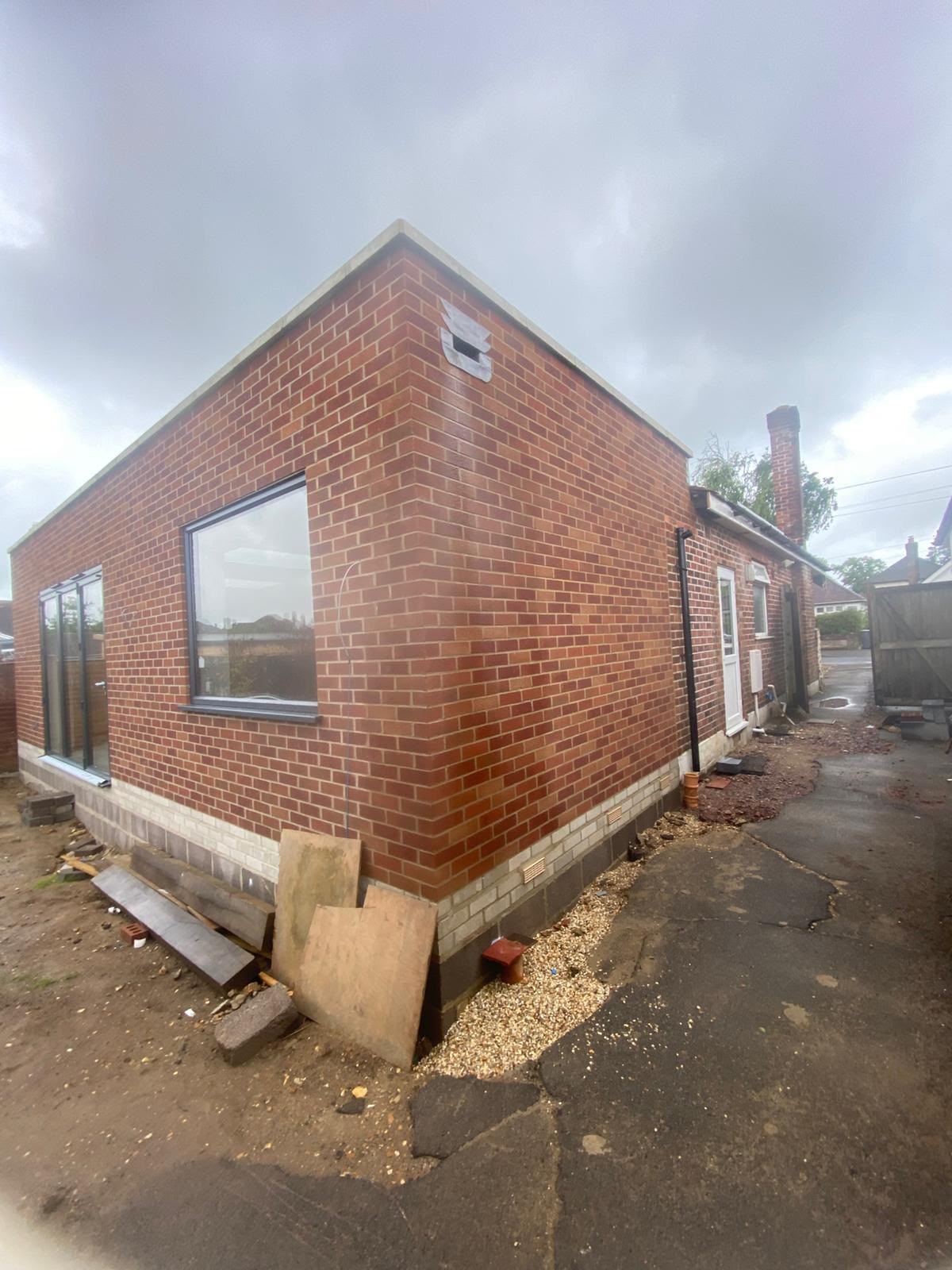
Repointing and repairing like for like on an unlisted building is maintenance, with no planning permission and no building control involved. Winfrith Newburgh has its own conservation area and 58 listed entries inside it, from the church down, which is a great many for a village this size. On a listed building or a listed wall even a change of mortar can be an alteration needing listed building consent from Dorset Council. We check which of those you are in before we quote, not after, and the quote is itemised, access, raking out, the mix, brick replacement and disposal on separate lines, so you can compare it properly.
Cost
What decides the price of a brickwork job
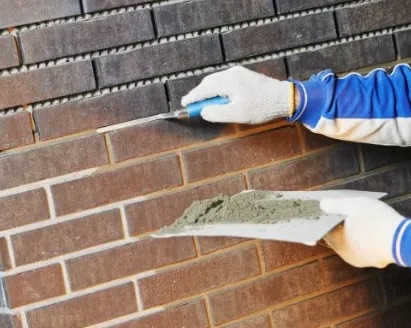
No rate per square metre. Access first: a thatched cottage tight to the village street, a farm range behind a yard you can back a lorry into and a flint wall out on a lane with traffic on it are three different jobs. How long the platform stands matters as much as its size, and work at height rules are why it is a priced line. Hand raking flint and soft brick is the slow part, and a reclaimed brick has to be sourced. Ask what the mix is and whether the scaffold is in.
If something has moved
Loose brickwork, or a wall that has shifted
Ring rather than use the form. Anything overhead or leaning goes to the front of the queue, and the first visit is about making it safe. We are along the A352 regularly, so a wall pushed out into a lane here, or a stack with movement in it, gets seen quickly. The phone is answered 24 hours for emergencies; scheduled work runs Monday to Friday, 8am to 6pm.
The one local thing
Water at the foot of the wall
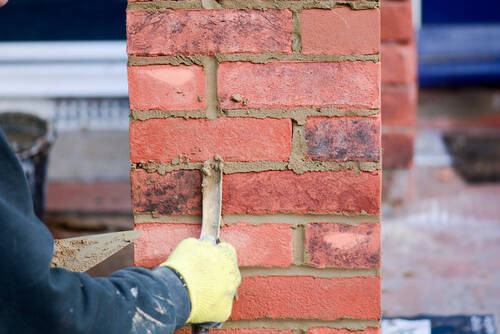
The Win runs through the village and a real part of Winfrith Newburgh sits inside flood zone 3, which you can check for your own address on the government flood risk service. For brickwork that matters less because of the flooding itself and more because of what it tells you about the everyday water table.
A wall whose footing sits in wet ground never fully dries out. Salts come up through the brick, the face blows off in the first hard frost, and the joint below the damp proof course, if there even is one, washes out faster than anything higher up. If your repointing has failed in a neat band around the bottom of the house and nowhere else, that is not bad pointing. That is the ground.
So the useful order of work here is not the order most people expect. Before you price the elevation, get the water away from the wall. That means checking where every downpipe actually discharges, because a gully that has silted up or a pipe that stops in a border is putting hundreds of litres against a footing every time it rains, and Approved Document H is the standard the drainage is meant to meet.
It means taking a raised border or a built up path back down below internal floor level. It means clearing the ditch or the channel if one runs past your boundary. Do that first and the repointing you then pay for lasts. Do it afterwards and you will be cutting out the same base course again in a few winters.
Who you are dealing with
A local firm you can check
We cover Winfrith Newburgh, Wool, West Lulworth, Owermoigne, Crossways and the rest of DT2 and BH20, and the travel is a line in the quote rather than something hidden in the rate. Bournemouth Roofing & Building Ltd, registered in England and Wales, company number 15471719, which you can look up in a minute. Thomas Hannen's business, and he is the one who comes out to price the job, not a salesman. A verified customer's 10 out of 10 on Checkatrade. The visit and the written quote are both free.
Questions
Winfrith Newburgh questions we get asked
The Win runs right past us. Is that our damp?
Very likely at the base of the wall. Winfrith Newburgh sits in flood zones 2 and 3 with the River Win effectively running through it, so the water table stays high and the lowest courses spend the winter wet. Damp rises into the joint, salts travel with it, and the mortar turns back to sand from the ground upwards while everything above head height is untouched.
How do you get old mortar out without wrecking the brick?
By hand, for the most part. An angle grinder cuts a straight line and brick edges are not straight, so on the older walls around Winfrith Newburgh a disc widens the joint and takes the arrises off permanently. I use a plugging chisel and a lump hammer, cut back to roughly twice the joint width, and only reach for a power tool on hard cement in sound modern brickwork.
Is our cottage inside the Winfrith Newburgh conservation area?
The mapped boundary decides that, and Dorset Council publishes it, so it gets checked before I price rather than after. Inside the Winfrith Newburgh Conservation Area appearance is controlled, meaning a wall repaired as it was counts as maintenance while a change of material, coping or joint finish does not. Outside the line the same wall is simply a repair. It is worth knowing which side you are on.
There are 58 listed entries here. Does that affect us?
Only if yours is one of them, and with 58 entries in a village this size that is no remote chance. Winfrith House and the parish church of St Christopher are the obvious ones, but garden walls and outbuildings inside the curtilage of a listed house are covered too, which catches people out. A listing does not stop the repair. It fixes how the repair has to be done.
We are converting an outbuilding. Does the ground need anything?
Winfrith Newburgh falls in a radon affected band where basic protection is expected in new work, so a conversion or an extension gets a membrane and a sealed floor detail as a matter of course. It makes no difference to repointing or to a garden wall, which is why it only comes up when the job creates a new or newly habitable floor. Building control will want it drawn.
Nearby, and next door
Bricklaying and repointing near Winfrith Newburgh
Bricklaying and repointing nearby
Our other trades in Winfrith Newburgh
Everything we do in Wareham Bricklaying and repointing, all areas Every area we cover
Free quote
Get an honest look at the wall
A free site visit, the mix and the method in writing, and the drainage checked before anyone prices the pointing.