
Driveways and patios in Tarrant Monkton
Loose stone that has rutted, a patio that rocks, or nowhere to park at all. We open the ground first and price the base and the surface separately.
The site visit is free and so is the written itemised quote. Thomas Hannen prices every job himself.
A drive on the valley floor at Tarrant Monkton almost never fails at the surface. It fails because the ground under it stays wet from November onwards and there was never enough stone down to spread a car over it. We dig a trial hole on the first visit, tell you what depth of sub-base is actually there, and price the dig and the surface as separate lines so you can see which one you are paying for.
Three things bring people out of this village to ring us. Loose stone parking that has rutted into two tracks and turns to slop by February. A patio behind an old cottage that has started to rock, one flag sitting proud of the next, moss in every joint. And no proper parking at all, because the house went up long before anyone owned a car and what you have is a gateway, a bit of verge and a wall you cannot move.
All three want a look before anyone quotes. We come out, walk the fall of the ground with you, open a hole at the worst spot, and find out where your rainwater goes today and where it could go instead. Then it comes back in writing, with the excavation, the muck away, the sub-base, the edgings, the surface and the drainage set out one at a time.
The work
What we build along the valley lane
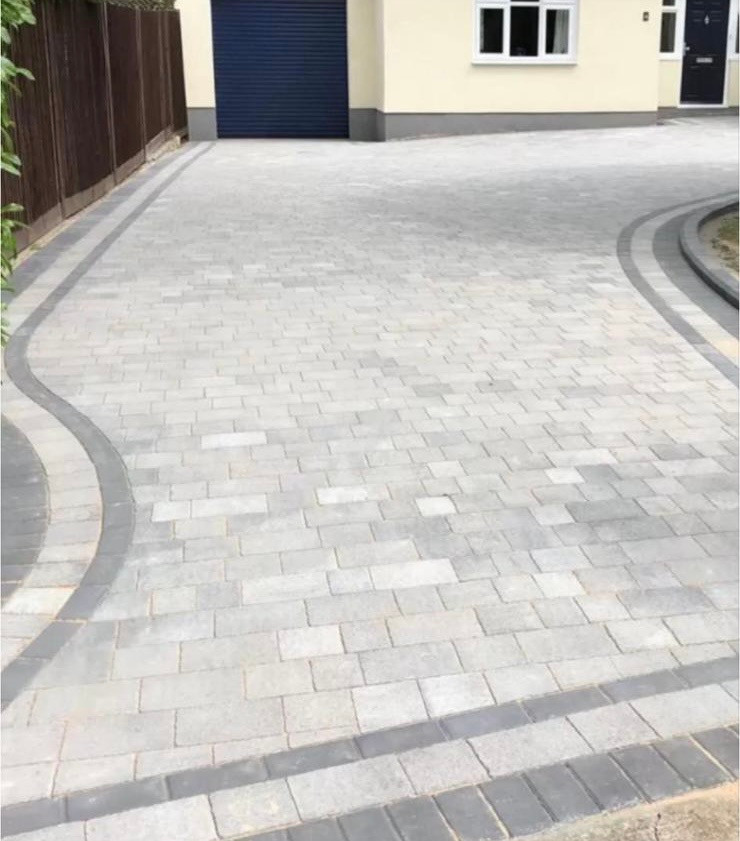
Loose stone that has stopped behaving. Most of the parking along the valley lane is gravel or hoggin, and it works right up until a tractor or an oil tanker turns on it. Then you get two ruts, a bank of stone thrown onto the verge, and puddles standing in the wheel tracks. Loose stone is not a cheap surface, it is a surface that needs a base like any other. We excavate to formation, lay a geotextile membrane so the stone and the subsoil stop mixing, compact a proper depth of sub-base, then either bring the gravel back in a cellular grid or bind the first few metres at the gateway where the wheels turn hardest.
Block paving suits a turning area better than anything else, because the blocks move a fraction rather than crack and a sunken bay can be lifted and relaid. It lives or dies on the edge restraint being haunched in concrete the whole way round and on kiln dried sand brushed into the joints. Gone wavy along one side is the edge letting go rather than the base; weeds mean the sand has washed out and you need a re-sand, not a new drive.
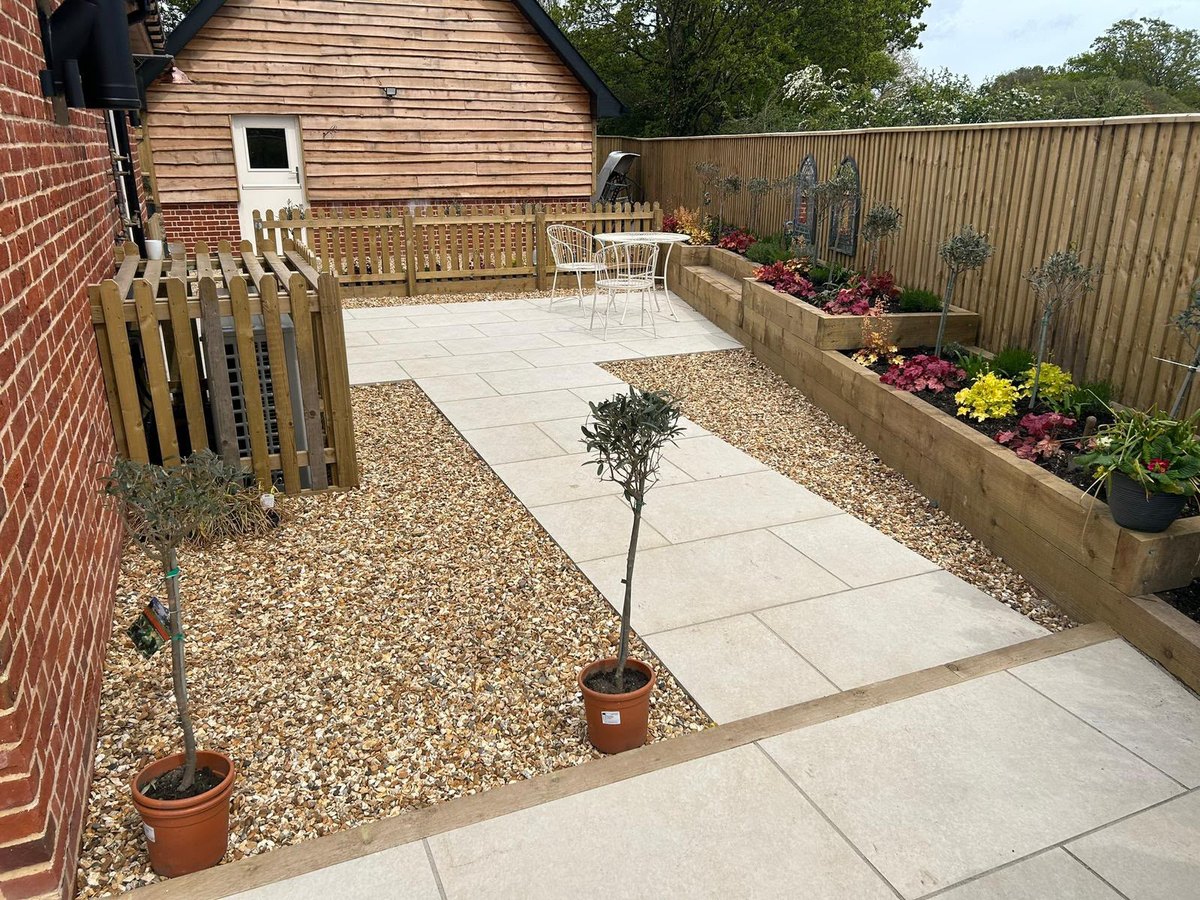
Against a flint and brick cottage wall the damp proof course is often low, and on the oldest there is not one at all, so the finished level stays well down and you come out over a step, or a channel drain across the threshold does the job. Flags go on a full mortar bed rather than five dabs, which is the commonest reason a patio rocks. The ground here holds water, so a soakaway needs a percolation test rather than an assumption. The lanes are narrow and some gateways narrower, so where a machine will not fit everything goes by barrow, and that shows in the price as time.
How it runs
From your call to a written price
One person to ring, and an itemised quote. More than five square metres of new hard surface at the front needs planning permission unless it is permeable or the water runs to a border, lawn or soakaway inside your own boundary, which is how we build them, and Planning Portal guidance on paving your front garden sets it out plainly. A patio at ground level round the back is permitted development. The village sits in the Tarrant Valley Conservation Area and there are 27 listed entries along the valley, so where a new surface runs tight against a listed wall the council can want listed building consent before you settle on a material.
Cost
What decides the price of a driveway
No rate per square metre, because what is under it decides more than what goes on top. A cottage that opens straight onto the lane, a farmhouse with a yard you can turn a lorry in, and a house set back behind a long gravel run are three different jobs before a spade goes in. Ground conditions, the depth of the dig and how much muck goes away are the real variables. On ground that stays wet, where the surface water goes is a design decision with a cost. Ask the depth of dig, the sub base and the drainage.
If it is urgent
A trip hazard, or a drive that floods
Ring rather than use the form. A lifted slab, a sunken bay by a doorway or a gully that has stopped taking water will not wait, because somebody falls or water ends up against the house. If water is standing against a cottage wall, or a flag has lifted on the path to the door, say so when you ring. The phone is answered 24 hours for emergencies; scheduled work runs Monday to Friday, 8am to 6pm.
Worth knowing
Where the water goes decides the build here
The valley floor here holds water through the winter and lets it go again in summer, and that single habit decides more about your drive than the surface you pick. It means a soakaway is not the automatic answer.
It needs a percolation test rather than an assumption, and plenty of holes dug along this valley fill up in January and simply stay full. Approved Document H sets out the order you are meant to work through, and the SuDS thinking behind it is the same: hold the water where it lands if you can, and only move it on if you cannot. Where infiltration will not do it, the answer is a positive outfall to a ditch you are allowed to use, or a permeable build-up with enough open stone under it to swallow a downpour and let it away slowly.
The practical part is when you test. Dig a hole in August and the ground will take anything you pour into it, which tells you nothing about the night in February when it matters. We test when the ground is wet, or we design for the wet case and say so. Two other things follow.
Set the falls so surface water runs away from the house rather than into the strip beside the wall, and keep any outfall well clear of the footings. And do not let a new drive tip its water out onto the lane, because that is somebody else's problem by the time it freezes. If a neighbour has just built something that now sends water your way, raise it before you build yours rather than after.
Who you are dealing with
A local firm you can check
We work across Tarrant Monkton, Tarrant Rawston, Tarrant Rushton, Tarrant Launceston, Blandford Forum and the villages either side of the valley, and DT11 generally. Bournemouth Roofing & Building Ltd, registered in England and Wales, company number 15471719, which you can look up in a minute. Thomas Hannen's business, and he is the one who comes out to price the job, not a salesman. A verified customer's 10 out of 10 on Checkatrade. The visit and the written quote are both free.
Questions
Tarrant Monkton questions we get asked
Will water soak away here, or does it need piping?
It has to be tested rather than assumed. The ground through the Tarrant valley is naturally wet, so a soakaway sized off a standard table can fill in its first winter and then stay full. A percolation test, in the real hole at the real depth, tells you whether infiltration works at all. Where it does not, the surface is fallen to a channel and taken to a positive outfall, which is a different job and gets priced as one.
Will a tarmac drive be refused in the conservation area?
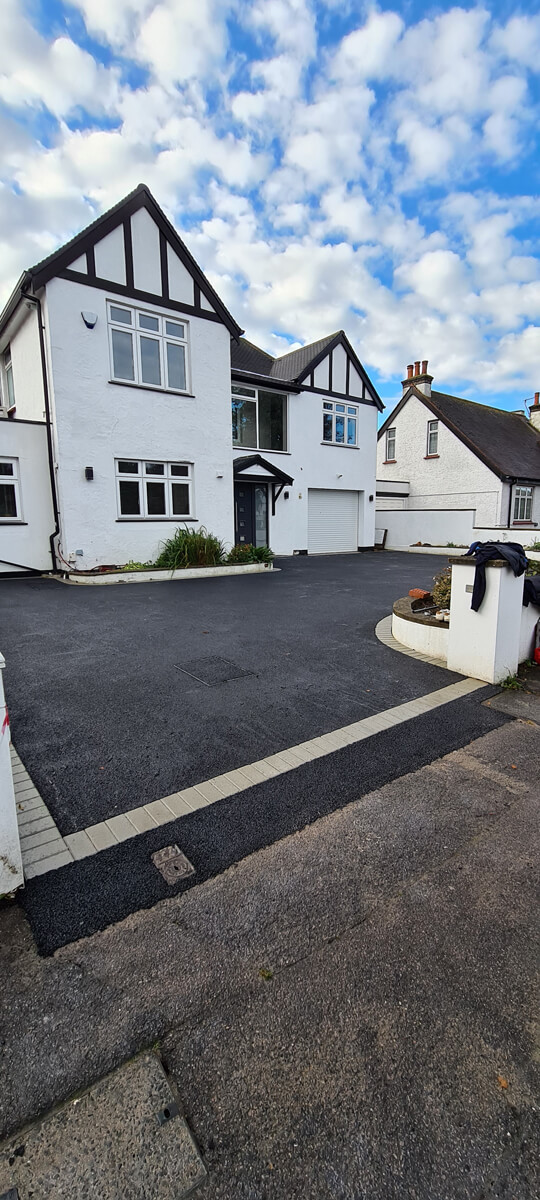
Refused is the wrong word, since most surfaces need no application in the first place. What the Tarrant Valley Conservation Area does is let the authority comment on how the frontage looks once a material changes, and a wide black apron in front of a village property is the version that attracts comment. Gravel, hoggin and a muted block are all straightforward. Dorset give a view before you commit to buying anything.
Is it worth waiting until summer to start?
On the wet ground at Tarrant Monkton it often is. The dig and the sub-base are the parts that suffer, because a formation churned up by a machine in February has to be taken out further and replaced with more stone than it should need. In a dry spell that same excavation stands up and the work is cleaner. If it cannot wait, we sheet the formation and stone it as we go instead of opening the whole area.
Where will the vans and the machine sit while you work?
On your ground wherever there is space for them, because parking on a village lane at Tarrant Monkton blocks it for everybody else. If the plot cannot take them we bring fewer vehicles and share, and the machine stays on site under cover rather than being trailered in each morning. The one thing genuinely needed is somewhere a lorry can stand for deliveries, and that gets agreed on the visit.
Gravel or block on a wet plot like ours?
Gravel over a cellular grid copes better with water, because the surface itself is open and the stone below holds a little before it drains away. Block works too, but on this sort of ground it wants permeable jointing and a reservoir base rather than the standard build. What usually settles it is how the frontage should look in a village setting, and whether a pram or a wheelchair has to cross it regularly.
Nearby, and next door
Driveways and patios near Tarrant Monkton
Driveways and patios nearby
Our other trades in Tarrant Monkton
Everything we do in Blandford Forum Driveways and patios, all areas Every area we cover
Free quote
Get a written price for your drive or patio
A free site visit in Tarrant Monkton, a trial hole where it matters, and an itemised quote covering the dig, the base, the edges, the surface and the water.