Rendering in Tarrant Monkton, cob and flint walls
An old wall in this valley stays standing because it can dry out, so the render that goes on it has to let it, and cement does not.
The site visit is free and so is the written itemised quote. Thomas Hannen prices every job himself.
In the older cottages along this valley the wall is often cob or flint and brick rather than modern blockwork, and those walls stay standing because they can dry out. Put a cement render on one and you have sealed it, and the damage shows up inside as damp long before the outside looks wrong.
So the first job on any older building here is working out what is behind the finish. Cob walls are thick, soft, and usually sit on a plinth of flint or brick with the corners slightly rounded. Flint and brick walls are hard but very absorbent. Both were built to work with a lime render and limewash, not against a plastic skin.
The rest of what we do is ordinary render work: hacking off blown areas, patching dash, and putting modern systems on the twentieth century houses where they belong. We tap the elevation, tell you what has actually let go, and put the access, preparation, system, beads and making good on separate lines. The site visit and the written quote are free.
The work
Cob, flint and the cement somebody put on in 1975
Tapping and reading the wall. A hammer handle tells you where the render has blown. The wall thickness at a window reveal tells you what it is. Anything much over 450mm with soft edges is likely cob, and cob is the one background where the wrong render does structural harm rather than cosmetic harm.
Taking cement off. Most of the failures we see on old cottages here are a hard cement render applied decades ago. It cracks, water gets behind it, and because the cement will not let that water back out the wall behind stays wet. On cob that means the earth softens; on flint and brick it means frost damage and salts. Removing it is careful hand work, not a breaker.
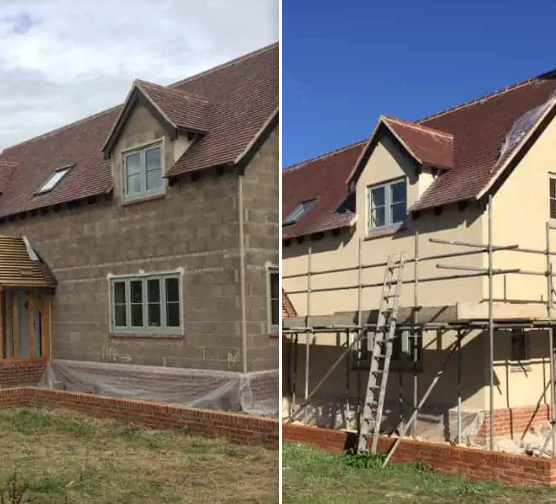
Lime render. Applied in coats onto a dampened background: a hair reinforced scratch coat left with a good key, a float coat ruled out, and a finish coat or a limewash over it. Soft, breathable and slightly flexible, so it takes the movement instead of passing it to the wall. Kept damp and protected while it carbonates, which is why the scaffold stays sheeted.
Flint and brick repair before rendering. There is no point rendering onto loose material. Open joints get raked and repointed in a lime mortar first, and anything spalled is cut out, so the background is sound before a coat goes on.
Sand and cement, pebbledash and Tyrolean. Ordinary and correct on the twentieth century houses in the village. Scratch coat, float coat, and dash or Tyrolean where the elevation already carries it, matched by sample panel where the aggregate can still be had.
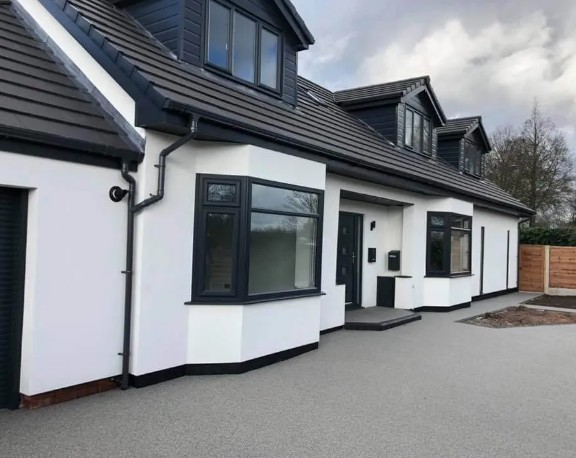
Silicone thin coat and monocouche. Both good systems on a modern cavity wall: a stabilising primer where the background is dusty, a mesh reinforced basecoat, then a through coloured topcoat that needs no painting. Neither belongs on cob or on a solid period wall, and we will say so rather than take the order.
Beads, bellcast and stop ends. On modern work a bellcast bead throws water clear at the base, stop beads finish reveals and angle beads keep corners true. On cob we usually form the arris and the drip by hand, because a hard metal bead in a soft wall gives the render something to crack against.
External wall insulation. On a modern house, board fixed outside and rendered over, on a render carrier where needed, lifts the thermal performance without losing a room. On a breathable solid wall it takes a specialist build up, and on a protected frontage it usually is not the answer at all.
Cracks, delamination and algae. A straight hairline crack is shrinkage. A stepped or widening crack is movement behind the render. Green on a shaded elevation lifts with a gentle clean down and a treatment, never a pressure washer on lime.
How it runs
From your call to a written price
Same team from first visit to last, one person to ring, and no sub-contracting your work out to somebody you have never met. The quote is itemised, not a figure on the back of a card: access and scaffold, protection, preparation of the existing wall, the system and number of coats, beads and stop ends, and making good on separate lines, so you can compare it properly against anyone else's.
Nothing is left open or unusable overnight. The site is swept at the end of each day rather than the end of the job, and what comes out leaves with us. If something turns up once we start that nobody could have seen, you get a photograph and a price before we carry on.
The village sits inside the Tarrant Valley Conservation Area, so external appearance is controlled: repairing a finish in the same material is maintenance, changing it is a planning question. There are 27 listed entries in the parish, and on a listed building the render is part of the fabric and needs listed building consent before it comes off. We check the address at the quote stage, not on the first morning.
Cost
What decides the price of a rendering job
No rate per square metre, because the square metres are the easy part; what is already on the wall decides the price.
Getting to it. A thatched cottage tight to the lane needs a platform that keeps clear of the eaves, a farmhouse with open ground takes a straightforward scaffold, and a converted barn with a tall gable needs one that reaches the apex. A bungalow gable comes off a tower, a three storey elevation wants a scaffold, and the platform has to stand for the whole system rather than a day. The work at height rules are why it is a priced line rather than something folded into a rate.
What is already on the wall. Rendering over sound brick is one job. Hacking off blown sand and cement, or a pebbledash that has parted from the background, is another, and it is the part nobody can see from the road. We tap the whole elevation before quoting, because the hollow areas set the hours.
The system, and what the wall behind it needs. Silicone thin coat over insulation, monocouche through-coloured, or traditional sand and cement all price differently and behave differently. On a solid wall that has to breathe, a plastic-rich modern system traps moisture and moves the problem inside, so the right system is a wall decision rather than a colour decision.
Comparing quotes? Ask which system is being quoted and how many coats, whether the old render is being hacked off or overlaid, whether beads, bellcast and stop ends are included, whether the scaffold is in the price, and what happens to the existing sills and pipework. Two quotes for the same job are usually two different jobs.
If it has started to come away
Render that has blown or cracked open
Ring rather than use the form. A section that sounds hollow when you tap it, or a crack you can get a coin into, is letting water behind the render and the frost does the rest. We make the loose area safe, sheet it if the weather is against us, and price the elevation once we can see how far the blown area actually goes. On a cob wall a lost patch of render exposes bare earth to rain, so those get sheeted the same week even when the proper repair has to wait for settled weather. The phone is answered 24 hours for emergencies; scheduled work runs Monday to Friday, 8am to 6pm.
Worth knowing
Why cement is the worst thing you can put on a cob wall
A cob wall is chalk, earth, straw and water, built thick, standing on a stone or brick plinth and traditionally kept dry by a good hat and good boots: a generous roof overhang above and a plinth below. It is not waterproof and was never meant to be. Rain wets the outer face, and the wall dries back out through that same face when the weather turns. Everything about how it survives depends on that drying.
A cement render stops it. Water still gets in, through a crack, around a window, up from a raised path, but it can no longer get out, so it sits in the earth and softens it. By the time the render is bulging the damage is already done, and it is a rebuild rather than a repair. The historic building guidance on cement and traditional masonry is blunt about it. So if your cottage has a hard grey render that rings dead when you tap it, get it looked at while it is only a render problem.
Who you are dealing with
A local firm you can check
We cover the Tarrant valley villages, Tarrant Keyneston, Tarrant Hinton and the lanes towards Blandford, broadly DT11, under Dorset Council. You are dealing with Bournemouth Roofing & Building, the trading name of Bournemouth Roofing & Building Ltd, registered in England and Wales, company number 15471719, which you can look up in a minute. Thomas Hannen's business, and he is the one who comes out to price the job, not a salesman. A verified customer's 10 out of 10 on Checkatrade. The visit and the written quote are both free.
Questions
Tarrant Monkton questions we get asked
How do I tell whether my wall is cob?
Measure it at a window reveal. Cob is thick, often well over 450mm, and the corners and openings look softened rather than sharp. It usually sits on a plinth of flint, stone or brick a foot or two high. If you are unsure, we will look before anything is quoted.
Can a cob wall that has been cement rendered be saved?
Usually, if it is caught while the problem is still the render. The cement comes off by hand, the wall is allowed to dry, any soft material is cut out and made good, and a lime render goes back on. Where the earth behind has already gone soft it becomes a rebuild.
Is limewash necessary or can I use masonry paint?
Limewash or another breathable coating is the point. Ordinary masonry paint is a plastic film, and putting one on a lime render undoes the reason for using lime, because the wall can no longer dry through the face. It also flakes off within a couple of years.
Will you turn work down if we ask for a modern render?
On a cob or solid period wall, yes, and we would rather lose the job than take money for something that damages the building. On a modern cavity walled house in the village a silicone thin coat or a monocouche is a perfectly good choice and we will fit it.
Can lime render be put on in cold weather?
Not safely. It needs to stay damp while it sets and it must not freeze, so the risky window runs from late autumn onwards. We will sheet a scaffold and do a small repair later in the year, but a full elevation is much better booked for the warmer months.
Nearby, and next door
Rendering near Tarrant Monkton
Rendering nearby
Our other trades in Tarrant Monkton
Everything we do in Blandford Forum Rendering, all areas Every area we cover
Free quote
Get the wall identified before anyone quotes a finish
Thomas comes out, works out whether the wall is cob, flint or modern block, taps the render and prices the right repair with the access and materials itemised. The visit and the quote are free.