Rendering in Holt
Render repairs, dash matching and full elevations around Holt, starting with whether the wall is failing or just green.
The site visit is free and so is the written itemised quote. Thomas Hannen prices every job himself.
Last updated
Rendering around Holt starts with a hammer, not the colour chart. A green wall is not a failed wall, and washing it costs a fraction of rendering it. Where tapping finds hollow or cracked render, it is cut back and patched, or the elevation is re-rendered in a silicone thin coat, monocouche or lime to suit the wall behind. Dash can be matched on a sample first. Damp showing on inside walls is plastering work.
Out on the Holt lanes the houses sit among trees and tall hedges. Shade, still air and leaf litter keep an elevation damp for longer after rain, and algae only needs a damp surface and a little light. So the north and east walls green over, the streaks run down from the gutter line, and people assume the render has had it.
Sometimes it has. Often it has not. We come out to Holt, tap the whole elevation, and tell you which of the two you have before anyone quotes for new work. The site visit and the written itemised quote cost you nothing either way.
The work
Telling a dirty wall from a failing one
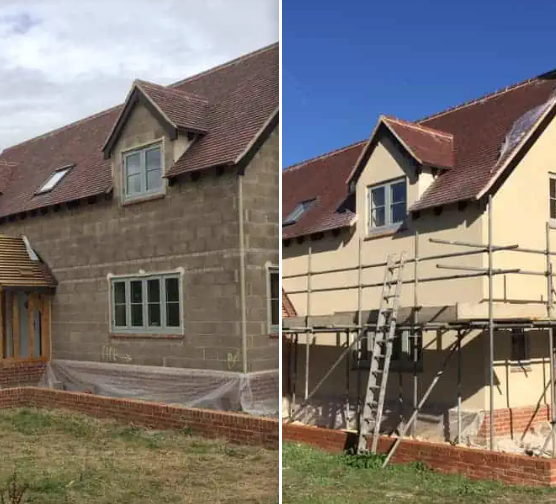
Sounding it comes first. A light hammer goes over every rendered elevation in Holt. A sound coat rings hard against the background. A blown one answers hollow, has already delaminated, and no coating applied over the top will hold it on. We mark the hollow areas, photograph them and measure them, because that area rather than the state of the surface is what decides the price.
When it is only growth. Green and black staining is algae, and it lives on the surface. A soft wash, a treatment and the shade dealt with where it can be, and the wall looks like itself again. Where the growth is heavy it will come back sooner on a shaded elevation, which is a maintenance rhythm rather than a fault in the render. Cutting a hedge back off a wall does more for it than most coatings do.
When it is the render. Hollow areas, a crack you can get a coin into, dash shedding in plates, a coat that has parted along the bottom edge. That is a job. The coat comes off back to the background, the wall is cleaned down, loose and spalled material is cut out and it is left to dry.
What goes back on. Beads first: angle beads on the corners, stop beads at reveals and against frames, a bellcast at the base so water leaves the wall rather than tracking back under it. Then a primer or a slurry key on dense block, a mesh reinforced polymer basecoat, and a topcoat. Silicone thin coat, through-coloured and scraped to a fine texture, is our preferred answer on cavity blockwork.
Monocouche, sand and cement and dash. Monocouche is one thick through-coloured coat for new blockwork and extensions. Traditional two coat sand and cement, scratched and floated, still belongs on plinths, garages, outbuildings and boundary walls and takes paint, dry dash or a Tyrolean finish. Existing pebbledash with a sound backing can be stabilised, patched and re-dashed to match.
The older cottages. The solid walled buildings out in Holt have no cavity and dry through their own face, so they take lime render and a breathable mineral finish rather than a plastic-rich modern system. On those walls a heavy coat of masonry paint applied to hide algae does real harm, because it seals the surface the wall was drying through.
Render over external wall insulation. Where EWI board goes on, the render becomes the weather skin over a render carrier or a mesh basecoat, and the thermal benefit rests on the sill, eaves and base detailing.
How it runs
Re-rendering in Holt, from tap test to top coat
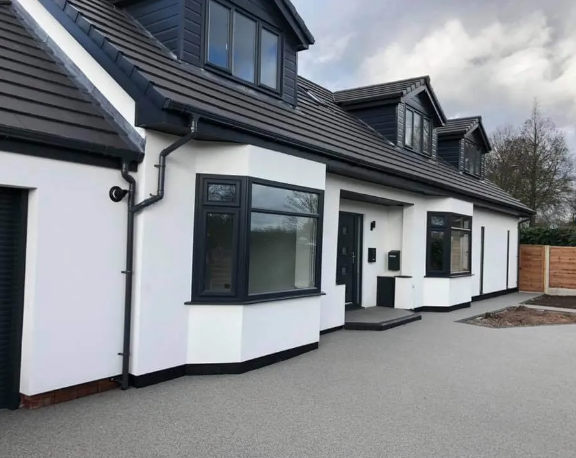
Re-rendering in Holt starts with a tap test. Thomas works across the whole elevation marking the hollow spots, then checks the foot of the wall where render meets the ground, the sills and the beads. His written price separates scaffolding and access, sheeting and protection, preparing the wall that is there now, the render system with its number of coats, beads and stop ends, and making good. Thomas is your contact for every coat.
Single storey walls in Holt can be done off a tower. Anything taller gets scaffolding, left up until the last coat has cured, and on a lane we agree where it stands and where the mixer sits. Frost and heavy rain stop rendering, so the dates follow the forecast.
Windows, doors, plants and paths are covered, and all the hacked-off render leaves with us. If the wall underneath is worse than the tap test suggested, say a cracked brick or a failed lintel, you see photos and a price first.
Replacing render on a wall that already carries it is maintenance. Rendering bare brick for the first time, or changing the finish, may need planning permission, and the Planning Portal's page on external walls explains when. Holt has no conservation area. On a listed building, consent comes before any work. Re-rendering an entire elevation also means meeting Part L through building control at Dorset Council.
Cost
Blown render, the right system and the platform
Render is priced after a tap test, never by the metre, because the old coat decides the job. The old coat. Rendering over sound brick is one job. Where the old coat is hollow, whether plain sand and cement or pebbledash that has let go of the background, it all has to be knocked off first, and none of that shows from the lane.
The wall behind. If the wall is older solid brick or stone, it needs to let moisture out. Put a plastic-rich system over it and the damp is held in and driven indoors, so a lime render may be right. A cavity wall, or one with external insulation, is happy with silicone thin coat or a monocouche that carries its colour through, and a traditional sand and cement render suits plenty of walls. Each prices differently.
Cracking from below. Holt is on clay that shrinks and swells. A crack running up from the base of the wall may be movement, and the cause should be found before new render goes over it. A bellcast bead at the base keeps water off the ground-level join.
Details. Stop ends, corner beads, sills, and taking pipework and lights off and back all add hours.
Getting to it. A Holt house behind trees, a cottage with no standing on the lane and a run of outbuildings each need a different platform, from a tower to a full scaffold, costed separately under the work at height rules.
Get any other quote to spell out the system and the coats, whether the old render is being hacked off or overlaid, and whether scaffold is included.
If it has started to come away
Render cracked or hollow along the base of a wall
Render that rings hollow when tapped, or a crack wide enough for a coin, lets water behind the coat, and then frost pushes it off. A coat that has parted along the bottom of a wall gets worse fast once the wet months arrive.
If a piece has fallen, keep people away from that wall. On the first visit we strip off anything loose, sheet the area if rain is due, and mark how far the blown section runs. For render coming away, the phone beats the form, and a call we miss is always returned as soon as we can manage it. Rendering is scheduled Monday to Friday, 8am to 6pm.
Worth knowing
Washing a wall is not a repair, and rendering it is not a clean
The two jobs get confused constantly, and both directions cost money. Rendering a wall that only needed washing is the expensive mistake. Washing a wall that is actually blown is the one that comes back, because you have made a failing coat look presentable for a season while water carries on getting behind it.
There is a further trap on the older buildings in Holt. A shaded solid wall that has gone green tempts people towards a thick masonry paint, and that is the worst answer available. It seals the face the wall dries through, so the moisture goes inwards, and within a few winters the paint film is lifting in patches with damp behind it. If an old wall is discoloured, the answer is a gentle wash and a breathable mineral finish, not a coating that promises to solve it permanently.
So the sequence we would suggest in Holt is boring and it works. Tap it first. If it is sound, wash it and cut back whatever is shading it, and see how it looks after a summer. If it is hollow, get the hollow areas measured and priced properly, and do the render for the right reason. Anyone who quotes to re-render an elevation without having sounded it has told you they have not looked at your wall.
Who you are dealing with
Who renders the wall, and where we are based
Render on houses and outbuildings in Holt, Furzehill, Broad Oak and round Wimborne, in BH21, comes under Dorset Council. Wolverton Road in Boscombe, where our base is, is 8.6 miles from Holt. The owner, Thomas Hannen, taps each elevation and prices it.
On Checkatrade a verified customer has given us 10 out of 10, and it is there to read. We charge nothing for the visit or for the written quote, which lists each line. Registered as Bournemouth Roofing & Building Ltd, registered in England and Wales, company number 15471719. Before you book a visit in Holt, you can read our customers' Google reviews, word for word, on our reviews page.
Planning at a glance
Do you need planning permission in Holt?
Most repairs in Holt need no application at all. What decides whether a change to the outside of your house does is who the council is, whether a conservation area or a listing applies, and whether the place sits in a protected landscape.
| Question | In Holt |
|---|---|
| Who decides | Dorset Council is the planning authority for Holt. Dorset Council's heritage pages set out what it controls. |
| Conservation area | None covers Holt, so a like-for-like repair is ordinary maintenance. |
| Listed buildings | Yes, there are listed buildings in and around Holt. If yours is one, work can need listed building consent. |
| Protected landscape | No National Park or National Landscape covers Holt. |
Questions
Questions about rendering in Holt
Our render has gone green. Does it need replacing?
Green render in Holt does not usually need replacing. Algae lives on the surface and comes off with a soft wash and a treatment. What matters is what is underneath, so we tap the elevation first. If it rings hard, you have a cleaning job. If it sounds hollow, the growth is the least of it and the coat needs attention.
Will masonry paint stop it coming back?
It will hide it for a while and on an old solid wall it can do real damage, because it seals the surface the wall dries through. On modern blockwork a breathable through-coloured render is a better answer than paint, and cutting back whatever is shading the wall helps more than either.
How often will a shaded wall need washing?
More often than a sunny one, and that is a fact of the setting rather than a fault. A north or east elevation under trees stays damp longer after rain, so growth returns sooner. Treat it as maintenance on a rhythm, in the same way you would clear a gutter.
What does hollow render actually sound like?
Like a drum, or a hollow box, against the flat ring of a sound coat. You can usually hear the difference yourself with a knuckle at ground level. We go over the whole elevation with a light hammer, including the parts you cannot reach, since a hollow area high up is the one that eventually drops.
Nearby, and next door
Rendering near Holt
Nearby places we also cover for rendering, with straight-line distances from Holt, and the other trades we offer in Holt itself.
Rendering nearby
Our other trades in Holt
Rendering guides
Silicone, cement or lime: which render? Cracked render: which cracks matter Listed building consent for repointing and re-renderingEverything we do in Ferndown Rendering, all areas Every area we cover
Free quote
Get it tapped before you pay to have it rendered
Thomas sounds the whole elevation, tells you honestly whether it is a clean or a render, and puts whichever it is in a free written itemised quote.