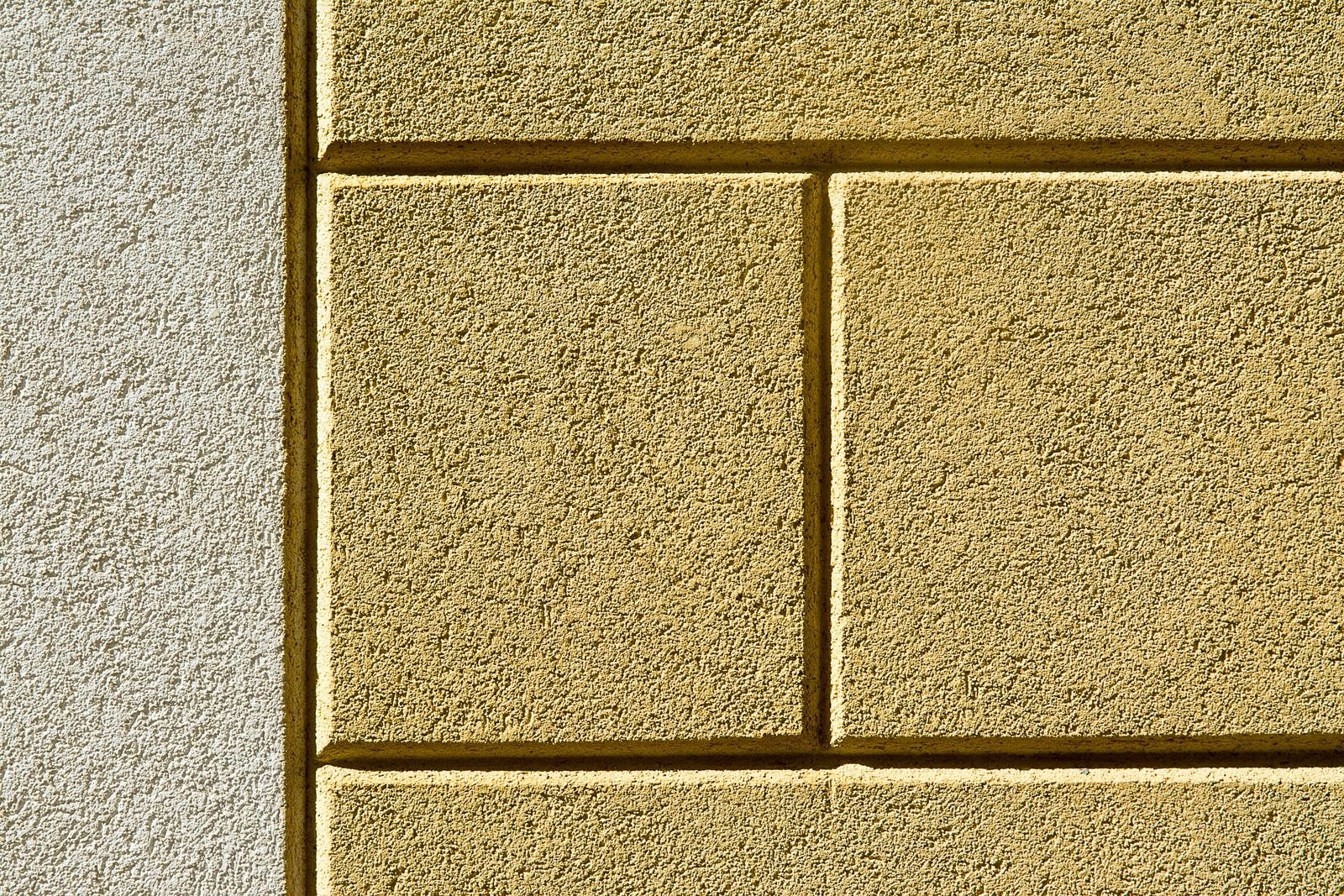
Rendering in Stourpaine, dash, lime and thin coat
Taking a dashed elevation back to a smooth modern finish changes how the house looks from the street, and inside a conservation area that is a planning question.
The site visit is free and so is the written itemised quote. Thomas Hannen prices every job himself.
Most render enquiries in the village start with pebbledash or Tyrolean that has begun to come away. Taking it off is straightforward. Deciding what goes back on is the part worth thinking about, because a smooth silicone finish looks nothing like the wall it replaced.
The usual call is a dashed wall that rings hollow along the bottom, or a bay that has dropped off and left a grey scar. Sometimes it is a crack at a window corner. Once in a while it is somebody who cannot stand the pebbledash any more.
None of them is a job to decide from a photograph. The free site visit is a survey with a hammer: we tap the whole face, work out how much has parted from the wall and what is behind it, then write it up with the hack off, the beads, each coat, the scaffold and the skip on separate lines.
The work
Getting the dash off, and choosing what replaces it
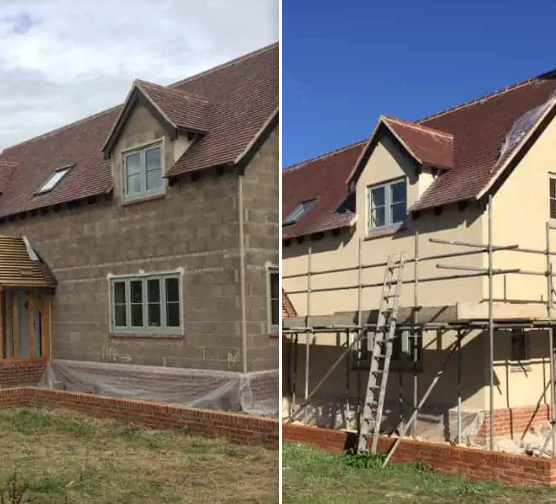
Getting the dash off. Pebbledash and Tyrolean are thrown finishes over a sand and cement backing, and they fail as a pair: the backing parts from the wall and the dash comes with it. We tap first, because dash hides cracking completely. Where a third of a face sounds hollow it is cheaper to hack off the whole elevation than chase patches for a fortnight.
Preparing the wall underneath. Once it is off you can see the background. We clean down, prepare and stabilise anything dusty with a primer, cut a key where the face is too smooth, and cut out brick that has spalled at the arris. Old chases and filled openings get made good, because a basecoat reads every one of them through the finish otherwise.
What goes back on. On a cavity wall the usual choice is a silicone thin coat: primer, a mesh and scrim reinforced basecoat, then a through-coloured topcoat scraped or floated to a texture off a sample board. Monocouche is the one coat alternative and holds up better on a long plain elevation. Older acrylic and polymer rich systems craze. If you want the dash back, it can be thrown again over a fresh backing.
Lime where the wall is solid. A pre-1919 solid wall has no cavity to keep water off the inner face, so it relies on being breathable. A plastic rich topcoat leaves moisture trapped, drives damp inwards and blows the render off in sheets. Those get lime, haired basecoat and soft topcoat, under limewash or a mineral paint that lets the wall work.
Beads, bellcast and stop ends. A bellcast bead throws water clear of the plinth instead of letting it run down behind the coat. Stop beads finish the render properly at reveals, verges and abutments, and stainless goes on wherever the wall gets wet, because galvanised beads rust through and stain the face. Where the render stops is where the job gets judged.
Insulated render, cracks and staining. On a cold wall, external wall insulation is worth pricing next to a plain re-render: EWI board fixed and dowelled on, a render carrier and mesh, then the same topcoat, with the thermal standard in Part L. Otherwise the routine faults are a crack wide enough to take a coin, a coat starting to delaminate around it, and green algae on the shaded gable, which is a clean rather than a render job unless the wall is wet.
How it runs
From your call to a written price
Same team from first visit to last, one person to ring, and no sub-contracting your work out to somebody you have never met. The quote is itemised, not a figure on the back of a card: access and scaffold, protection, preparation of the existing wall, the system and number of coats, beads and stop ends, and making good on separate lines, so you can compare it properly against anyone else's.
Nothing is left open or unusable overnight. The site is swept at the end of each day rather than the end of the job, and what comes out leaves with us. If something turns up once we start that nobody could have seen, you get a photograph and a price before we carry on.
The village has its own conservation area, and that changes the answer. Outside it, rendering an external wall on an unlisted house is normally permitted development where the new finish is similar in appearance to the old. Inside the boundary, appearance is the thing being controlled, so swapping a dashed elevation for a smooth coloured one is a planning question rather than a repair. There are 26 listed entries in and around the village, the parish church among them, and on a listed building the render itself is protected fabric and needs listed building consent. We look the address up with Dorset Council before quoting a change of finish.
Cost
What decides the price of a rendering job
No rate per square metre, because the square metres are the easy part; what is already on the wall decides the price.
Getting to it. A cottage on the village street needs the scaffold set with the footway managed, a semi with a garage in the way wants a bridged lift, and a rear elevation reached through a side gate has to be hand loaded. A bungalow gable comes off a tower, a three storey elevation wants a scaffold, and the platform has to stand for the whole system rather than a day. The work at height rules are why it is a priced line rather than something folded into a rate.
What is already on the wall. Rendering over sound brick is one job. Hacking off blown sand and cement, or a pebbledash that has parted from the background, is another, and it is the part nobody can see from the road. We tap the whole elevation before quoting, because the hollow areas set the hours.
The system, and what the wall behind it needs. Silicone thin coat over insulation, monocouche through-coloured, or traditional sand and cement all price differently and behave differently. On a solid wall that has to breathe, a plastic-rich modern system traps moisture and moves the problem inside, so the right system is a wall decision rather than a colour decision.
Comparing quotes? Ask which system is being quoted and how many coats, whether the old render is being hacked off or overlaid, whether beads, bellcast and stop ends are included, whether the scaffold is in the price, and what happens to the existing sills and pipework. Two quotes for the same job are usually two different jobs.
If it has started to come away
Render that has blown or cracked open
Ring rather than use the form. A section that sounds hollow when you tap it, or a crack you can get a coin into, is letting water behind the render and the frost does the rest. We make the loose area safe, sheet it if the weather is against us, and price the elevation once we can see how far the blown area actually goes. Dash that has already dropped off a bay leaves the wall behind it open, so that is one to ring about in the autumn rather than let a winter work on it. The phone is answered 24 hours for emergencies; scheduled work runs Monday to Friday, 8am to 6pm.
Worth knowing
Taking the dash off changes the street, not just your house
A conservation area does not stop you rendering. What it controls is appearance, and pebbledash is appearance. A row where every house carries a grey thrown finish reads as one thing; the same row with one wall in smooth cream reads as another, and that is the change the designation exists to consider. So the sequence is: decide what you want, ask, then book the scaffold.
There are three routes. Like for like is the easy one: throwing fresh dash over a new backing is maintenance and nobody needs to weigh in. A change of texture or colour inside the boundary is worth a call to Dorset Council first, and they will usually say quickly whether it is acceptable. On a listed building the render is part of what is listed, so consent comes first even when the change is an improvement, and the case for lime over cement is normally the argument that wins it. Ask how long that takes and the answer is weeks before a job is priced, or months after somebody has hacked a wall off.
Who you are dealing with
A local firm you can check
We cover Stourpaine, Durweston, Shillingstone, Pimperne and the villages along the Stour north of Blandford, broadly DT11, with Dorset Council for planning and building control. You are dealing with Bournemouth Roofing & Building, the trading name of Bournemouth Roofing & Building Ltd, registered in England and Wales, company number 15471719, which you can look up in a minute. Thomas Hannen's business, and he is the one who comes out to price the job, not a salesman. A verified customer's 10 out of 10 on Checkatrade. The visit and the written quote are both free.
Questions
Stourpaine questions we get asked
Can you take pebbledash off without damaging the brickwork?
Usually, yes. The dash and its backing come off together and the brick underneath is normally sound, though a few faces will have spalled where water sat behind. Those get cut out and made good. On soft old brick we would rather render over a repair than chase the last of the backing out of the joints.
Can we have a smooth finish instead of dash?
Technically yes on almost any wall. Whether you are allowed to depends on where the boundary runs, because a change of texture inside a conservation area is a change of appearance. Ask before you commit. If the house is outside the boundary and not listed, the choice is yours.
Is throwing new pebbledash still worth doing?
On the right house, yes. Thrown dash is tough, sheds water and hides patched repairs. Its weakness is that it hides the cracks too, so a dashed wall wants tapping every few years rather than looking at. On a period solid wall we would steer you to lime.
Will one rendered house stand out on the terrace?
It can, and that is worth saying before the money is spent. A colour matched to the neighbours in the same texture settles down within a season. A bright colour on one house in a row of grey will still be the first thing you see in five years.
Do we need scaffold for a single storey rear wall?
Not always. A low rear elevation can be done off a tower where the ground is firm and level. Anything at two storeys, anything over a conservatory, and anything being hacked off gets a scaffold, because it is a platform to work from for a week rather than a way of reaching the wall.
Nearby, and next door
Rendering near Stourpaine
Rendering nearby
Our other trades in Stourpaine
Everything we do in Blandford Forum Rendering, all areas Every area we cover
Free quote
Get the dashed elevation tapped and priced
Thomas comes out, taps the whole face, tells you how much has actually parted from the wall and prices the hack off, the system and the scaffold separately. The visit and the quote are free.