
Driveways and patios in Bryanston
Paving in Bryanston and the DT11 addresses either side of the Stour, from a long gravel drive to a stone terrace behind an old cottage.
The site visit is free and so is the written itemised quote. Thomas Hannen prices every job himself.
What the ground under a Bryanston drive will actually carry comes first, and what the conservation area lets the front of the property look like comes a close second. Neither is a question about the surface. We check both on the first visit, then price it.
People here usually ring about one of three things. A gravel drive has worn through to the mud in the wheel tracks and needs more than another load of stone. A terrace or path behind an old cottage has settled, so water now runs back towards the wall. Or an entrance is being widened or reworked and nobody is sure what can be altered and what cannot.
We come out and look at all of it together: the fall of the land, what is under the existing surface, how a machine and a lorry would get in, and where the rainwater goes now. The written quote then splits the dig, the muck away, the sub-base, the edgings, the surface and the drainage onto separate lines. Both the visit and the quote are free, and we would rather talk you out of work than sell you a surface that is going to sink.
The work
Gravel drives, terraces and entrances around Bryanston
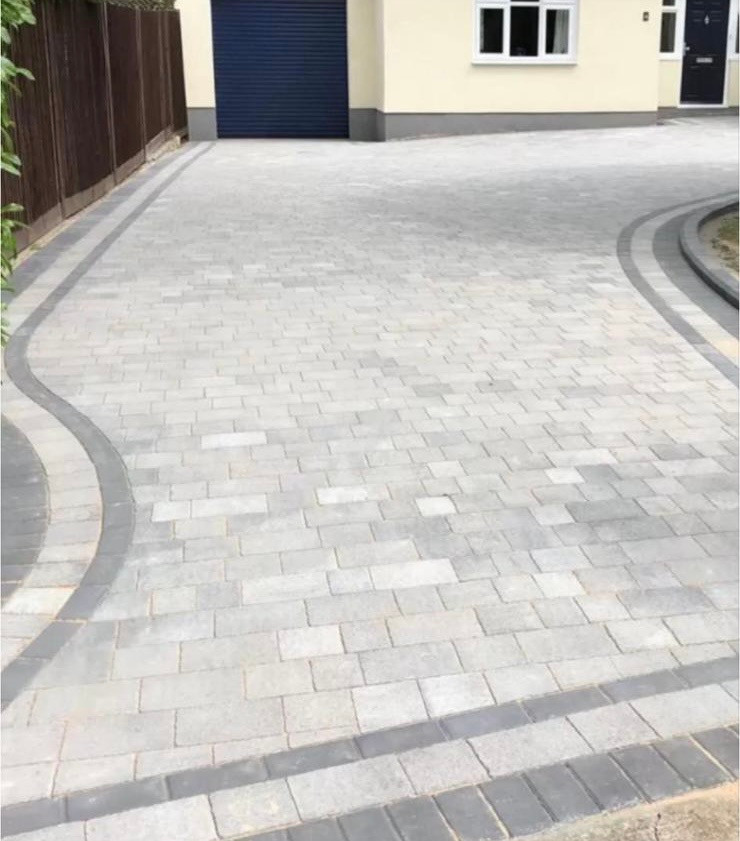
Long gravel drives. Plenty of the approaches here are loose stone and they fail the same way every time: the stone thins where the wheels run, the ruts hold water, and the water takes the rest of it downhill. Tipping more gravel on top lasts a season. What lasts is an excavation to a firm formation, a geotextile membrane, a sub-base compacted in layers, and the top stone held in a cellular grid so it cannot travel. Edges are the other half of it, a haunched kerb or a timber border, because a drive with lawn either side has nothing keeping it in.
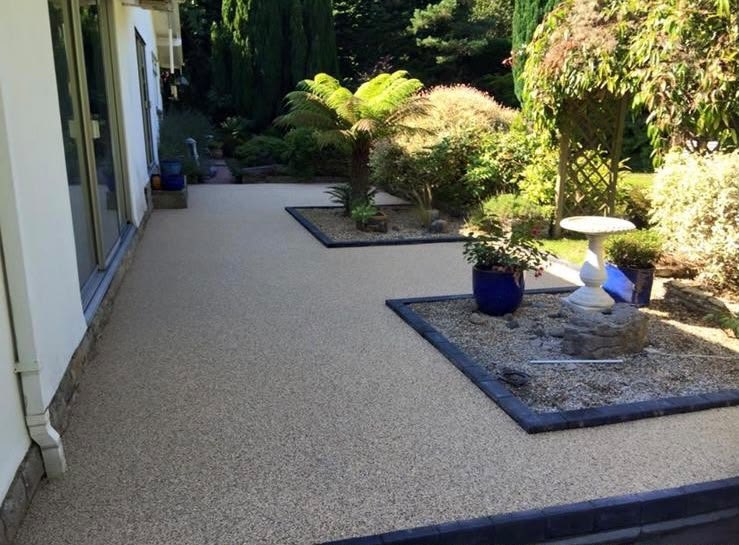
Resin bound gives a firm, quiet surface with no jointing to empty and nothing to re-sand, and it will go over sound concrete, which saves a dig. Permeable block paving is the answer where the water has to stay on the plot, and single bays lift and go back without disturbing the rest. Tarmac still suits a long run that has to take turning traffic. The depth under all three is set by the use and by the ground, not by a catalogue.
Entrances, walls and turning space. A lot of the frontages here sit behind brick boundary walls with a gap only just wide enough for a modern car, so the real job is often the entrance rather than the drive: a proper radius, edge restraint that survives being clipped, and enough space inside to turn so nobody has to reverse out onto the road. The village sits in the Blandford St Mary and Bryanston Conservation Area, so what a wall, a gate or an entrance looks like carries weight, and where a wall has to be altered to widen an entrance that gets settled before anything is quoted rather than after.
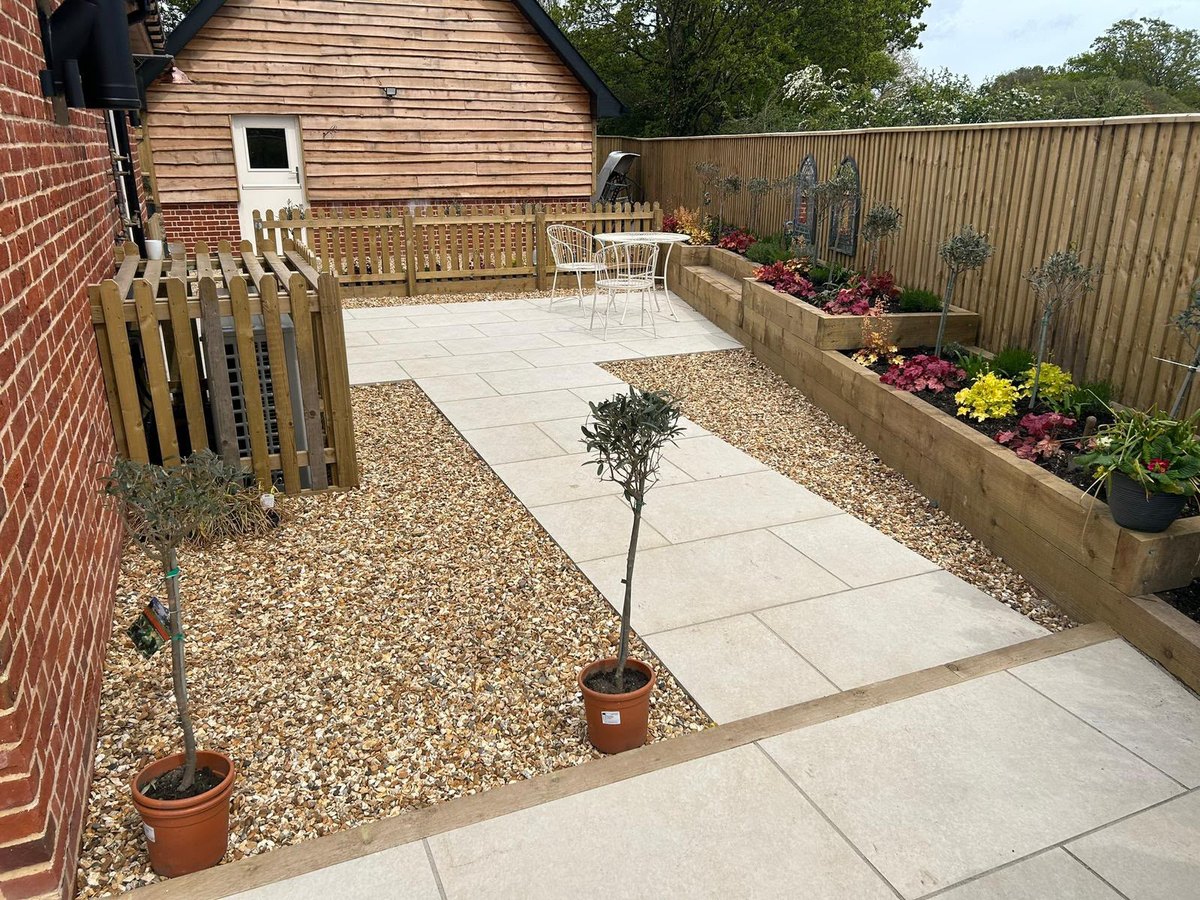
Nearly a fifth of the housing here predates 1919, and those cottages sit low with ground built up against them over many years. Natural stone, porcelain and slabs all go on a full mortar bed with a fall away from the building, never on five dabs with a void in the middle. The finished level stays down off the damp proof course, and where there is not the height for that we drop a step, run a channel drain along the threshold, or keep a drained gravel margin against the wall so nothing bridges it.
The rest is repairs: a sunken bay relaid, pointing renewed on a stone terrace, a re-sand where the joints have emptied and weeds have taken hold, staining lifted, a gully cleared, a soakaway tested, an outfall found for a downpipe that runs onto the paving. Spoil goes on its own line, grab lorry where one can stand, skip where it cannot, barrow and small machine where the access is tight, and the disposal is named rather than folded into a rate.
How it runs
From your call to a written price
The quote splits excavation, muck away, sub base, edgings, surface and drainage onto separate lines. Bryanston sits in the Blandford St Mary and Bryanston Conservation Area, so what a wall, a gate or an entrance looks like carries weight here: Planning Portal guidance on walls and gates covers the basics. The eleven listed entries here are on the Bryanston School estate rather than in the housing, but a listed building needs listed building consent first. On the paving the rule is water: over five square metres, an impermeable front surface draining to the road needs planning permission, and Planning Portal sets out where that line falls. Dorset Council handle the highway side too, and the Planning Portal explains what a dropped kerb involves.
Cost
What decides the price of a driveway
Nobody can give you a rate per square metre honestly, because what is under the surface decides more of the price than the surface. A cottage with a wall tight to each side of the entrance, a house with a long drive a lorry can get up, and a newer terrace on a shared verge are three different jobs before the ground is opened. Depth of dig, ground conditions and how much muck leaves site carry most of it. Ask any builder how deep, what sub base, where the water goes, and who takes the spoil.
If it is urgent
A trip hazard, or a drive that floods
Ring rather than use the form. A slab that has lifted, a bay sunk by a doorway, a gully that has stopped taking water: somebody falls, or the water ends up against the house. The first visit is about making it safe. Bryanston is about sixteen miles from us, over the river from Blandford. Outside Monday to Friday, 8am to 6pm is by arrangement.
Worth knowing
What the conservation area changes about the front of the property
The paving rules and the conservation area pull in different directions, and it is worth knowing which one applies to your job. The paving rules only care about water: keep the run-off on your own land and the surface itself is permitted development, whatever it is made of.
The conservation area cares about appearance, and appearance at the front of a property here is mostly the boundary: the wall, the piers, the gates and the width of the opening. That is the part where a phone call before the work is worth far more than an apology after it.
In practice that means we treat the entrance as its own item. Taking down or lowering a boundary wall to widen an access can need permission in its own right in a conservation area, and it is a separate question from the drive behind it.
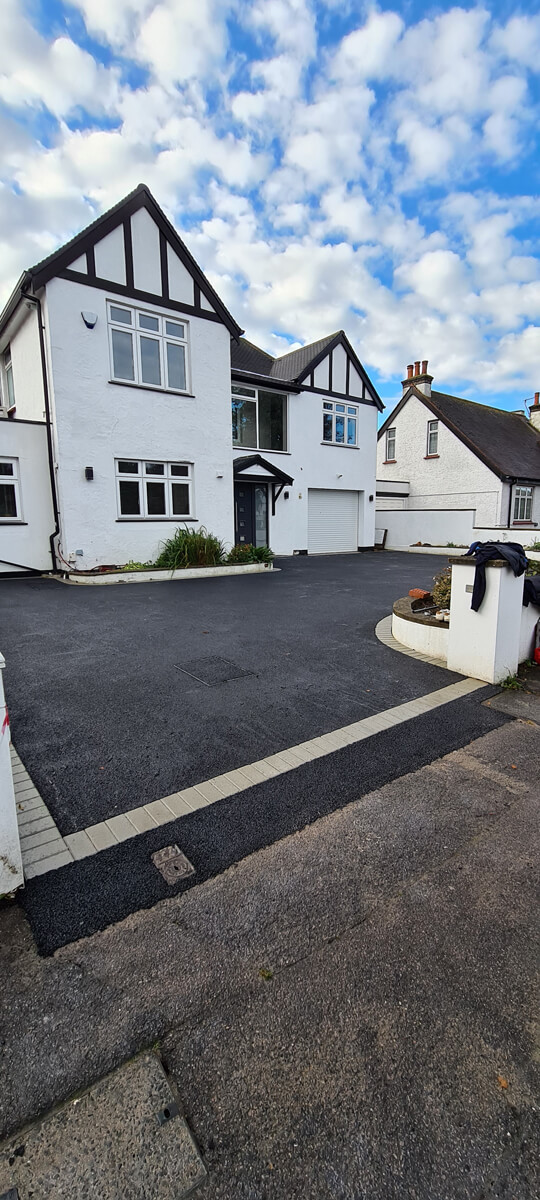
Design is looked at more closely here than in most places, so a black tarmac apron across an old stone entrance will get attention that a gravel or a bound gravel finish will not. None of this stops you having a proper drive. It just means the sequence matters: settle the entrance and the boundary first, then choose the surface, then book the machine.
Who you are dealing with
A local firm you can check
We cover Bryanston and DT11, across the river through Blandford Forum, Blandford St Mary, Stourpaine and Durweston, with Dorset Council for planning, building control and anything on the highway. Bournemouth Roofing & Building Ltd, registered in England and Wales, company number 15471719, which you can look up in a minute. Thomas Hannen's business, and he is the one who comes out to price the job, not a salesman. A verified customer's 10 out of 10 on Checkatrade. The visit and the written quote are both free.
Questions
Bryanston questions we get asked
Is a new frontage in Bryanston judged on appearance?
By the conservation area, yes, wherever the street can see it. The Blandford St Mary and Bryanston Conservation Area controls appearance, which makes replacing like for like maintenance and a change of material or colour something Dorset Council wants to be part of. Round the back, out of public view, the choice is usually yours. We check which side of that line a frontage falls on before quoting.
Nearly a third of homes here are terraced. Does access suffer?
It changes how the job runs rather than whether it can happen. Terraced houses are 31.1% of the stock around Bryanston and Blandford Forum, and many have no side gate, so everything dug out comes through a boarded route and everything going back in arrives the same way. That is barrow work and it is priced as barrow work. Where a neighbour allows a fence panel out, the job moves along faster.
Why do drives round here break up at the edges first?
Because there is usually no edge restraint left. 18.3% of the housing here went up in the 1970s and early 1980s, and a drive of that age tends to have a kerb bedded on very little with no haunching behind it. Once the edge gives, blocks or tarmac at the side spread outwards and everything inside follows them. A relay that does not rebuild the edge fails again in exactly the same way.
What paving sits right near listed buildings like the Portman Chapel?
Something quiet. There are eleven listed entries around Bryanston, the Portman Chapel at Bryanston School among them, and the conservation area sets the tone for anything in sight of them. Gravel over a bound base, or a muted stone or clay paver, sits comfortably against that. A bright modern block or a strong colour is what draws an objection. The further a surface is from public view, the less any of it bites.
Who deals with the crossing over the pavement at Blandford Forum?
Dorset Council, as highway authority. Everything from the back of the footway outwards belongs to them, including the application for a crossing and the inspection of it, and that runs to its own timetable whatever we are doing. Our work stops at your boundary line. The crossing appears as a separate item on the written quote, so it stays clear which part is our labour and which part is the council's process.
Nearby, and next door
Driveways and patios near Bryanston
Driveways and patios nearby
Our other trades in Bryanston
Everything we do in Blandford Forum Driveways and patios, all areas Every area we cover
Free quote
Get a price for paving in Bryanston
Give us the address and tell us what you have noticed. We come and look at the ground, the entrance and the access, then put an itemised written quote in front of you. No charge and no obligation.