Driveways and patios in Lover
Gravel and hoggin approaches, block paving, resin, tarmac and cottage patios around Lover and SP5. We walk the whole drive before we price any of it.
The site visit is free and so is the written itemised quote. Thomas Hannen prices every job himself.
A long gravel drive at Lover that has potholed does not usually need surfacing in something else. It needs the water taken off it and an edge put on it, and that costs a fraction of a tarmac or resin run of the same length.
Out here the calls tend to be about approaches rather than parking bays. The drive has rutted where the wheels always run and there is a hollow you now steer around. Water comes off the lane, follows the drive down and stands where you least want it. Or the path and the paving at the back of an old cottage have sunk, and the step out of the back door has quietly become a drop.
We come out, walk the whole length of it in the wet if we can, and dig a trial hole where the wheels sit. What you get back is an itemised written quote where the dig, the sub-base, the drainage and the surface are separate lines you can question one at a time.
The work
Long approaches, loose stone and cottage back doors
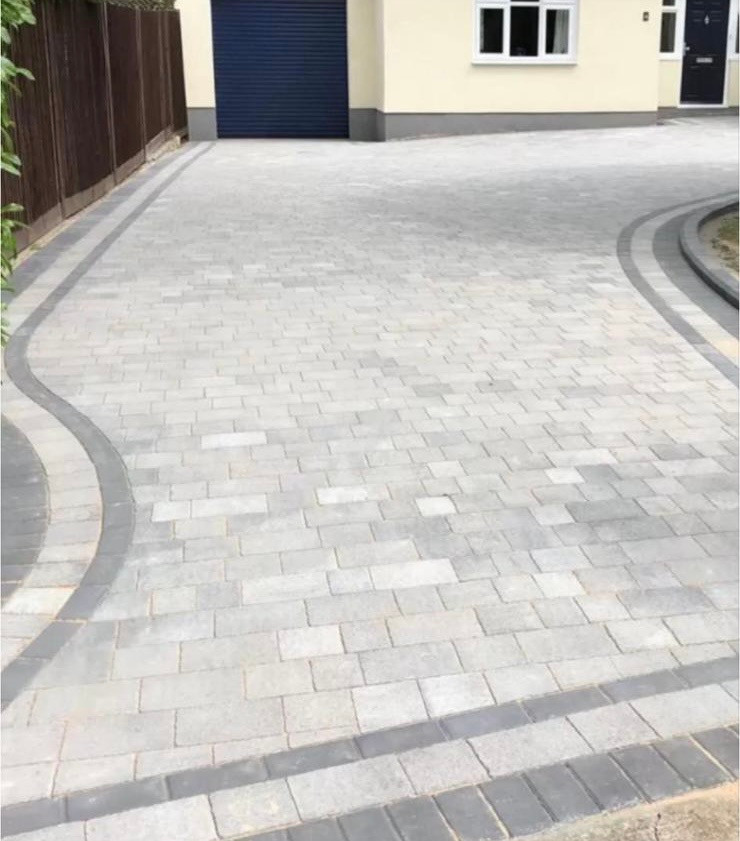
Gravel and hoggin drives that have stopped shedding water. A loose surface only works while the water leaves it. Once ruts form they become the channel, the stone migrates downhill and the hollows hold ponding all winter. Putting it right is mostly earth work: excavate back to a formation that will carry a car, a geotextile membrane to stop the stone disappearing into soft ground, a compacted sub-base and a proper crossfall so water leaves the drive rather than runs along it. The ground out here is slow to drain, so on a long run we will often add a shallow channel drain or a gravel filled cut-off across the top, and then what comes off the lane never gets on to your drive in the first place.
Edges, which is what keeps a loose surface in place. Most of the stone drives we are asked to top up are not short of stone. They are short of an edge restraint. Timber, a haunched kerb, a brick border or a bound margin in resin or tarmac at the road end all do the same job: they stop the surface spreading into the verge and stop stone being carried out onto the lane, which matters more here where there is no kerb line to catch it and nothing but grass either side.
Plots here usually have the room to turn, and if you are rebuilding a drive anyway it is the cheapest time to add a turning area. The build-up under a turning circle takes more punishment than a straight run, because a steered wheel scuffs and works the surface, so the depth goes up where the car turns and the quote shows that as its own area rather than one rate across the lot. A dig also produces a great deal of material. On a bigger plot it can occasionally be graded into a bank or a low spot on site, which saves the muck away, but only if the ground can take it and nobody is creating a new puddle. We look at that on the survey rather than promising it in advance.
More than a quarter of the houses out here predate 1919, and the paths and terraces behind them are small areas with awkward levels against walls that have been there a long time. Natural stone and reclaimed brick go on a full mortar bed with pointing rather than a brushed-in compound, because irregular units and tight joints will not take a slurry. Where the ground has settled against a step, we rebuild the step rather than pack up the paving to meet it.
How it runs
From your call to a written price
One person to ring, and an itemised quote: excavation, muck away, sub base, edgings, the surface and the drainage on separate lines. Your planning authority here is the New Forest National Park rather than a district council, and its property map will tell you in a minute what the address carries. For paving itself the test is the same as anywhere: more than five square metres of new hard surfacing at the front that sheds onto the road needs planning permission, and the Planning Portal explains the test, while a permeable build-up or a fall onto your own ground keeps it permitted development.
Cost
What decides the price of a driveway
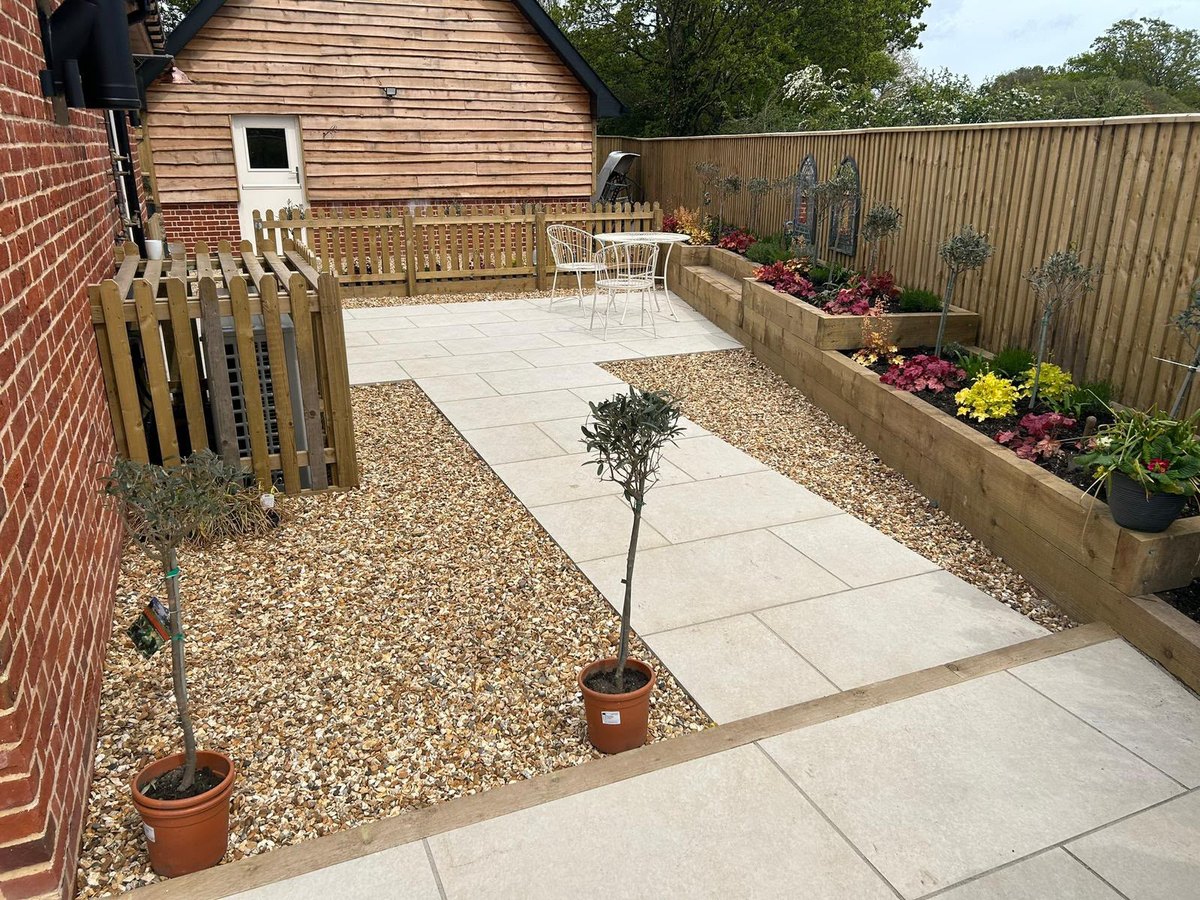
No rate per square metre. What is under it decides more of the cost than what goes on top. A cottage with a gate a car only just clears, a bungalow with a long gravel approach, and a house set well back off the lane are three different jobs, because access decides whether a machine digs it or a barrow does. On a long approach the turning area takes more depth than the straight run and is priced apart. Ask any quote how deep the dig is, what sub base goes in, where the water goes, and who takes the spoil.
If it is urgent
A trip hazard, or a drive that floods
Ring rather than use the form. A lifted slab, a sunken bay by a doorway or a gully that has stopped taking water will not wait. The first visit is about making it safe and getting the water going somewhere. Out here that is usually a rut deep enough to ground a car halfway along a drive. The phone is answered 24 hours for emergencies; scheduled work runs Monday to Friday, 8am to 6pm.
Worth knowing
Old walls have to breathe, and paving is what usually stops them
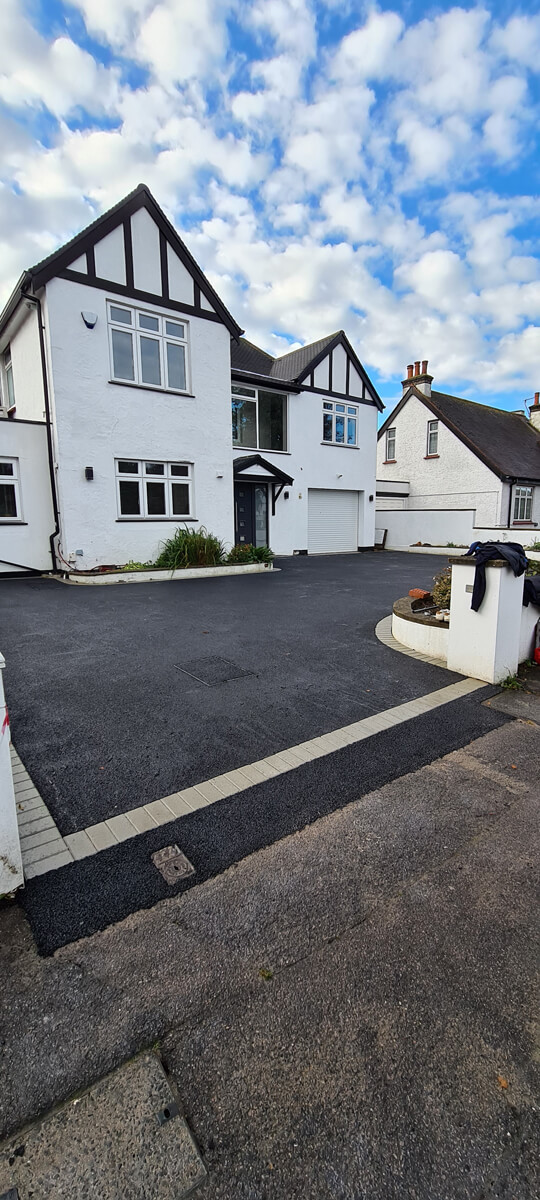
A good share of the housing around here predates the First World War, and those walls are solid rather than cavity. They were built to take up damp and give it back off the surface, and many of them either have no damp proof course at all or have one sitting only a course or two above the ground.
That single fact decides more about a patio here than the choice of slab does. Every new surface laid on top of the last one lifts the outside level, and the day the paving passes the inside floor level, the wall starts wicking water indoors and the room smells of it by February.
So on an old cottage we set the finished level first and choose the paving second. That normally means taking the ground down rather than building it up, keeping the paving clear of the wall with a gravel margin or a narrow channel drain, and running the fall away from the house instead of into it.
It also means not sealing the base of a wall with concrete or a poured resin that runs right up to the brickwork, because that traps the moisture at exactly the point it was meant to escape. None of it costs much extra if it is designed in. All of it is expensive once the plaster inside has gone.
Who you are dealing with
A local firm you can check
We cover Lover and the SP5 villages around it, from Redlynch and Landford across to Downton and out along the forest edge. Bournemouth Roofing & Building Ltd, registered in England and Wales, company number 15471719, which you can look up in a minute. Thomas Hannen's business, and he is the one who comes out to price the job, not a salesman. A verified customer's 10 out of 10 on Checkatrade. The visit and the written quote are both free.
Questions
Lover questions we get asked
Do we need permission for a new entrance out here?
For the surface, usually not, as long as it drains onto your own ground. For the entrance onto the highway you do, because the crossing belongs to the council and not to the property. Lover sits inside the New Forest National Park, so anything visible from the lane, gates, posts and lighting, gets looked at more closely than it would elsewhere. We build to the boundary and stop until the highway side is agreed.
Is it worth binding the gravel or leaving it loose?
Loose gravel is fine on the flat and a nuisance on a slope, where it migrates downhill and finishes up in the lane. On a sloping entrance we either bind the top of the slope or set a cellular grid into the base so the stone stays where it is put. Loose does let water through, which counts for something on ground that is slow to take it once winter arrives.
What do you do about the tree roots in the entrance?
We work round them rather than through them. Cutting a major root to get depth for a base will either kill the tree or leave it unstable, and inside the National Park a tree beside the lane may be protected in any case. Over roots we build up instead of digging down, using a no dig construction with a geotextile and coarse stone that spreads the load. The level rises a little and the tree carries on.
The back door threshold is low. What can we do about the level?
Work down rather than up. In the older cottages, and 27.7% of the housing around Lover predates 1919, the threshold often sits barely above the outside ground as it is. So the patio goes in lower than the door and we form a step, or where you want it flush we run a slot drain across the doorway with a real outlet, not a gravel strip that silts up. Building up to the door causes the damp.
How quickly can you get out to look at it?
Usually within a week or so, and there is no charge for the visit. Lover is at the far edge of the patch, so Thomas Hannen ties it in with other work over that side rather than making a special trip, which sometimes means offering you a day rather than a choice of them. The written itemised quote follows, with excavation, base, drainage and disposal set out on separate lines.
Nearby, and next door
Driveways and patios near Lover
Driveways and patios nearby
Our other trades in Lover
Everything we do in Ringwood Driveways and patios, all areas Every area we cover
Free quote
Get a price for a drive or patio in Lover
Tell us the address and what the drive or the paving is doing. We will come and look at the ground, then put an itemised price in writing. Both are free.